From a surplus batch, with no provenance, measuring the resistance with current increasing (upper = squares) and then decreasing (lower = diamonds):

The resistance at a given current need not lie between those bounds, because it depends strongly on the thermistor’s temperature (duh), which depends on heat loss to the surroundings.
With that in mind, 1 or 2 Ω looks like the right ballpark for these gadgets. Figure around half a watt each at 600 mA; string three in series to get 9 Ω during a cold start and 3 Ω for warm starts. It’s not clear that would solve the transistor killing spike, but it’s a thought.
Compared to the SCK055 NTC thermistor, they have about the same resistance at the same current, despite starting at half the initial cold resistance. I think that’s because they’re somewhat larger and thus run cooler at a given current.
The original data and a portrait of the thermistor:
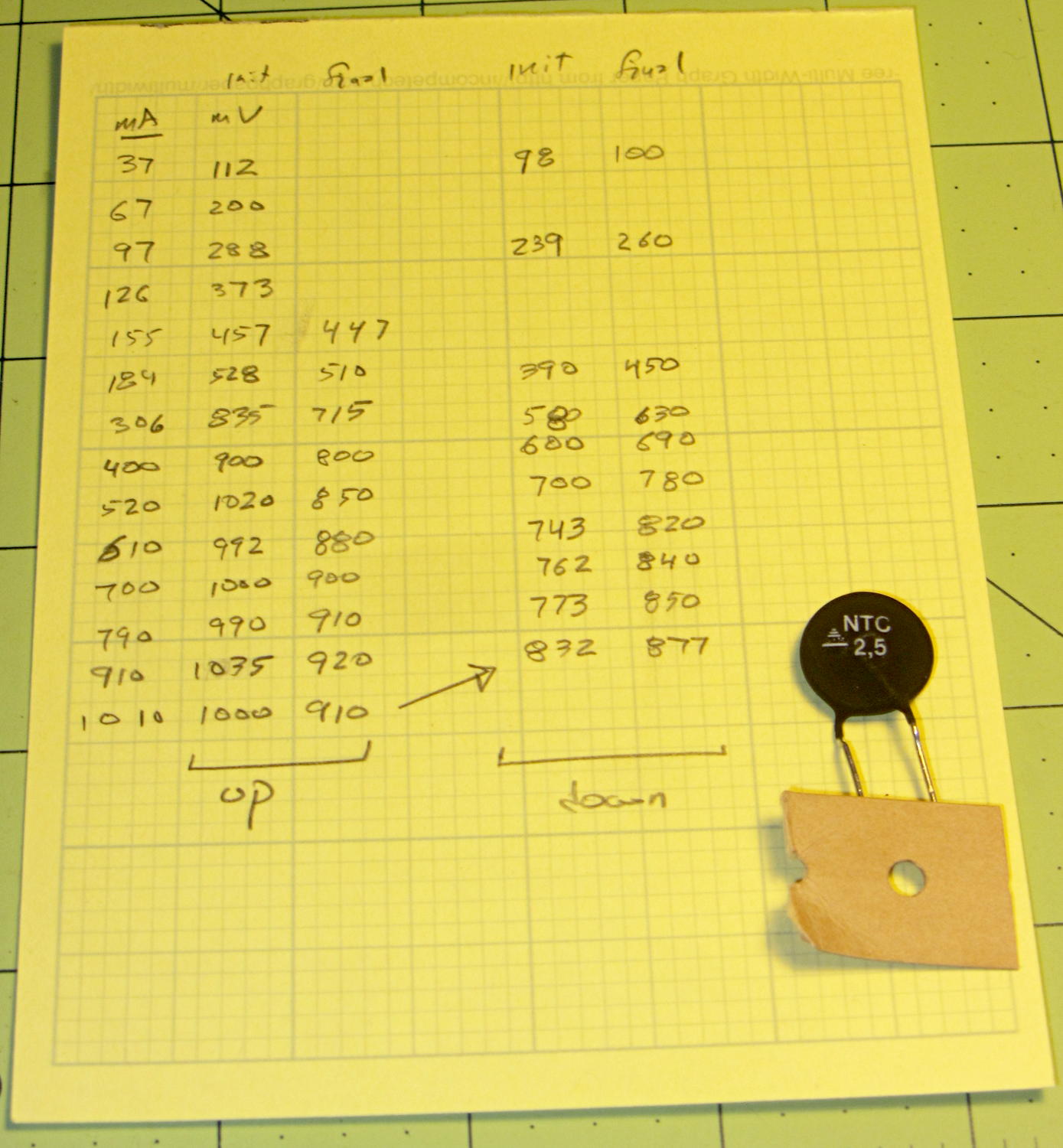
Anybody recognize the logo? The symbol in the striped triangle is S+M, if that helps.
It’s from TDK/EPCOS: datasheets.
 The Smell of Molten Projects in the Morning
Comments
4 responses to “NTC 2.5 Power Thermistor Characteristics”
Looks like an Epcos (now part of TDK) logo. http://sigma.octopart.com/510886/image/EPCOS-B57235S100M.jpg
Thanks!
[…] four of those NTC power thermistors seems in order. This picture also shows the snubber hanging from the back of the ET227, but I […]
[…] four NTC power thermistors lie just to the right of the relay, before the bridge […]