So I picked up a lot of 20 p-channel MOSFETs from the usual eBay supplier in China, which arrived in good order. As is often the case, the SOIC chips are in snippets of tape-and-reel carrier, but this tape looked decidedly odd:
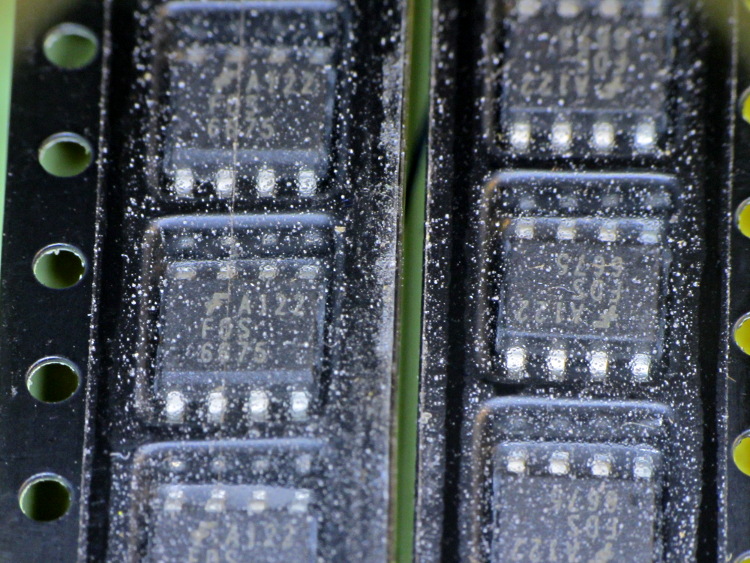
Peeling back the tape shows that the crud is just on (or perhaps inside) the tape, not on the ICs or inside the carrier pockets:
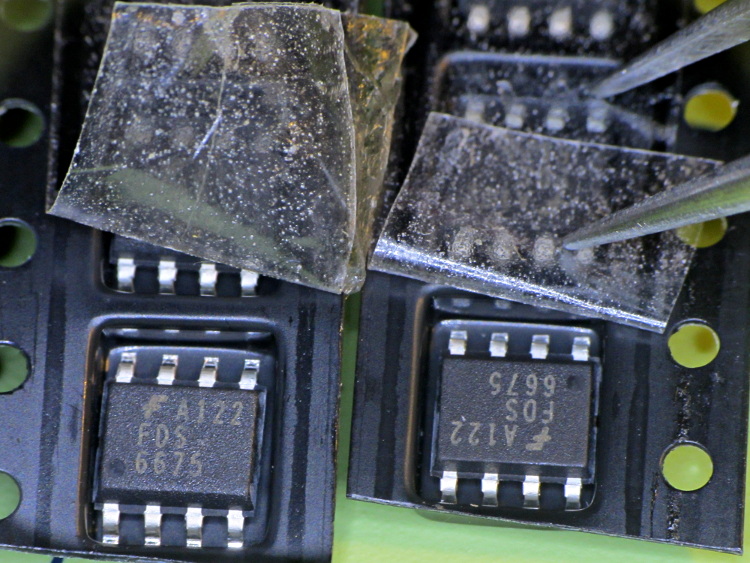
Some of those specks are dirt, some seem to be bubbles, other are just, well, I don’t know what they might be. Maybe they were having a bad day in the tape factory?
One might reasonably conclude the chips aren’t in their original carrier…
I must gimmick up a quick test to verify that the chips behave like p-channel MOSFETs, instead of, oh, solid plastic; that Fairchild logo looks a bit grotty, doesn’t it?
 The Smell of Molten Projects in the Morning
Comments
5 responses to “Semiconductors From eBay: A Tinge Of Doubt Crosses My Mind”
Were they all oriented the same way?
Surprisingly, yes… the QC inspection got that right!
I think the parts are date coded 2001, workweek 22. This might explain the crud on the tape all by itself. Beyond that, ink on plastic parts was bog-standard for many years, and logos could look a bit crufty. I haven’t bought any low-end parts since Y2K, so I’m not sure of how the marking and coding is handled now.
In the stone ages, we’d mark after test (yields were that bad…), but as things got under control, marking got to be a part of the assembly process. The parts probably never got the chance to get out of orientation, with automatic loading of the tape carrier. The old bulk feeders were a weird-but-beautiful bit of kinetic sculpture in the factories.
That’s how I read it, too. The fact that Fairchild still lists these as being in full production (albeit in RoHS attire) gives me pause, though; did somebody uncover a stash hidden for a dozen years?
When I was serving my time in the Fishkill Factory, watching vibratory feeders align all those parts as they crept upward along the spiral was a wonder to behold…
did somebody uncover a stash…?
Probably. I’d bet your parts ended up in a corner of a warehouse, or possibly in inventory of a soon-to-be bankrupt hardware maker… It didn’t help that Fairchild was then part of National Semi as part of a, er, shotgun marriage.