Ed Nisley's Blog: Shop notes, electronics, firmware, machinery, 3D printing, laser cuttery, and curiosities. Contents: 100% human thinking, 0% AI slop.
The front brake on my bike started sounding more gritty than usual on a recent ride, which led to pulling the pads off, which led to discovering that one pad had worn completely through:
Worn-through brake pad
The rim had a slight scuff where that aluminum tab stuck through, but nothing worth worrying about. The wear indicators aren’t reliable, because the pad curve matches 27-ish inch wheels and the Tour Easy has a 20 inch front wheel. If you align the pads to the outside of the rim, as I do, the inside edge gets light wear. So I let ’em wear, check them when the tire gets a flat, and this is the first time a pad has worn through. I think that means the front tire hasn’t had a flat in quite a while…
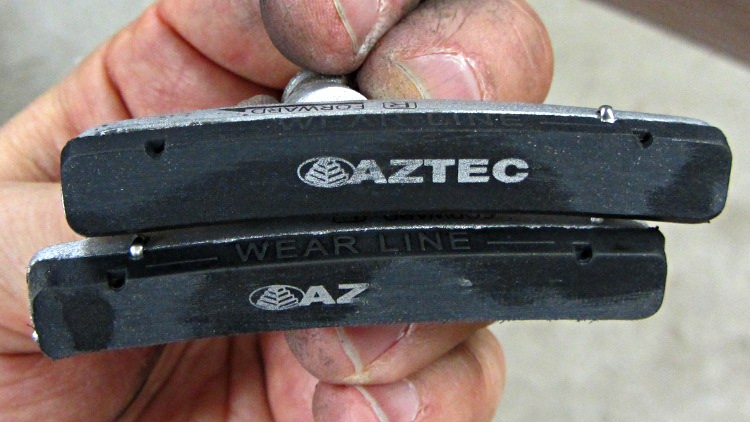
While I was at it, I replaced all the pads on both our bikes. The rear pads didn’t have nearly as much wear, which is about what you’d expect, although the wear indicator grooves have just about bottomed out:
Worn replaceable pads
Those are replaceable pads, which work quite well on the new brake arms. I suspect by the time I get around to needing new inserts (I bought a bunch, of course) they’ll be obsolete and unobtainable.
I file the pads flat to save a bit of time wearing them in:
Filed replaceable pads
I don’t hold with the notion of toeing in the pads to avoid squealing, vastly preferring crisp brakes with very little travel. Whatever the material is in Aztek pads, they don’t squeal after they’ve fitted themselves to the rim… but, of course, this new pair howled worse than the Freezer Dog when I got them out on the road.
Squealing brakes aren’t entirely a bad thing, as they scare the daylights out of oblivious pedestrians, but I’d rather use the bell. So I gripped a strip of fine sandpaper between pad and rim, gently squeezed the brake lever, and rolled the bike about two wheel revolutions. Repeat on the other side and the rim’s now nice and clean and grippy. Flip the sandpaper over, scrub the pad surface, and they don’t make a sound.
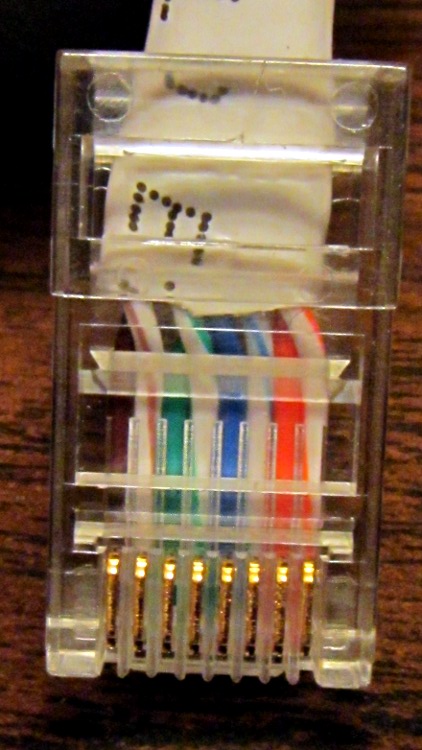
Yeah, the blue-stripe and green-stripe wires should be interchanged. Turns out the Link indicators on both ends lit up just fine, but no bits made it across the wire. Took quite a while to figure that one out, alas.
Turns out I was moving that router upstairs to get a better signal for folks out in the driveway and snaking the cable through the only suitable (i.e., existing) hole in the floor required cutting the molded-in-place connector off, then crimping a new one on. Both you and I know those wires must cross, but in the excitement of pushing all those wires into the connector, well … so it goes.
A useful explanation, including crossover and POE cable arrangements, lives there.
I did wrap silicone tape around the cable and connector butt for strain relief.
Memo to Self: just verifying the colors on the existing cable sometimes isn’t good enough!
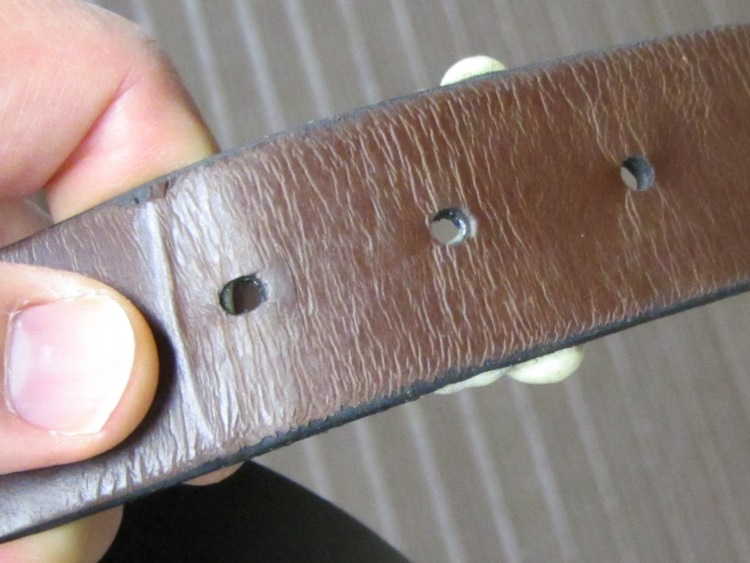
When I bought a new belt some months ago, I thought the lack of stitching meant it was made from a single strip of leather. Come to find out that it’s actually two strips glued together with something sticky that came un-done at the point where the belt passes through the buckle.
So I peeled a bit more apart, smoothed a thin layer of urethane glue (aka Gorilla Glue) inside, laid waxed paper on both side just in case the foam expanded beyond my wildest imagination, and clamped it together:
Belt clamping
The glue layer turned out just about perfect, with only a few blobs sticking out the sides:
Belt with urethane glue blobs
Those blobs snapped off easily enough and the belt works fine again. We’ll see how long this one lasts…
It was decided, in that place where what is decided must be, that the time had come to hack back the giant forsythia stand encroaching from the neighbor’s yard. The stuff tip-roots, so anything that stands in its way gets assimilated, and the only way to make headway is to tear it out by the roots.
We eventually clearcut a section about 15 feet wide and 40 feet long by the simple expedient of lopping off everything that stuck up:
Cleared Forsythia
Removing the roots required prying with a 7 foot length of 1.5 inch octagonal steel bar braced on a chunk of 4×4 inch lumber rammed up against the roots. With my full weight on a 6 foot lever arm, the roots would just barely break free.
A dozen wheelbarrow loads like this went atop the branches on the heap:
Forsythia root balls
That’s my kind of outdoor work: kill them all…
Mary raked and seeded the debris field just before the next rainfall. It ought to be good for another few years.
Actually, that NIC didn’t slip right into place, because its backpanel plate was sized for a full-height PC case. Unlike the cheap stamped steel you find these days, NetGear used much thicker metal that required an attack with the bandsaw, a hammer, and some files to clean up the raw edges.
But it fit pretty well after all that:
Shortened NIC backplate
You can just barely see the NetGear logo wrapped around the right-angle bend…







 The Smell of Molten Projects in the Morning