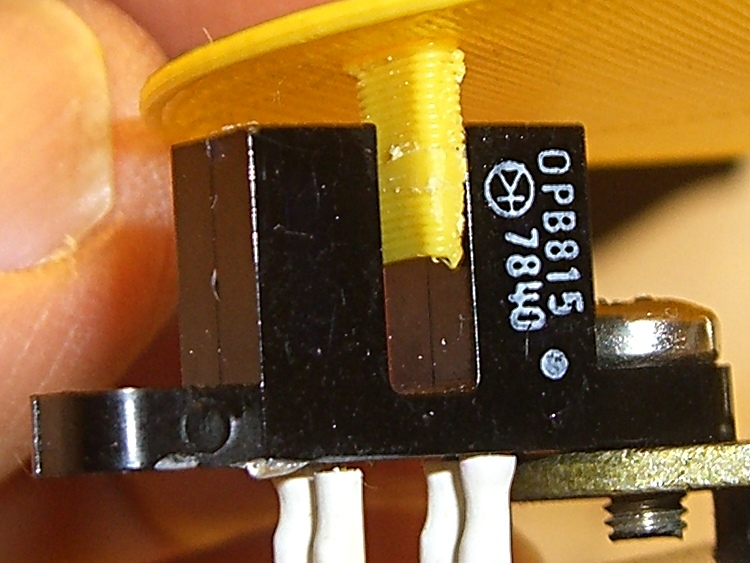
Given this ID printed on the side of an old OPB815 optical interrupter switch:
And this pinout diagram from a randomly chosen datasheet for that part number:
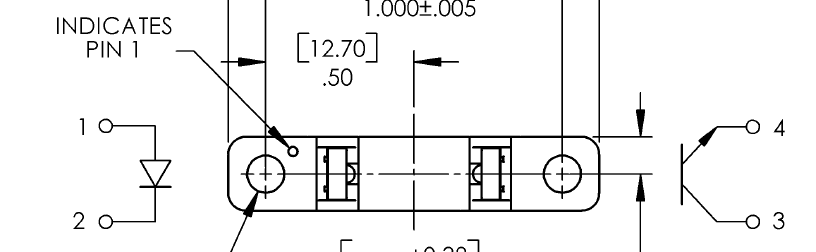
One might reasonably be led to believe that the white dot on the part marks the LED anode. That’s what I thought, too, but the innards are actually rotated 180° from the picture: the dot marks the transistor collector.
Took me a while to figure that out; I eventually tore one apart and used my pocket camera to look for the blue-white glare of the IR emitter.
After the dust settled, I rummaged around in the impacted shitpile holding my paper documents and found the original 1982 datasheet, with my very own scrawled notes:

Back in the day, the dot on pin 1 marked the transistor collector…
Memo to Self: No, scanning all that old paper wouldn’t help.
 The Smell of Molten Projects in the Morning
Comments
7 responses to “OPB815 Optical Switch: Always Measure Your Components”
“Not recommended for new design” in 1982, that is truly an old part–in every way.
What is the overall project for mounting the interrupter to the stepper? Automatic missed step detection?
Well, I have been accumulating stuff for quite a while… [grin]
The pix will go into a Circuit Cellar column about stepper motor microstepping: maybe I can raise the general awareness of how it’s supposed to work, so folks pick the proper motors and drive ’em correctly.
You’ll see a bunch of the working notes & pix here as I beat things into shape… I promised to write that up quite a while ago and it turns out that CC thought it’d be interesting, too. Sometimes it works out that way!
Seems like you would want a bunch of beam choppers spread around the wheel. Each one would be some integer number of full steps, plus some integer number of micro-steps.
So you would put a 2/50th blade at 0, a 2/50th blade at 4/50 + 1uStep, a 2/50th blade at 8/50 + 2uStep and so on . . . . seems like that could give some interesting data.
Of course your blade position is only accurate to the accuracy of the ToM, I guess that is why the wheel is so big.
The optical risetime covers the better part of four microsteps, so you can use it to indicate that the wheel is about in the same position it was last time. For detailed sync, well, it’s not stable enough.
I’m using the 1/rev signal to get a startup position, then counting microsteps all the way. The optical resolution isn’t good enough to detect one missing microstep, but more than that would be feasible. Generally when a motor “misses a step” it actually misses a bunch of ’em, so that would work.
The wheel got to be that big because that’s where the optical switch wound up on the motor damper; the TOM really doesn’t enter into this project at all, other than as a motivation. It’s all a quick-and-dirty measurement setup, not a permanent installation… but that’s what 3D printing is really good for: quick-turn parts.
I have used quite a few decades ago in the resistor manufacturing machines. You have yours mounted on one screw.. I don’t see any lock washers. The unit could loosen and you will have some plastic bits flying around.
Ah, but remember the application: this will exist for the next two weeks, duct-taped to the top of the solderless breadboard box, and then return to the parts box. The only reason I built it was to get half a dozen scope screenshots for a Circuit Cellar column!
[…] the shaft with a 4-40 setscrew to hold it in place. The post has 4-40 mounting holes for one of those optical switches, plus a big hole for the wiring. The solid models look about like you’d expect: Wheel and […]