Having collected useful thermal numbers at low power levels, it’s time to fire that mother up and see what happens at temperatures around 200 °C. That, however, requires powering both resistors, rather than attacking one with clip leads as I’ve been doing. Given that I expect to change the resistors several times in the course of this adventure, soldering to the lugs seemed like a lot of effort.
I mooched some solderless lugs suited for 2-56 screw terminals from Eks, pulled off the plastic insulating sleeves, lightly crimped them on 14 AWG solid copper wire, and silver-soldered the joints. The crimp handles most of the current, while the solder keeps the interior from accumulating oxidation products at high temperatures: a gas-tight joint is a happy joint.

The resistor leads have holes just slightly too small for 2-56 screws, but a pass with a #41 drill does the deed; I think it’s an accumulation of solder rather than an under-sized hole.
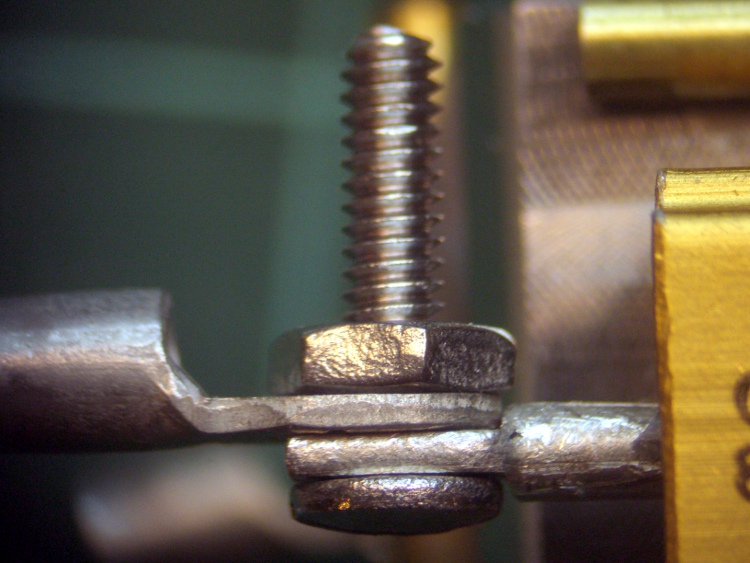
The leads are stamped to shape and two of them didn’t have quite enough room for the lug. You don’t want the joint to look like this:

The briefest touch of a riffler file made them right, so as to look like this:
Then it was ready for insulation:
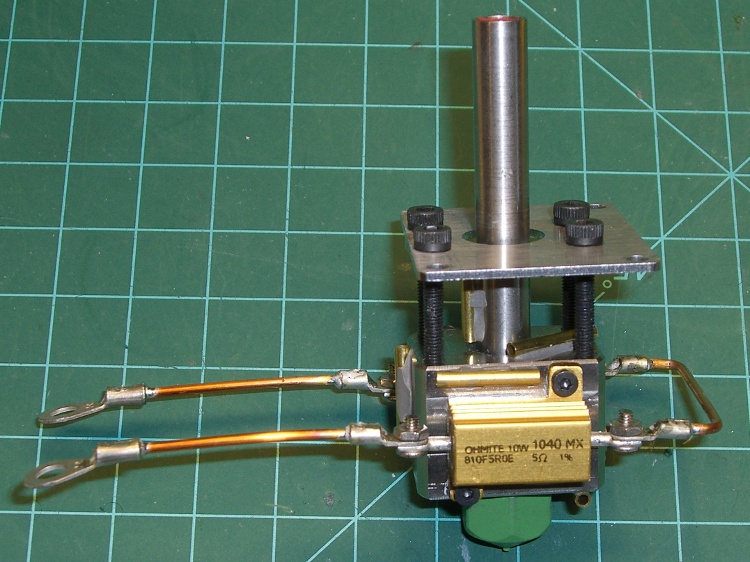
Note that the resistors are in series, not parallel (as per the Makerbot instructions), because I want a resistor failure to produce an unambiguous symptom: no heat. In addition, I expect to operate the heaters at much lower power, making higher resistances easier to drive from the +12 V.
In truth, those screw-and-nut connections aren’t the most durable or reliable joints, particularly without lockwashers under the nuts to soak up the differential thermal expansion. But they’re good enough for what’s coming next.
 The Smell of Molten Projects in the Morning
Comments
5 responses to “Thing-O-Matic / MK5 Extruder: Resistor Connections”
Did you file the resistor lug or the wire lug?
The resistor: it’s not long for this world and ought not mind some ritual scarification…
What’s the final word on crimp+solder? I’ve read conflicting advice on the procedure (just crimp, or crimp then solder).
Beats me. A good crimped joint is quick and very reliable.
I add solder when I want a bit more solid metal in the joint, but that requires better strain relief between the connector and the wire: the solder turns flexible wire into a breakable rod.
Solder is a terrible electrical conductor that’s still better than air…
[…] The Smell of Molten Projects in the Morning « Thing-O-Matic / MK5 Extruder: Resistor Connections […]