The Smell of Molten Projects in the Morning

Ed Nisley's Blog: Shop notes, electronics, firmware, machinery, 3D printing, laser cuttery, and curiosities. Contents: 100% human thinking, 0% AI slop.

Month: November 2010

  • Bed Bugs: Infestation and Breeding

    The first thing to understand about our infestation is that we never actually saw an adult bed bug. In fact, of the hundred-odd photos I took during the experience, it’s not clear that any show a bed bug.

    That’s a crucial difference between our infestation and the horror stories you’ll read about elsewhere. Our infestation consisted of a relatively few bed bugs and, because we (generally) acted quickly, decisively, and consistently, they didn’t multiply beyond control.

    There is no mistaking a bed bug bite, however, and that will probably be the first indication that you have an infestation. The references in the first post in this series should give you a general idea of what a bite looks and feels like, but here’s a quick summary:

    • You’ve never felt a bite itch like that in your life
    • Two or three such bites, a few cm apart, are diagnostic

    Some people have a long-delayed reaction or no reaction at all. If you’re one of those folks, then our techniques probably won’t work for you, unless the rest of your family has more “normal” reactions.

    Bed bugs are obligate hematophages: they must have at least one blood meal at each stage of their life cycle. That’s where you come in. While they prefer humans, it seems any mammal will serve in a pinch, and if you’re the sort with indoor dogs or cats, you have a real problem.

    Because they’re only a few millimeters long, bed bugs tend to stay relatively close to their food supply (i.e., you), rather than commute long distances. The bed bugs you brought home will, most likely, quickly take up lodging in your bed, a favorite chair, or the desk where you sit for a few hours. Eliminating all of those lodgings, known as harborages, is essentially impossible, despite what you read in the references.

    Each of the five instars from egg to adult requires at least one blood meal to provide enough energy to grow and molt. An adult female bed bug requires one meal after mating, after which she can produce a few hundred eggs without another meal. Although the references aren’t forthcoming, we think bed bugs have no qualms about introducing loops in their family trees: any male may inseminate any female.

    (Digression: So you think you’re comfortable with weird sexual practices? This will turn your stomach: bed bugs practice traumatic insemination.)

    Our overall plan of battle, then, was quite simple:

    • Eliminate as many harborages as practical
    • Prevent every instar from progressing to the next stage
    • Prevent breeding

    The plan may be simple, but the implementation posed some, ah, difficulties…

  • Bed Bugs: Overview

    Back in July, we returned from our bicycling vacation with a few bed bugs in our luggage. We have our suspicions about where they came from, but that’s not really relevant: bed bugs can come from nearly anywhere. You can bring a bed bug home from a classy hotel just as easily as from a sleazy dive… and you will!

    After three months, we think we’ve eliminated the last bed bug: no bites for the last three weeks. One can never be absolutely certain, but that’s definitely a good sign, particularly in combination with the monitoring measures we’re using.

    We accomplished this on our own, without the use of a licensed PCO (Pest Control Operator) and without the use of toxic chemicals. It was, however, extremely expensive in terms of time, materials, and furnishings, as well as completely disrupting our family life.

    While our methods definitely do not scale to the level required for a major infestation, most likely you’ll be in our situation: you return from a vacation with one or two, um, guests. If you understand what we’ve done and why we’ve done it, you’ll have a better basis for your own decisions and actions.

    So.

    Most of what you’ll find in the usual Internet forums comes from (possibly) well-meaning folks who haven’t done any reading or experimentation: it’s raw anecdotal experience. Not to slander them, but it’s better to start with the basics, which you get from the primary sources.

    To that end, here are the better sources we’ve found and used:

    With those references in hand, I can describe what we did and how it worked. If you’re the sort who can’t drive past a nasty accident without gawking (and we are all that sort, really), then the next week or so should be good for at least that level of amusement…

    A note to the potential purchasers of our house, when you read this in what’s currently our future: yeah, bed bugs. The only difference between this house and the next one on your list is that you know what happened here, what we did, and how it worked out. Trust me on this: no other homeowner will tell you anything about their bed bug experiences, to the extent of lying to your face.

    Believe it.

    Update: Here’s a quick index to the rest of (this chapter of) the Bed Bug Story:

  • LyX and LaTEX Tweakage

    Minor tweaks to the Lyx document settings I used there for the Trinity robot contest rules.

    Controlling line numbering with the lineno package:

    \linenumbers
    \nolinenumbers
    

    A two-column layout with change bars seems to stretch the machinery to the limit; the varioref package (sucked in automagically by something else) often complains (quite properly) about changed blocks spanning boundaries that might cause an infinite loop. Save the file, then turn the error message into a non-fatal warning to see what actually happens. Turn it back into a fatal error when done:

    \vrefwarning
    \vrefshowerrors
    

    It seems impossible to alter change bar colors from the default blue and red in PDF documents, so I tweaked the PDF link colors instead. Use the xcolors package in place of colors, then pick a different color from the Base Colors set (to avoid having to figure out how to specify another set) in the Additional options part of the PDF Properties tab:

    urlcolor=teal,linkcolor=teal
    

    In principle, changing the \dvipost options should work, but not with PDFs created through pdflatex. For example, this has no effect:

    \dvipost{cbstart color push Magenta}
    \dvipost{cbend color pop}
    

    Saving a file under a new name with FileSave As completely confuses a subsequent HTML conversion; the .html file loses all the internal formatting and becomes one giant line of text. Save the .lyx file with the new name, close Lyx, start it up again, reload the file, and it’s all good.

    Memo to Self: Convert \vrefwarning back to \vrefshowerrors before it bites you!

  • What Do Squirrels Do When It Rains?

    Rain-soaked squirrel
    Rain-soaked squirrel

    Although I’m not a big fan of tree rats squirrels, I’ll admit this one was having a tough time of it during a recent rainstorm. He (she?) sat motionless on that stub of a branch for well over half an hour, no doubt thinking gloomy thoughts.

    Taken through two layers of mid-1950s window glass, so it’s not the sharpest image in my collection, but I’m not going out in the rain just to take a picture of a squirrel!

  • Voting Machines: More Distrust Thereof

    As mentioned there, I have reason to distrust electronic voting machines, which stir the unreliability of PC-based computing into the boiling pot of election politics.

    Voting machine LCD miscalibration - Open Poll
    Voting machine LCD miscalibration – Open Poll

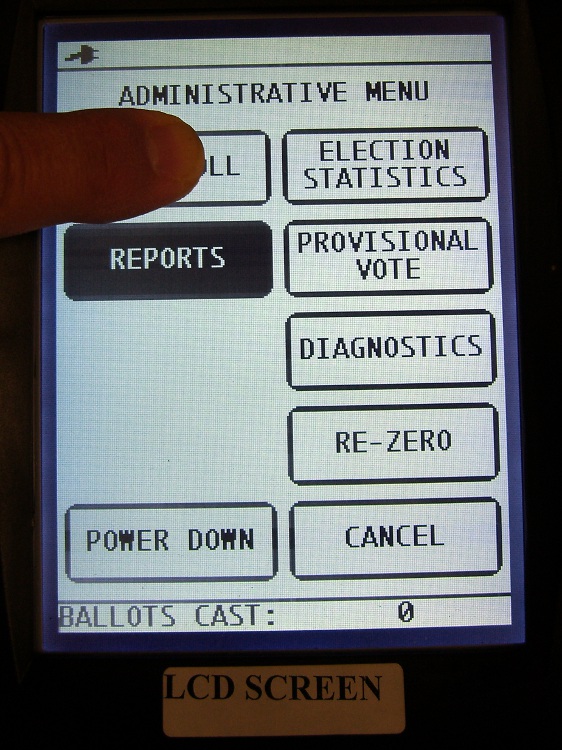
    Attempting to open the polls with the Administrative Menu on the LCD produced this incorrect response. Fortunately, the next screen in the Reports section had a Cancel option, so I could back out and try again by tapping the screen well above the Open Poll button. That worked.

    Later on in the day, for the first time in my experience as a Ballot Marking Device Election Inspector, a voter requested to use the BMD machinery to cast her ballot.

    Voting machine LCD miscalibration - BMD Audio Session
    Voting machine LCD miscalibration – BMD Audio Session

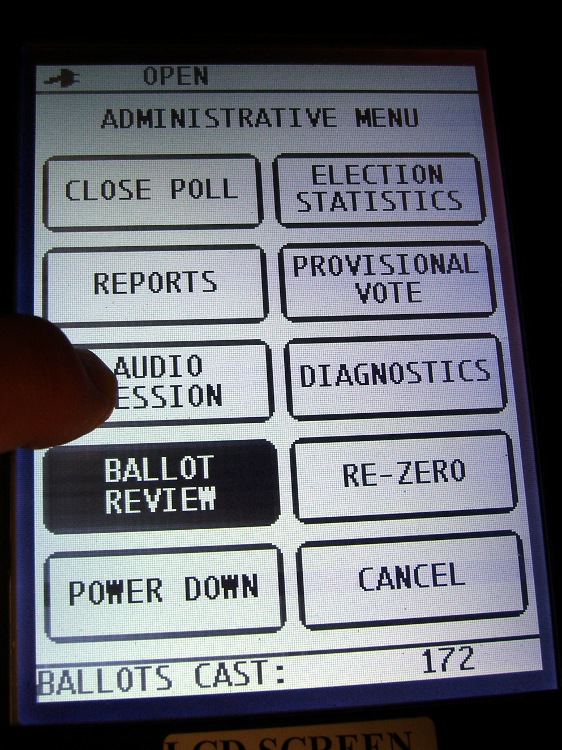
    Here’s what happened when I tried to start the somewhat misleadingly named Audio Session that invokes the BMD: Ballot Review turns on a mode that presents the scanned values from the next ballot on that tiny little LCD, one contest at a time.

    When I called the Board of Elections to get help, the tech said “Hmmm. That shouldn’t happen.” We did get the Audio Session started and the voter commenced entering her choices, eventually succeeding in producing a printed ballot that she found satisfactory.

    The tech sent to fix the situation (we Election Inspectors are not encouraged to fiddle around with the machinery, for well and good reason) was stumped. Eventually we scanned a ballot, using a live vote as a debugging aid, and managed to get the option turned off again. Obviously we hit a corner case, but that’s not what you want in an election with voters lining up behind a dysfunctional scanner.

    It was, of course, the one-and-only scanner in the polling place.

    While this does not directly affect the election results, it certainly does not inspire confidence in the architecture, the programming, or the operator training of the election system.

    Not a pleasant experience…

  • Wind Turbine on the Move

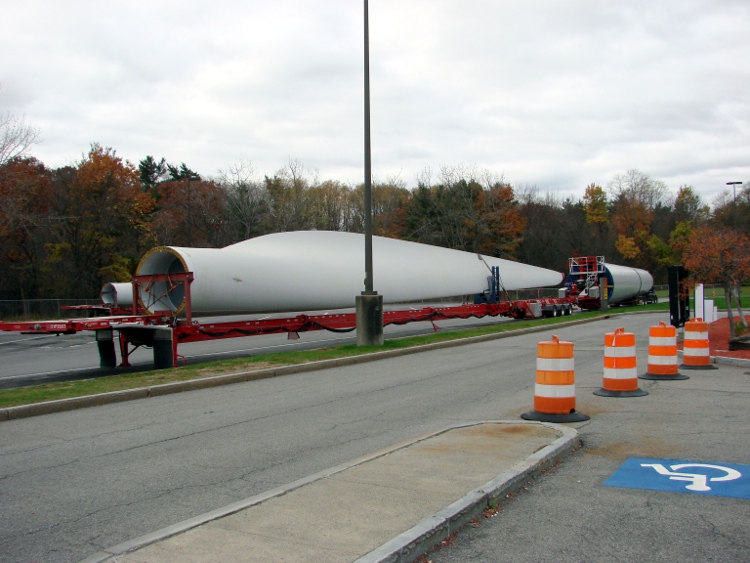
    Pulled into an I-90 rest stop west of Albany NY and saw what appeared to be a large water tank on a flatbed, parked next to … an airplane wing?

    Wind turbine blade and tower section
    Wind turbine blade and tower section

    Nah, this can’t be.

    Turns out that the “tank” (in the distance of the picture) was part of the mast for a wind turbine, with three airfoil blades on separate trailers scattered around the edges of the truck parking area.

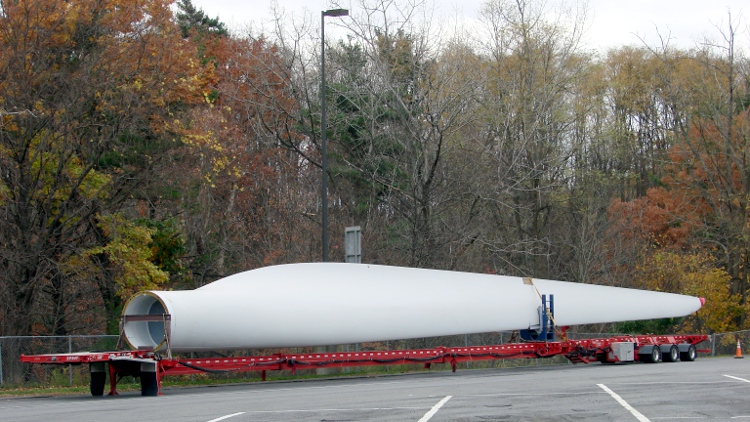
    This being a Marching Band trip (returning from the NYSFBC Dome contest in Syracuse: 4th place), I deployed two bandies as measuring instruments. They put on their drill face, stepped 8-to-5 along the blade, and reported it as 120 feet, which agreed well with my uncalibrated 125-foot pace.

    Wind turbine blade - side view
    Wind turbine blade – side view
    Wind turbine blade - end view
    Wind turbine blade – end view

    Seen end-on, a blade doesn’t present much to see. The plastic-foam endcap is a nice touch, though.

    The hub and generator nacelle (and, most likely, many more tower sections) were missing from the collection, which leads me to think they’re marshalling all the pieces before delivery to a wind farm site. It’s also possible these came from a decommissioned installation, as they seemed somewhat weathered.

    A semitruck driver said they’d been parked in the lot since late last week.

    The placard on the back of the trailer reads, in both English and French (due to a Quebec license plate):

    CAUTION THIS TRAILER OFFSETS

    A bit of Google-fu (try searching for offsetting steering semitrailer -carbon) indicates that the trailer has self-steering wheels, which makes sense given that it’s a single unit rather than a double-bottom semitrailer rig.

    The tower section had a bogie wheel assembly strapped to one end (labeled “TOP” on the canvas cover) and a semitrailer tongue strapped to the other: no need for a trailer between the two, as a cylindrical turbine tower is certainly stronger than anything you’d find on the road.

  • Trust Multimedia Mouse vs xorg.conf

    This is the xorg.conf stanza required for a Trust MI-7700R multimedia mouse to set default left-hand use:

    Section "InputClass"
        Identifier      "Trust MM Mouse"
        MatchProduct    "Trust Mouse 15206"
        Option          "SendCoreEvents" "True"
        Option          "ButtonMapping" "3 2 1 4 5 6 7 8 9 10"
    EndSection
    

    And then it Just Worked, including horizontal scrolling.

    I can’t vouch for the multimedia functions, though.

    Memo to Self: Weirdly, the AA cells are in parallel, not series. Put them in “normally” and you get a dead short across a 3-V battery!

    Maybe that’s why it’s obsolete?