Because my hombrew circuit boards don’t have plated-through holes, I solder Z-wires from top to bottom. This entails little more than a solder blob around the wire on each side, but this time I wondered if having a slightly larger solid-copper area on each surface would be an improvement. Regrettably, I wondered this after masking the board.
Because I use an Ultra-fine-point Sharpie to touch up pinholes & suchlike, I decided to try it on larger areas by simply coloring in a few of the openings in the ground-plane grid.
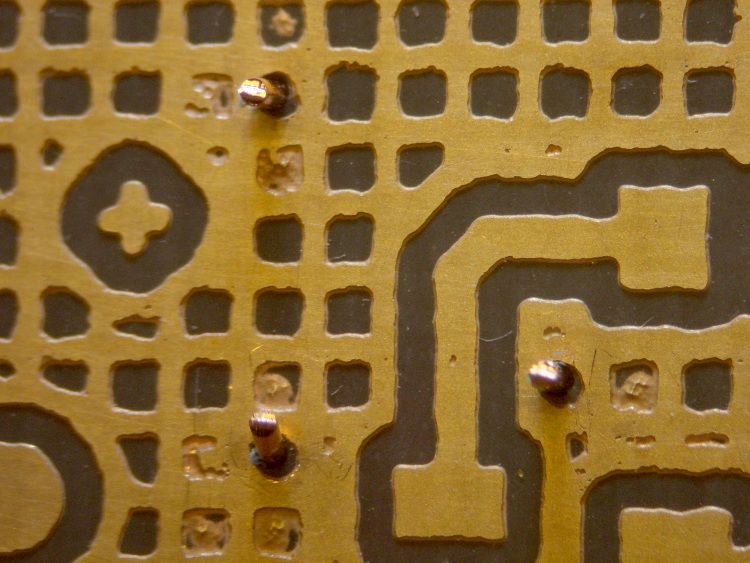
Short answer: doesn’t work so well.
However, I’m using direct etching: rubbing ferric chloride on the masked PCB with a sponge. The abrasion probably wears the Sharpie ink off the surface and then the copper begins etching as usual. If I were doing this with normal agitation / aeration, perhaps a Sharpie mask would work better.
This is also 1-ounce copper, so there’s twice as much etching going on. Perhaps half-ounce copper would vanish fast enough that the Sharpie mask would remain effective.
A bit more detail, with another Z-wire pointed right at you.

The grid is 20-mil wide on 50-mil centers, with 25-mil isolation to other signals. The “via” holes use a 24-mil drill.
The row of dents just below the wire came from tiny openings in the mask that happen when Eagle poured the ground plane against the isolation surrounding the trace at the bottom. The toner-transfer resolution isn’t quite good enough to leave a clean opening and the etchant can’t quite reach the bottom to dig out the copper.
Memo to Self: Next time, try a 100-mil square pad around the via, centered on a grid intersection to fill in four adjacent openings.
 The Smell of Molten Projects in the Morning
Comments
10 responses to “Sharpie as PCB Etch Resist”
I used a wider-tipped Sharpie and got this, but it took re-applying the sharpie a couple times during the etching process. I think I’m going to try nail polish next time.
Sounds like abrasion or erosion is the problem, then.
I have a bottle of my shop assistant’s orange-with-sparkles nail polish (she outgrew it) that works well for blobbing out major areas, but it’s no good for staying within the lines in the finest coloring-book style.
Perhaps I should spend more time in the makeup section of the local big-box retailer? I’m sure somebody has a fine-point nail polish applicator…
My ex-gf the mechanical engineer, a ferociously bright person, introduced me to the idea. She had hot pink nail polish that she used to draw lines and stripes all over all her tools because “nobody would be caught dead with these.” And I *know* there are very fine-point nail polish applicators, although I’ve not seen them, because I’ve friends in the high school crowd who have flowers drawn on their fingernails, with lines that look like they’re less than 0.005″ across for the stems/leaves. Next time I run across someone who Does Nails I’ll ask.
flowers drawn on their fingernails
Those might be decals, at least from what my shop assistant reports.
Some trawling in the Big Box Retailer’s Bee-you-tee-ful Accessories Department will be educational. Fortunately, any odd looks will just bounce right off…
Why… that’s *cheating*!
But I bet you’re right.
‘course, Willard Wigen swears by using individual hairs for painting tiny stuff. But I don’t have his fine motor control skills.
Ed, nail polish has been a favorite of mine. You need to dilute it into a thinner consistency with methyl acetate, ethyl acetate or acetone – in order of preference. Ordinary spray painting thinner might work too. With the thinned down nail polish I can touch up the fine lines with the smallest brush I get at the local stationary store.. Advantage of this is that you can trim off excess with a blade.
I’ve squirted acetone into the bottle whenever it gets too gummy, but I’d never considered thinning it down that much.
I’m sure I have some teeny brushes around here somewhere; my shop assistant might have a stash she’d be willing to share… thanks for the suggestion!
I wonder if the solvent-resistant “Industrial” Sharpies I favor would fare any better. I’ll have to give it a shot next time I etch a PCB, but that might be a very long time…
More likely than not, they contain the same sauce in a different package. The MSDS sheets say the industrial ones lack ethanol in the solvent mix, but they’re not forthcoming about what’s left after the solvents evaporate.
Where do you get such things?
I get ’em at one of the chain big-box hardware stores — I forget if it’s the blue one or the orange one. No clue if they’re actually different or not but at least the advertising claims sound nice…
At least http://www.eevblog.com/forum/index.php?topic=122.0 claims the Industrial ones suck just as much for PCB etch resist.