You’ve probably seen “ultimate geek clocks” floating around on the web, which seem to be Nixie tubes, binary readouts, or analog clocks with lightly encoded markings.
Poseurs, all of them!
If you’re an alpha geek, this is how you tell time…
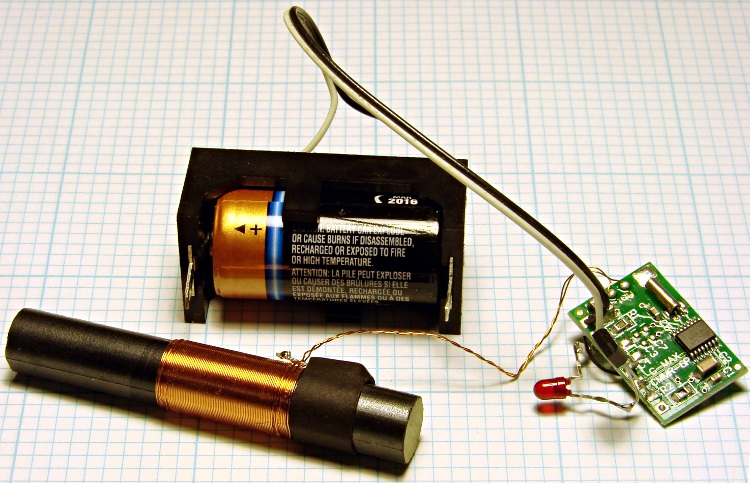
It’s a WWVB receiver wired up to a CR123A primary lithium cell. The time display is a single red LED, driven by a low-threshold FET. Yeah, you can package it up in a cute little box (which is the picture on hackaday.com), but this is the essence of the thing.
Over the course of a minute, the LED blinks out the hour, minute, year, day-of-year, Daylight Saving Time, leap year, leap second, and some other stuff in binary-coded decimal.
The key to the format is there and the bit format is straightforward:
- Long = frame marker
- Medium = binary 1
- Short = binary 0
You just watch the LED, catch the frame marker, decode BCD data on the fly, convert from UTC to local time, and that’s all there is to it.
Sheesh, it’s only one bit a second: anybody can handle that, right?
Truth to tell, I can hang on long enough to get the minute, but I taper off pretty quickly after that.
Tech detail…
Basically, you get the receiver and CR123 cell holder from DigiKey for maybe fifteen bucks. Wire up a FET (ZVNL110A or some such) to the receiver’s inverted-polarity output, so the LED is ON during the data bit’s active time (carrier drops 10 dB). I blobbed on a 300 ohm SMD resistor, so the total current is maybe 250 µA with the LED on. If you’re going crude, you can probably wire the LED & resistor directly to the receiver’s positive-polarity output.
A primary CR123A is good for 1500 mAh and the average current is maybe 150 µA, so the clock will run for nearly a year. The LED is pretty dim, but perfect for late-night viewing.
Reception is iffy during the day here in the Hudson Valley. At night it’s just fine. Interference from LCD panels with near-60-kHz refresh is a real problem, so it doesn’t play well near PCs.
I put the clock on a shelf where I can watch it when I wake up in the middle of the night: it knocks me out again pretty quickly.
In real life, I put this together to verify my WWVB simulator… but I might just box up a spare for the shelf, too.
 The Smell of Molten Projects in the Morning
Comments
7 responses to “Alpha-Geek Clock”
[…] CR123A cylindrical lithium cell (having a bunch of them on the shelf and some holders for another project). The connector is in an awkward location, below the IDE socket’s flex-PCB cable, and both […]
[…] I had to do it. The Alpha-Geek Clock WWVB receiver circuitry, such as it is, now resides in a nice Pactec enclosure, with a bright red […]
[…] good! This clock has a built-in WWVB receiver to make sure the time is always accurate. But with just one LED as the display we wish you good luck when reading it! A whole bunch of info (time, day, year, etc) is blinked out […]
This is a great idea. All of the enclosure possibilities are Soooo exciting. how about making an enclosure out of a frame diagram and polycarbonate?
[…] second is from hackaday.com: they loved the Alpha-Geek Clock, although they linked to the inside […]
[…] data collection is in order, but the receiver’s LED showing data pulses now tracks the Alpha Geek Clock’s display almost perfectly. Leave a […]
[…] Or one could go full analog with three red LEDs driven by the WWVB signal. […]