Ever notice how, when you take your car in for inspection, it always comes back with the wheel lug nuts tightened beyond the ability of mere mortals? I think it’s because they have their pneumatic impact wrenches turned up to 11, just to make sure the nuts never, ever come loose and expose them to liability.
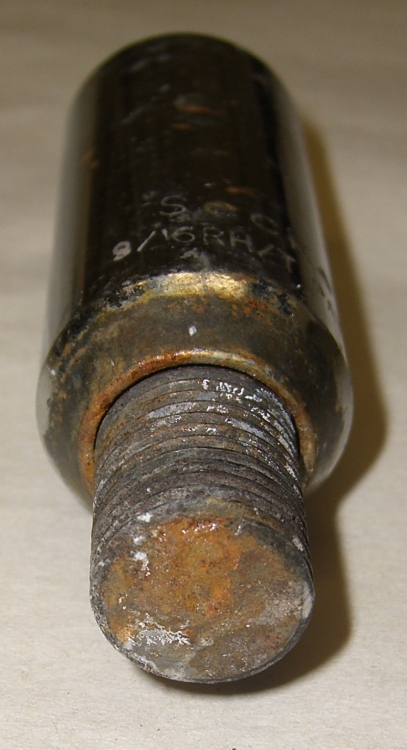
Found this yesterday while walking back from the store with two gallons of milk. The shiny bit in the background is labeled SocketLug, which is evidently a trademark associated with Gorilla (but with no Web presence), and sports patent number 5797659. The stud in the front evidently snapped out of somebody’s wheel, probably flush with the surface. Gonna be trouble getting that out!
The lug is a threaded 9/16-inch steel stud, with a root area of maybe 0.18 square inches. Let’s suppose the yield strength is 100 kpsi, so breaking that thing required 18 k pounds. The thread looks to be 18 TPI for a 1.8 degree helix angle; call it 3%. If they lubed the threads and lug (ha!), letting us assume 20% friction, then the wrench was applying 700 pounds at a 9/32″ moment arm: call it 2.5 k lb-in or 30 k lb-ft of torque. Pretty impressive, given that typical pneumatic wrenches weigh in at around 500 lb-ft of torque.
Which says it really wasn’t the wrench doing the breaking, which should also be obvious because it was lying at the side of the road rather than on the shop floor. Even a 1000 lb-ft wrench would create only 5% of that yield load in the stud, so something else was wrong.
That orange patch in the upper left looks like rust in a crack, with the gray area in the lower right revealing the final fault. Maybe the shop monkey (or owner?) managed to whack it while installing the tire, create a small crack that let in the usual NYS road salt, and after a season or two the stud failed after being cranked tight once again.
There’s likely another four on that wheel: safety in numbers! Unlike those old Citroens with but a single nut securing each wheel…
 The Smell of Molten Projects in the Morning
Comments
4 responses to “Shiny Lug Nuts: Overtightening Thereof?”
> Gonna be trouble getting that out!
A broken stud usually comes out without difficulty.
The factory service manual shows a special tool which uses the mechanical advantage of a forcing screw.
The seasoned mechanic chooses the expedient approach: a blunt drift struck with a three pound hammer. This technique is fast and effective, but it is unkind to the wheel bearings. Hey, it is a customer car and the damage won’t show up for a few months…
I have two sets of easy-out removers (large & small) in the tool chest. To the best of my knowledge, I haven’t ever used ’em… and hope to keep it that way!
Given the sizes of that SocketLug and the stud, it’s from a truck and should be visibly missing. Wonder how long it’ll take for them to notice?
I get a kick out of the back & forth debate about the need to return to your garage to have the lugnuts retorqued after the wheels have been re-installed – say after 60 miles or 100km. It’s the installers attempt to shift the liability to the consumer if you don’t & there is a failure.
This is hog wash & there needs to be a class action lawsuit to set this straight. Lugnuts on passenger vehicle wheels do not need to be retorqued ever if the wheel is installed properly. The wheels, bolts & nuts are designed for a one time proper torquing. And they will stay on. Do they re-torque your wheels after your new car comes off the assembly line? If there are dufusses out there who don’t do it correctly the first time then they shouldn’t be working in garages requiring them to do so. I’ve never retorqued my wheels in 50 years & I’ve had my wheels on & off many times. Do it right the first time & stop the re-work.
Which is all the explanation there needs to be, alas.
I use a torque wrench to install the lugs, then use it again when it’s time to take them off just to see how tight they are. I’ve seen one lug require about 75% of the installation torque, but all the rest have been in fine shape.
So I’d say you’re absolutely right: torque ’em properly and be done with it!