Ed Nisley's Blog: Shop notes, electronics, firmware, machinery, 3D printing, laser cuttery, and curiosities. Contents: 100% human thinking, 0% AI slop.
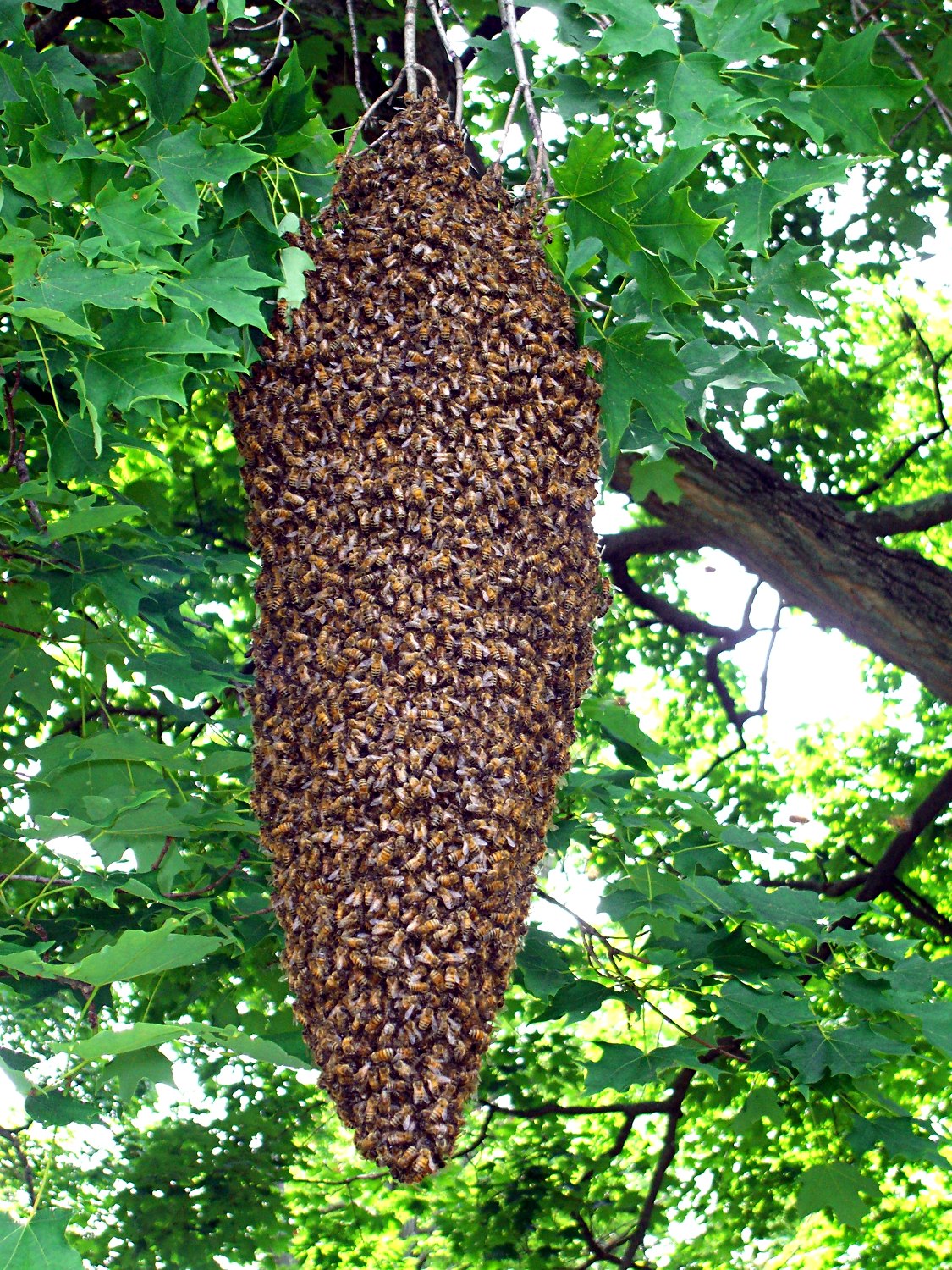
They’re doing well in their new home, building out comb on the foundation. The queen is in good shape, laying eggs as soon as the workers finish the cells. The workers seem to be feeding pollen directly to the larvae rather than storing it, which makes perfect sense. They’re taking two quarts of 1:1 sugar water every day!
Either you already know what this is all about or you really don’t want to know.
We put out bird boxes to encourage more House Wrens, but House Sparrows often take over the boxes. This year we kept the boxes down until the sparrows had already started their nests in the bushes, hoping that the wrens would get a head start on their nests. Two days after we put the boxes up, we had a nesting pair of wrens… and two days later a pair of sparrows had evicted them and were installing their own nest.
Rechecking the box specs, it seems wrens prefer a hole somewhere between 7/8″ and 1-1/8″, but I’d drilled 1-1/2″ holes for bluebirds (a long time ago, before we knew bluebirds vastly preferred the edges of open fields). Making a hole larger is easy, making one smaller is more difficult.
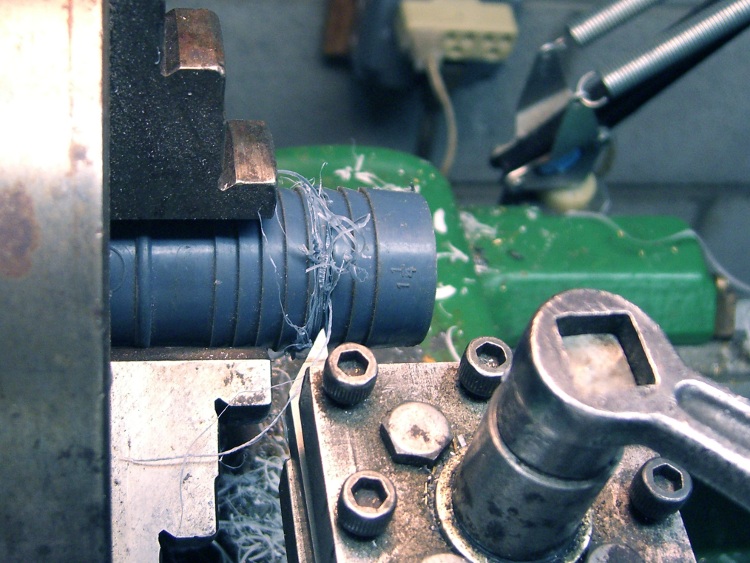
Cutting off the barb
I thought of making a wood bushing, then came to my senses: a 3/4″ thick wood ring with 1/4″ walls just wasn’t going to work. Given that the wrens (or their ancestors or relatives) have already tried nesting in our gardening boots, bicycle helmets, and tool trays, I figured they wouldn’t be too fussy about the material around their entrance hole.
To the Basement Laboratory Machine Shop Wing!
The parts heap disgorged a box of huge hose barb fittings, one of which had a 1.1″ ID and a 1.4″ OD: close enough. I parted off 3/4″ from the end of the barb, using a bit not really suited for the purpose that gave a nearly perfect edge in the soft plastic. One swipe with a deburring tool and it’s done.
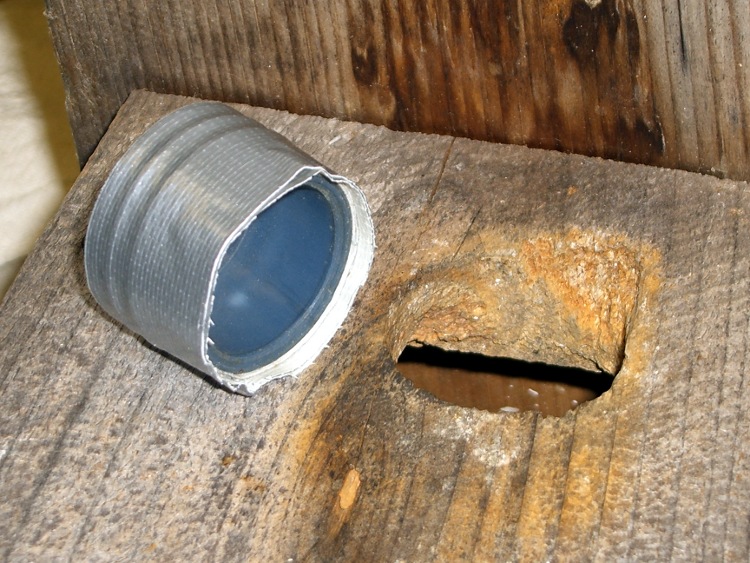
Bushing ready to install
A few wraps of duct tape provided a nice press fit and a springy retaining force without gluing the barb in place. This is pretty, mmmm, barbaric, but if it survives one nesting cycle I’ll do something much nicer.
Time is definitely of the essence here, as we fear the wrens have been driven away: we haven’t heard them since their eviction. I did three boxes in about half an hour; we’ll see what transpires.
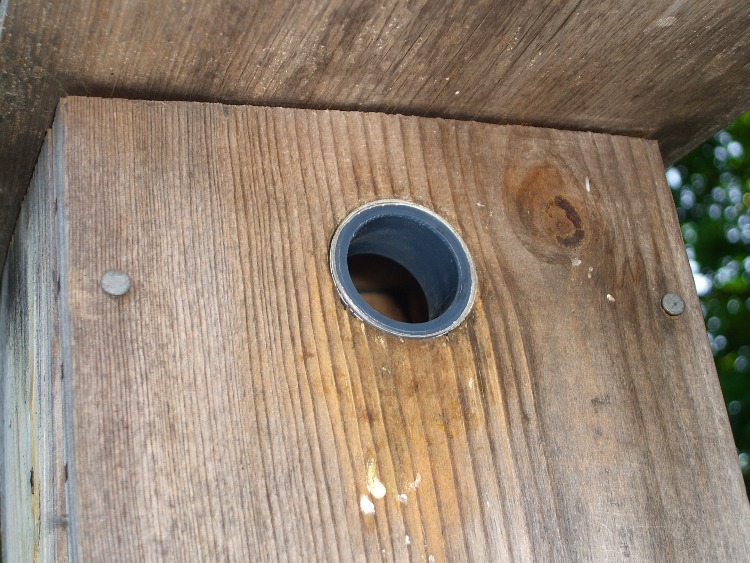
The bottom pic shows the box from the front yard, where Downy Woodpeckers nested for a few years. They thought the hole needed a bit of renovation… and they have the tools for the job!
We met this lass while walking around the high school one evening.
My first thought was that eliminating the Morse Code requirement has definitely broadened the amateur radio population, but it turns out she’s part of the Hudsonia Blanding’s Turtle study. Perhaps the new construction around the school has opened pathways for her to explore the world.
She seemed to be looking for a way up-and-over the curb to return home. We figured she was big enough to figure this out on her own and old enough to have done so many times before, so we left her to her own devices. When last seen, she was chugging along the curb at a pretty good clip.
Listen for tag 123122 (or 817) on 150.888 MHz… she’s running AM QRP with a bad antenna.
Update: It’s hard to tell with turtles, but it’s a girl! When I reported the tag number to Hudsonia, they said “817 is one of our old-timers; we’ve been tracking her for at least 10 years now.”
This gizmo appeared in one of Mary’s garden containers and, as is their custom, curled up tight and stayed that way when she picked it up.
Wooly Bears generally have a central brown band, but all-black isn’t unusual. I hadn’t known about the orange bands across the back between the body segments.
Those spiny hairs are so stiff and it weighs so little that it skitters around on the desk at the slightest touch, all without moving a muscle…
Find out more about Wooly Bears there or by searching on the obvious keywords.
We put it back in the garden where it can turn into a moth and produce more Wooly Bears to delight children of all ages.
Wooly Bear caterpillar – bottom view
Wooly Bear caterpillar – top view
Photography note: exposing a dead-black spiny thing against a woodgrain desktop is basically impossible. The desktop is grossly overexposed so the Wooly Bear details come out more-or-less visible. Ugly, but you get the idea.
This fellow has been helping to remove the stump in the front yard for a quite a while; today he let me peek around the edge of the door and take a few pictures…
He’s about crow-sized with a much snappier paint job.
Scary-sharp beak!
Pileated woodpecker – head-on
Pileated woodpecker
Pileated woodpecker – left side
Taken with a Sony DSC-H5 with their VCL-HGD1758 1.7x teleconverter lens at about 50 feet, then ruthlessly cropped. Not as good as an SLR with a real telephoto lens, but good enough for my simple needs. The teleconverter with a macro lens on the back provides some standoff distance for photos of tabletop widgetry.
The turkeys were discussing their activities yesterday evening while getting ready for bed in the trees out back. This isn’t unusual, but they seemed rather louder than usual.
We walked out the driveway, me with the Sony DSC-F717 in IR Night Shot mode, and eavesdropped for a while. The two early birds in the trees may have been air bosses for the rest of the flock, as nobody else arrived while we were there.
So I didn’t get any pictures, but it reminded me of some I took a few years ago when a hen with a gaggle of chicks roosted in a maple directly in front of the house.
Three peeps are easy to see, but she had at least two others snuggled up on her left side!