Ed Nisley's Blog: Shop notes, electronics, firmware, machinery, 3D printing, laser cuttery, and curiosities. Contents: 100% human thinking, 0% AI slop.
It didn’t involve waiting: by random chance, a fifth NYSDOT road repair crew happened to be in that area when Mary rode by. She stopped directly atop the sinkhole and screamed at the flagger until he came over. She explained the problem and, wonder of wonders, this time they put asphalt in the right spot.
The patch looks hand-tamped and will pop out after a while, but it’ll be great while it lasts.
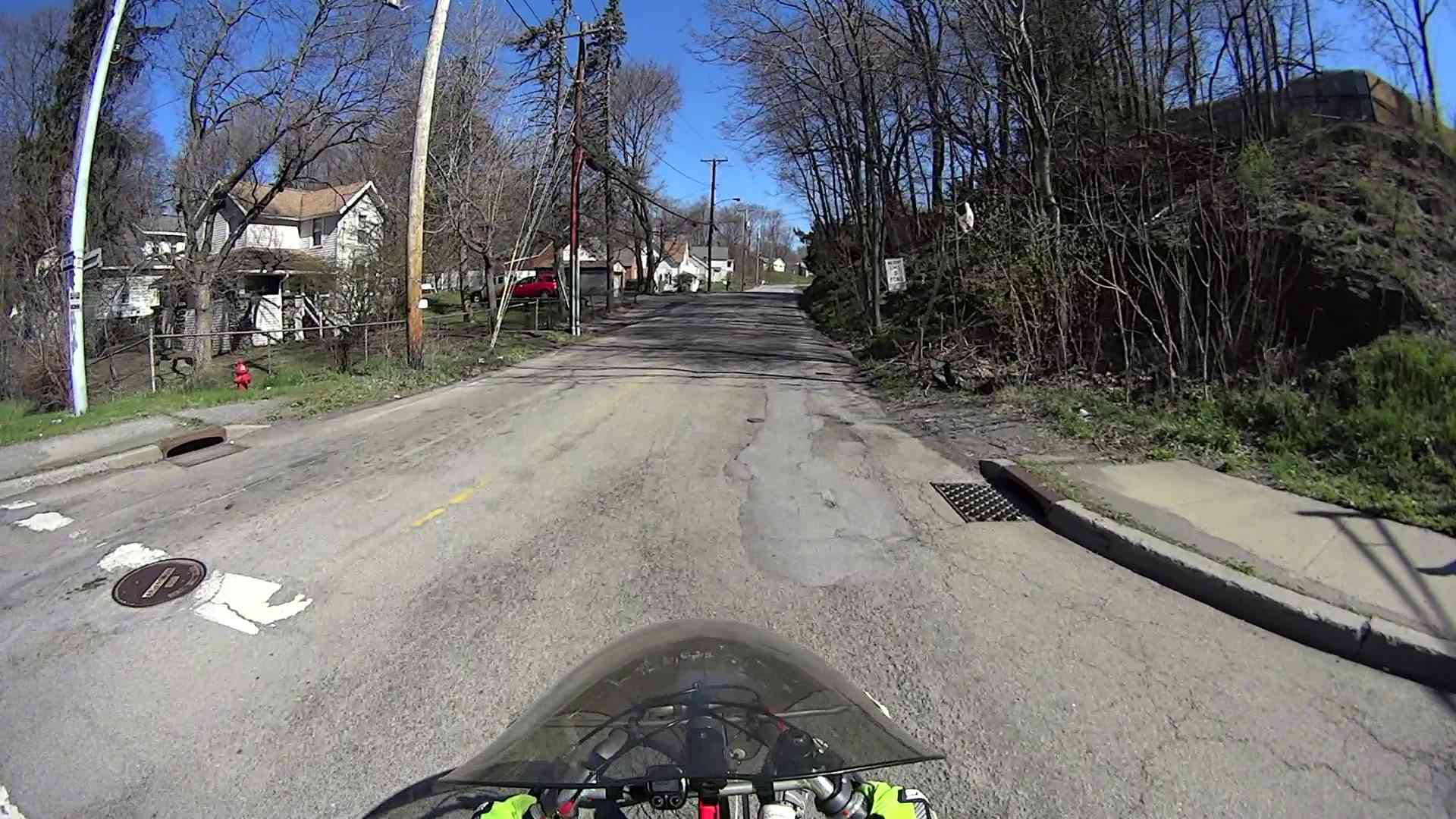
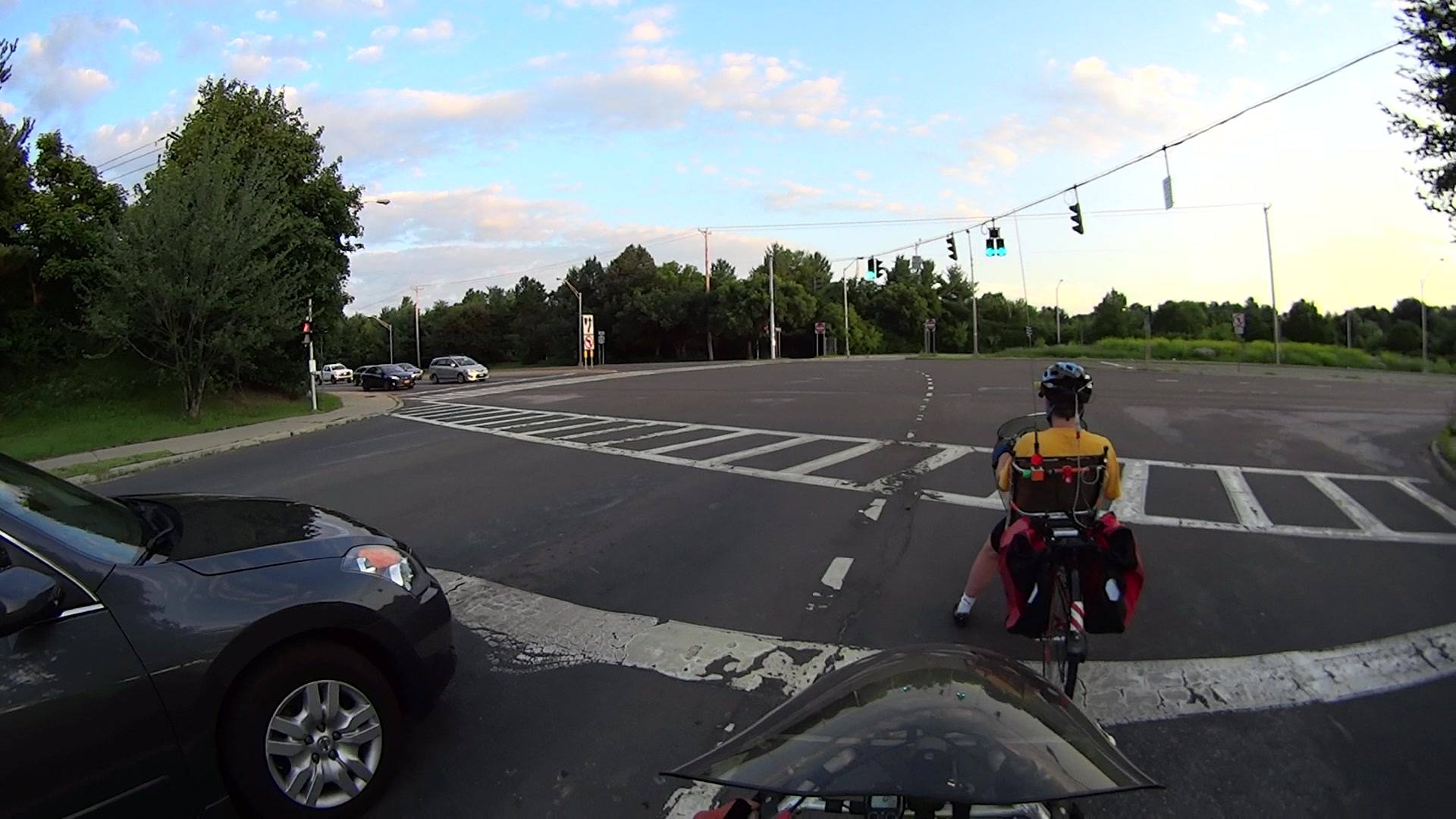
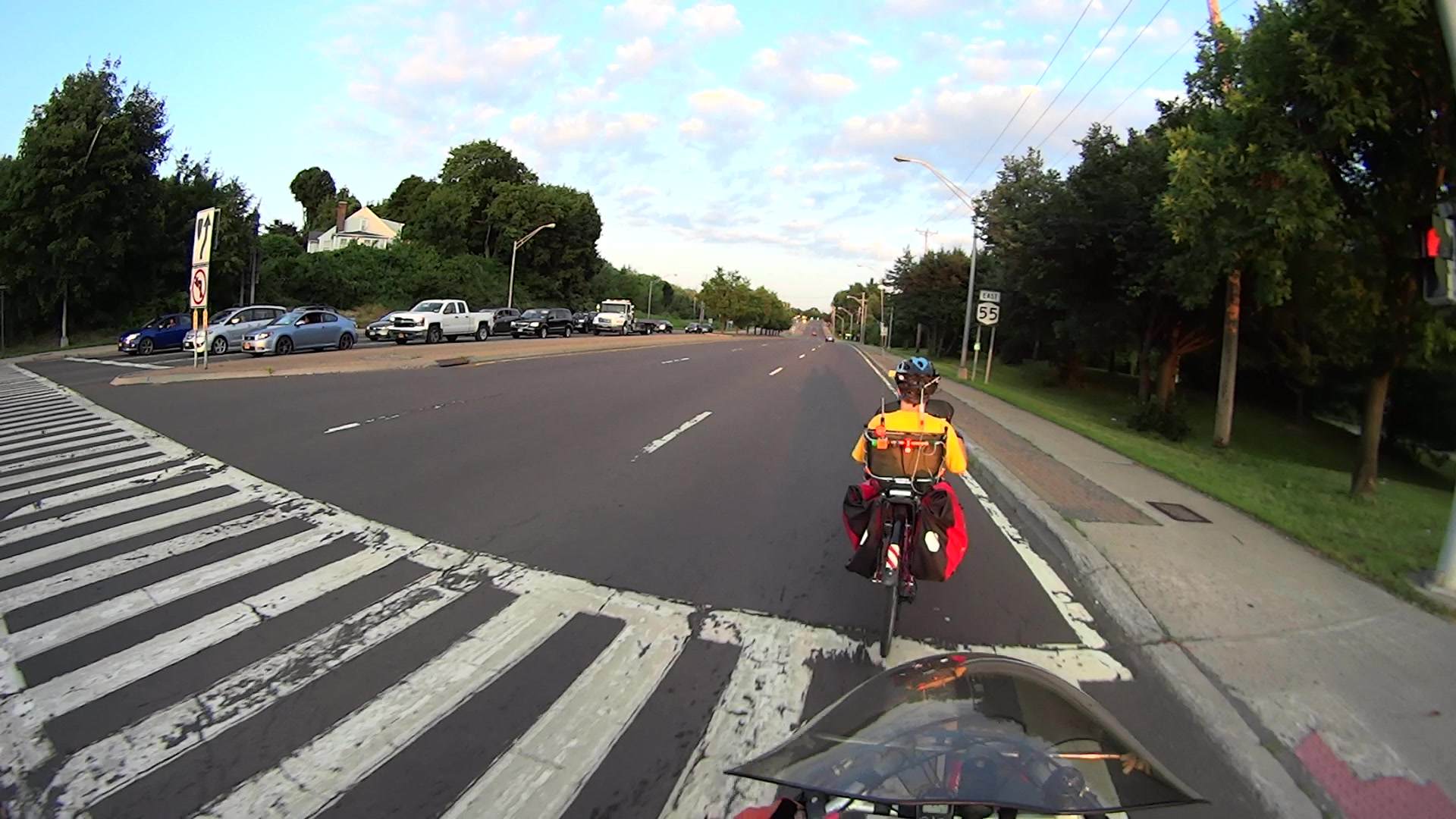
Just because I hadn’t done so for quite a while, I rode Grand Avenue from Beechwood north to the rail trail. The rotted asphalt at the Westbound Arterial (a.k.a. Maple St, at that point) intersection makes it easy to spot the quadrupole sensor loop:
Grand at Arterial WB – front camera – 0193
After half a minute, with no traffic pulling up behind me, I eased the bike over the central wire:
Grand at Arterial WB – front camera – 1693
Which is exactly as awkward as it seems:
Grand at Arterial WB – front camera – 1945
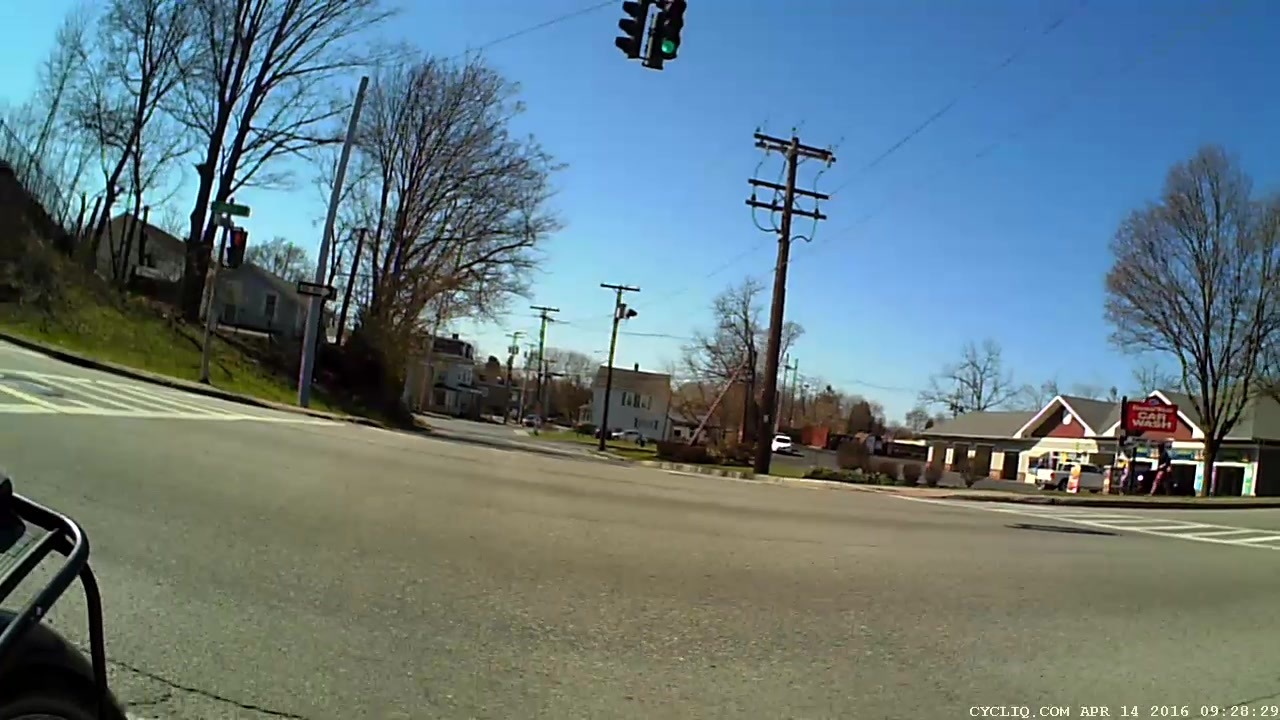
Much to my surprise, the sensor tripped:
Grand at Arterial WB – front camera – 3044
That’s about 50 s from the time I rolled over the first of the two sensor loops, which is fast enough for me. It’s unusual to find a sensor loop that detects a bike, though.
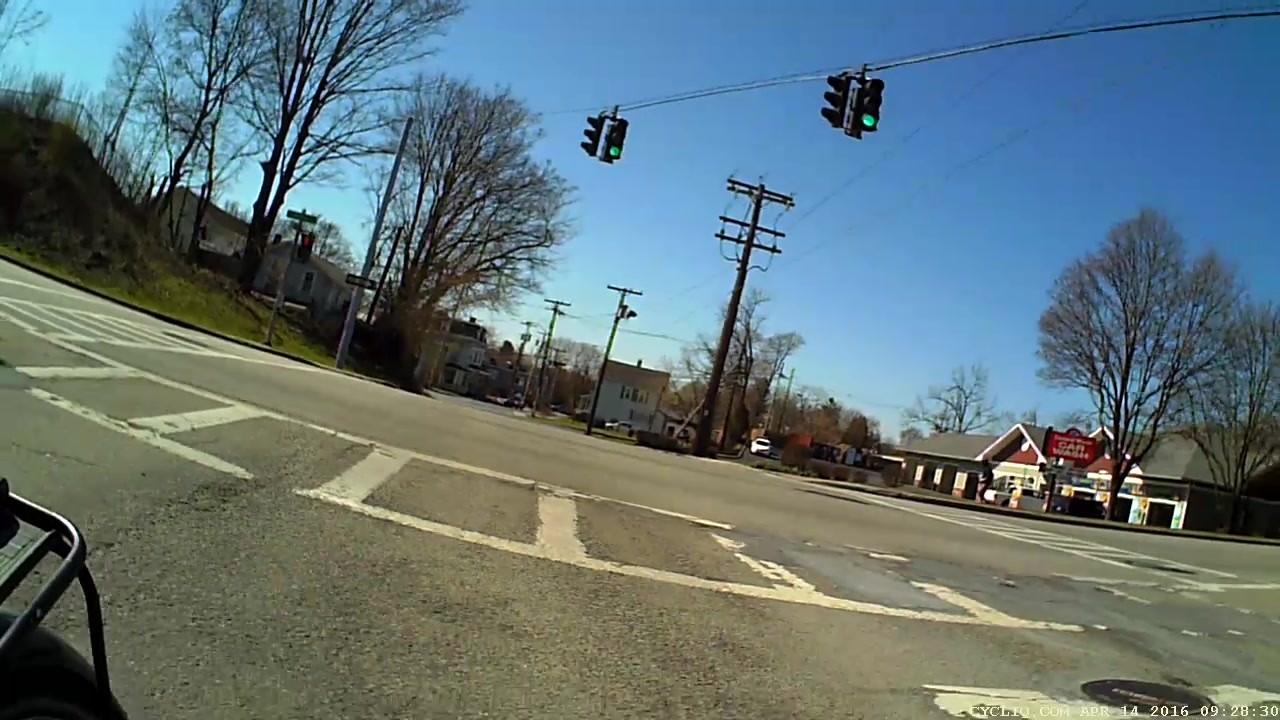
A bit over 6 s seconds later, I’ve cleared the intersection:
Grand at Arterial WB – front camera – 3445
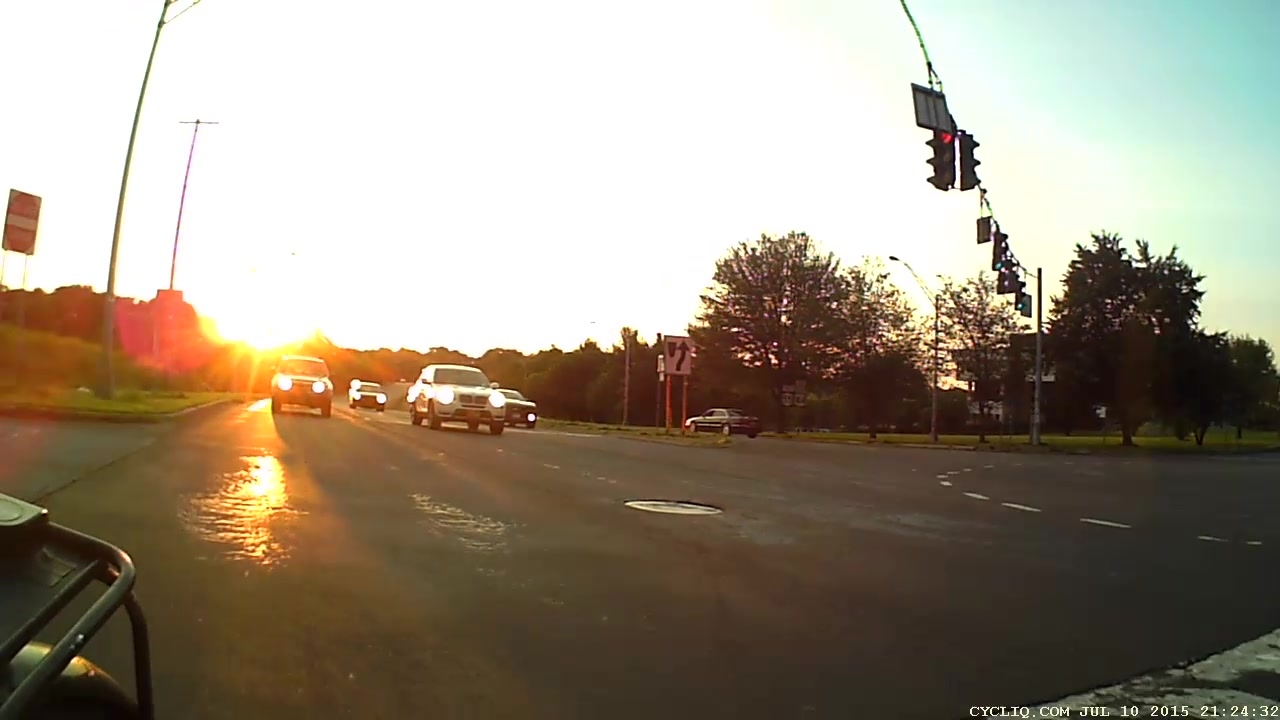
The rear camera shows that the light remains green:
Grand at Arterial WB – rear camera – 1085
And it stays green:
Grand at Arterial WB – rear camera – 1121
About 11 s after turning green, a car approaches the sensor loop:
Grand at Arterial WB – rear camera – 1228
I think that reset the signal timing, so that light remained green for nearly 23 s:
Grand at Arterial WB – rear camera – 1581
It turned red after 26 s:
Grand at Arterial WB – rear camera – 1671
As nearly as I can tell, the minimum green time for this intersection is 12 s.
So life is good: the sensor loop detects a bicycle and the signal remains green for long enough to a bike to clear the intersection. If only all intersections worked that way!
Compare that with the minimum 7 s for the Burnett Blvd intersection and you (well, I) wonder why crossing six lanes requires 5 s less than crossing three lanes. Perhaps different standards apply to this single-direction cross-traffic flow that make it much more difficult than Burnett’s bidirectional cross traffic?
It’s been sinking, month by month, ever since I reported it to NYSDOT last July. They dispatched a work crew that did a remarkable job of patching everything around the sinkhole (note the asphalt obliterating the center line), but somehow missed the actual hole on the shoulder, despite the picture I sent. Just before snow season, a second crew patched many small holes along Rt 376 from Red Oaks Mill to Hooker Avenue, but, once again, missed this one.
If it doesn’t look like much, let’s go for a check ride.
This section of Rt 376 forms part of NYS Bike Route 9.
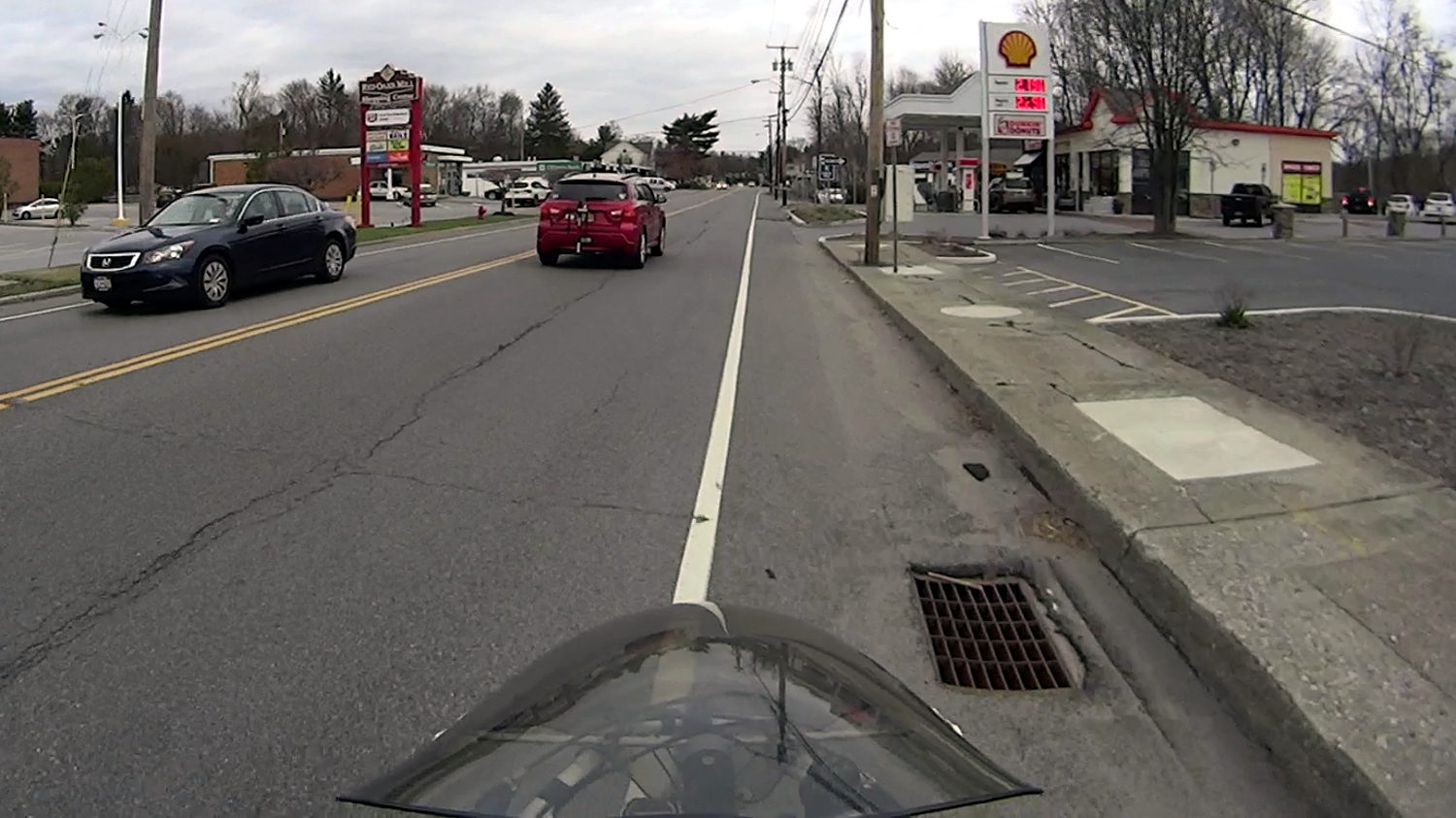
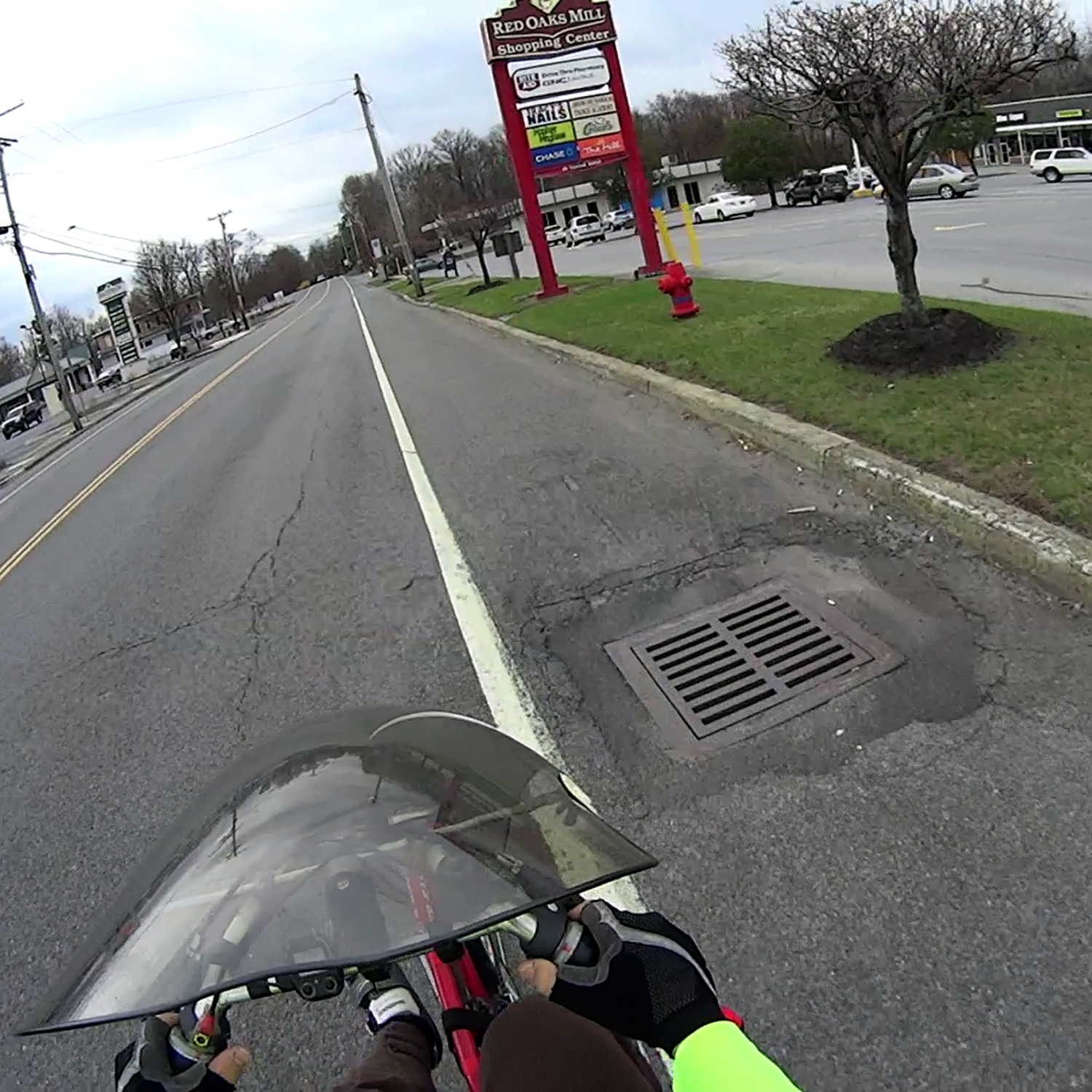
Apart from having a wheel-catcher grid, this one seems survivable:
Drain grate 1 – 43 Vassar Rd
You can avoid it as long as you stay alert.
This beauty, however, stops cars dead in their tracks:
Drain grate 2 – 35 Vassar Rd
Drivers who pass cars making a left turn into the strip mall on the other side slam to a stop if they’re lucky enough to see that crater before it claims their right front tire; the grid is about a foot down from grade. The scrapes and scuffs on the far side show that, if it wasn’t for bad luck, some folks wouldn’t have no luck at all.
Obviously, you can’t bicycle through that one.
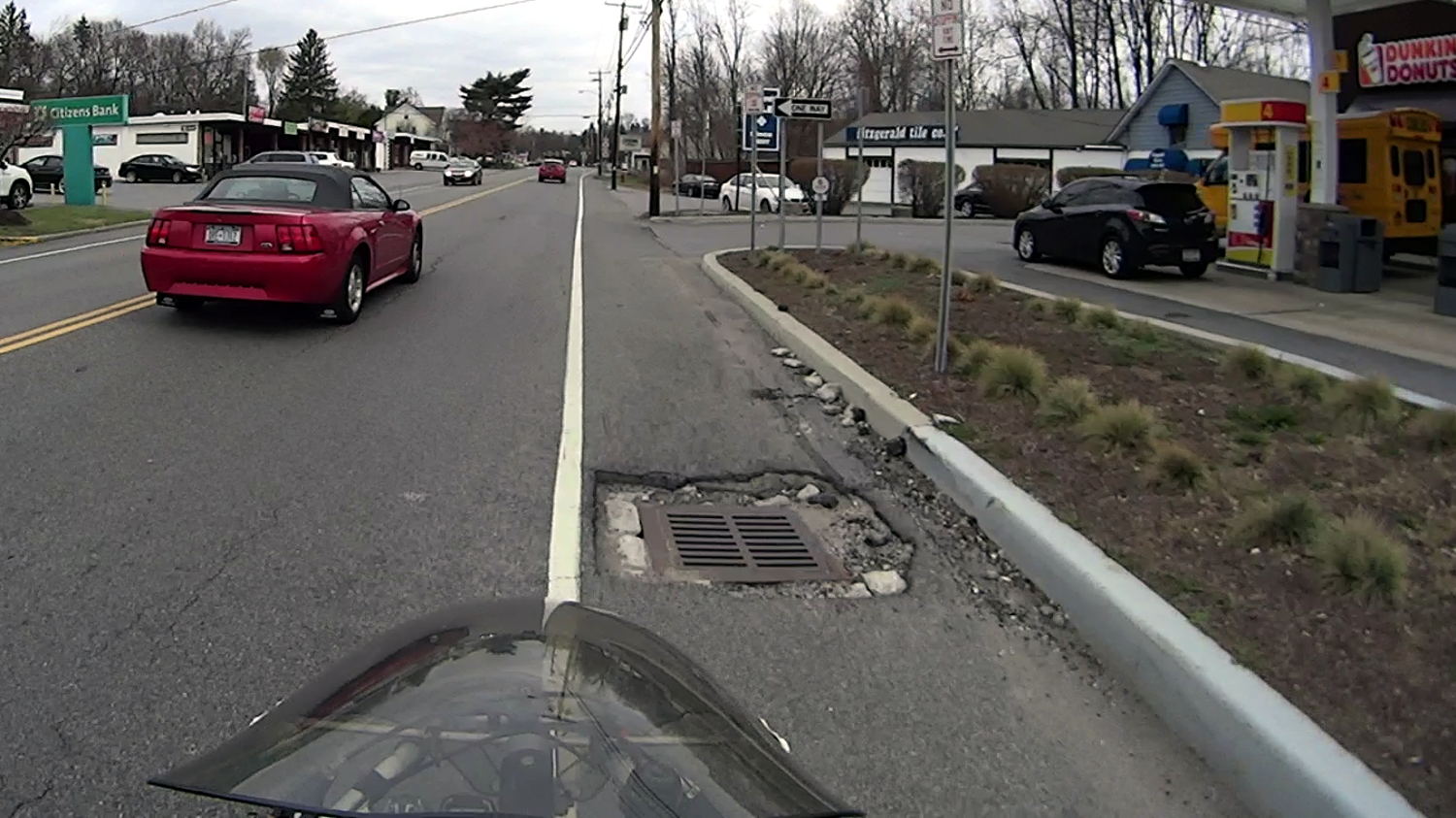
This grate, directly across Vassar Road, would count as a serious pothole in any other context:
Drain grate 3 – 40 Vassar Rd
The pavement remains in better shape, because it’s just to the left of the strip mall entrance, but, again, the grate is about a foot below grade. Those scrapes on the far side suggest some folks didn’t notice that in time.
If I rode any further to the right, perhaps just on the other side of the fog line, my wheels would be on the steep slope from the fog line down to the grid. It’s survivable as long as you expect it and keep a tight grip on the handlebars.
Vassar Road, formally known as Dutchess County Route 77, forms part of NYS Bike Route 9.
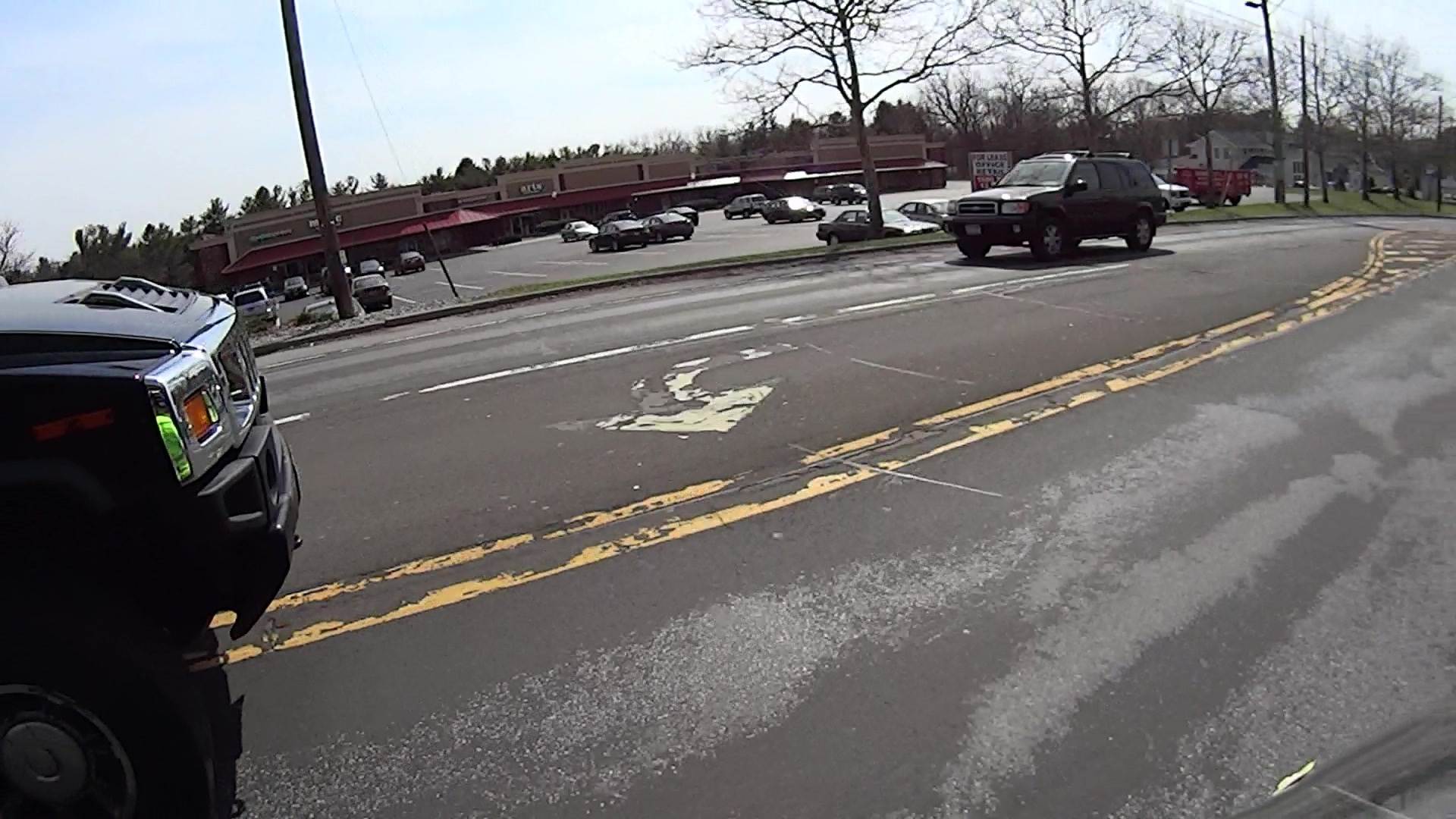
You can’t hear the horn that’s been honking for the last few seconds (sequence numbers = 1/60 s) as we approach 695 Dutchess Turnpike (a.k.a. Rt 44, a.k.a. NYS Bike Route 44):
Rt 44 at 695 – H2 Overtaking – front camera – 0113
You’ll note my fluorescent green shirt reflected in all that chrome. You can’t see the groceries tucked into the two under-seat bags; I’m not towing the trailer.
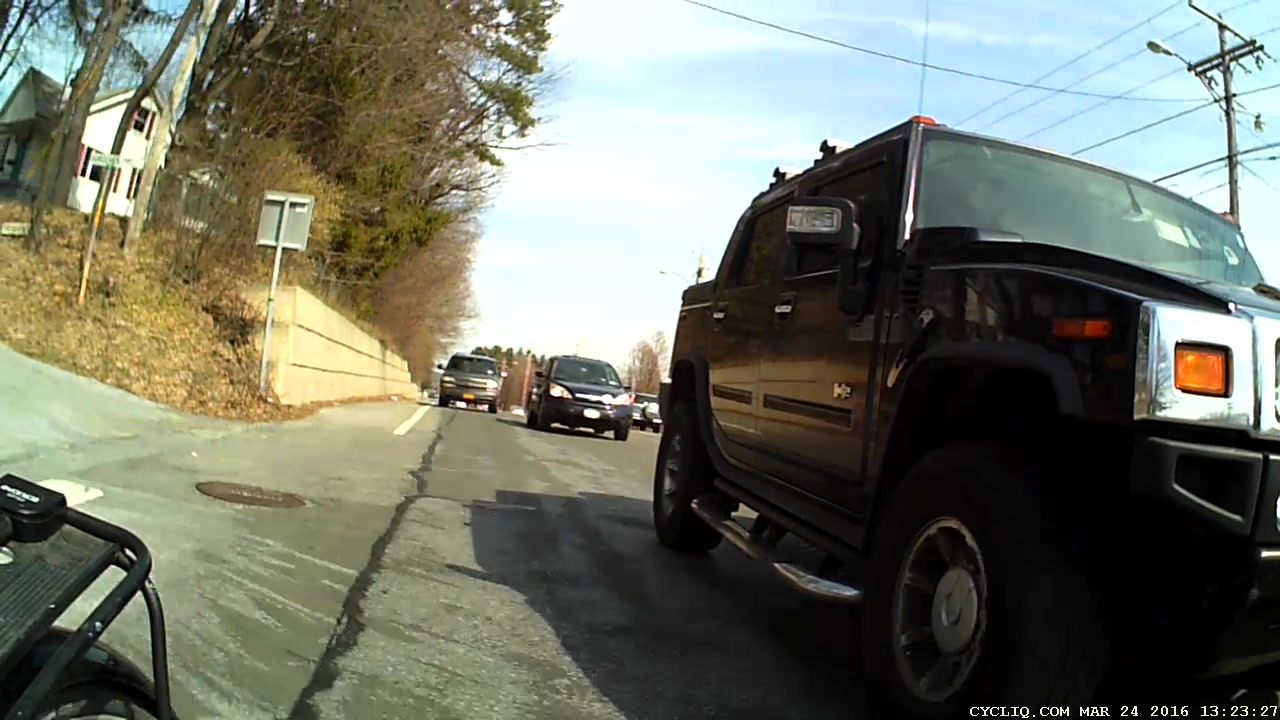
He gave us a surprising amount of clearance, given the aggressive honking:
Rt 44 at 695 – H2 Overtaking – front camera – 0186
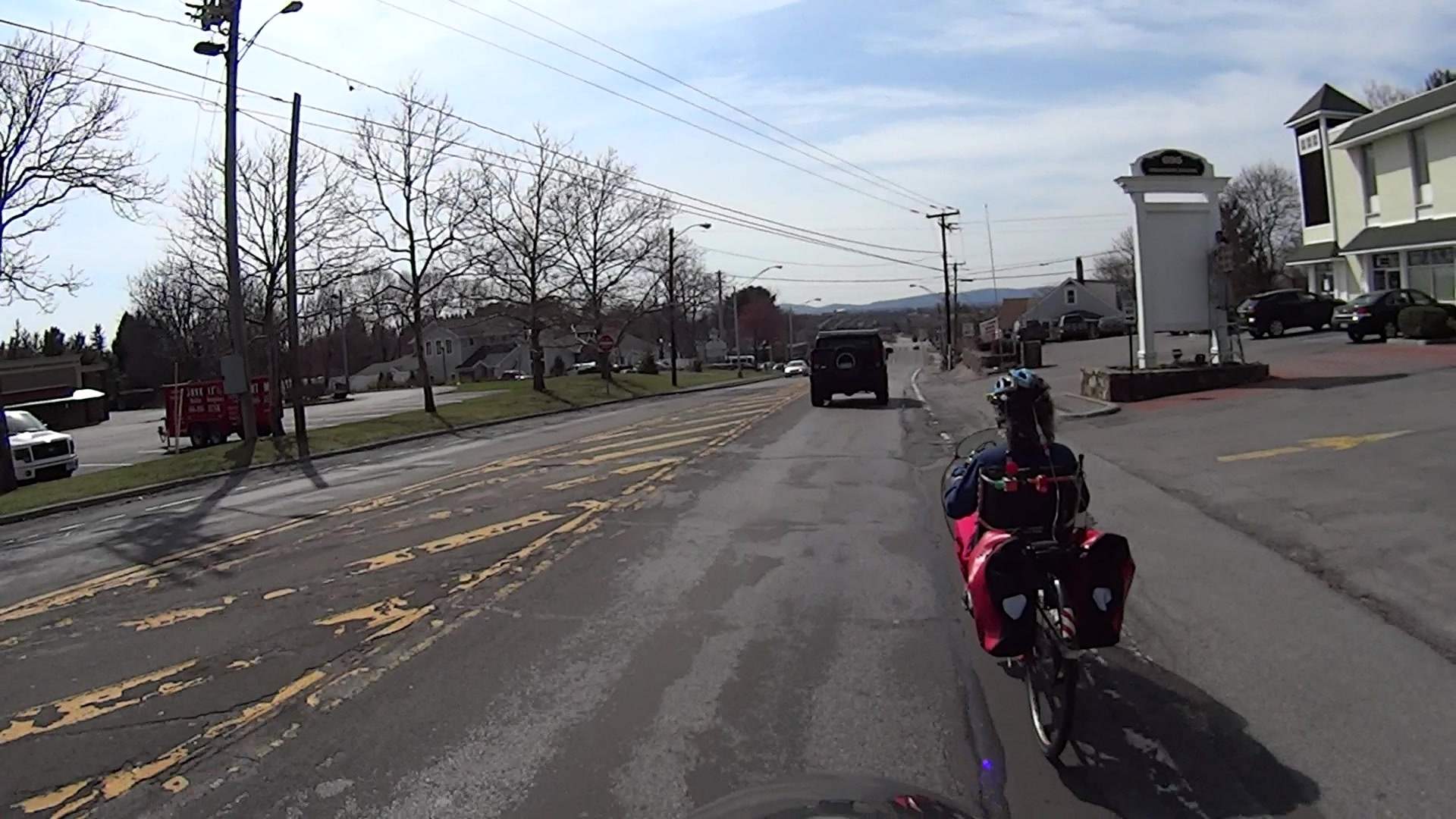
That’s one reason I ride a bit to the left of Mary’s track.
Now he can rev up and cross the double-yellow line:
Rt 44 at 695 – H2 Overtaking – rear camera – 0305
Total elapsed time from first honk to when I finished shouting out the license plate: 16 s.
At the next traffic signal and the better part of 70 s from the first honk, he turned left and we turned right, pretty much simultaneously:
Rt 44 at 695 – H2 Overtaking – rear camera – 2274
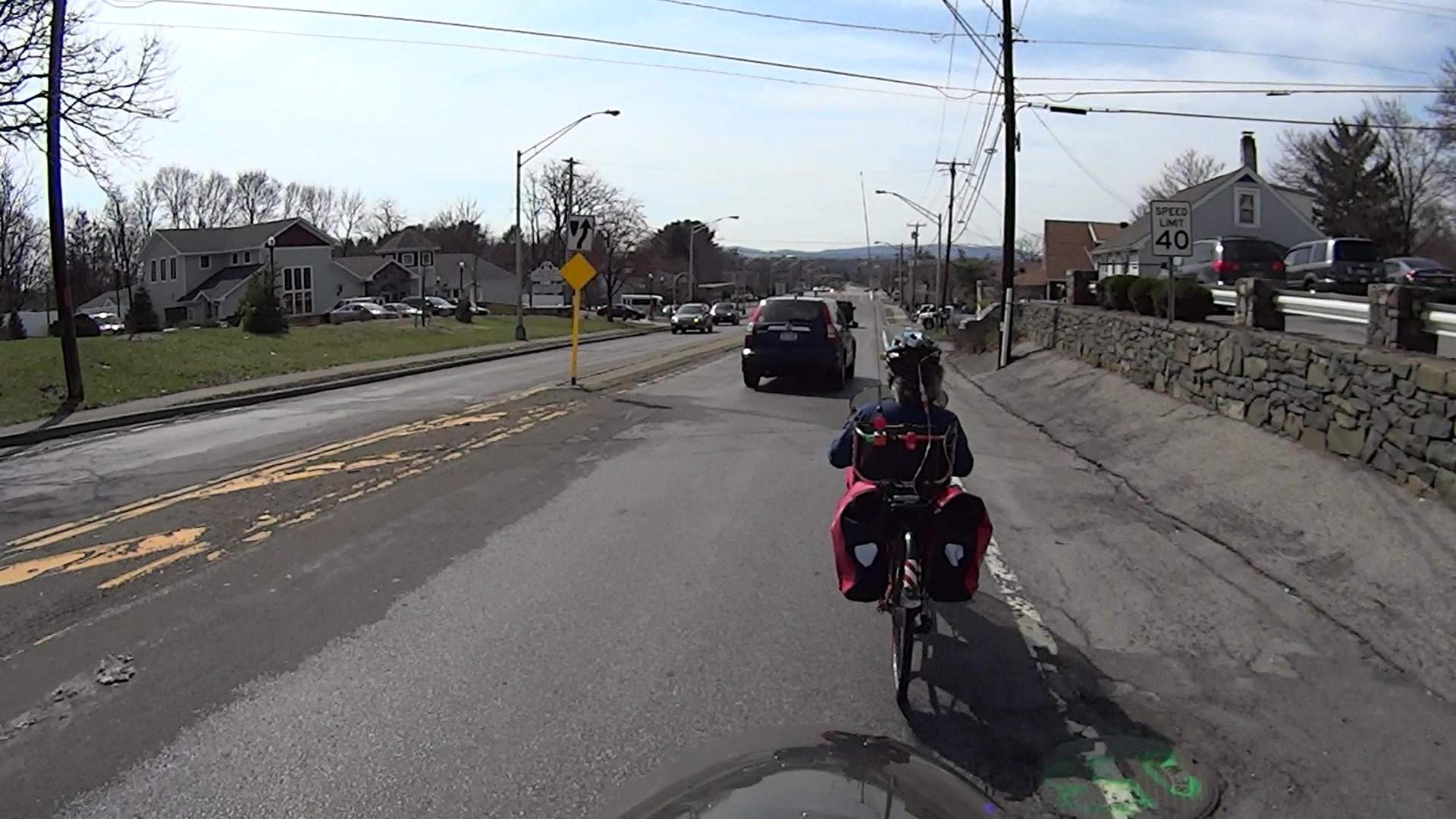
In lighter news, the green-painted manhole cover suggests some construction may be in-plan:
Rt 44 at 695 – H2 Overtaking – front camera – 0697
I’m not holding my breath for an improvement over the status quo, though.
Part of the problem may be that Hummers aren’t nearly the fashion statement they used to be; that failed Chinese deal didn’t help their image in the least.
FWIW and much to my surprise, H2s have chickenshit horns …
The library kiosk that handles paying your overdue book fines:
Fine payment kiosk with driver info
Now, you’d need to know a few things about what’s going on inside, but I’d say they’re pretty much rolling out the welcome mat for you to find those things out…
Wanna bet it’s running Windows, just like all the electronic voting machines?
On 12 July 2015, I sent a report to NYSDOT about how the traffic signals at Burnett Blvd / Rt 55 greenlighted opposing traffic when our bicycles were still in the intersection:
Can you increase the minimum green and yellow times on the signals from Burnett Blvd to Rt 55?
The current settings are too short for bicycle traffic making a left turn across six traffic lanes.
The pictures show key points from our ride on 2015-07-10, returning from the Balloon Festival in Poughkeepsie. We took the DCRT around Poughkeepsie, went through Arlington to Rt 376 at Collegeview, then took Rt 376 Red Oaks Mill.
The image sequence numbers identify frames extracted from video files. The Front camera runs at 60 fps and the Rear camera at 30 fps.
The red signals are in the process of turning off in Front 0196.
Burnett at Rt 55 Signal – Front 0196
One second later in Front 0260, the car and our bikes are starting to roll. Given the number of drivers blowing through red signals at full speed, devoting one second to watching for oncoming traffic seems prudent.
Burnett at Rt 55 Signal – Front 0260
The yellow signals are turning on in Front 0633, seven seconds after the green. The car has reached the pedestrian ladder across Rt 55, but we’re still crossing the westbound lanes of traffic. We may not be the fastest riders on the road, but we’re not the slowest, either.
Burnett at Rt 55 Signal – Front 0633
We’ve reached the far side of the intersection in Front 1142, just under 16 seconds from the green.
Burnett at Rt 55 Signal – Front 1142
However, Rear 0408 shows that the opposing signals turned green while we’re still crossing the eastbound lanes of Rt 55. That’s about 15 seconds after the Burnett Blvd signals went green.
Burnett at Rt 55 Signal – Rear 0408
About 2.7 seconds later, Rear 0490 shows cars accelerating across the intersection toward us as we cross the pedestrian ladder. They started rolling immediately after their signal went green; waiting a second isn’t a universal practice.
Burnett at Rt 55 Signal – Rear 0490
Setting the minimum Burnett green to 12 seconds, the minimum yellow to 10 seconds, and the minimum delay from Burnett green to Rt 55 green to 30 seconds would help cyclists (just barely) reach the far side of the intersection before opposing traffic starts rolling.
Also: can you adjust the sensor amplifiers on Burnett to respond to bicycles and mark the coil locations on the pavement in both lanes? That would help us through the intersection during low-traffic-volume times, as our bikes seem unable to trip the signals.
Thanks…
This reply from the NYSDOT autoresponder was all I ever got from them:
Thank you for your inquiry. We will respond to your email message as soon as possible.
On 2 August 2015, I sent a report to NYSDOT about how the traffic signals at Old Post Rd – Spring Rd at Rt 9 greenlighted opposing traffic when our bicycles were still in the intersection:
The minimum green-to-opposing-green signal timing from Old Post Road across Rt 9 to Spring road is about 18 seconds: not long enough for bicycles to safely cross an intersection with eight traffic lanes.
The “Green” picture shows our starting position as the signal turned green: behind the first car in line. There’s another car behind us, which ensures the loop sensor will trip; it does not detect bicycles.
Spring Rd – Rt 9 – 2015-08-01 – Green
The “Yellow” picture shows the signal changing after 12 seconds, with the car from behind us now in the middle of the northbound lanes. We’re still in the middle of the southbound lanes.
Spring Rd – Rt 9 – 2015-08-01 – Yellow
The “Opposing Left Green” from the rear camera, 18 seconds from the first picture, shows green left-turn arrows for Spring Road. The opposing cars began rolling with Mary lined up with the northbound right-turn lane and me lined up with the right travel lane.
Spring Rd – Rt 9 – 2015-08-01 – Opposing Left Green
The car behind blew through the red signal on Old Post Rd; I think that’s why the opposing left-turning cars didn’t start sooner.
In the other direction, I often use the left turn from Spring Rd to southbound Rt 9 to reach the South Road Square strip mall. Similarly short yellow and overall cycle times apply in that direction.
Can you add (at least!) five seconds to the yellow and perhaps ten seconds to the minimum cycle time for both directions? That would help us clear the intersection before opposing traffic starts moving again.
Can you also mark the sensor loop locations in all those lanes so cyclists can find them and adjust the amplifier sensitivity / dwell to respond to bicycles? We’ve lined up atop the quadrupole loop pavement cuts on Old Post Road to no avail, but there’s not even a hint of the loop positions under the new Spring Rd paving.
Thanks…
This reply from the NYSDOT autoresponder was all I ever got from them:
Thank you for your inquiry. We will respond to your email message as soon as possible.
On 6 January 2016, this email message arrived from the same email address that never responded to my reports (emphasis added):
Dear Mr. Nisley:
This is in response to your correspondence regarding your experiences as a bicyclist at the intersections of Route 55 at Burnett Boulevard and Route 9 at Spring Road in the Town of Poughkeepsie, Dutchess County.
The New York State Department of Transportation (NYSDOT) is in the process of investigating alternate detection types and inductance loop patterns that would detect a wider range of vehicles. As alternate detection types are tested and approved, they will be integrated into the next traffic signal upgrade at both intersections. The distance varies based on geometry. The loops are centered in each lane and the front loop is a quadrapole, so there are wires down the middle of the loops.
A new timing program was implemented at Route 9 at Spring Road in August, and the yellow and red clearance times meet the current standards. The timing at Route 55 at Burnett Boulevard is in the process of being updated, and the clearance times will be updated as necessary to meet the current standards. Clearance times are determined based on speed, intersection dimensions, grade, and reaction time and cannot be adjusted. The sensitivity on all loops will also be adjusted, so they are as sensitive as possible without causing cross talk between the loops.
We appreciate and share your interest in making our highway systems safe and functional for all users.
If you have any questions or need additional information, please feel free to contact our Regional Traffic Safety & Mobility Group at (845) 437-3396.
NYSDOT Hudson Valley Region
I don’t regard that date a coincidence; NYSDOT was not responding to my reports. I sent a further note to clarify a few points:
On 01/05/2016 02:18 PM, dot.sm.r08.nysdot wrote: Clearance times are determined based on speed,intersection dimensions, grade, and reaction time and cannot be adjusted.
That seems to mean the times can be adjusted, but you won’t adjust them to allow cyclists enough time to clear the intersection.
We appreciate and share your interest in making our highway systems safe and functional for all users.
So, giving opposing traffic a green light while we’re still in the intersection NYSDOT’s way of “making our highway systems safe and functional for all users”.
Do I understand your statements correctly?
No reply, as I’ve come to expect by now.
I think the emphasis on “meet(ing) the current standards” is how NYSDOT will attempt to defend against claims that road conditions caused or contributed to a car-on-bike collision. I find it surprising that contemporary “standards” would allow greenlighting opposing traffic against bicycles, but perhaps they simply choose a standard that excludes bicycles.














 The Smell of Molten Projects in the Morning