Ed Nisley's Blog: Shop notes, electronics, firmware, machinery, 3D printing, laser cuttery, and curiosities. Contents: 100% human thinking, 0% AI slop.
On 12 July 2015, I sent a report to NYSDOT about how the traffic signals at Burnett Blvd / Rt 55 greenlighted opposing traffic when our bicycles were still in the intersection:
Can you increase the minimum green and yellow times on the signals from Burnett Blvd to Rt 55?
The current settings are too short for bicycle traffic making a left turn across six traffic lanes.
The pictures show key points from our ride on 2015-07-10, returning from the Balloon Festival in Poughkeepsie. We took the DCRT around Poughkeepsie, went through Arlington to Rt 376 at Collegeview, then took Rt 376 Red Oaks Mill.
The image sequence numbers identify frames extracted from video files. The Front camera runs at 60 fps and the Rear camera at 30 fps.
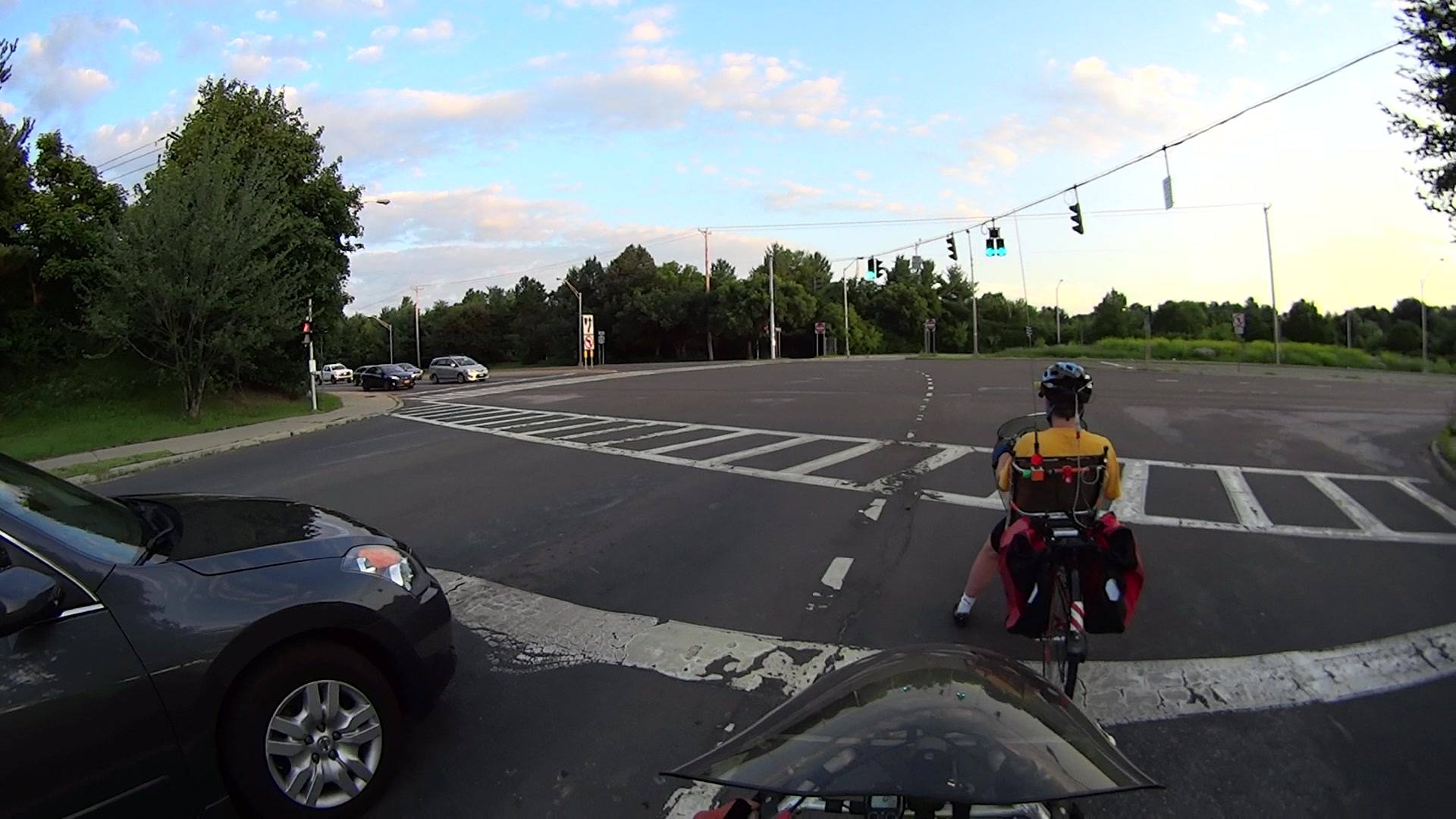
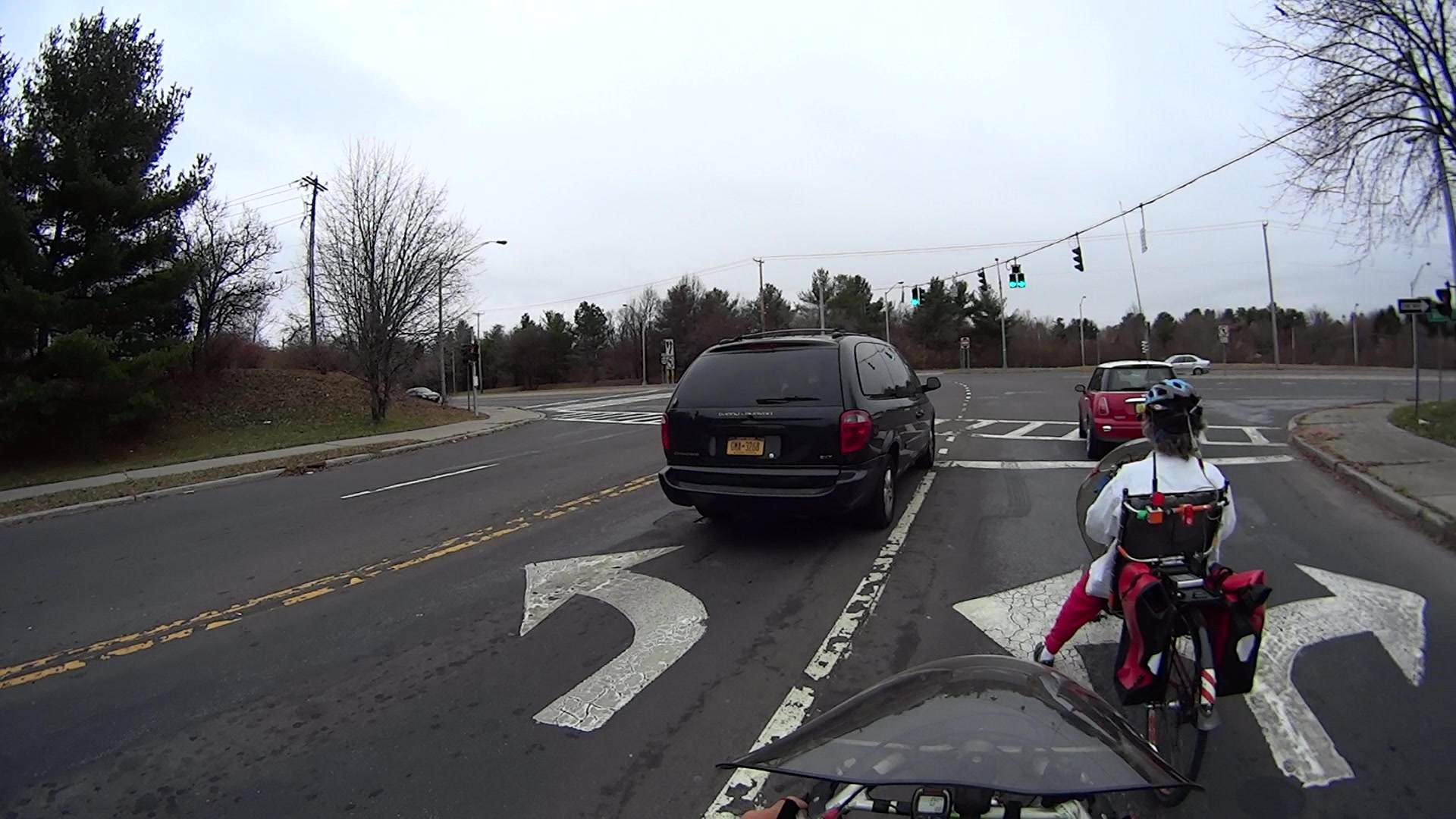
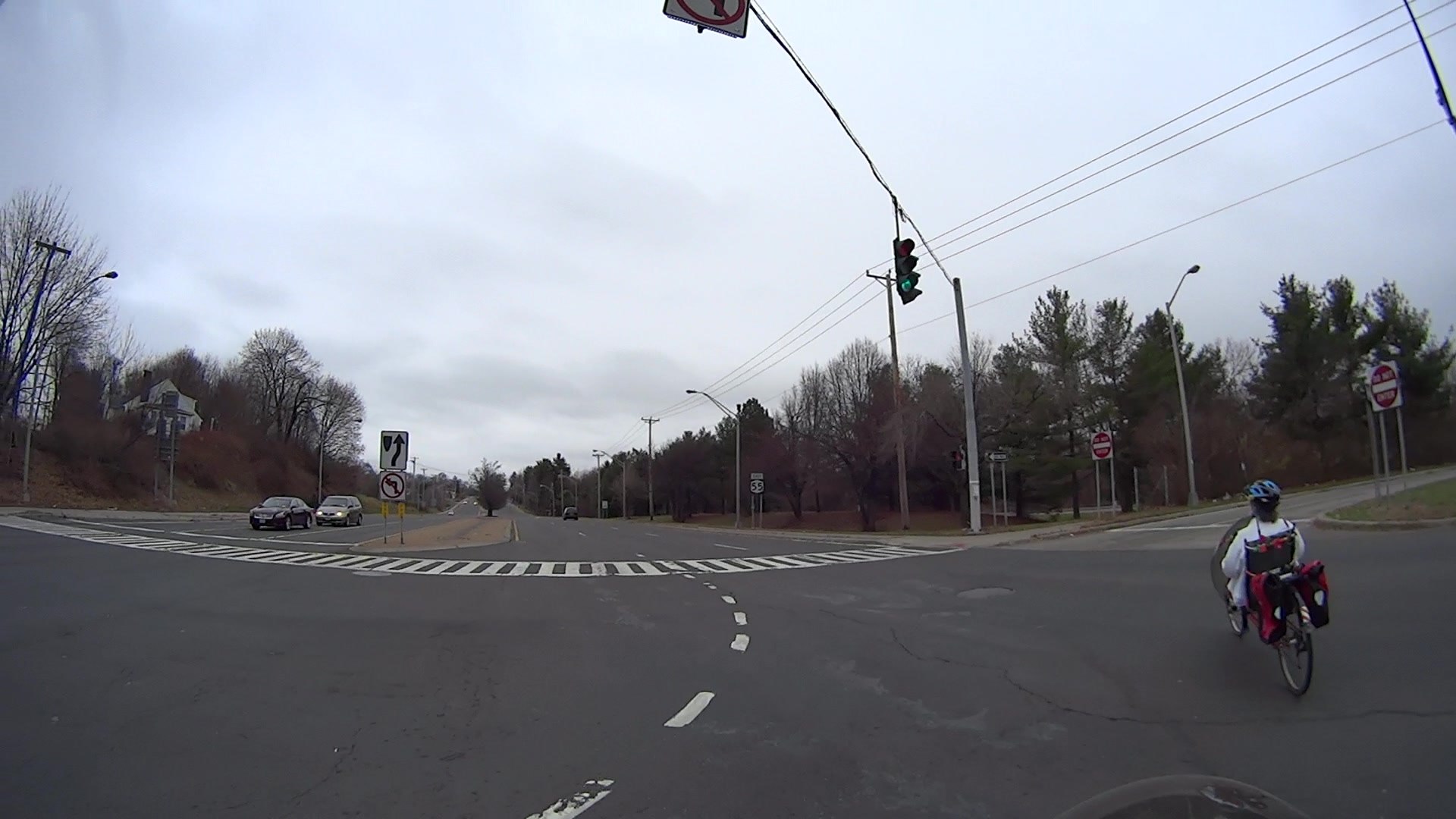
The red signals are in the process of turning off in Front 0196.
Burnett at Rt 55 Signal – Front 0196
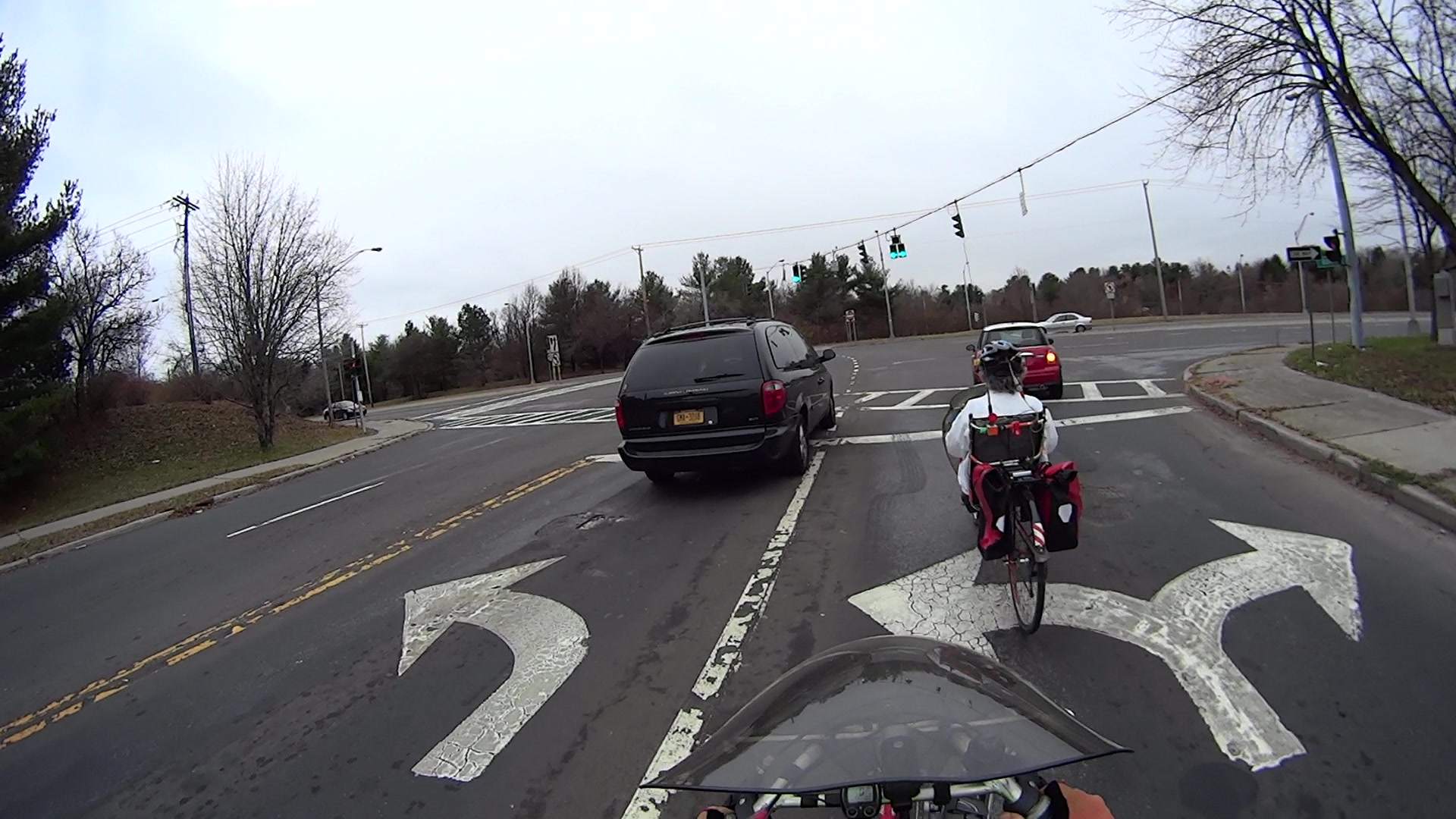
One second later in Front 0260, the car and our bikes are starting to roll. Given the number of drivers blowing through red signals at full speed, devoting one second to watching for oncoming traffic seems prudent.
Burnett at Rt 55 Signal – Front 0260
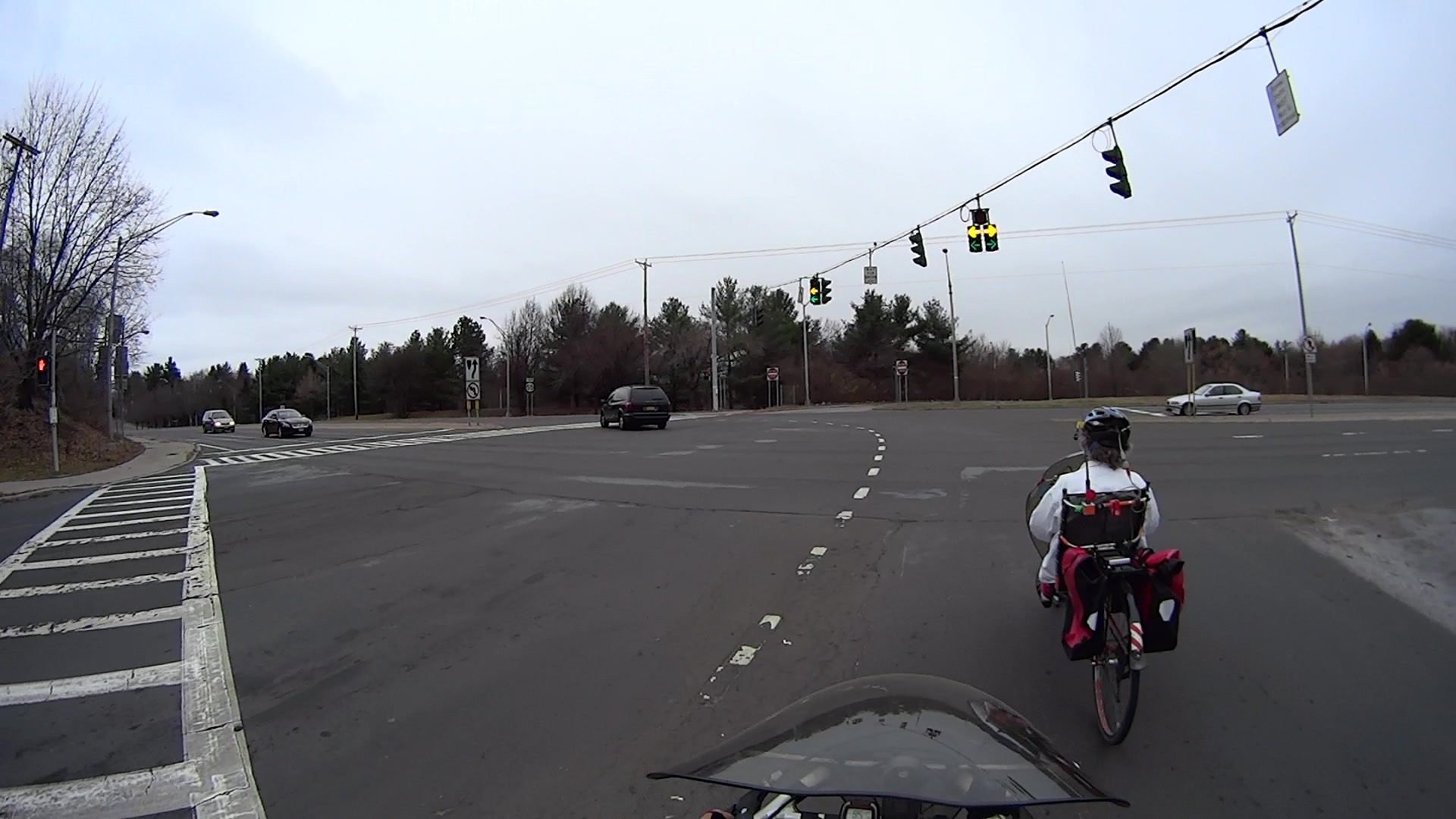
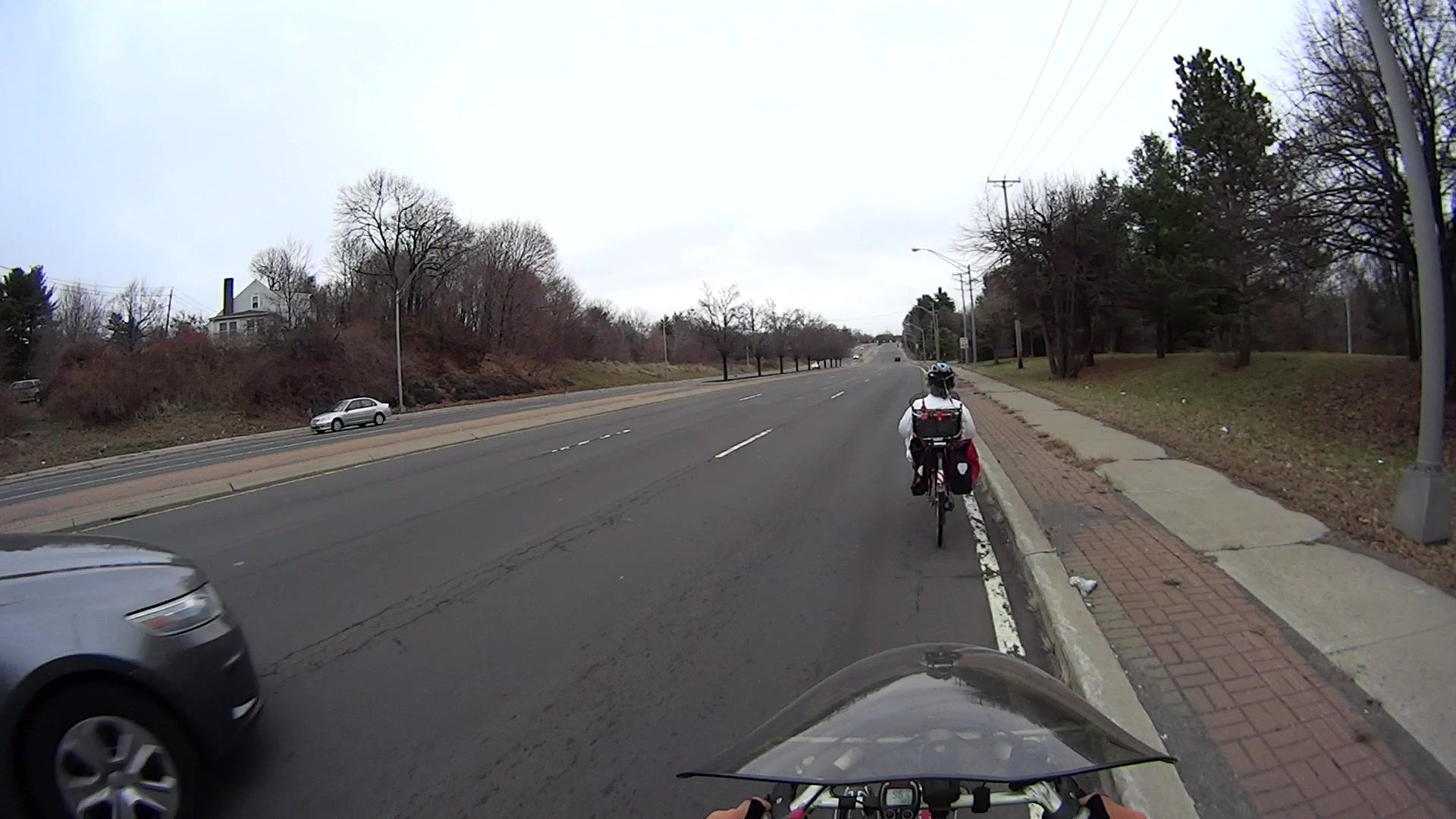
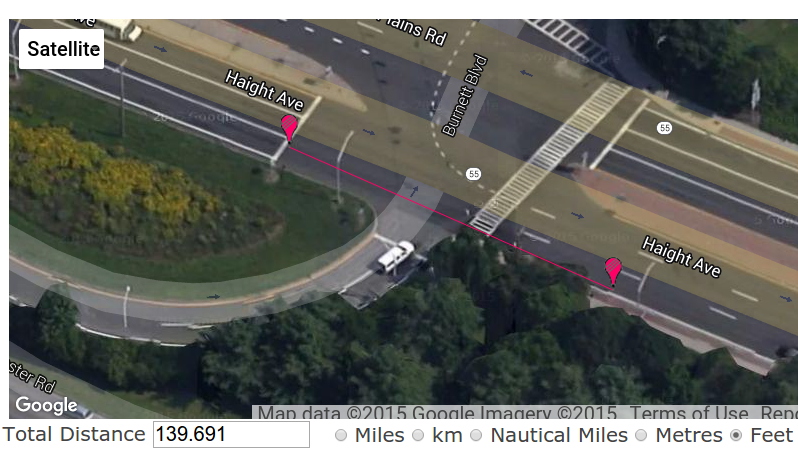
The yellow signals are turning on in Front 0633, seven seconds after the green. The car has reached the pedestrian ladder across Rt 55, but we’re still crossing the westbound lanes of traffic. We may not be the fastest riders on the road, but we’re not the slowest, either.
Burnett at Rt 55 Signal – Front 0633
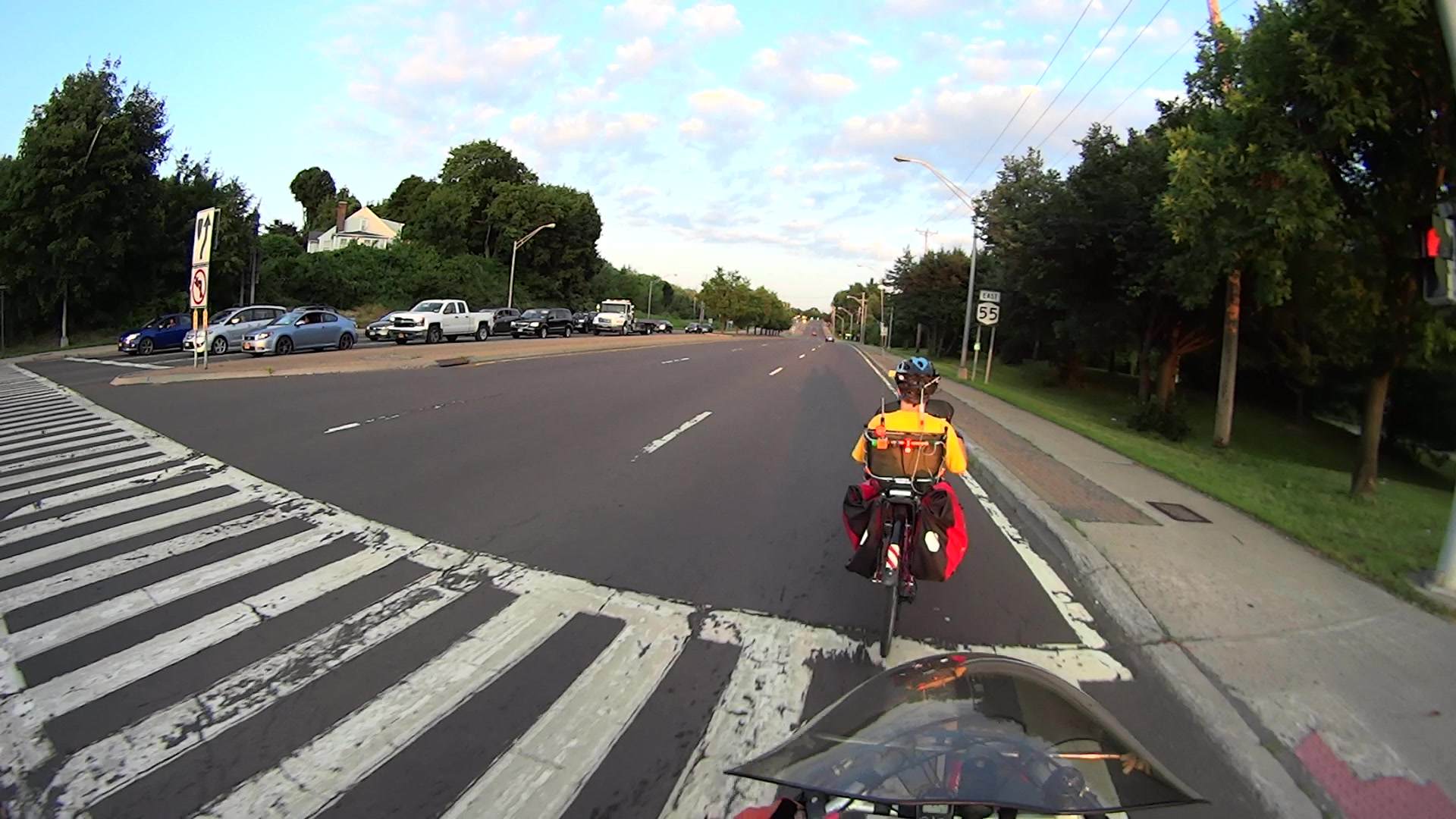
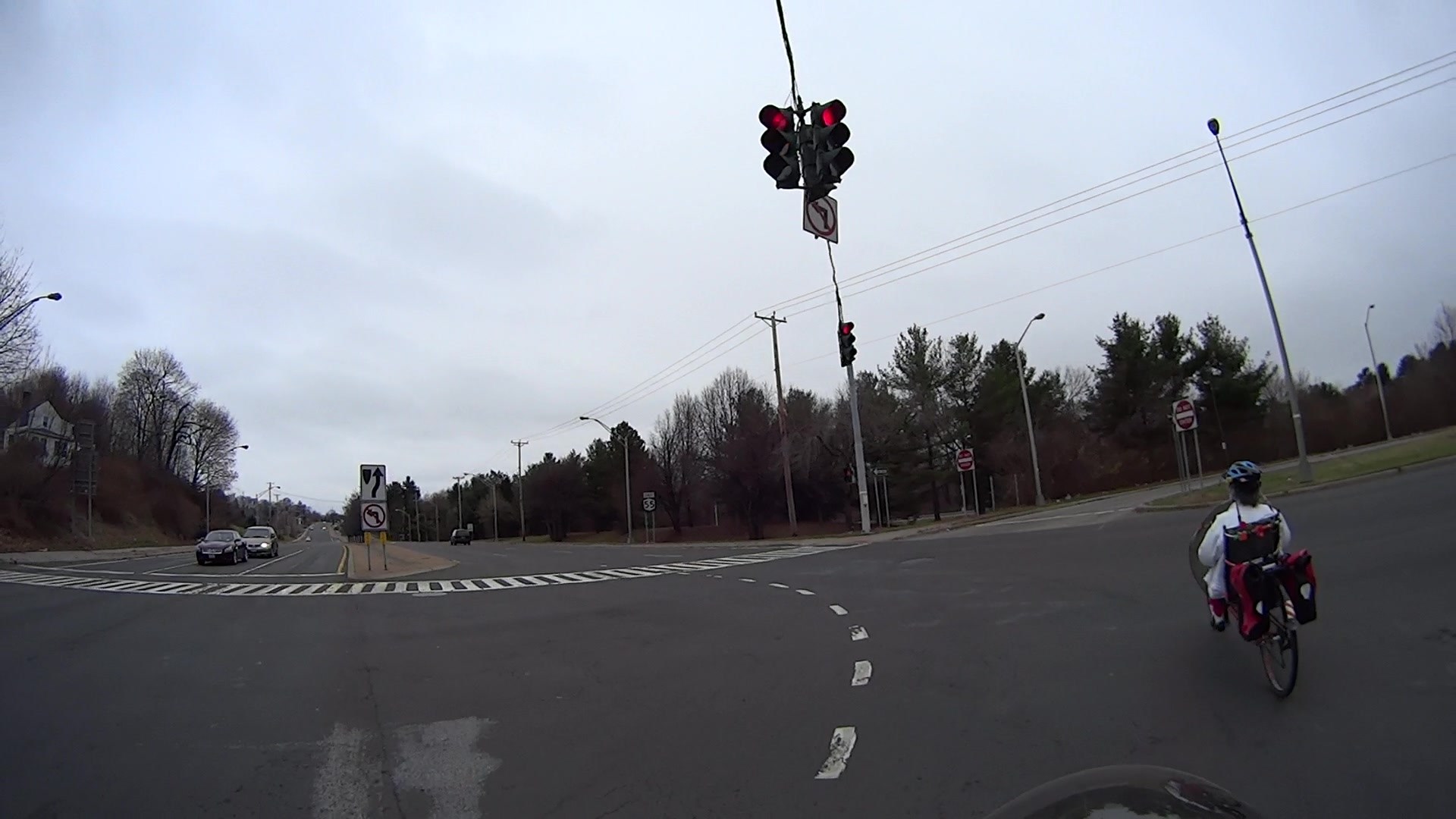
We’ve reached the far side of the intersection in Front 1142, just under 16 seconds from the green.
Burnett at Rt 55 Signal – Front 1142
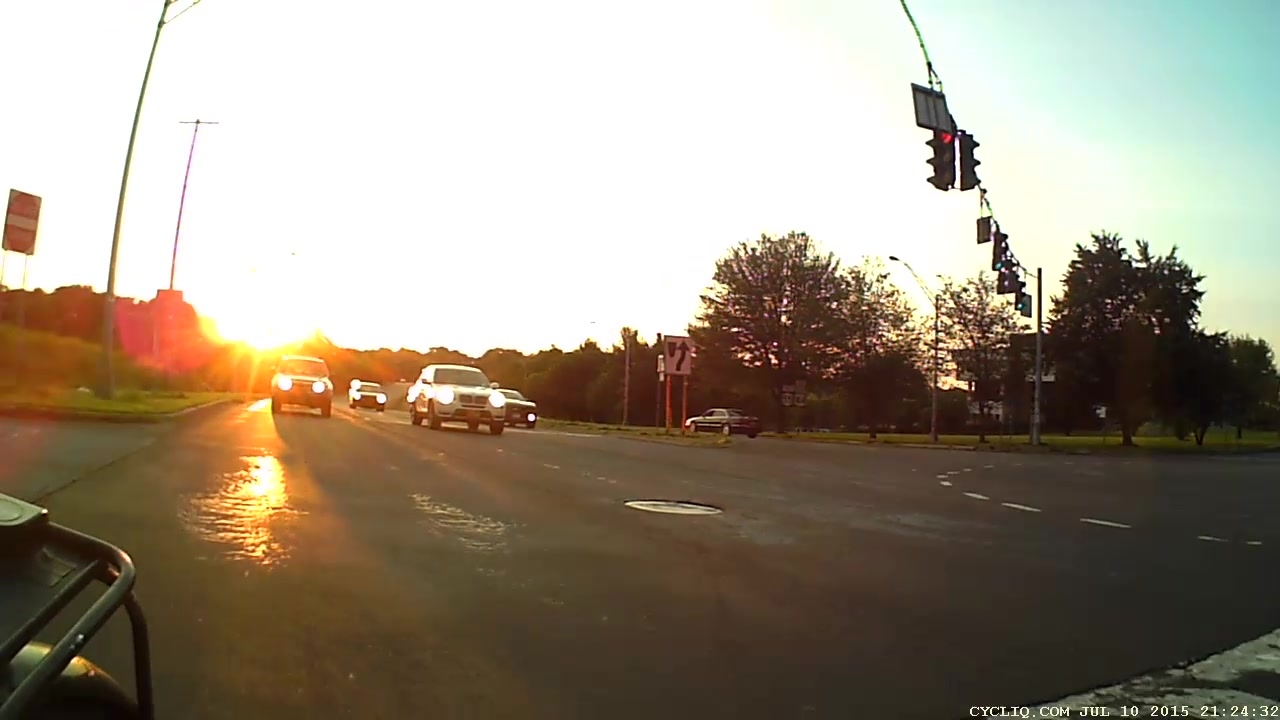
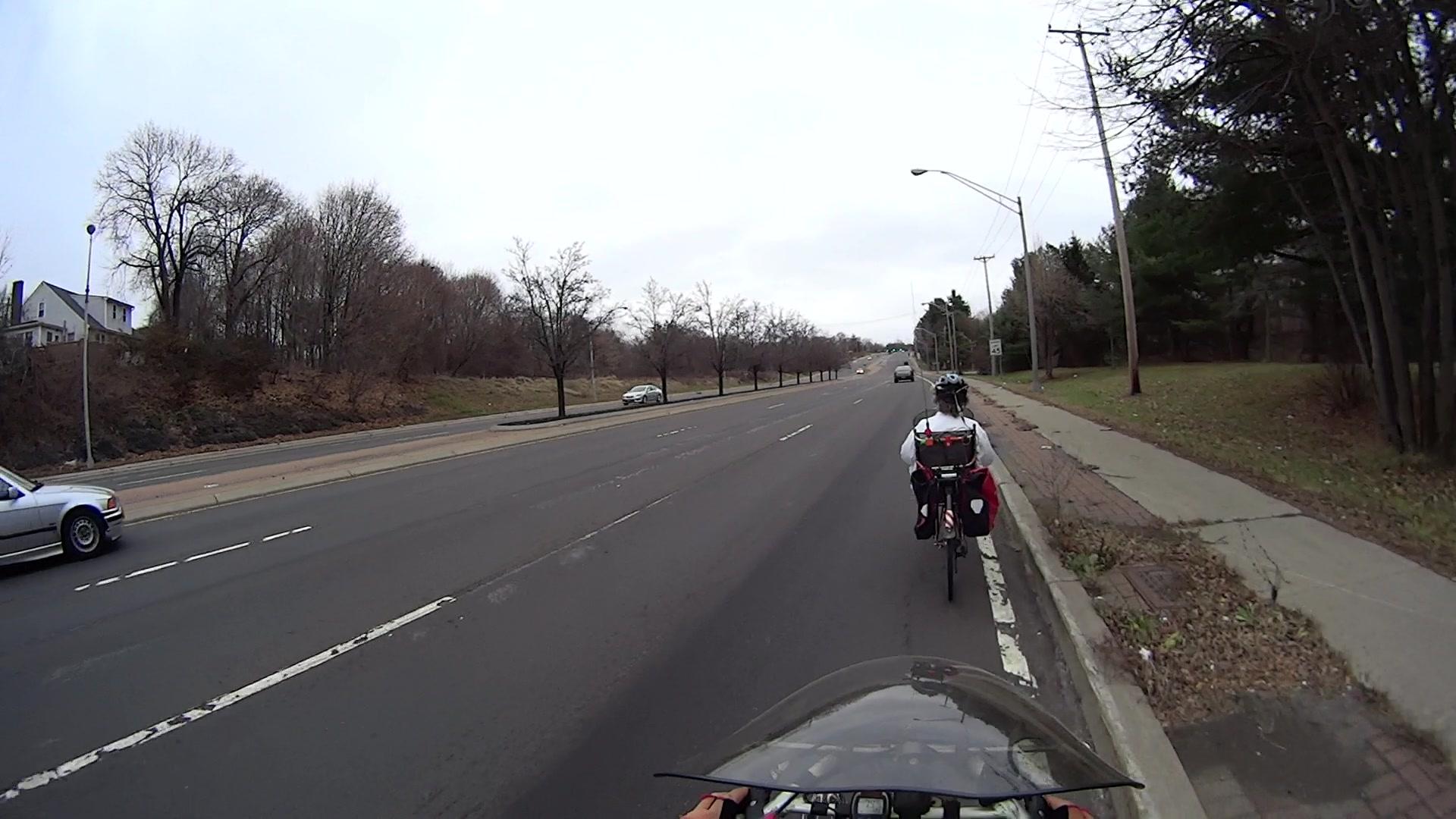
However, Rear 0408 shows that the opposing signals turned green while we’re still crossing the eastbound lanes of Rt 55. That’s about 15 seconds after the Burnett Blvd signals went green.
Burnett at Rt 55 Signal – Rear 0408
About 2.7 seconds later, Rear 0490 shows cars accelerating across the intersection toward us as we cross the pedestrian ladder. They started rolling immediately after their signal went green; waiting a second isn’t a universal practice.
Burnett at Rt 55 Signal – Rear 0490
Setting the minimum Burnett green to 12 seconds, the minimum yellow to 10 seconds, and the minimum delay from Burnett green to Rt 55 green to 30 seconds would help cyclists (just barely) reach the far side of the intersection before opposing traffic starts rolling.
Also: can you adjust the sensor amplifiers on Burnett to respond to bicycles and mark the coil locations on the pavement in both lanes? That would help us through the intersection during low-traffic-volume times, as our bikes seem unable to trip the signals.
Thanks…
This reply from the NYSDOT autoresponder was all I ever got from them:
Thank you for your inquiry. We will respond to your email message as soon as possible.
On 2 August 2015, I sent a report to NYSDOT about how the traffic signals at Old Post Rd – Spring Rd at Rt 9 greenlighted opposing traffic when our bicycles were still in the intersection:
The minimum green-to-opposing-green signal timing from Old Post Road across Rt 9 to Spring road is about 18 seconds: not long enough for bicycles to safely cross an intersection with eight traffic lanes.
The “Green” picture shows our starting position as the signal turned green: behind the first car in line. There’s another car behind us, which ensures the loop sensor will trip; it does not detect bicycles.
Spring Rd – Rt 9 – 2015-08-01 – Green
The “Yellow” picture shows the signal changing after 12 seconds, with the car from behind us now in the middle of the northbound lanes. We’re still in the middle of the southbound lanes.
Spring Rd – Rt 9 – 2015-08-01 – Yellow
The “Opposing Left Green” from the rear camera, 18 seconds from the first picture, shows green left-turn arrows for Spring Road. The opposing cars began rolling with Mary lined up with the northbound right-turn lane and me lined up with the right travel lane.
Spring Rd – Rt 9 – 2015-08-01 – Opposing Left Green
The car behind blew through the red signal on Old Post Rd; I think that’s why the opposing left-turning cars didn’t start sooner.
In the other direction, I often use the left turn from Spring Rd to southbound Rt 9 to reach the South Road Square strip mall. Similarly short yellow and overall cycle times apply in that direction.
Can you add (at least!) five seconds to the yellow and perhaps ten seconds to the minimum cycle time for both directions? That would help us clear the intersection before opposing traffic starts moving again.
Can you also mark the sensor loop locations in all those lanes so cyclists can find them and adjust the amplifier sensitivity / dwell to respond to bicycles? We’ve lined up atop the quadrupole loop pavement cuts on Old Post Road to no avail, but there’s not even a hint of the loop positions under the new Spring Rd paving.
Thanks…
This reply from the NYSDOT autoresponder was all I ever got from them:
Thank you for your inquiry. We will respond to your email message as soon as possible.
On 6 January 2016, this email message arrived from the same email address that never responded to my reports (emphasis added):
Dear Mr. Nisley:
This is in response to your correspondence regarding your experiences as a bicyclist at the intersections of Route 55 at Burnett Boulevard and Route 9 at Spring Road in the Town of Poughkeepsie, Dutchess County.
The New York State Department of Transportation (NYSDOT) is in the process of investigating alternate detection types and inductance loop patterns that would detect a wider range of vehicles. As alternate detection types are tested and approved, they will be integrated into the next traffic signal upgrade at both intersections. The distance varies based on geometry. The loops are centered in each lane and the front loop is a quadrapole, so there are wires down the middle of the loops.
A new timing program was implemented at Route 9 at Spring Road in August, and the yellow and red clearance times meet the current standards. The timing at Route 55 at Burnett Boulevard is in the process of being updated, and the clearance times will be updated as necessary to meet the current standards. Clearance times are determined based on speed, intersection dimensions, grade, and reaction time and cannot be adjusted. The sensitivity on all loops will also be adjusted, so they are as sensitive as possible without causing cross talk between the loops.
We appreciate and share your interest in making our highway systems safe and functional for all users.
If you have any questions or need additional information, please feel free to contact our Regional Traffic Safety & Mobility Group at (845) 437-3396.
NYSDOT Hudson Valley Region
I don’t regard that date a coincidence; NYSDOT was not responding to my reports. I sent a further note to clarify a few points:
On 01/05/2016 02:18 PM, dot.sm.r08.nysdot wrote: Clearance times are determined based on speed,intersection dimensions, grade, and reaction time and cannot be adjusted.
That seems to mean the times can be adjusted, but you won’t adjust them to allow cyclists enough time to clear the intersection.
We appreciate and share your interest in making our highway systems safe and functional for all users.
So, giving opposing traffic a green light while we’re still in the intersection NYSDOT’s way of “making our highway systems safe and functional for all users”.
Do I understand your statements correctly?
No reply, as I’ve come to expect by now.
I think the emphasis on “meet(ing) the current standards” is how NYSDOT will attempt to defend against claims that road conditions caused or contributed to a car-on-bike collision. I find it surprising that contemporary “standards” would allow greenlighting opposing traffic against bicycles, but perhaps they simply choose a standard that excludes bicycles.
We ride through the intersection at the Rt 55 end of Burnett Blvd a lot, because it’s the only route between Raymond Avenue and the Dutchess Rail Trail. Previous posts have documented the signal timing, but this sequence shows the situation we’ve feared from the beginning… cross traffic not stopping because we are in the intersection with an opposing green light.
The sequence numbers indicate the frame at 60 f/s.
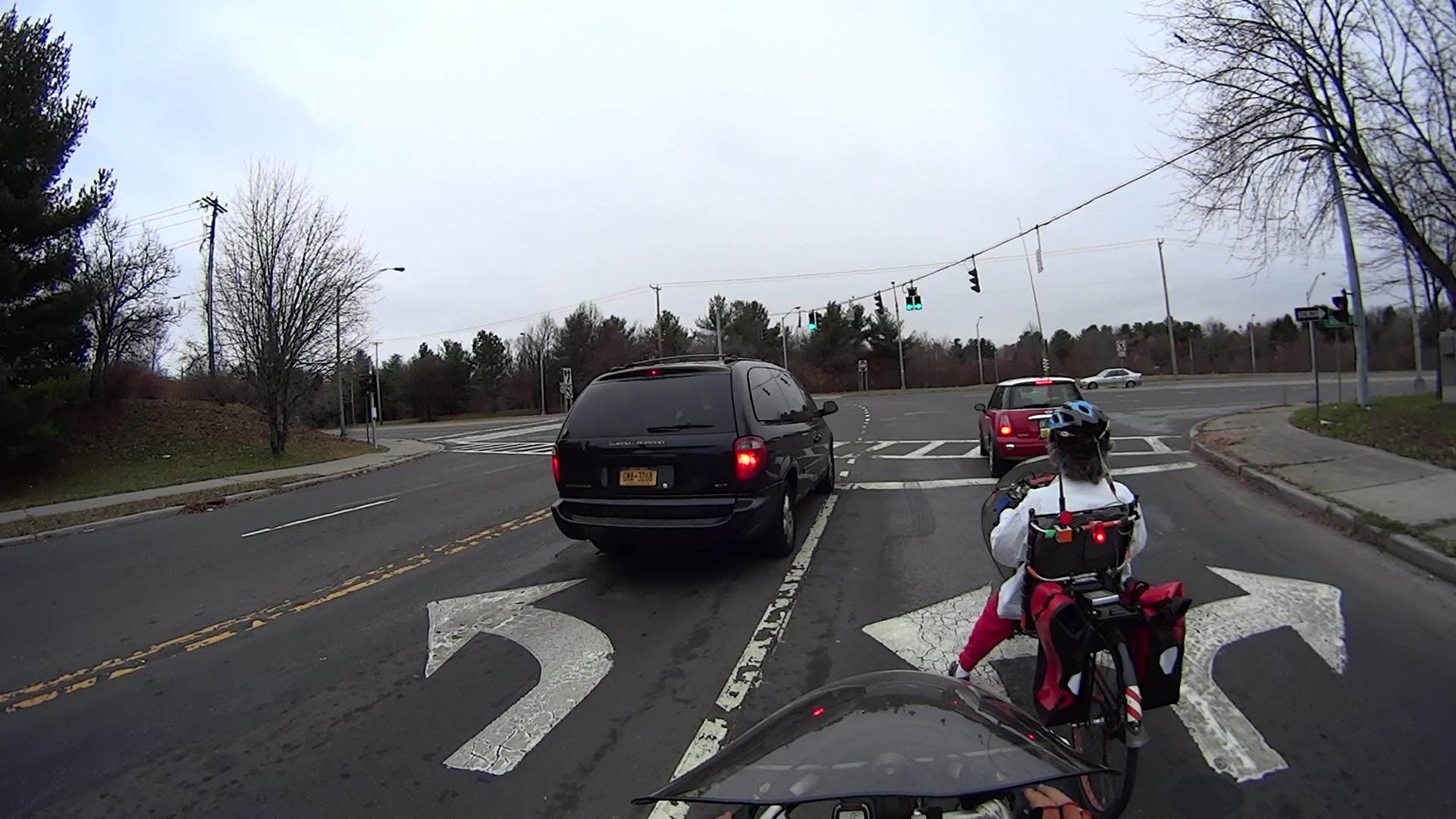
T +0.000 = our signal just turned green:
Burnett at Rt 55 2015-12-14 – 0096 – Green
T +1.250 s = the drivers ahead of us release their brakes and begin rolling:
Burnett at Rt 55 2015-12-14 – 0171 – Green start
T +2.400 s = we begin rolling:
Burnett at Rt 55 2015-12-14 – 0240 – Green rolling
It’s worth noting that we cannot start any earlier, unless you regard jumping the green and passing cars at an intersection as Good Practices, which we don’t.
T +7.217 s = the yellow signal goes on in our direction:
Burnett at Rt 55 2015-12-14 – 0529 – Yellow
That’s six whole seconds from the time the cars started rolling and 4.8 s from the time we started.
Notice the white car to our right that’s stopped in the leftmost eastbound lane of Rt 55.
T +12.100 s = our signal turns red:
Burnett at Rt 55 2015-12-14 – 0822 – Red
I’ve reached the middle of the intersection, Mary’s about centered on the three eastbound lanes of Rt 55.
T +13.333 s = the opposing signal turns green:
Burnett at Rt 55 2015-12-14 – 0895 – Opp Green
Traffic in both directions of Rt 55 can now begin moving, but the white car remains stopped; it’s almost directly behind me in the leftmost lane. Because Mary is following the curved line guide lines, she’s just entering the rightmost lane. What you can’t see is a black car approaching from behind her that didn’t have to stop.
T +20.950 s = the car in the right lane that didn’t have to stop passes me:
At 40 mph = 60 ft/s, that car passed the stop line 2.3 s earlier, at T +18.7 s, when I was still crossing the right lane.
It’s entirely likely that the driver didn’t see either of us while approaching the intersection, because he (let’s assume a he for the sake of discussion) had a green light nearly 5 s = 300 ft before reaching the stop line. Unless he’s paying more attention than most drivers, he was intent on the signal to judge whether he must slow down; for the last 7.3 s he’s known that the intersection is clear, because nobody else should be in the intersection against his green signal.
T +24.667 s = The white car in the left lane passes Mary:
Burnett at Rt 55 2015-12-14 – 1576 – Second car
All I’m asking NYSDOT to do is lengthen the signal timing so we’re not caught in the middle of the intersection by opposing traffic with a green signal. Adding a few seconds onto the yellow and minimum cycle time doesn’t seem unreasonable, but it’s been six months since I reported the problem with no action; I’ve pinged their Bicycle & Pedestrian coordinator several times with no response.
If their engineers are “studying” the situation, it’s not producing any visible results; they haven’t asked me for any additional data.
I Am Not A Lawyer, but I think my collection of photos should provide sufficient evidence to convince a jury that NYSDOT is totally liable for any bicycling injuries at that intersection, based on the inability of cyclists to meet the signal timing. I really don’t want to find out if I’m right…
Burnett at Rt 55 2015-11-08 – Yellow 5 s after green
Apparently, NYSDOT’s bicycle safety criteria allow greenlighting opposing vehicles onto bicyclists in the middle of intersections, so there’s no particular urgency to fix this non-problem.
They’ve been “studying” that situation, without contacting me for any further information, since July, so you can decide how much they’ve accomplished thus far. I know NYSDOT employees get offended when you call them liars to their face, but they have never, ever produced any evidence showing that I’m wrong.
It took a while, but the owners of Janet Drive did a commendable job of resurfacing the giant potholes that were consuming the parking lot entrance:
Janet Dr at 708 Dutchess Turnpike entrance – 2015-10-05
That patch covers all the holes, has a smooth surface, and neatly joins the adjacent pavement without huge bumps. It’s entirely possible to do good repairs, if you just hire the right contractor.
Which doesn’t happen if you’re NYSDOT, unfortunately, as they regards a few random hand-tamped blobs on a section of Rt 44 (and Bike Rt 44, for whatever that’s worth) as entirely adequate:
Rt 44 – 695 at Quest Diagnostics – 2015-10-05 – no progress
The sinkhole on Rt 376 that we must dodge maybe four times every week continues to grow:
Somebody who should know better suggested the NYSDOT crew just ran out of asphalt after patching all around the sinkhole that I’d reported back in July, but …
The NYSDOT Bicycle and Pedestrian Coordinator (yeah, she exists) assured me the engineers were studying the signal timing and would contact me directly:
Burnett at Rt 55 2015-08-31 – Yellow 8 s after green with cars
That hasn’t happened after four months, so I’d say NYSDOT uses the word “study” to mean “stonewall”.
It doesn’t have my patter, but you’ve already seen most of the pictures and stories here, tagged Tax Dollars Asleep and can probably fill in the blanks.
To quote from the PDCTC Master Plan linked above:
The Plan establishes the following vision: In Dutchess County, walking and bicycling will be part of daily life, providing safe and convenient transportation and recreation.
Chekkitout:
Rt 376 SB 2015-08-25 – North of Maloney – 2Spring Rd 2015-08-01 – EB – grate rear view
Mary says it was one of my more impassioned presentations…
You cannot register or operate any of the motorized devices from the list below on any street, highway, parking lot, sidewalk or other area in New York State that allows public motor vehicle traffic. You may be arrested if you do.
[List of things]
Golf Cart (also referred to as Golf Car or Neighborhood Electric Vehicle) – a small motorized device with four wheels designed to carry people. You can’t register a golf cart as an ATV. Many low speed vehicles are similar in appearance to a golf cart, and can be registered and driven on New York State highways. 1
[More things]
1. For a low speed vehicle to be registered in New York
it must meet federal motor vehicle safety standard 500 (49 CFR 571.500)
its maximum performance speed must be certified by the manufacturer
it must appear on the list of approved limited use vehicles
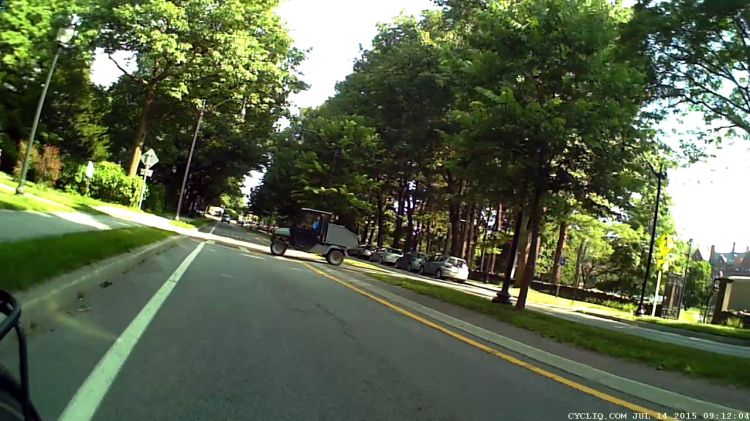
With that in mind, here’s a fairly common sight along Raymond Avenue…
Raymond Avenue 2015-07-14 – Vassar Golf Cart – approach
Raymond Avenue 2015-07-14 – Vassar Golf Cart – front
Raymond Avenue 2015-07-14 – Vassar Golf Cart – crossing
Vassar College regards as Raymond as its private driveway, with its fleet of golf-cart-class and tiny-pickup vehicles traveling the web of sidewalks and pedestrian crossings on and off campus. In point of fact, Vassar does own all of the property on both sides of Raymond from Hooker to Collegeview, but Raymond itself unquestionably has “public motor vehicle traffic”.
Vassar’s Annual Sidewalk Sodding Week occurs shortly before their graduation / alumnae homecoming ceremonies. The sidewalks and paths obviously weren’t designed for shared vehicular & pedestrian use, so the cart tires gouge unsightly ruts along the pavement edges; the sod prevents those muddy strips from marring the festivities.
The concrete sidewalks along Raymond take a beating from the vehicles, too, but the overall concrete quality (or lack thereof) may have something to do with that.
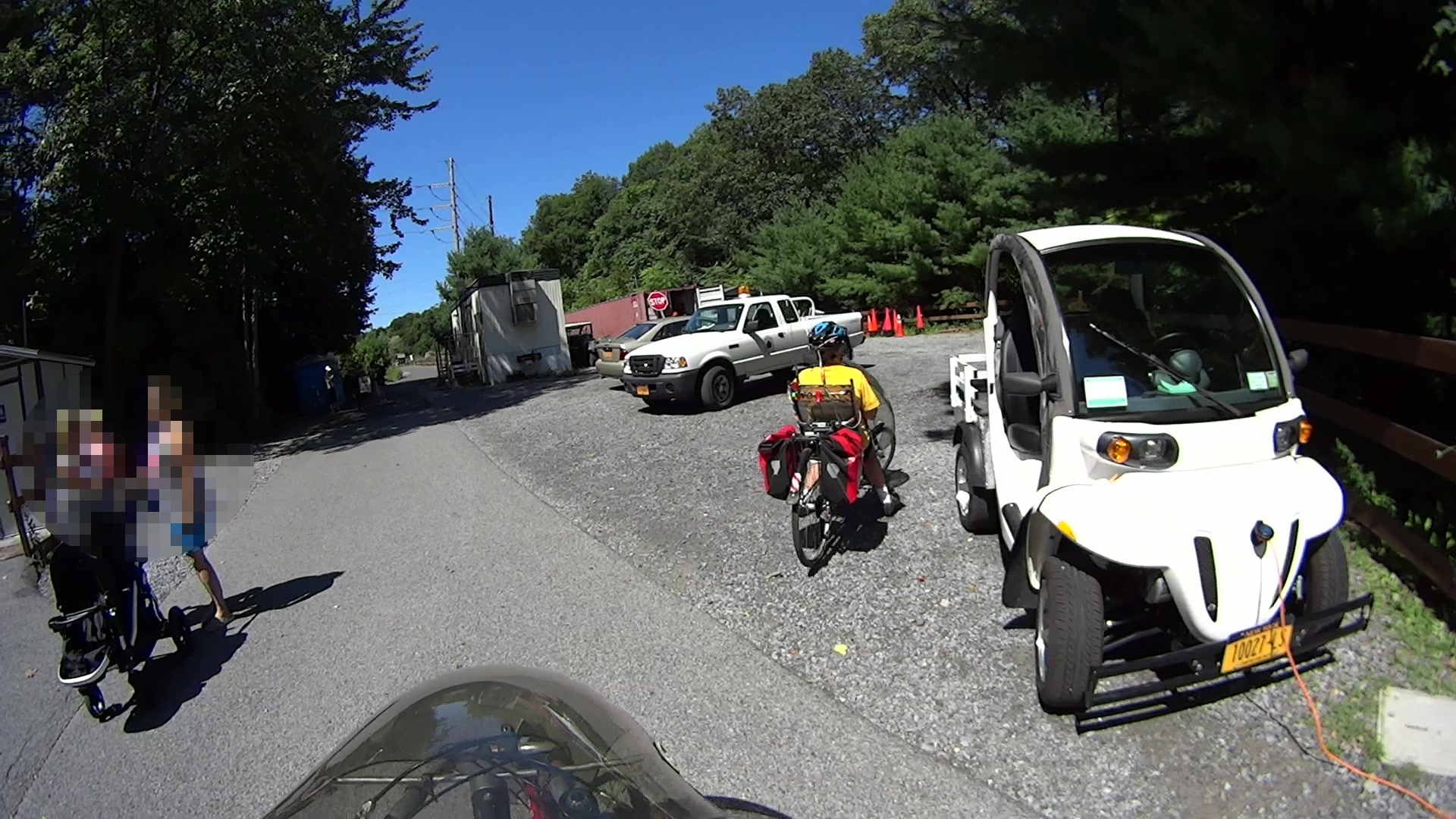
This spiffy tiny-pickup golf cart used by the NYS OPRHP sports a Limited Use Auto plate: