Ed Nisley's Blog: Shop notes, electronics, firmware, machinery, 3D printing, laser cuttery, and curiosities. Contents: 100% human thinking, 0% AI slop.
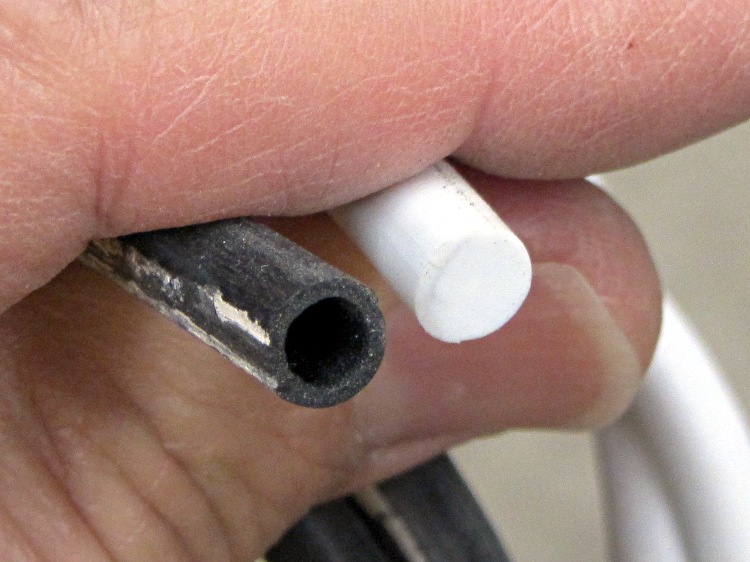
While doing something else, I rediscovered the fact that common 5 gallon plastic bucket lids have an O-ring gasket that seals against the top of the bucket. Some seals are hollow tubes, some are solid rods:
5 gallon can lid gaskets
The white O-ring has about the right consistency to serve as a quilting pin cap, along the lines of those 3D printed and silicone rubber filled cylinders. Although the rubber / plastic stuff isn’t quite as squishy as silicone snot, it holds the pin point firmly without much of a push.
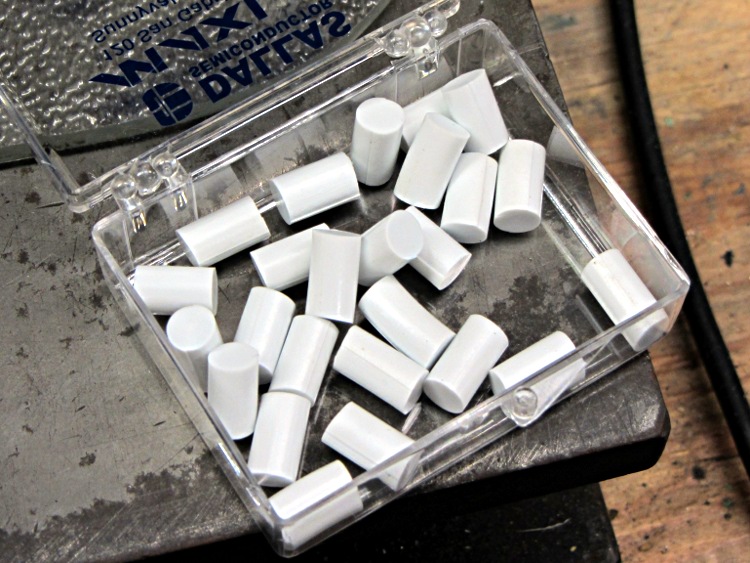
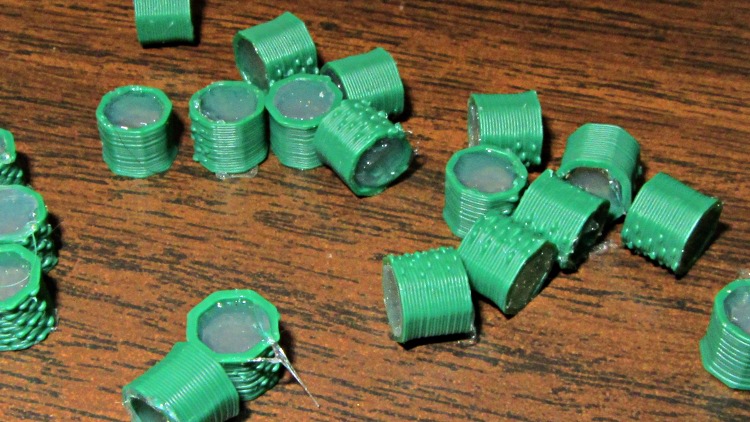
Chopping the O-ring into 10 mm sections produced another small box of prototypes:
Lid gaskets as pin caps
Garden planting season remains in full effect, shoving all quilting projects to the back burner and delaying the evaluation phase of the project…
Mary has been quilting up a storm lately and is growing dissatisfied with the special safety pins she’s been using to hold the layers together. Long straight pins are ideal, except that maneuvering a large quilt through her sewing machine resembles stuffing a porcupine into a keyhole. A commercial solution costs nearly half a buck per pin, which seems unreasonably spendy for something you need by the hundreds.
We kicked around some finger- and quilt-friendly dimensions and I cobbled up a solid model:
Quilting Pin Cap
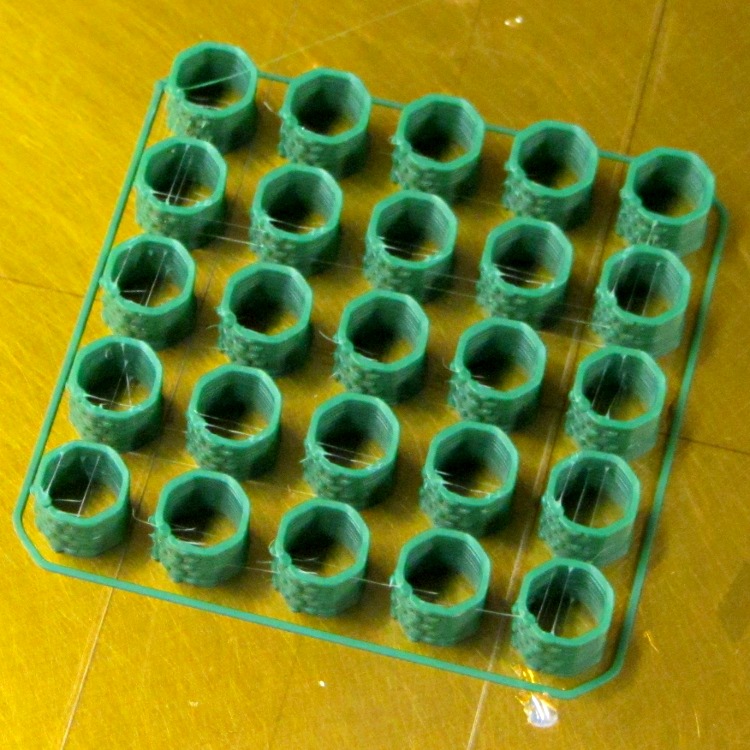
Which turned into an array of small octagons that won’t roll off the table:
Pin cap array on build platform
We figured 25 would be enough to decide if this is workable and whether the dimensions fit fingers, pins, and quilts.
Filling them with silicone rubber required one squirt each:
Filling pin caps with silicone
The trick with the silicone rubber is to cut the snout so it fits flat on the cylinder top. Put the cylinders on a piece of non-stick paper (I used the back of the carrier for some double-sided tape, but wax paper would be better), hold one with tweezers, squirt in enough rubber to fill the cylinder solidly from bottom to top, then slide the snout sideways to smooth the surface.
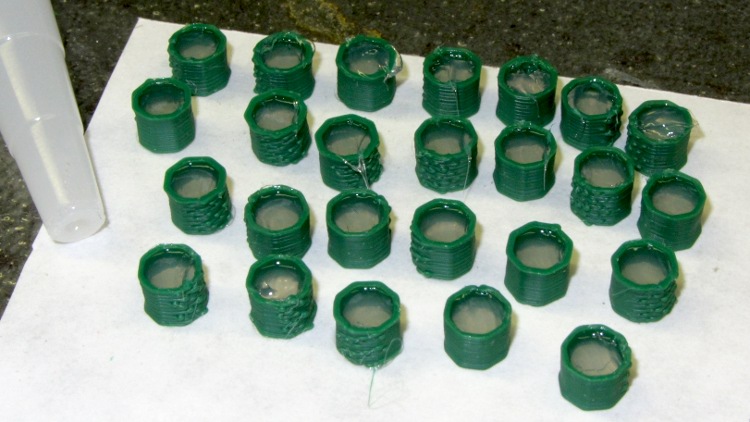
Wait for a day, pop them off, and remove any drool:
Silicone-filled pin caps
It’s garden planting time right now, so it’ll take a while before I tweak the design and run off the next batch.
I don’t know how to compute an actual cost for each of those things. I regard the entire Thing-O-Matic as fully depreciated and pretty much a sunk cost, which means the expense boils down to the incremental cost of plastic and silicone. All the Quality Shop Time is, of course, free… and maybe even therapeutic.
The (trivially simple) OpenSCAD source code:
// Quilting pin caps
// Ed Nisley KE4ZNU April 2012
//- Extrusion parameters must match reality!
// Print with +1 shells and 3 solid layers
ThreadThick = 0.25;
ThreadWidth = 2.0 * ThreadThick;
HoleWindage = 0.2;
function IntegerMultiple(Size,Unit) = Unit * ceil(Size / Unit);
Protrusion = 0.1; // make holes end cleanly
//----------------------
// Dimensions
ID = 5.0;
OD = ID + 2*ThreadWidth;
Length = 5.0;
Sides = 8;
//----------------------
// Useful routines
module PolyCyl(Dia,Height,ForceSides=0) { // based on nophead's polyholes
Sides = (ForceSides != 0) ? ForceSides : (ceil(Dia) + 2);
FixDia = Dia / cos(180/Sides);
cylinder(r=(FixDia + HoleWindage)/2,
h=Height,
$fn=Sides);
}
module ShowPegGrid(Space = 10.0,Size = 1.0) {
Range = floor(50 / Space);
for (x=[-Range:Range])
for (y=[-Range:Range])
translate([x*Space,y*Space,Size/2])
%cube(Size,center=true);
}
//----------------------
// Build them!
ShowPegGrid();
rotate(180/Sides) {
difference() {
PolyCyl(OD,Length,8);
translate([0,0,-Protrusion])
PolyCyl(ID,(Length + 2*Protrusion),8);
}
}
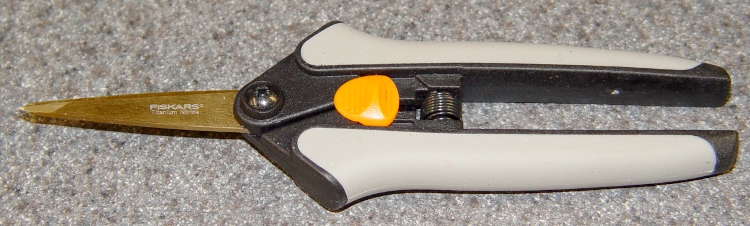
These Fiskars scissors[Update: they’ve moved to the Gardening section. Try there or there. ] seem to be intended for sewing & quilting, but they work just fine for snipping plastic filament, cutting tape, and severing hangnails…
Fiskars Softouch Scissors
The titanium nitride coating probably doesn’t add much value to the mix, but that’s what they had at JoAnne Fabric when I bought ’em.
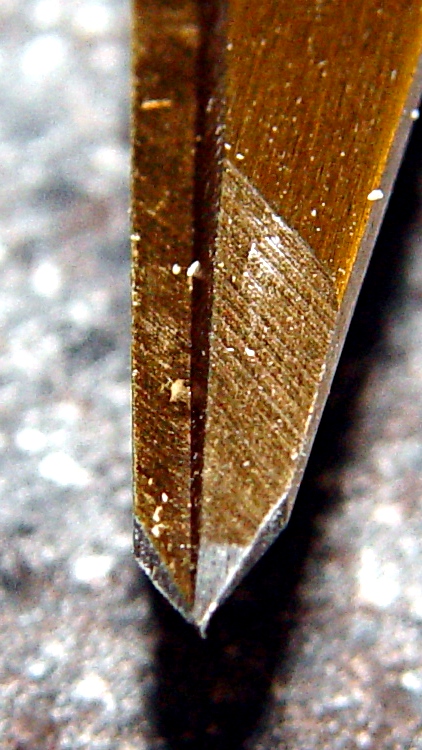
Fiskars scissors tip detail
This detail of the tip shows why they’re so great for detail work: each blade ends in a two-way taper to a genuine cutting point. Of course, that means they’ll survive exactly zero falls to the shop’s concrete floor, but they’re fine while they last.
The trick is to sign up for JoAnne sale flyers, which regularly deliver “40% off any one item” discount coupons, then make a targeted shopping expedition. Those coupons account for the green self-healing cutting mat that’s in the background of so many pictures around here, too…
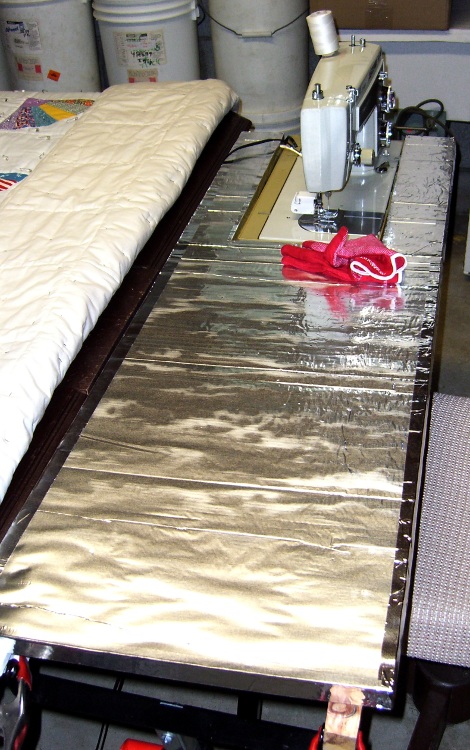
Mary has been quilting up a storm lately and wanted a larger surface to handle a bed-sized quilt. A table in the basement was big enough, but she wanted a larger flat surface around the sewing machine adjacent to the table.
I converted the typing return (*) from her upstairs desk into a table, then cut a piece of aluminum-clad 1-inch foam insulation board to fit. It’s 4 feet long, a convenient length to cut from the 4×8-foot insulation board, and slightly narrower than the typing return. Cutting it required a long X-Acto knife blade, but a really sharp utility knife would work as well.
Some stainless-steel tape finished off the edges. The tape itself is lethally sharp-edged, but it’s perfectly harmless if you do a good job of smoothing it against the foam board…
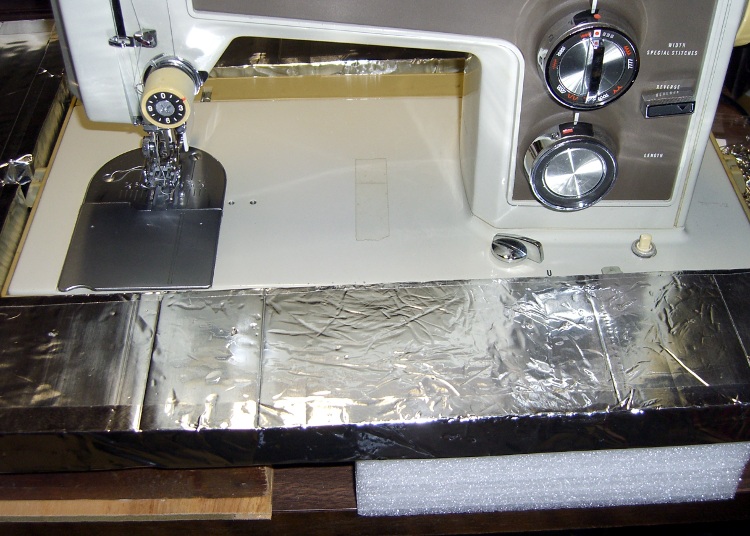
A pair of closed-cell rigid foam blocks held one end of the board at the proper height around the sewing machine, while a pair of cutoffs from the wood pile were just the right thickness & length to extend under the other end. It turns out that precise height isn’t nearly as vital as we expected; close enough is fine.
I cannibalized a pair of table-saw feed roller stands for this project; they had just the right height adjustment and shape to support the typing return and the foam board.
The end result aligns the surface of the sewing machine with both the top of the table and the surface of the foam board. The quilt slides easily over the whole affair and doesn’t bunch up like it did before. Success!
Foam support blocks
(*) A “typing return” is the little table that sticks out from a desk, upon which you put a typewriter, back in the day when typewriters ruled the land. Nowadays, she uses it for her sewing machine, which normally lives at her desk, because there’s no practical way to type at right angles to one’s desk.
That’s the sort of item you can’t do web searches for, because all the terms are so heavily overloaded. Give it a try; you’ll find one or two useful hits. There’s a difference between syntax and semantics; we’re not in the semantic web yet by long yardage.
One of Mary’s first investments when she got out of college was a sewing machine and she’s been using it ever since. Of late, it’s gotten a bit sporadic and the foot control seemed to be at fault.
The symptoms were that the foot control required too much travel (equivalently: foot pressure) to get up to speed, it started abruptly (poor speed regulation), and sometimes cut out without warning.
So I took it apart to see what I could do.
Two pins in the side hold the top cover in place and serve as pivots. Loosen the two visible screws in the center of two of the bottom feet, hold the top half of the case down, and slide the pins out.
A wedge on the top half presses down on the middle of the steel bar, pressing it into the rheostat. A dab of silicone lube on the wedge greatly improved that action.
Rheostat graphite wafers and contacts
The speed control itself is brutally simple: a carbon-pile rheostat in series with the 120 VAC 1 A sewing machine motor. The ceramic case and heatsink tab tell you that things get pretty toasty inside that Bakelite case.
Disassembly is obvious, which is one of the nice things about old electrical gadgets: you can puzzle out how they work and how the parts fit together just by looking. A slew of graphite disks slides out from two cylindrical tunnels in the ceramic case, followed by two graphite contact buttons. The brass fittings on the front have carbon dust on their raised surfaces, but are basically just stamped & machined metal parts.
No fancy electronics, no firmware, just a high-power (and utterly non-inductive!) carbon variable resistor.
The rheostat has three modes, in increasing order of pressure:
Off — no pressure on the foot control
Resistive speed control — resistance varies with foot pressure
Full throttle — rheostat resistance shorted by front switch
Rheostat speed control contacts
With no pressure on the foot control, there’s a generous gap between the contact bar on the back surface and the two graphite buttons sticking out of the ceramic case. There’s no way for the contacts to close by shaking or accident.
A bit more foot pressure connects those two buttons through the shorting bar across the back. Light pressure on the graphite disks means a relatively high resistance, on the order of several hundred ohms, and relatively low current to the motor. Of course, that also means the motor has poor starting torque, but … a sewing machine doesn’t need a lot of torque.
Increasing foot pressure squeezes the disks together and decreases the resistance. It drops to a few tens of ohms, perhaps lower, but it’s hard to get a stable measurement. The motor averages all that out and trundles along at a reasonably steady pace.
Rheostat full-speed contacts
Finally, the brass disk in the central case tunnel shorts the tabs on the two brass end contacts and lets the motor run at full speed. Increasing the foot pressure beyond that point doesn’t change anything; the spring-loaded shaft can’t deform the tabs.
The steel shaft and contact disk can short one or the other of the two piles, but that just decreases the already small resistance by about half. That might give the motor a speed boost instantly before jumping to full speed.
As nearly as I can tell, the carbon disks evaporated over the decades, as the piles seems quite loose and required a lot of foot motion to reach the first contact point. I lathe-turned a pair of brass disks about three wafers thick, so that they’d take up the empty space in the piles.
I also filed the brass end fittings flat so that they contact the disks over more of their surface. The first two disks looked like they had hot spots: loose carbon collected in the areas where the contacts didn’t quite touch them. I doubt that actually improved anything, but it’s the thought that counts.
The spacers worked reasonably well, although I wound up removing one graphite disk from each pile to ensure the full-speed contacts would close properly. They’re in a small plastic bag tucked under the aluminum heatsink tab, where they can’t get lost. With any luck, the bag won’t melt around them.
Rheostat with brass spacer button
A few days later, the sewing machine stopped working entirely. The foot control itself seemed to be working correctly, but a bit of poking around showed that the cord had a broken conductor just outside the strain relief. I cut the cord off at the strain relief, hacksawed the strain relief apart, then rewired it. The cord is now four inches shorter and everything works fine again.
I think this would be a nice candidate for a PWM controller, but then I’d have to shoehorn all that circuitry into the base of the sewing machine or add another cord to the foot control. Ptui, this works well enough.