Ed Nisley's Blog: Shop notes, electronics, firmware, machinery, 3D printing, laser cuttery, and curiosities. Contents: 100% human thinking, 0% AI slop.
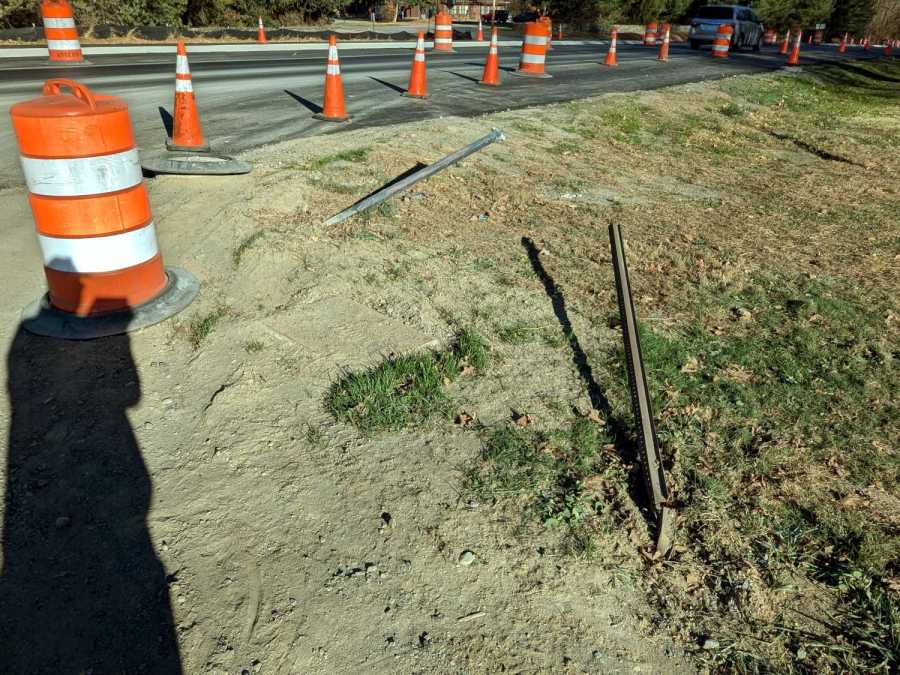
Having watched a tour bus jounce over the poor suffering street lamp base, I can easily understand how something similarly large killed the street signs:
Street Lamp Base – Overview
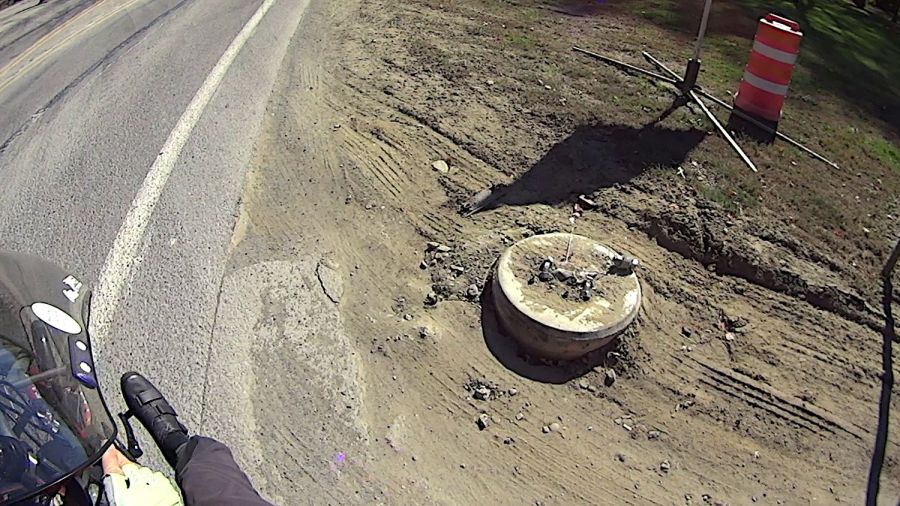
The black ring in the upper left formerly positioned a barrel over the lamp base:
Street Lamp Base – barrel ring
Something heavy shaved down those bolts:
Street Lamp Base – detail
The blue-and-white pull cord seems at risk of vanishing.
They’re now laying asphalt and the project continues apace.
NYS DOT installed rows of street lamp foundations along both sides of Rt 376 as part of the intersection reconstruction that will eventually put a fourth traffic circle along Raymond Avenue. Until the intersection of Rombout House Lane with Rt 376 vanishes, this lamp base at the corner sits well within the turning radius of the heavy trucks entering & exiting the contractor’s material dump & equipment marshalling yard:
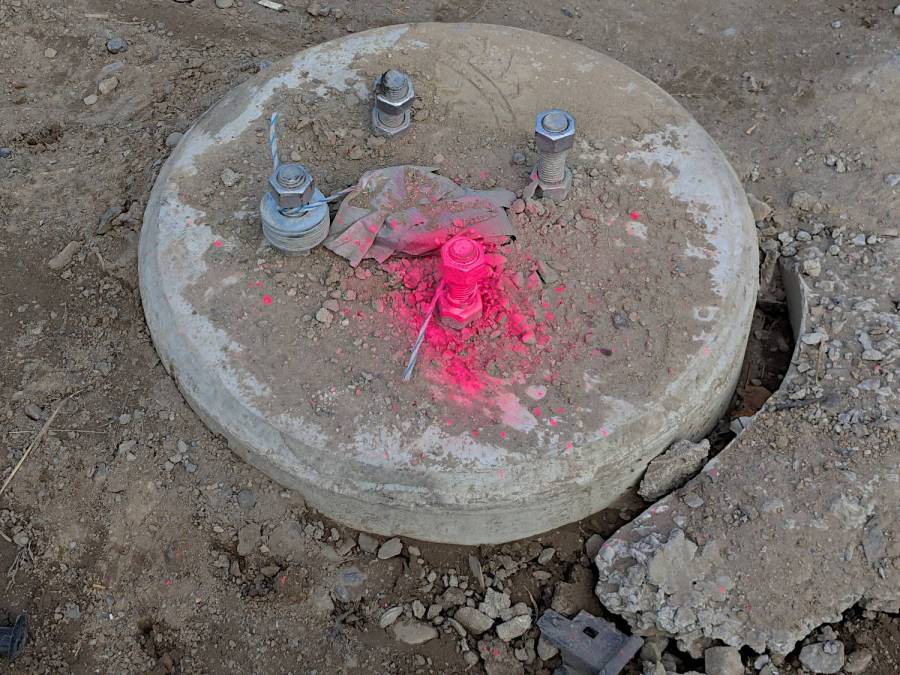
Street Lamp Base – A
The fluorescent paint appeared after something heavy ran over the base and bent two of the bolts that should secure the lamp post.
A few days and a few more passes killed those bolts dead:
Street Lamp Base – A – more destruction
The barrier barrel in the background sat atop the base for a few days, but obviously didn’t affect the outcome.
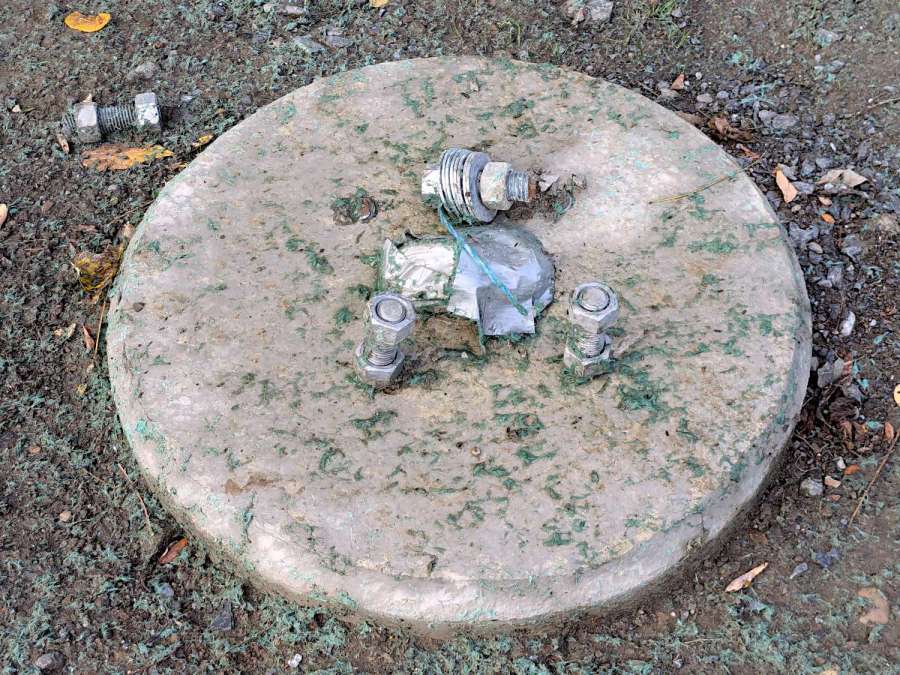
A few hundred feet south, a heavy metallic mass sheared off another pair of bolts and bent the survivors:
Street Lamp Base – B
Someone eventually moved the sheared bolt atop the base, so perhaps the damage has been noted where that note will have some effect.
The “bolts” are the threaded end of long rods embedded in the three or four feet of pre-cast concrete forming the lamp base. The concave concrete mass to the right in the first picture is residue from the poured concrete in the hole anchoring the base to the ground.
A four foot deep trench along the row of lamps holds electrical conduit between them for the wiring that will eventually surface through the conduit covered by the duct tape. The white-and-blue cord hauls the pull tape from one base to the next to pull the conductors through the conduit.
Replacing those cast-in-place bases won’t be a trivial (pronounced “inexpensive”) operation and I suspect a powerful motivation to just un-bend the wounded bolts and pretend they’re not severely weakened. I doubt a base with just two bolts will pass final inspection, but maybe the inspector won’t look inside the lamp pole covers.
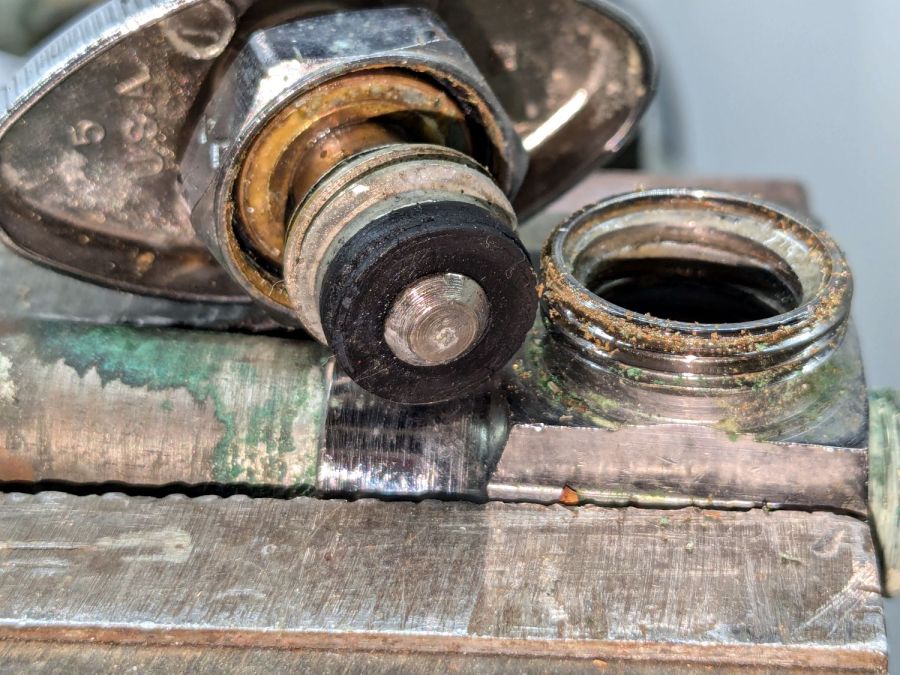
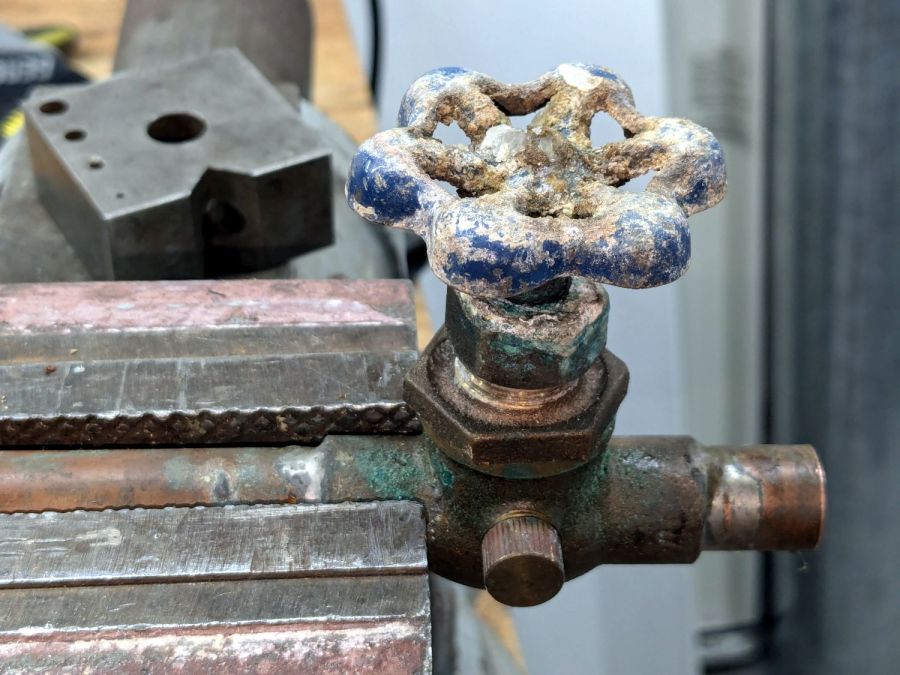
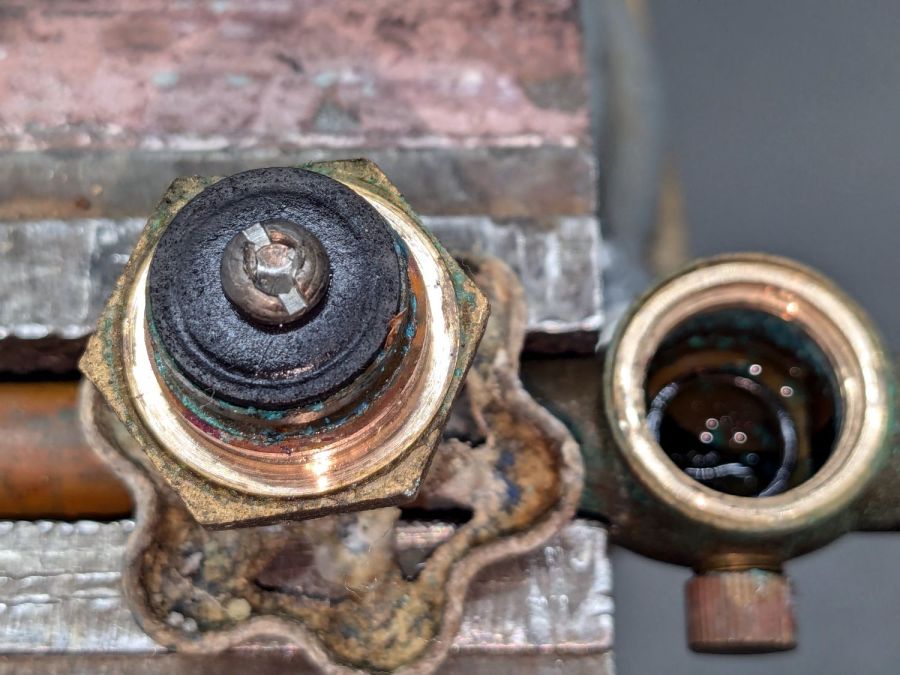
The shutoff valve for the hose bib in the front of the house, mounted knob-downward, has been dripping quietly for many many years before I replaced it:
Hose valve shutoff – knob corrosion
I’d turned the valve off to no avail, so this was no surprise:
Hose valve shutoff – washer
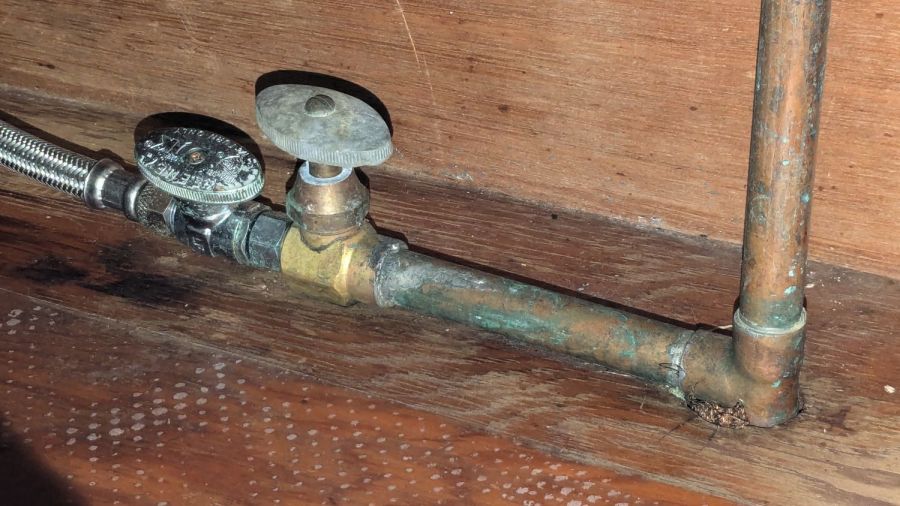
While it is theoretically possible to replace those washers, even the professionals know better than to disturb a sleeping valve:
Dishwasher valve doubling
The tandem valve was likely installed half a decade ago, along with the dishwasher it services. Perhaps the washer inside remains soft.
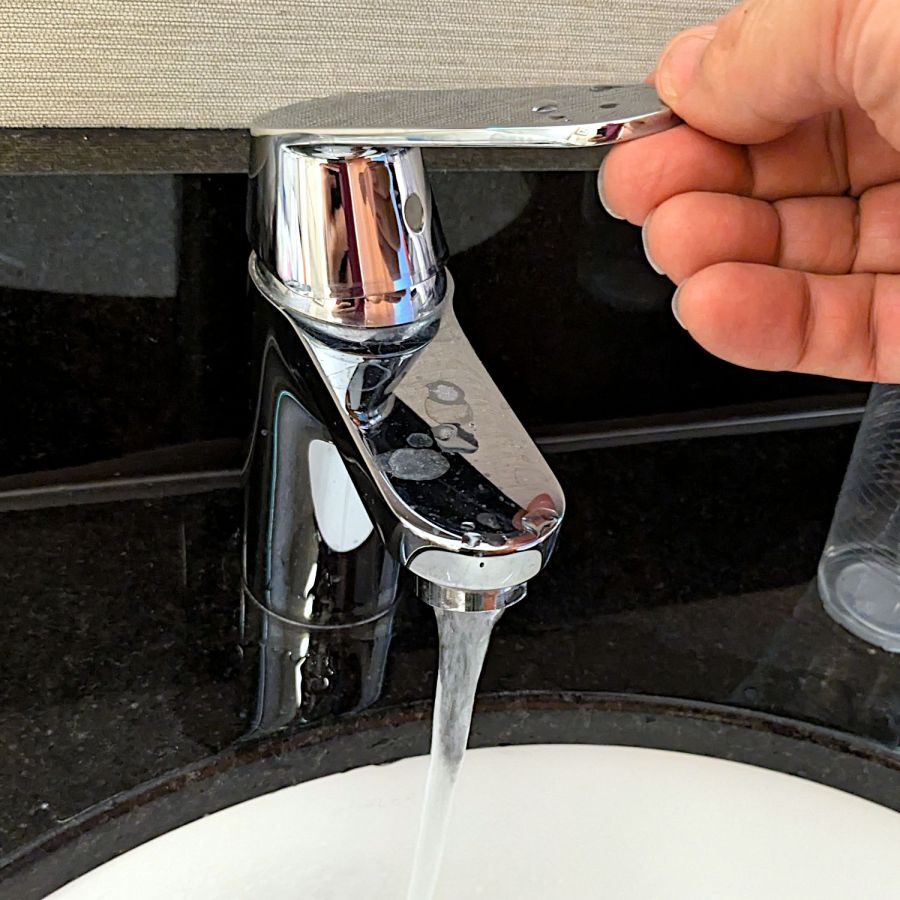
The sink faucet in our motel room worked the way you’d expect:
Grohe sink faucet
It pivots left-right to adjust the temperature and lifts to control the flow, which is Off when the handle is parallel to the sink countertop.
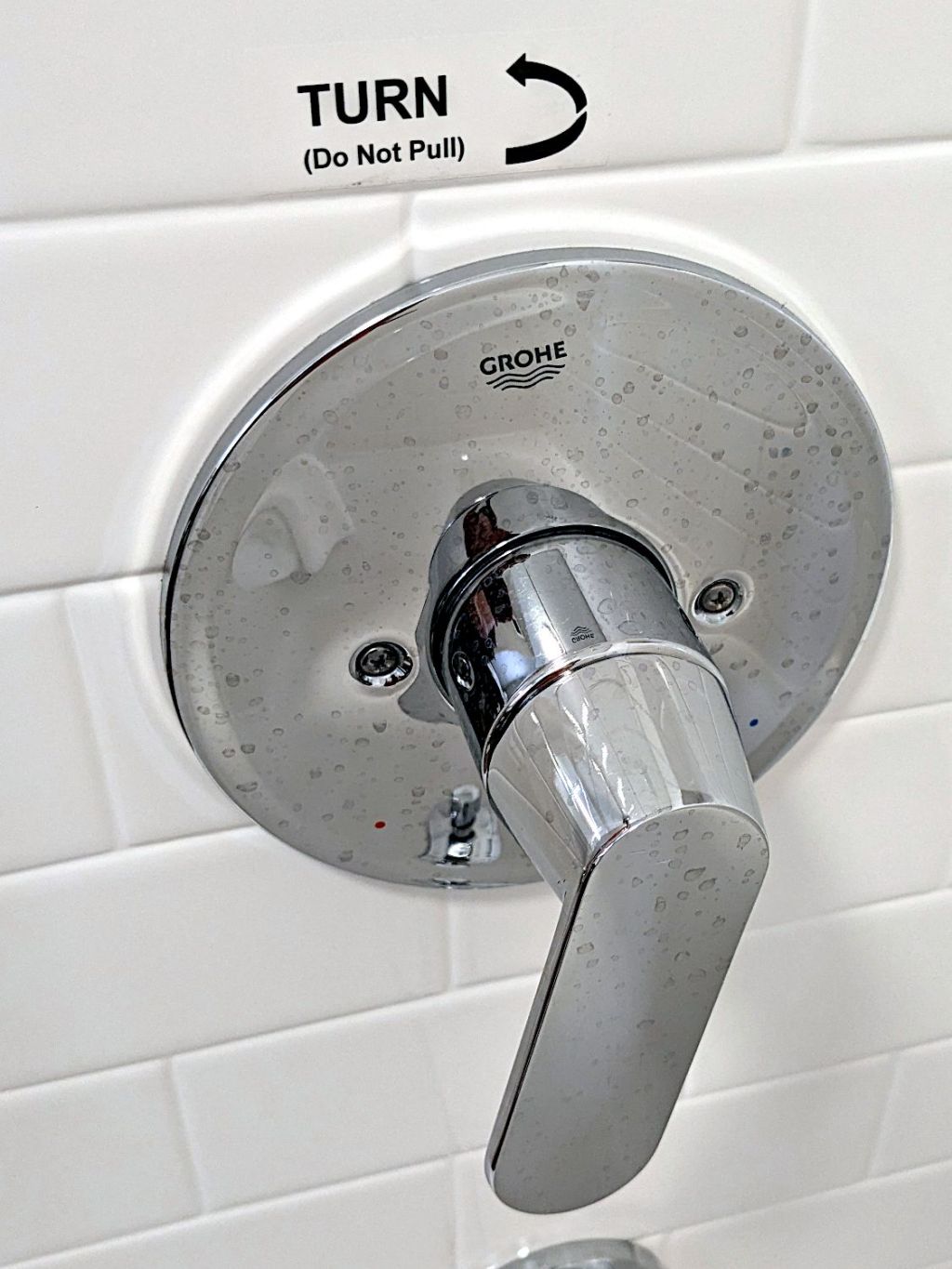
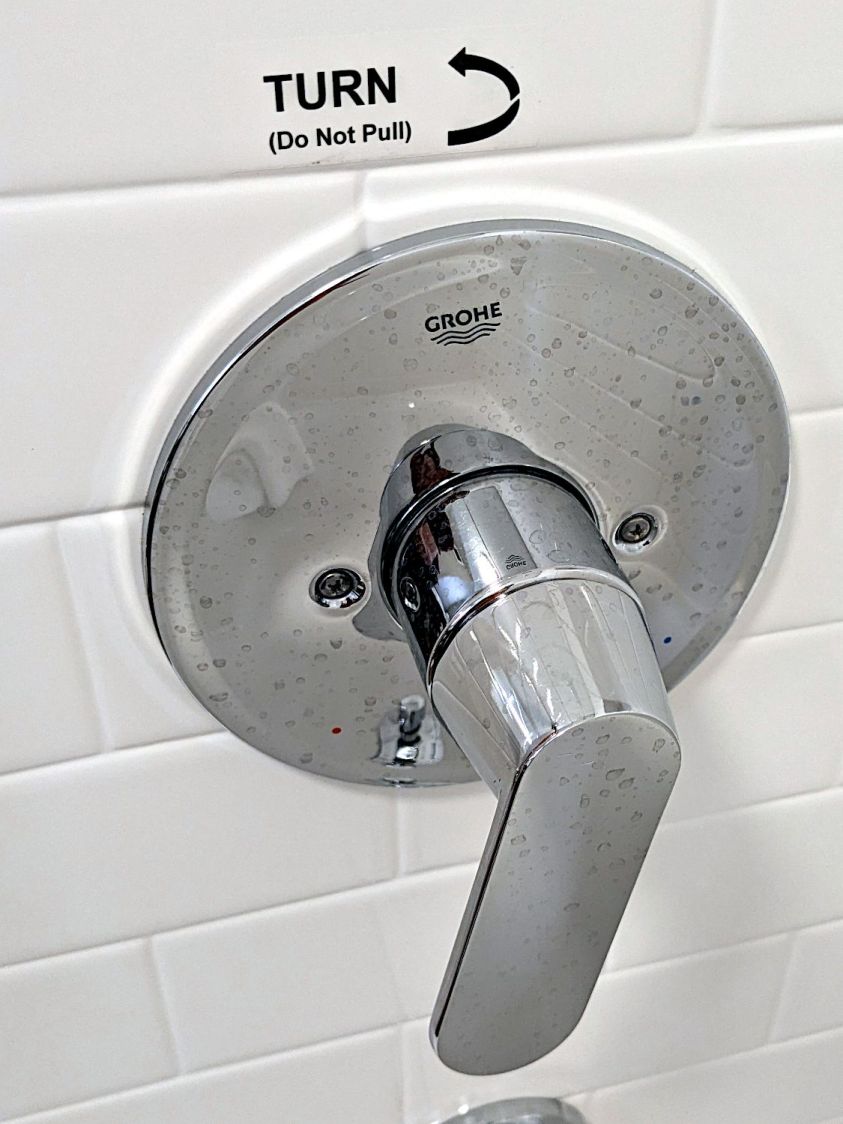
Evidently, everybody assumes that’s the way the identical faucet handle works in the shower, despite the helpful label:
Grohe shower faucet
Did you notice the minuscule red dot below-and-left of the handle or the corresponding blue dot just to its right? Absent the label, those provide all the hints you’ll get as to how the handle operates.
The faucet body & plumbing were loose in the wall, as though many previous people had given it a firm yank to get water out of it.
I’m 3.5 diopters nearsighted and can’t see those little dots. Mary is 2 diopters farsighted and can’t see the label or the dots.
What did they think would happen with different valves having identical affordance?
The kitchen faucet worked its way loose again. Attempting to shut off the water revealed a pair of leaky valves under the sink, so I shut off the house water in the basement, cut the valve pipes below the solder drips, and installed a pair of push-connect shutoffs:
Kitchen faucet shutoff valve – push connection
I loves me some good push-connect fitting action, which is new news to me. Back in the Bad Old Days™, I’d be under the sink with a propane torch, trying to solder a pair of wet pipes and failing miserably.
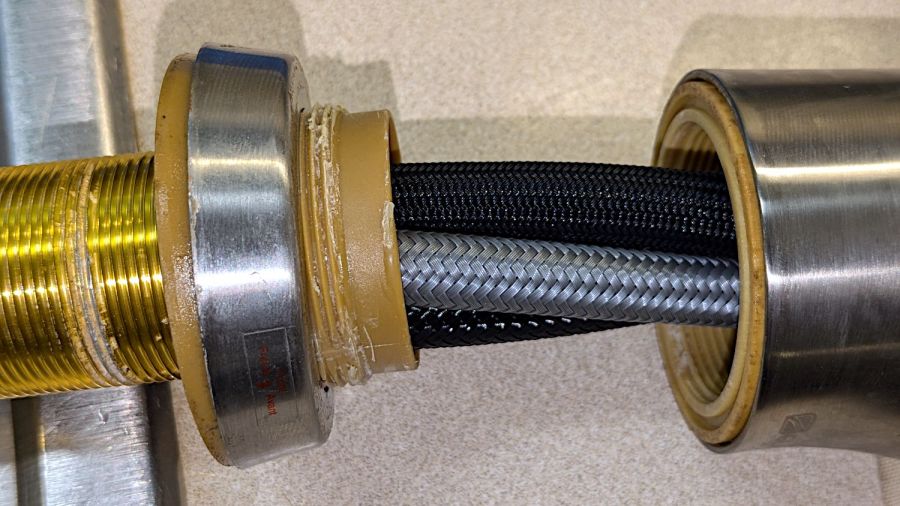
With that out of the way and the faucet dismantled for the first time (by my hands, anyway), the threads holding the base to the spout column may have been damaged during factory assembly:
HD Glacier Bay kitchen faucet – damaged threads
I thought the gunk was thread lock compound, but it’s shredded plastic from the base fitting threads. The corresponding female threads inside the spout column are undamaged, so I think somebody tried screwing it together with the threads misaligned, backed off, then muscled it together.
It’s worth noting there are no keys or stops fixing the correct orientation of any of these parts. In particular, the trim ring bearing the small Front label (facing you in the picture) has no fixed orientation: whoever assembles the faucet in the factory must position it correctly on the fly as the base screws into the column and jams tight.
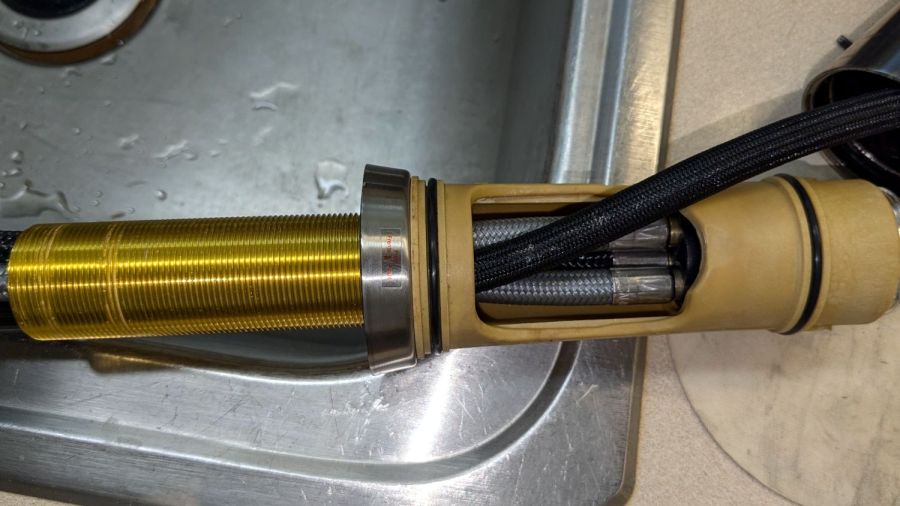
So I cleaned up the damaged threads as best I could, flipped the threaded brass tube end-for-end to put the cleanest part into the base, and reassembled everything with careful attention to starting the threads correctly:
HD Glacier Bay kitchen faucet – flipped brass tube
Tightening the base fitting into the column is much easier with everything on the kitchen counter, although centering the label on the molded opening required several tries.
Protip: a pair of grippy gloves and rubber sheets help a lot.
I want to find out how secure the original design, properly tightened and aligned, will be, so I did not apply any threadlocker.
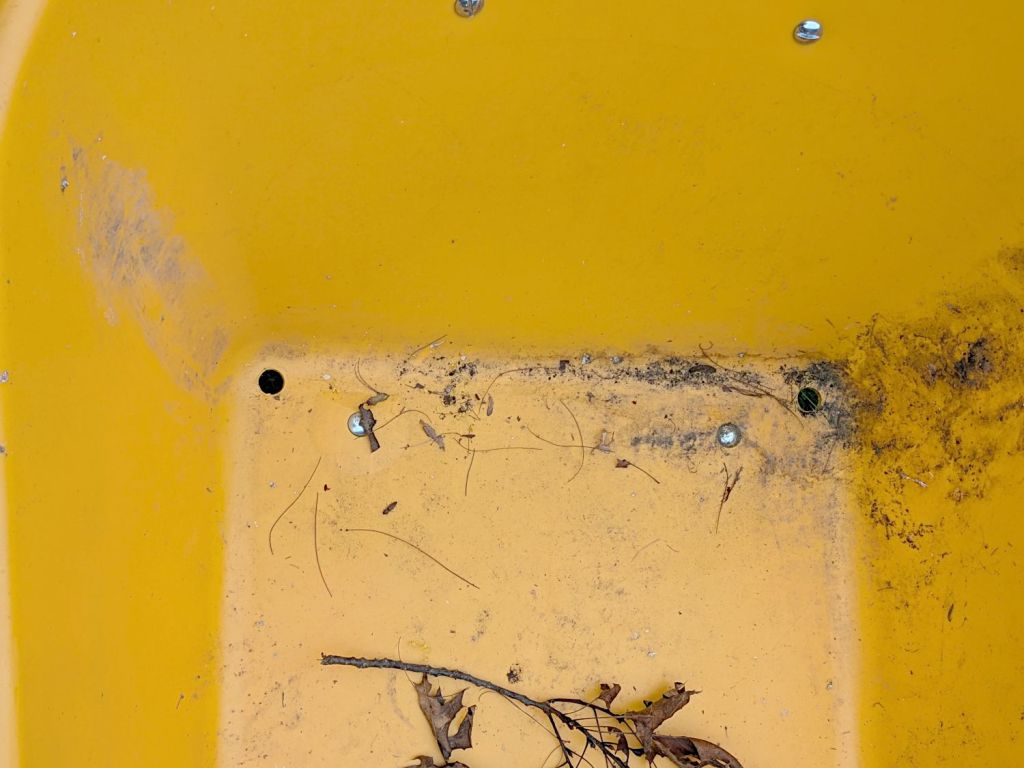
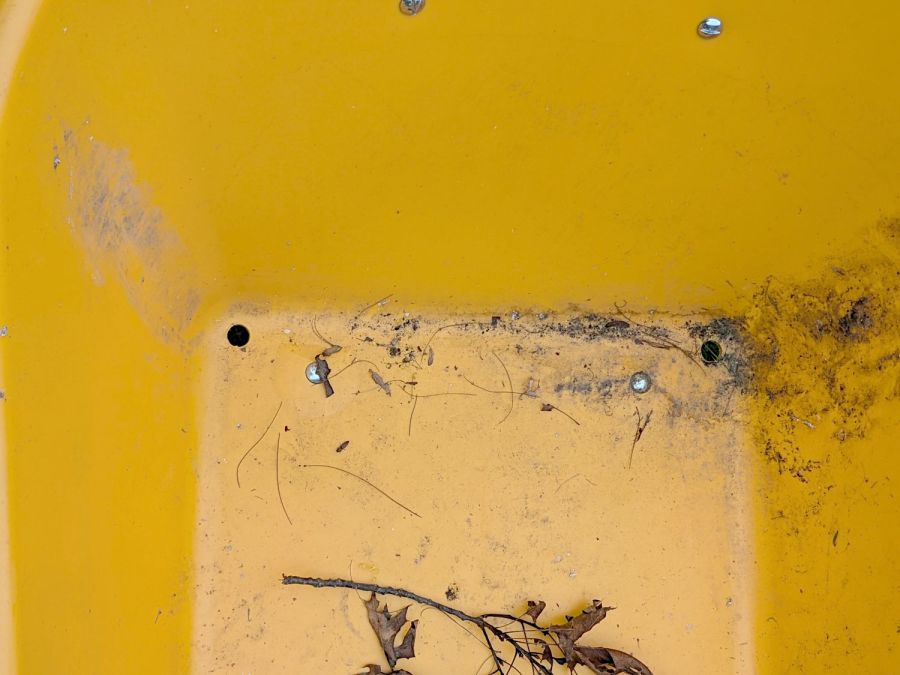
Attacking a plastic wheelbarrow with a ¾ inch hole saw prevents it from becoming a mosquito breeding station:
Wheelbarrow drain holes
We had been storing it tipped to one side, resulting in the wheel filling up with water, which can’t be a Good Thing.
If it must carry a load of sand, I’ll just duct-tape the holes.
One of Mary’s friend looked at, but did not order, this wheelbarrow on Amazon. Shortly thereafter, she received a wheelbarrow in two packages: the handles and a box with everything else strapped into the barrow. After a discussion with Amazon’s support / help staff, she was told to just keep it at no charge.
Over the next few weeks, she received five more wheelbarrows, each prompting a discussion and keeping them at no charge. Eventually, somebody figured out how to stop the stream.
So half a dozen gardeners now have free wheelbarrows, courtesy of a glitch in The Machine.







 The Smell of Molten Projects in the Morning