The Smell of Molten Projects in the Morning

Ed Nisley's Blog: Shop notes, electronics, firmware, machinery, 3D printing, laser cuttery, and curiosities. Contents: 100% human thinking, 0% AI slop.

Tag: Rants

And kvetching, too

  • The Decline of Literacy: Part Two

    Saw this in a somewhat downscale grocery store while chaperoning a Marching Band event.

    Hand Dryer Graffiti
    Hand Dryer Graffiti

    I’d give him (it’s a mens’ restroom) some bonus points, as I think he caught and corrected the error, but then there’s that “to”. Ouch.

    I ask you, though, what grade were you in when you learned how to spell “much”? I doubt you’ve had any trouble spelling it since then.

  • Credit Card Privacy Choices

    Just got a new credit card, which arrived with the usual “Privacy Policy” flyer describing how they’ll keep our sensitive bits safe & secure. Except, of course, that by default they’ll share those bits with nearly any organization that asks, if there’s even the least bit of money to be made in the process.

    The flyer explains how we can tell them of our privacy choices. Oddly, in this Internet Age, none of the banks have figured out how to put our privacy policy choices on their websites. Maybe that would be entirely too efficient.

    Anyhow, we’re supposed to either:

    • Pick up the phone to deal with their customer service apparat or
    • Pick up a pen, fill out a form, cut it out, and mail it to them

    For our joint accounts, if I forget to say “And this also applies to my wife”, well, then they’re free to share her sensitive bits.

    I’m sure they know that when they make “choosing” difficult enough, nobody will bother.

    Ya think?

    For the record:

    • Chase: press 0 to short-circuit the account info blather and get to a rep
    • Citi: press 6 for that purpose. Why not 0? Huh…

    The Chase folks tell me this may require up to 90 days to take effect. Wow, do they fill out forms and hand-carry the paperwork to Galactic HQ for further transcription?

    Memo to Self: Remember to tell the nice voice…

    • This applies to both account holders
    • Turn off all information sharing options
    • Turn off “convenience checks” (is anybody stupid enough to use those things?)
    • Turn off automatic credit line increases

    This takes about four minutes for each account on a Sunday morning.

  • Verizon FiOS: Wheeling and Dealing

    So Verizon seem determined to spend as much money as it takes to bury us in FiOS Triple Play mailings. For the last few months, we’ve been getting at least one mailing a week with exactly the same offer. Perhaps they think we’ll eventually get fed up and buy the damned thing, although rumor has it that the offers keep coming even after you do that.

    Anyhow, I called the number (877-896-3354 this week) to ask:

    • How about selling us FiOS 15/5 Internet and Freedom Essentials (unlimited US residential VOIP) for $60/month for two years with no installation fee?
    • Failing that, put us on the Do Not Solicit list to shut off the junk mail

    Come to find out that:

    • Nope, the nice voice can’t dicker on the monthly price, but…
    • They’re willing to waive the installation fee ($50) without blinking
    • The fact that we don’t have a TV and aren’t interested in the Triple Play is a dealbreaker for them
    • The DNS list is just a checkbox on their display of my account: done!

    At this point we’re spending $50 for Optimum Online cable 13/2 (more or less) internet and nigh onto $30 for a Verizon landline phone without “long distance” calling (which we do by VOIP these days). They can do a bundle for something like $80/month with a brief teaser discount, but no better than that. So we’d wind up paying more for basically the same thing.

    After a pleasant conversation he asked if I would recommend Verizon to my friends & relations. I said “Absolutely not” and he asked if I wanted to talk to a Quality Assurance representative. Figuring it’d be good for a laugh, I said yes… and then went directly to the usual interminable wait-on-hold.

    The QA guy asked why I wouldn’t recommend Verizon, so I gave him a few reasons:

    • Their phone menu system is impenetrable
    • I often get mysteriously disconnected during intra-Verizon handoffs, particularly if I’m asking difficult questions
    • Nobody in their “customer support” phone tree can explain how much the “Other charges, taxes & terms” might add up to on a bundle deal: they can’t tell me what their service will cost!
    • Nobody at Verizon can explain the random charges / credits / debits / adjustments on my buddy Aitch’s wireless + Triple Play bill. He’s a smart guy; if he can’t figure it out, I certainly can’t.
    • Their pricing is not competitive; it’s more than we’re paying now for basically the same thing. Why switch?

    He actually tried to claim that I can’t get FiOS speeds from cable. I pointed out that the difference between 15/5 and 13/2 isn’t “This is FiOS. This is BIG!”, it’s just barely discernible and not guaranteed anyway. Oddly, in the last few months, Verizon has quietly bumped the base FiOS speed from 12/2 to 15/5, which I infer means they found that trying to sell a slower speed to cable customers wasn’t working out that well.

    I also infer this whole FiOS thing still isn’t going as well as they’d like. If it was, the incessant offers would stop.

    The QA guy said he’d call me back if they could do anything about the price; there’s evidently a New & Better Deal coming out in a few weeks. Of course, since we’re on the DNS list, we’ll never know…

    I told him here’s what it would take to get me to switch: paying less than $80/month for internet + phone. I figure $60 (plus the mystery charges) would save me maybe $10/month. I’ll geek for that if they don’t screw me over for installation and suchlike.

    Failing that, we may just shoot the landline in the head and go with the cheap prepaid cellphone deal. Google Voice seems to be a reasonable solution; I got a local number that’s very close to our current landline, so maybe it’s time to print up a stack o’ cards and send out some notices.

  • Whirlpool Water Heater “Lifetime” Warranty: The Good and the Bad

    So our 6-year-old Whirlpool electric water heater tank failed and dribbled water on the floor. Fortunately, I spotted the leak before it flooded the basement: I look at the heater just about every time I venture into the Basement Laboratory Electronics Wing. Judging from the mildew & fungus growing on the wooden base I built for it, though, I haven’t been doing a good job of walk-by inspecting. In my defense, the visible wooden edge is 3/8″ thick below the dark rim of the heater.

    Grit drained from tank
    Grit drained from tank

    I turned off the inlet & outlet ball valves, flipped the breaker off, routed a garden hose out the door, laid the end in an old cake pan, and drained the tank. The pan collected a fair amount of rusty grit (and more washed down the driveway), which means the glass-lined tank was suffering from internal rust.

    A call to the Warranty Hotline produced an Indian-subcontinent accented voice, who told me that I had to get a licensed plumber to tell them that it was, in fact, rusted out. “Any plumber in the phone book will do”, he said, “Just have them call this number and we will verify the situation with them.”

    My back of the envelope, confirmed by friends, is that it’d cost about $150 for a plumber to drop in. Oh, and this was on a Saturday morning, which means it might be a while later and bit more expensive than that. Paying somebody $75/hour to wait on hold didn’t seem attractive.

    A new heater of the same general nature is $400, give or take.

    Soooo, in round numbers, I’d be spending half the cost of the “free”  replacement just to find out if Whirlpool would honor the warranty.

    I was ready to just cut my losses and buy another heater when my friend Aitch suggested two simple alternatives:

    • Call the warranty line again, point out that this is the Internet Age, and offer to send them pictures of the problem, along with a statement that I was being truthful.
    • Spend the $150 to ship the dead heater to the office of the Whirlpool CEO with a note describing the situation

    I picked the first option and had a brief conversation along these general lines:

    • paying nearly half the price of a new heater for an “evaluation” is absurd
    • the leak was near the top; even the caps over the heating elements were rusted
    • the grit shows that tank has internal rust, so it’s not external corrosion
    • I’ll send pictures anywhere you want

    Much to my astonishment, the pleasant voice gave me a replacement authorization! No pictures needed.

    Knock me over with a feather…

    So I hauled the corpse back to Lowe’s, swapped it out for a new one, and away I went.

    Now, it’s worth noting that the new heater has a 12-year tank warranty, not the lifetime one that came with the original purchase. Given my experience with the first one, we’ll see what happens; I suppose they learned how expensive a lifetime warranty can be.

    Overall, a pleasant surprise, although the initial presentation wasn’t encouraging in the least.

    Memo to Self: Don’t ask, don’t get…

  • More Vital Firefox Privacy Add-ons

    If you’re still using IE, stop that.

    Start using Firefox. Then…

    Install some of those add-ons, then come back here.

    Did you remember to kill Flash cookies?

    Install TACO to magically opt-out from all of the advertisers who claim to honor opt-out requests. Won’t have much effect, but it’s worth trying.

    Install Ghostery to see which sites are tracking what.

    Now it’s time to delete your cookies again. You must then log into all your favorite websites again, but you’ll be accumulating less clutter.

    This should not be necessary…

  • Horrible Noises Inside Kenmore HE3 Washer: Fixed!

    So our whoop-dee-doo Sears Kenmore HE3 clothes washer started emitting horrible scratching & grinding noises, but only every now and then during the high-speed spin cycle or, more rarely, the washing agitation cycle.

    In an ordinary washer, you’d suspect the transmission was going bad, but the HE3 has a direct-drive 3-phase motor: no transmission to wear out.

    A bit of searching shows HE3 washer drums may fall apart at their welded (?) seams, but that didn’t seem to be the case here. So I press-ganged our daughter into a plumbing job; the machine is something over six years old, so it’s not as if we have any warranty to void.

    Move the washer out where you can get to the back without contortions. Pull the plug, turn off the water, unscrew the water supply hoses at the back panel, squash the hose clamp & remove the drain hose.

    Sediment buildup in hot water inlet
    Sediment buildup in hot water inlet

    One obvious, but unrelated, problem appeared when we disconnected the water hoses: plenty of black grit in the hot water inlet. Looks like it’s time to drain & flush the hot water heater again, which will turn into a major project because the anode rod has firmly rust-welded itself in place. That’s a project for another day…

    Disassembling the cabinet requires a Torx T-20 bit. There are a lot of screws, so fetch a stable container to hold them all.

    Take off the top cover (three screws, then slides back) to reveal the angle brace across the back that holds all the electronics and valves and suchlike. Pull the big vapor vent tube (on the right as you face the rear) out of that bracket, remove the eight (!) screws holding the bracket in place, and move it up out of the way.

    Remove the back cover, taking care to not loosen the screws holding the frame crossmembers in place; those are the screws in the U-shaped cutouts along the edges.

    Note: you can remove just the back cover by removing the lower screws in the angle brace, all the screws holding the cover, then sliding it down and out at the bottom. It’s easer to see what’s going on if you take the top cover off and moving the angle brace frees up a lot of gimcrackery that gets in your way. Your choice.

    Everything connects to the drum housing through exceedingly flexible rubber boots held on by circumferential wire clamps. Grab the ends with Vise-Grip pliers, squash ’em together, and the clamp should slide off the housing onto the boot. Peel the boot off and you can look inside.

    Foreign Object Sighted
    Foreign Object Sighted

    Peering in through the pressure sensor opening in the bottom rear of the housing revealed something odd: a loose black cylinder. A bit of deft tweezer and grabber work pulled out a much-the-worse-for-wear ballpoint pen housing, minus the cap, point, and pocket clip. The fiber-fill ink reservoir formed a tuft at one end.

    Mmmm, that would account for the blue water in the drain tube…

    Combine the number of missing parts with an inability to see any of them in the bottom of the housing: more surgery is indicated.

    Tub drain boot
    Tub drain boot

    The housing drains into the ejector pump through that huge black boot clamped onto the bottom of the drum housing. Put a pan underneath the pressure sensor hole, squeeze the boot, and water will bloosh out the sensor hole, generally landing in the pan. There’s a floating-ball check valve inside the boot that prevents backflow to the housing, so you may need some wiggly-jiggly action to work the water around the valve. A few reps will get most of the water out of the drain boot.

    Drain Boot Removed - Pump Inlet
    Drain Boot Removed – Pump Inlet

    Remove the boot from the housing and pump inlet, remove the ball, and admire the innards. We found most of the rest of the pen in the drain boot, plus a generous helping of slime and gunk. Oh, and a hairband and a big chunk of a pencil.

    The pump has a juice-can-size reservoir just inside its inlet, which I think is there to collect debris: a barrier keeps most of the big chunks out of the pump impeller. There’s no way to get stuff out other than lying flat on your stomach and sticking your finger into that slimy hole, so get over it. We extracted the remaining pen bits and most of the rest of the pencil.

    While you’re in there, roll over onto your back, reach up inside the drum housing and feel around to get anything else out. Your assistant can shine a flashlight down through the drum perforations; you’ll be able to see the shadows cast by any odds & ends that are lying on the housing.

    Wipe the slime off the rubber boots, reassemble in reverse order, and you’re done!

    However: the bottom of the washer consists of a big metal pan that will, most likely, start to rattle just after you push the washer back in position. Removal isn’t really an option because one of the front screws is under the motor drive box, but you can sort of pry up the edges and stuff thin cardboard, strips of duct tape, or other elastic stuff between the pan and the washer frame. It took me far too many iterations to figure out what was rattling around in there: it is not obvious!

    Debris From Washer
    Debris From Washer

    Here’s what we found in the drum housing, drain boot, and pump settling tank: the corpse of one of my favorite Uni-Ball Micro pens, a tiny screw, bits of a pencil that my assistant had been looking for, and one of her hairbands.

    That pretty much explains the intermittent grinding sounds: the drum would rotate normally until the swirling water swept the pen housing into contact with the drum, at which point the 800-some-odd RPM rotation would grind the pen against the housing for a few laps. Ditto for the pencil.

    Now, the mystery is how that stuff got from inside the drum past the rubber sealing gasket into the space between the drum and the housing. There doesn’t seem to be any way to get a long rigid object through there, but obviously it happens!

    Slime Behind Door Gasket
    Slime Behind Door Gasket

    After you move the washer back into position, take ten minutes and a generous handful of rags to wipe the abundant collection of mold & mildew from behind the rubber gasket. You can sort of evert the gasket, which simplifies access to the edge of the drum. As you can see, ours has a nice biofilm going on in there; not visible is the gunk growing on the back side of the gasket.

    It seems HE3 washers have a reputation for smelling bad, due to that sort of growth in hidden places. Oddly, we don’t have an odor problem, obviously not through any action on our part. Rumor has it that running a pure-bleach hot-water cycle helps, as does a product for dishwashers that removes their stink, but we don’t have any experience with those.

    As a mental math exercise, I had my assistant divide the $300 bucks a plumber would have billed for this repair by the $7/hr she’d get for a typical minimum-wage shit job. She’s thinking that becoming a plumber might beat smiling at retail customers in a dying mall… but I think she should concentrate more on her math & science.

    [Rant: Not that America seems to value tech jobs much these days, but she has the advantage of being female, so maybe she can still get a tech gig. Don’t get me started, you know how I get.]

    Anyhow, the washer runs just as quietly as it ever did, which is to say that like a turbojet engine spooling up during the spin cycle. At least it doesn’t sound like it’s ingesting a bird every now & again…

    [Update: And then the spider holding the drum in place failed, as it does with so many of these washers.]

  • Digital Concepts CH-3988S Charger and 4 each AA + AAA NiMH Cells: Craptastic!

    Got a Digital Concepts CH-3988S charger with quartets of AA & AAA cells from buy.com (which no longer sells it, no surprise, but it’s still available elsewhere) on closeout for about 12 bucks delivered, down from the “regular” price of something like $40; anybody who paid that much got well and truly hosed.

    I fully expected the cells to be crap and they were: they don’t even bear a manufacturer’s name. Tellingly, they weigh 25 grams each, lighter than the 28-30 grams of more cough reputable brands.

    No-name AA NiMH - Charge 1
    No-name AA NiMH – Charge 1

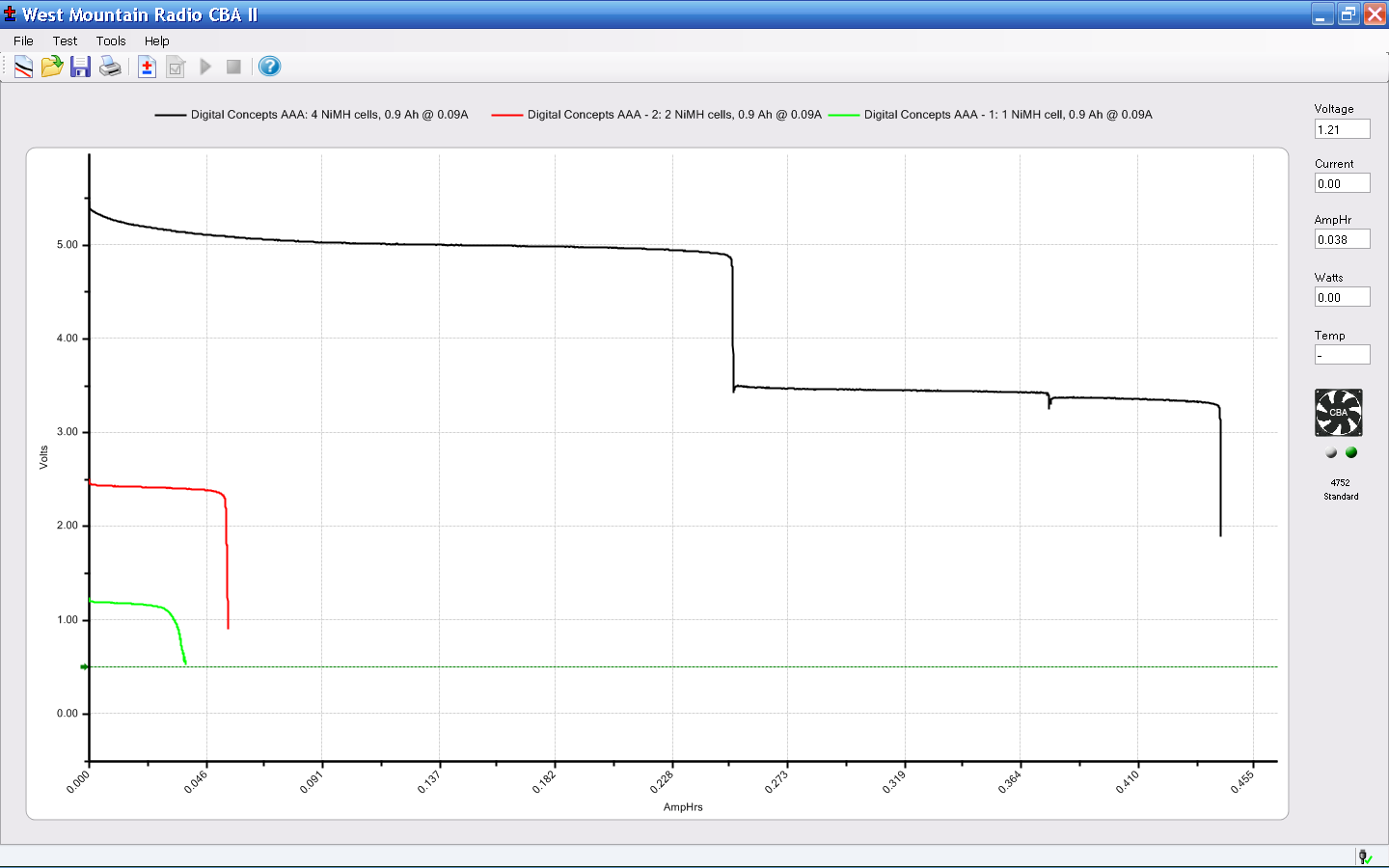
    The upper trace (click the graphs for readable pix) is the four AA NiMH after the charger said it was happy with them. The trace drops off the cliff at about 25 mAh. Call it 1% of nominal capacity.

    The four lower traces are the individual cells after another trip through the charger. The far-right end of those bottom curves is 70 mAh, with the cell voltage barely over 1 V for the entire discharge.

    Fairly obviously, they’re not accepting a charge.

    Charging the cells in a known-good 400 mA charger (roughly C/6) brought the best cell up to 160 mAh, with the rest around 100 mAh; the charger was happy with them after far less than 6 hours, so apparently the cells display a much higher terminal voltage than they should.

    So I plunked them in a dumb 250 mA slow charger and let ’em cook for the full 8 hours. That should, in principle, give them roughly 2 Ah of charge, no matter what the terminal voltage may be; I measured 1.8 V, which is far too high for that rate.

    No-name AA NiMH - Forced Charge 3
    No-name AA NiMH – Forced Charge 3

    So, here’s the result…

    Crap. Pure, utter, unadulterated crap. The cells supplied 500 mAh, much more than before, but that’s so far below their rating it’s not even funny. There’s obviously one cell in there that’s bad, but the others can’t possibly be far behind.

    I didn’t waste any time on the quartet of AAA cells, but I expect they’re pretty much the same.

    It’s faintly possible that exercising these turkeys will bring them up to maybe 50% of capacity, but it’s not like that’d make me ecstatic. The reviews you’ll find here and there support the conclusion that something is wrong with these cells.

    No-name AA NiMH - Charge 4
    No-name AA NiMH – Charge 4

    Here’s the result of the next cycle, after a night in their very own charger. The upper trace is all four of them together, once again failing after 500 mAh.

    The four lower traces labeled “Cell x” are the individual cells, tested without recharging. Three of the four have about 700 mAh left in them, which would bring their total capacity to 1200 mAh, roughly half of their nominal capacity.

    Cell B, the green trace, is obviously the weak link, as it failed almost instantly. Recharging it on a known-good charger got it back up to 530 mAh (the  “Cell B recharge” curve), roughly 25% of its nominal capacity. So much for the idea it’ll get better if you treat it right.

    Now, turning to the charger…

    The Digital Concepts CH-3988S charger is advertised on its package as a “2 Hour Charger”, but its manual / datasheet indicates that claim is, mmmm, not strictly correct:

    CH-3988S Charging Times
    CH-3988S Charging Times

    Remember that the nominal AA cell capacity is 2.3 Ah, so charging the four AA cells included with it requires three or four hours. Well, OK, only 2.5 hours if you do ’em pairwise, but that’s five hours total.

    On the other paw, the charger does (seem to) monitor the cell voltage and cut off automagically, on either negative delta-V or maybe just peak voltage. Unleashing it on a pair of partially discharged Tenergy RTU 2.3 Ah cells indicates that it cooks the piss right out of them, there toward the end.

    The charger is (probably) OK for low-rate charging of known-good cells, which is what I got it for; the cells accompanying it are crap. It’s not worth returning for twelve bucks, seeing as how the shipping would eat half of that.

    So, anyway, if you ever wondered what a bottom-dollar charger-with-cells offer gets you, now you know.