The Smell of Molten Projects in the Morning

Ed Nisley's Blog: Shop notes, electronics, firmware, machinery, 3D printing, laser cuttery, and curiosities. Contents: 100% human thinking, 0% AI slop.

Tag: CNC

Making parts with mathematics

  • Remote Control Button Shield

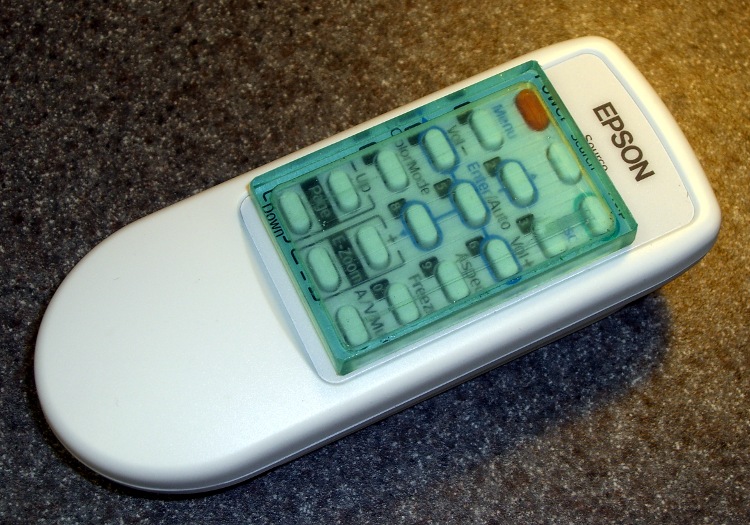
    Button shield in place
    Button shield in place

    Mary was giving one of her vegetable gardening presentations and had the projector go into Mute mode all by itself. It’s hard to debug something like that under pressure, but (as nearly as we can tell) the projector’s remote control (!) got squashed inside the tote bag and managed to tell the projector to go mute itself…

    The remote control has buttons that stand proud of the surface by about 2 mm and, worse, they’re exposed from all sides. There seems to be no way to turn the mumble thing off, other than by removing the batteries, so I conjured up a quick-and-dirty button shield. Not the fanciest thing I’ve ever made, but it’s sufficient for the purpose.

    [Update: Apologies to all you Arduino fans who think this should have something to do with a remote-control circuit board plugged atop a Diecimila, but I think the Arduino designers could have picked a more descriptive term than “shield”. Plenty of folks seem to arrive here by searching for the obvious keywords and go away unhappy. If you’re looking for Arduino stuff, click on the obvious tag in the right-side column that’ll call up everything I’ve written about on the subject… ]
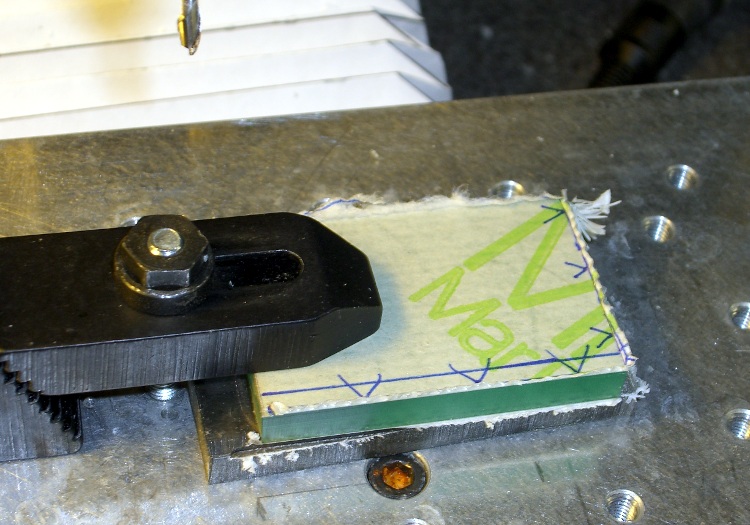
    Sizing the perimeter
    Sizing the perimeter

    I thought about making a tidy form-fitting slab that would fill the entire space between the button matrix and the case, but that gets into curved edges and fussy fitting; fortunately, I came to my senses. Without wanting to make a prototype to get the second one right, I simply trimmed the outside of the polycarbonate slab to a ruthlessly rectangular 33×50 mm. That gives about 2 mm clearance on each side of the button matrix and fits with about 1 mm clearance from the case. The lengthwise dimension is what it is.

    The 29×46 mm pocket must be about 3 mm deep to clear the button tops.

    The G-Code came from the Hugomatic pocketRect2points generator, which worked just fine; normally I hammer out my own G-Code, but I was leaving on a trip the next day. The cut depth of 1 mm per pass was probably too conservative. A cutting speed of 300 mm/min with a 2000 rpm spindle worked reasonably well with water cooling.
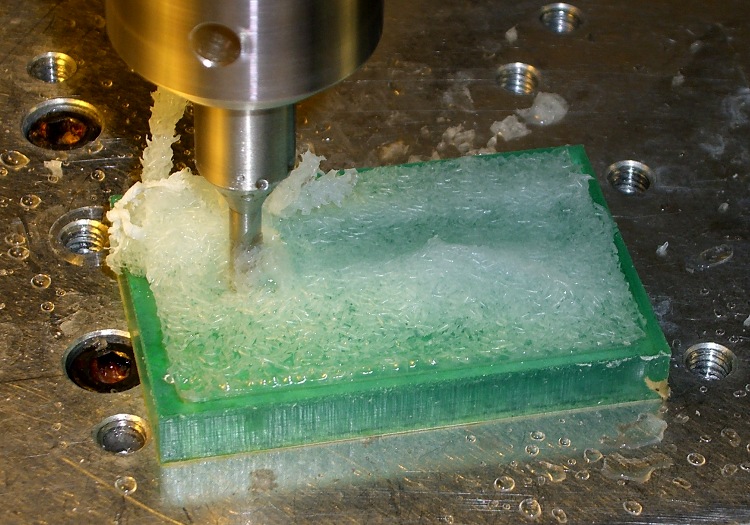
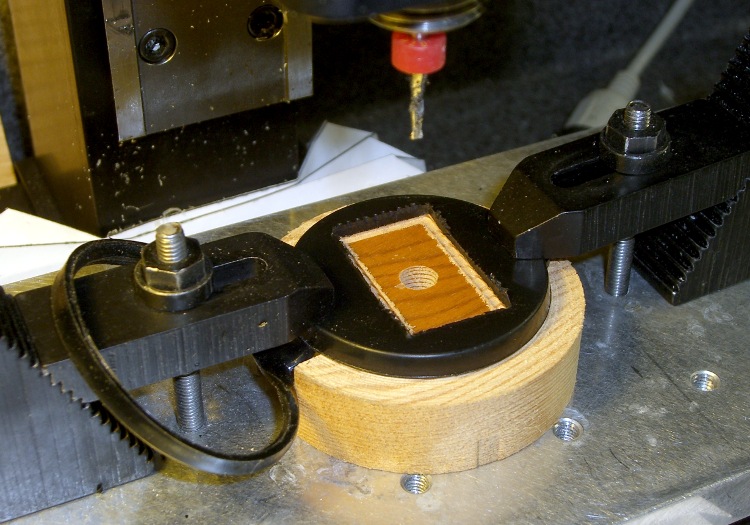
    Pocket milling with water coolant
    Pocket milling with water coolant

    A 1/8″ end mill produced corner radii that matched the buttons fairly well, which means it took a loooong time to chew out the pocket. The picture shows the mill knee-deep in a pool of water and swarf; I vacuumed the chips out at the end of each pass and added more water.

    Double-stick tape held the polycarb & sacrificial plate to the tooling plate, which worked surprisingly well given that I just wiped the grunge off and squashed it down. A machinist’s square aligned the rectangle closely enough and, of course, I used the laser aligner to set the coordinate zero to the left-front corner.

    For lack of anything smarter, a rubber band holds the shield in place on the remote. I thought about fancy hinges and Velcro and stuff like that, but the projector is used by non-technical folks and, as nearly as I can tell, the remote control never gets used at all.

    Quick and dirty, indeed: about two hours, first doodle to snapping the rubber band, including a bit of time wasted on an ancient G-Code generator that spat out bad coordinates.

    Plus time to write this up, natch…
  • Camera LCD Sunshade & Magnifier: Part 2

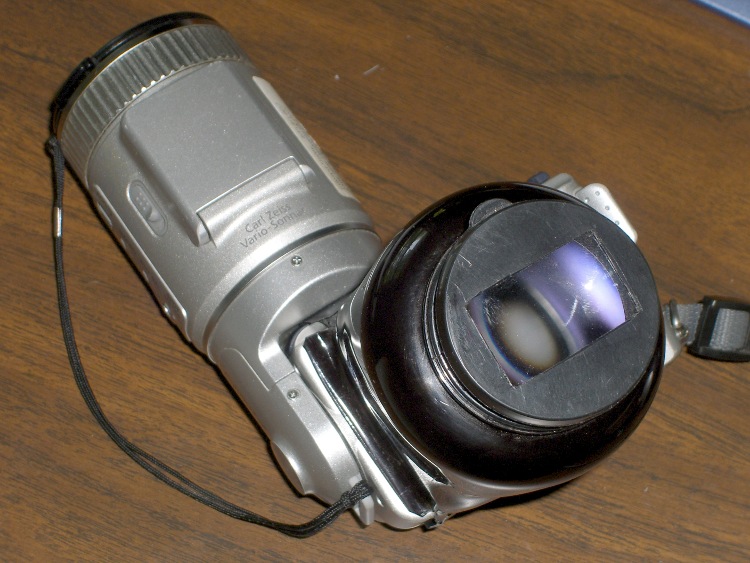
    Lens end of viewer
    Lens end of viewer

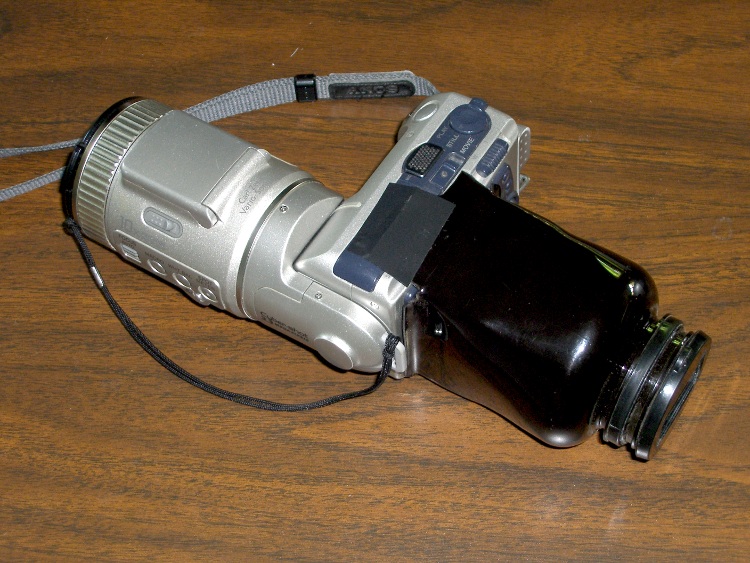
    With the bottle formed & trimmed to shape, it’s time to mount the lens. This view shows the final result, with the camera body angled upward.

    The general idea is that the bottle cap already attaches securely to the bottle, so I can just cut a rectangular hole in the lid, make it just slightly smaller than the lens, and affix the lens inside with the planar surface facing outward.

    Two motivations for making the hole slightly smaller than the lens:

    • The lens has rounded corners, as it was cut from a 38 mm diameter round lens
    • It won’t stick out, get bumped, and fall off
    Lens opening cut in bottle cap
    Lens opening cut in bottle cap

    The first step was, of course, to make a fixture: a sacrificial wood block with a raised section that fits snugly inside the cap. I found a nice maple disk in the scrap bin, chucked it in the lathe, and turned a section to fit. I don’t have a dust extraction system, so I did this one-handed with another on the shop vac to suck up the swarf. Yuch, wood is dusty!

    That simplified clamping the rather slippery lid in place. It’s probably polyethylene that would slide away under heavy cutting loads, but with a 2 mm end mill that wasn’t a problem. The origin is at the center of the cap, directly atop the convenient injection-molding sprue button.

    The lens is 34.4×22.1 mm, so I cut a 32×20 mm opening using manual CNC. Given a 1 mm cutter radius, the G-Code looked something like this:

    #1=[20/2-1]
    #2=[32/2-1]
    g0 x[0-#1] y[0-#2]
    g1 z-2 f100
    x#1
    y#2
    x[0-#1]
    y[0-#2]
    g0 z30

    That’s from memory, so it might not work quite right. Basically, store the key variables in parameters and use those instead of mistyping a digit somewhere.

    The opening even has nicely rounded 1-mm radius corners from the 2 mm cutter…

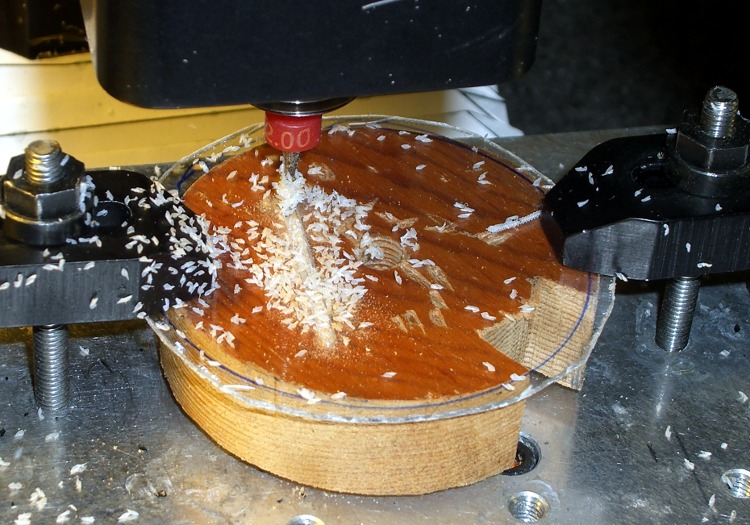
    Cutting acrylic lens holder
    Cutting acrylic lens holder

    I added a sheet of acrylic inside the lid to hold the lens in position and provide a more glue-attractive surface. The lens opening here was a slip-fit for the lens: 34.5×22.2 mm. The G-Code looks pretty much the same:

    #1=[22.2/2-1]
    #2=[34.5/2-1]
    g0 x[0-#1] y[0-#2]
    g1 z-2 f100
    x#1
    y#2
    x[0-#1]
    y[0-#2]
    g0 z10
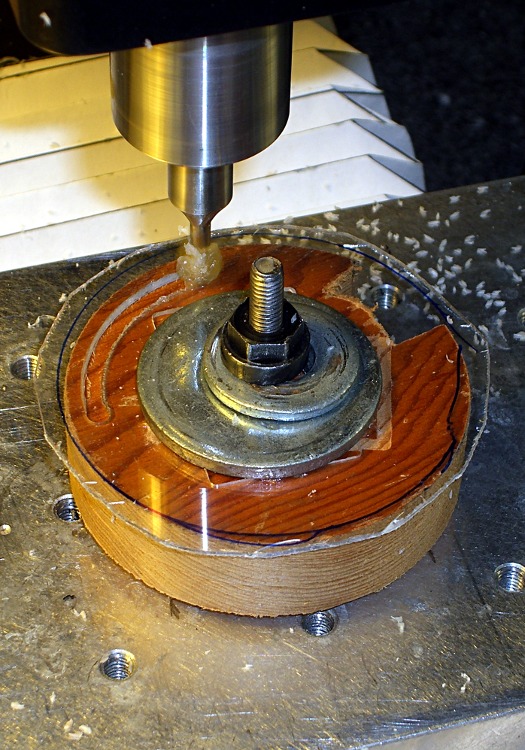
    Trimming outside of acrylic lens holder
    Trimming outside of acrylic lens holder

    The wood disk even had a convenient hole in the middle, making it easy to re-clamp the acrylic from the center with a stack of washers. The laser aligner made alignment easy: make the nut finger-tight, put the spot on the left edge near the front, jog to the rear, twist to split the difference, iterate a few times, then snug down the nut.

    Then the origin is halfway between the edges. Knowing the opening size, find one edge and touch off by half that amount.

    The cardboard lid liner was 43 mm in diameter, so I figured that would work for the acrylic sheet. Circular interpolation makes getting a precise diameter trivially easy, after you remember that this is outside milling so you must add the cutter radius:

    #1=[43/2+1]
    g0 x[0-#1] y0
    g1 z-2 f100
    g2 i#1
    g1 z30
    Finished cap with lens
    Finished cap with lens

    What’s not shown there is the blob of acrylic that welded itself to the cutter because I was taking picures rather than dribbling water on the workpiece to keep it cool. I hate it when that happens.

    But everything pretty much worked out. The holder was a snap fit inside the cap, just like it was supposed to be.

    I glue the lens to the acrylic holder with silicone snot (aka “adhesive” or “caulk”), let it cure overnight, snapped the cap on the bottle, and iterated once to get the lens properly aligned with the opening (the acrylic sheet rotates freely inside the cap).

    Viewer attached to camera
    Viewer attached to camera

    The end result is, admittedly, ugly on a stick, but the first reports from the user community are encouraging!

    We may add a dark cloth ruffle around the bottle cap as an eye shade and eyeglass protector, but that’s in the nature of fine tuning.

  • Homebrew V-750 Dosimeter Charger Pedestal: LED Holder, Spring, and Assembly

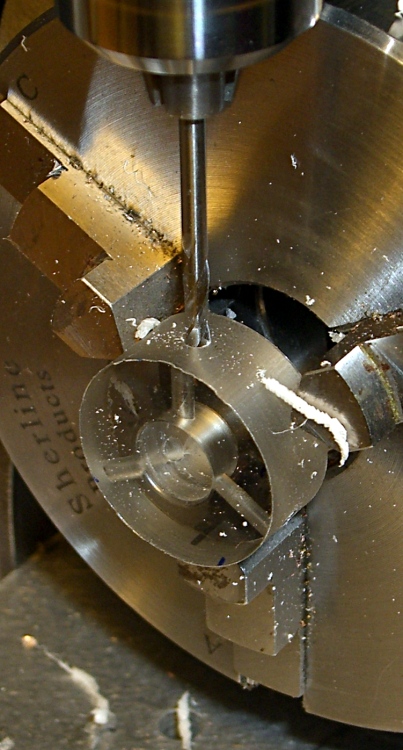
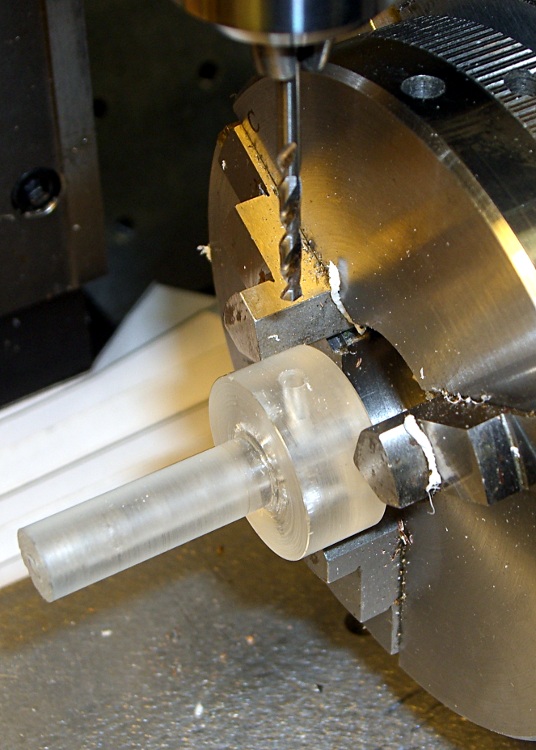
    Drilling mounting holes in base ring
    Drilling mounting holes in base ring

    The charger pedestal includes an LED to light up the dosimeter’s graticule. I seated a 10 mm white LED into a polycarbonate ring that also serves as the base for the stiff spring that presses the contact assembly against the dosimeter’s internal spring.

    I made the base while I was doing the lathe work for the contact assembly, then grabbed it in the Sherline mill’s 3-jaw chuck to drill the 4-40 holes with a touch of manual CNC.

    As before, I manually tapped the holes, but it’s a lot easier with each hole at the right location and pointed in the right direction!

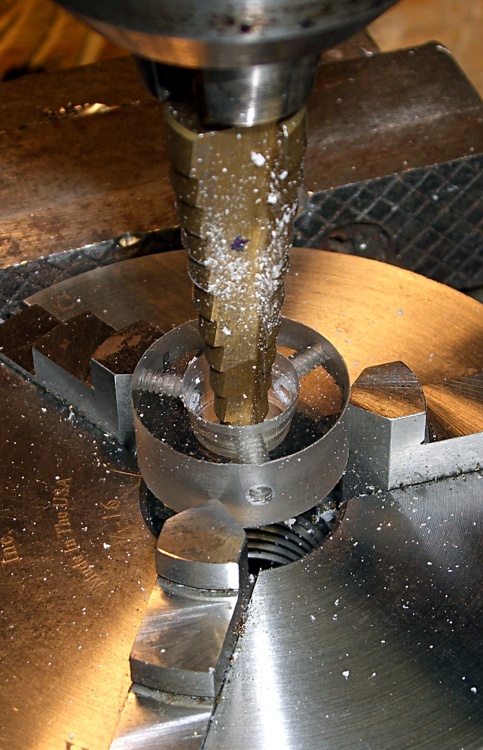
    Step bit making an annular ring
    Step bit making an annular ring

    I described the step-drilling that produced the correct hole and shoulder sizes there. That won’t work every time, but in this situation it was just about perfect.

    The LED power wires pass through the central hole in the ring. I used a blob of hot-melt glue to hold the LED in place; epoxy would be more in keeping with the nuclear weapons theme, but HMG is just fine with me.

    There’s another hole just to one side of the LED, more or less centered between the mounting screws, that passes the wire from the dosimeter charging contact out of the pedestal. This wire starts at the center of the top, passes inside the spring, and must not be pinched along the way.

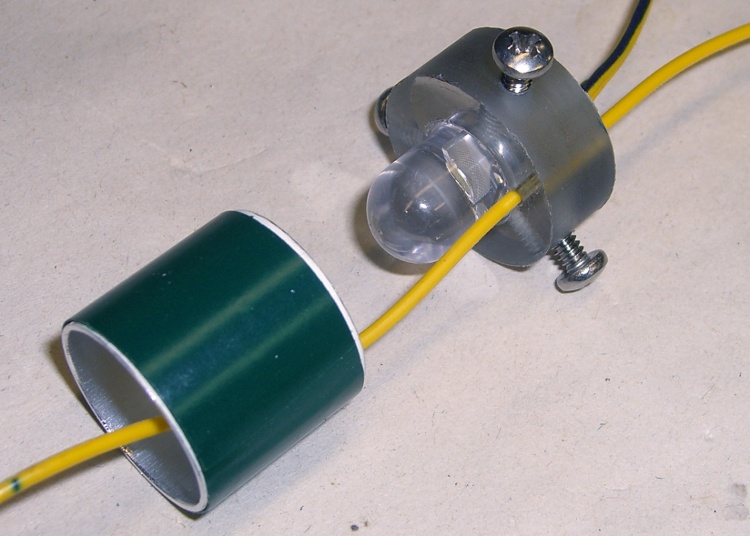
    LED in base with spring positioning ring
    LED in base with spring positioning ring

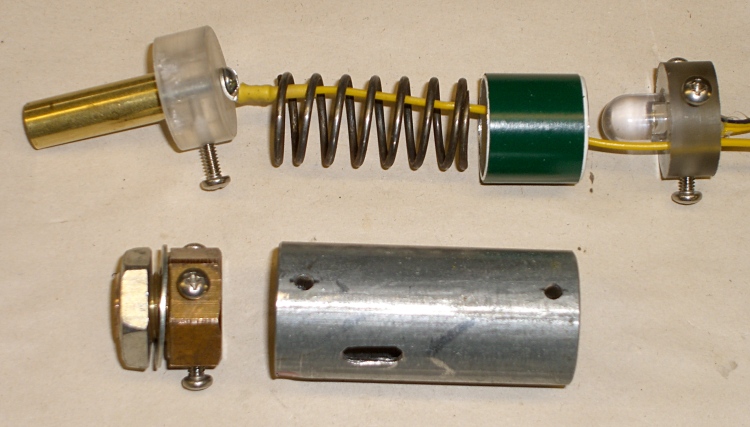
    I added an aluminum cylinder as a positive stop to prevent the dosimeter contact assembly from getting pushed too far into the pedestal. The length matches up with the anti-rotation slot in the EMT: the screw doesn’t quite hit the top or the bottom of the slot.

    A wrap of green electrical tape around the outside made the cylinder a slip fit inside the EMT shell. It shouldn’t move at all.

    The cylinder also holds the spring in place so it can’t rub against the charging wire, but I’m pretty sure that isn’t necessary.

    The spring comes from my parts heap. It must provide a bit under 8 pounds of force to activate the dosimeter charging spring with about 3 mm of travel. I picked the length of the EMT shell to preload the spring to make the answer come out right, which also affects the length of the aluminum cylinder.

    The spring OD must fit into the EMT and the ID must clear the 10 mm LED and charging wire in the base. Your mileage will most certainly vary.

    Charging pedestal components
    Charging pedestal components

    Assembly is straightforward, but goes much more easily with three hands.

    • Screw the panel mount bolt into place
    • Attach the charging wire to the central contact & remove the anti-rotation screw
    • Slide the central contact in place, reinstall the screw through the slot
    • Slide the spring & aluminum cylinder in place, wire in the middle
    • Pass the wire through the LED base ring
    • Press the base assembly into position and hold while installing the screws
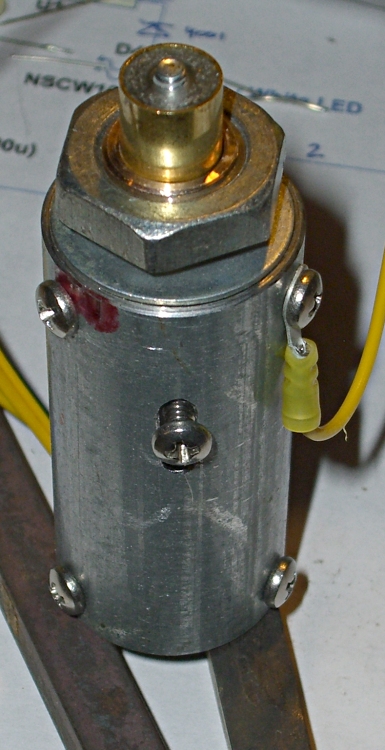
    Finished charging pedestal
    Finished charging pedestal

    The charger I built turns the LED and charger power on with a push-to-activate digital encoder knob, so there’s no need for the 1 lb spring & switch found in the V-750 charger.

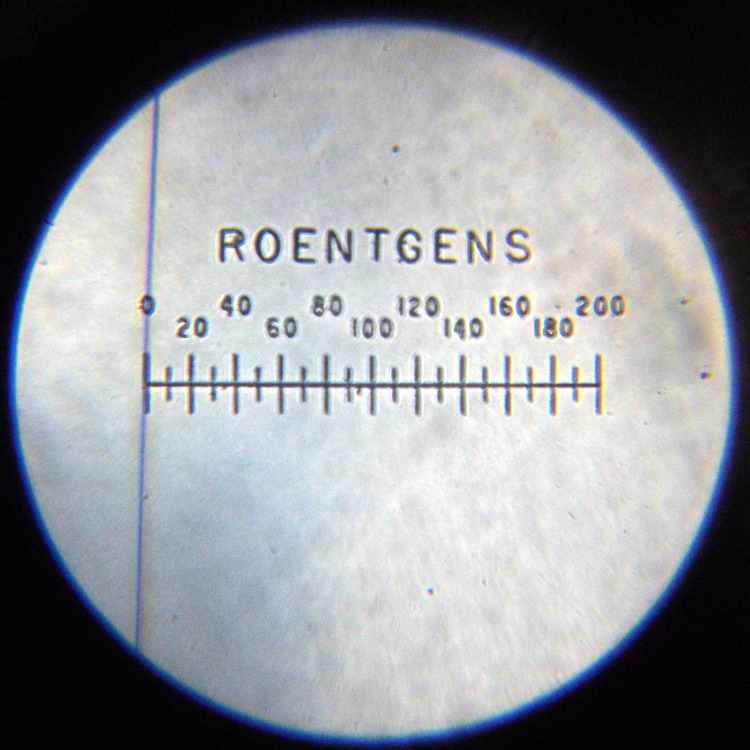
    To read the dosimeter, just hold it loosely atop the pedestal, push the twiddle knob down, and the LED comes on.

    To zero the dosimeter, press it firmly and twiddle the knob for zero!

    I’ll describe the charger circuity at some point; it’s detailed in my Circuit Cellar column in the August 2009 issue.

    V-742 Dosimeter set to Zero
    V-742 Dosimeter set to Zero
  • Homebrew V-750 Dosimeter Charger Pedestal: Outer Shell

    Finished charging pedestal
    Finished charging pedestal

    This is a chunk of EMT (Electrical Metallic Tubing) with 4-40 clearance holes that attach it to the panel mounting bolt, hold the base disk in place, and keep the central contact assembly from rotating. The overall view gives you a good idea what’s involved.

    The nominal EMT size is 3/4″, which (of course) means the ID is about 0.8″ and the OD is a bit over 0.9″. There’s a weld seam running the length of the tube that I cleaned up on the lathe, so the actual ID is slightly enlarged. While it’s in the lathe, face off both ends to whatever length suits the spring you’ll eventually use.

    There’s nothing tricky about this, other than getting the three holes on each end lined up properly with their mating parts. Once again, manual CNC comes in handy: grab it in the 3-jaw on the rotary table, use G81 to drill the hole and G0 A120 and G0 A240 to index the locations. Make sure you retract the drill bit far enough to clear the chuck jaws!

    The two sets of holes need not be perfectly aligned with each other.

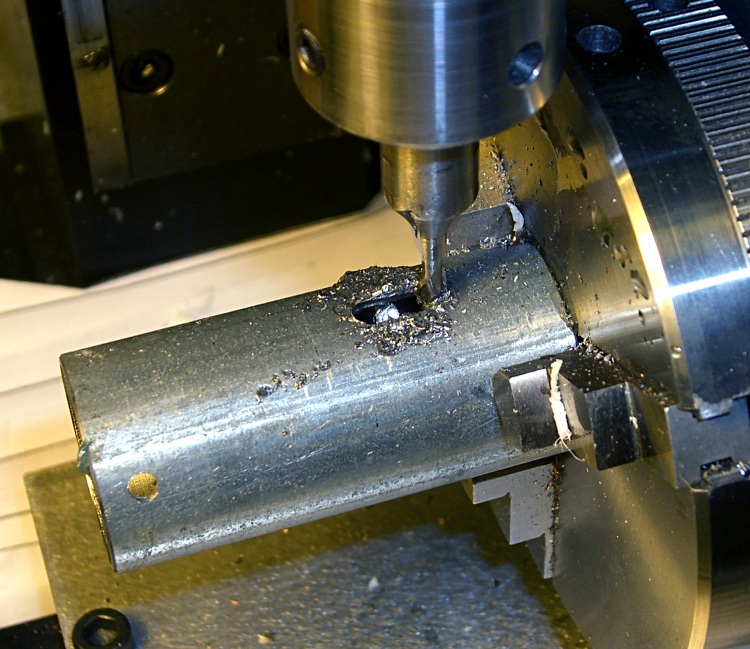
    Milling rotation stop slot in shell
    Milling rotation stop slot in shell

    The photo shows that I milled the rotation stop slot after drilling the holes. It’d be easier to do that without removing the cylinder from the chuck, but this was one of those incremental designs where I was checking the fit as I built it.

    The slot should be long enough to allow the contact assembly to slide almost completely into the pedestal. That prevents you from crunching the dosimeter’s innards when you’re pressing it down on the spring.

    The clearance from tool holder to chuck isn’t all that large; you might want to put the slot at the far end of the cylinder… but then I’d have to conjure up a pipe center for the Sherline tailstock and figure out how to mount it high enough to match the rotary table’s axis.

  • Homebrew V-750 Dosimeter Charger Pedestal: Panel Mount

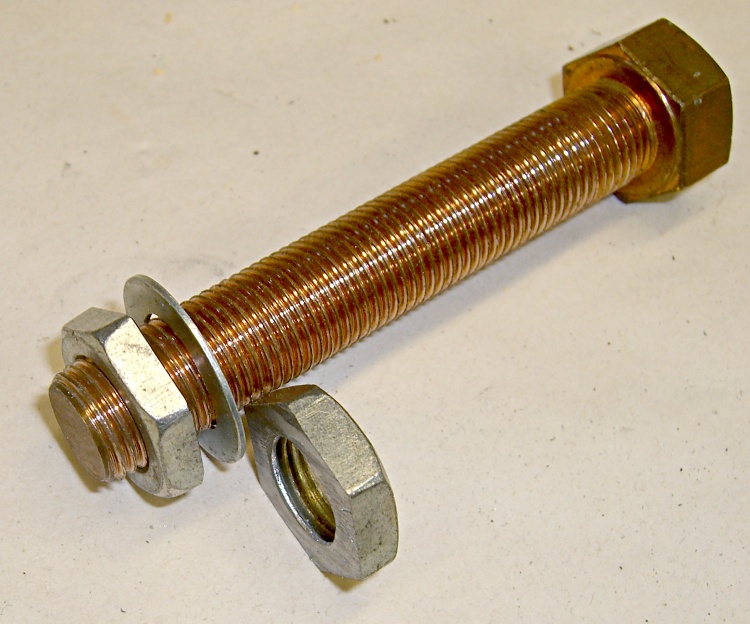
    Copper 1/2"-20 bolt with thinned steel nut
    Copper 1/2"-20 bolt with thinned steel nut

    The original V-750 pedestal is a threaded bushing around the cylinder that contacts the dosimeter. Hard to make from scratch, but it’s basically a bolt with hole in the middle. I can do that…

    A foray into the parts heap produced a copper bolt threaded 1/2″-20 and a matching steel nut. I bandsawed the nut in half, doing a surprisingly good job of cutting it parallel to the surfaces, and filed off the obvious blems. The thin washer fit a 7/16″ bolt until I filed the hole out; the OD is a bit undersized for a 1/2″ head and looks much better in this application.

    I grabbed the bolt threads in the lathe and turned down the head for a slip fit in the EMT. Turns out the head wasn’t exactly concentric with the threads, but now the rounded-off hexagon tips are. Drill out the middle for a slip fit around the 11/32″ brass tubing, break the edges, and it’s all good.

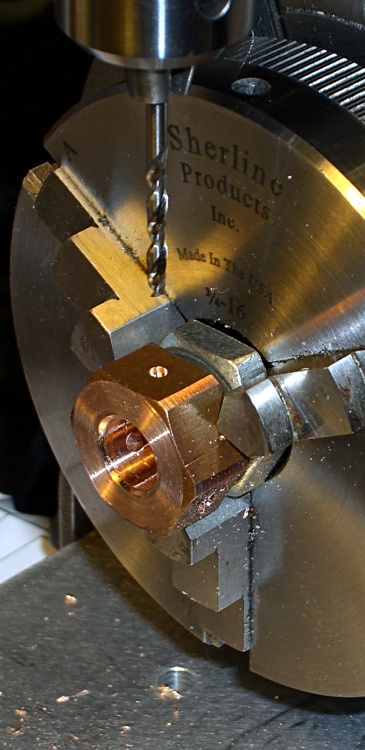
    Drilling EMT mounting holes in bolt head
    Drilling EMT mounting holes in bolt head

    The bolt threads need to be barely long enough to go through the aluminum box I’ll eventually mount this thing in and pass through the nut, so I sawed the bolt off to 3/8″, more or less, and cleaned up the end in the lathe.

    I thought about soldering the bolt to the EMT shell, but, fortunately, came to my senses before doing any damage. Instead, I drilled & tapped three 4-40 holes in the head that will match with similar clearance holes in the EMT. This is the sort of thing that works really well with “manual” CNC: get the first side lined up, then just type G0 A120 and you’re at the next face. A manual G83 peck drill cycle pokes the hole exactly where it’s needed.

    Manual tapping, a bit more edge breaking, some cleanup, and the thing looks pretty good.

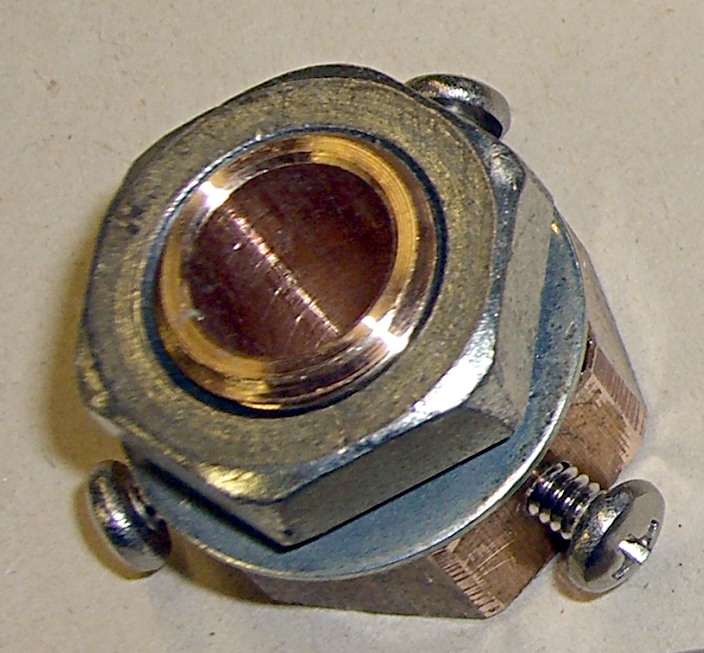
    Pedestal mount - oblique view
    Pedestal mount – oblique view
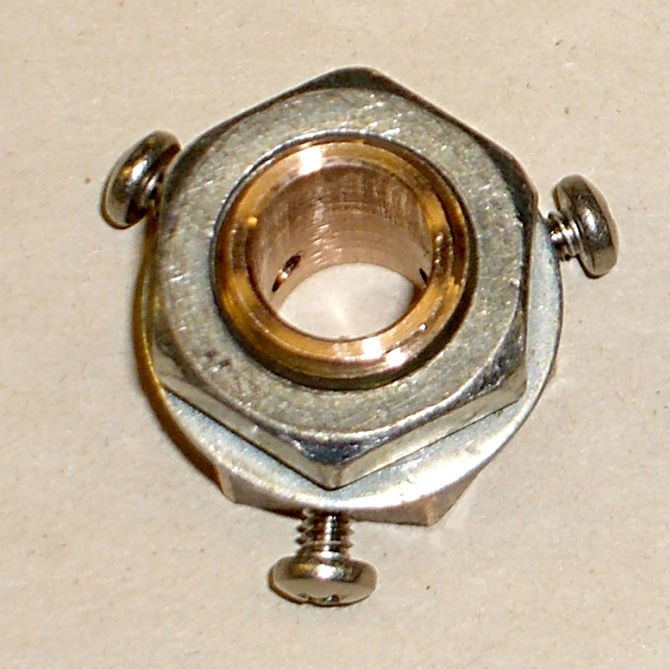
    Pedestal mount - top view
    Pedestal mount – top view
  • Homebrew V-750 Dosimeter Charger Pedestal: Insulator & Light Pipe

    Contact Detail - Bottom View
    Contact Detail – Bottom View

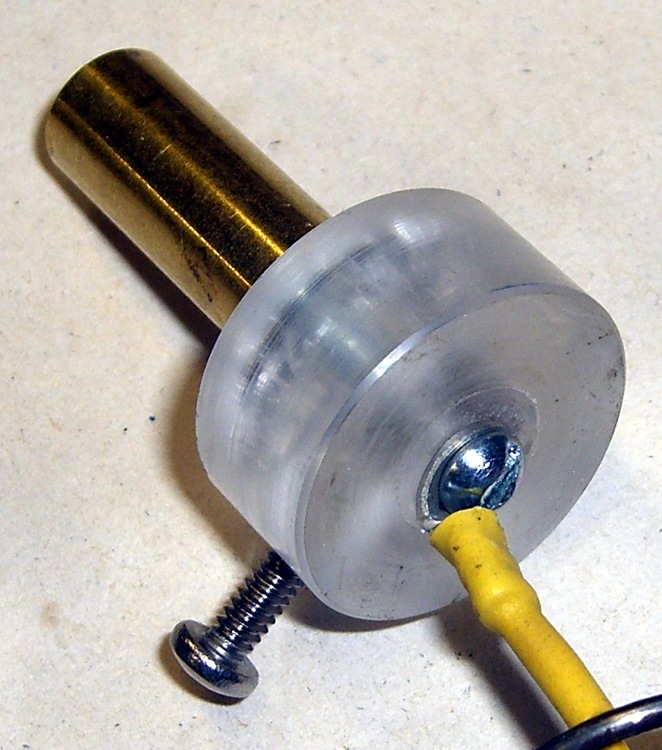
    The cylindrical center of the pedestal must conduct light into the dosimeter, conduct a positive charge into the contact pin, and push that pin hard enough to make contact inside the dosimeter.

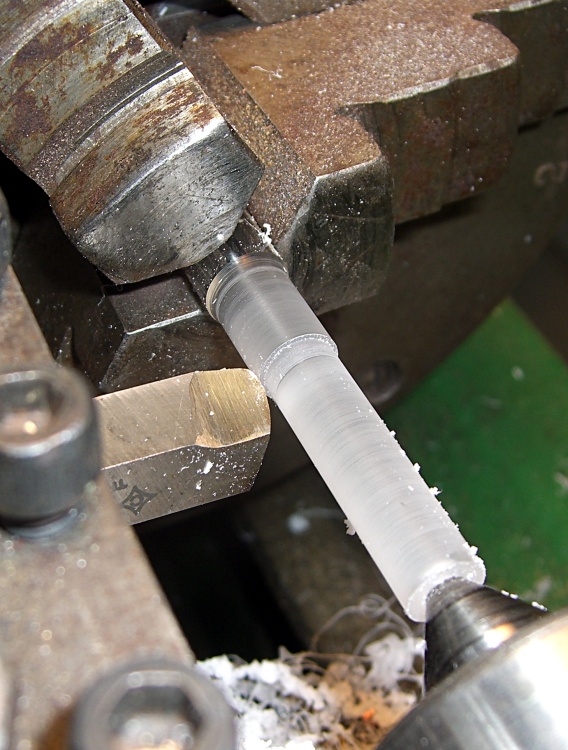
    The general notion is to turn an acrylic rod to a slip fit inside an 11/32″ telescoping brass tube, glue a wider acrylic disk to the bottom to take up the spring pressure, and run a 4-40 machine screw right down the axis to carry the current. There’s also a screw in the side to prevent the shaft from rotating.

    Although the bulk of screw and solderless lug looks like it should block much of the central shaft’s view of the LED in the base, enough light gets around to illuminate the dosimeter’s scale. The acrylic doesn’t need an optically perfect finish, either, as diffuse light works fine.

    Turning contact base ring
    Turning contact base ring
    Turning central contact post
    Turning central contact post

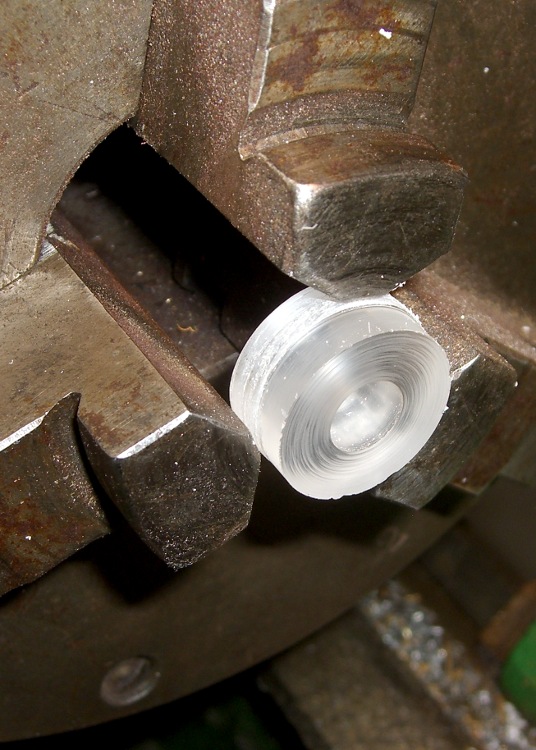
    I used a hole saw to extract a disk from a piece of acrylic that used to contain one of those crappy desk clocks they give out as awards when money’s too tight to mention. The diameter should be a bit larger than the EMT’s ID so you can turn it to a slip fit.

    Chuck the disk up reasonably square and drill out the center to a bit over 11/32″, so the tubing will bear against the rod rather than the base.

    The acrylic rod has two slip fits: into the brass tubing and into the disk. Neither will be particularly fussy, so don’t lose much sleep over perfection here. Apply some good solvent adhesive to the rod’s large end and slide it into the disk. Pause for a day while it cures: it’s a big joint.

    After it’s cured, chuck up the rod and turn the disk so it’s nice & square & neatly finished.

    You’ll need two more disks: one for the pedestal base and another to act as a collet. I made them from 3/8″ polycarbonate sheet, of which I have what may turn out to be a lifetime supply. The base disk will be another slip fit in the EMT, the collet must match the actual OD you just turned on the contact disk. Saw a slot in the collet disk to convert it into a (crude) collet.

    Drilling 4-40 clearance hole
    Drilling 4-40 clearance hole

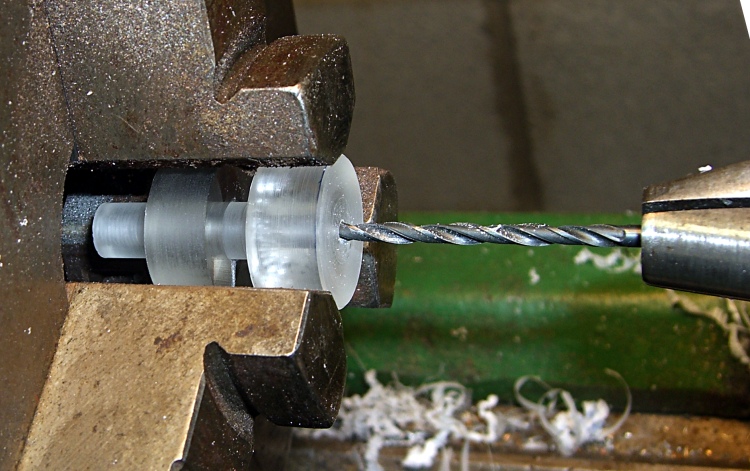
    The original V-750 pedestal has a nice stamped rod running the length of the central post, but I figured a long 4-40 screw would work as well. However, there’s no reason to thread the entire length of the post, so drill out a 4-40 clearance hole from the disk to within about 1 cm of the other end. This is where the collet disk comes in handy; you can see the saw slit at the bottom, between two jaws.

    Take the rod out out and thread the end.

    Drilling rotation stop hole
    Drilling rotation stop hole

    The last step is drilling & tapping a 4-40 hole in the side for the rotation stop screw. This will fit into a corresponding slot in the EMT shell to prevent you from twisting the contact wire off.

    Put everything together, with a dab of cyanoacrylate adhesive to keep the brass tubing in place, and you’re done with this part.

  • Anchoring Sherline Stepper Motor Wires

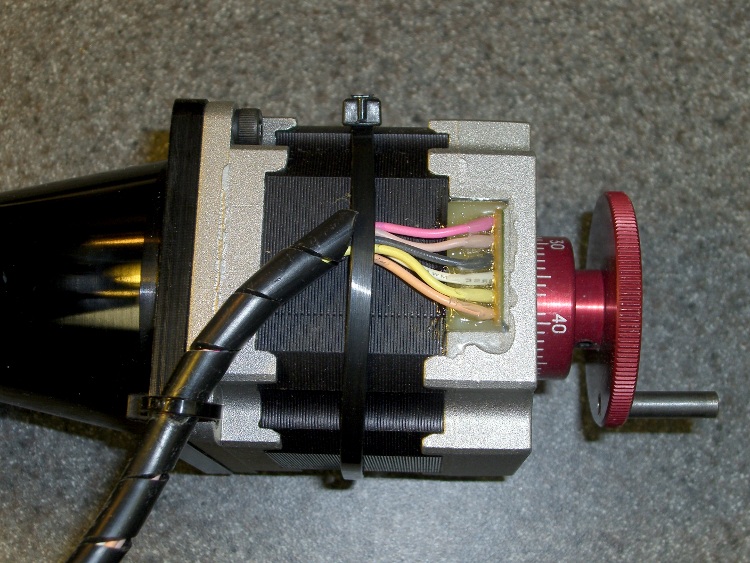
    Anchoring stepper motor wires with cable ties
    Anchoring stepper motor wires with cable ties

    The wires coming out of Sherline CNC milling machine stepper motors, as with most small stepper motors, emerge from an epoxy-filled opening. As a result, whenever the motor or wires move, all the stress concentrates right at that epoxy surface.

    Which is exactly where the wires will break…

    There’s no good way to add strain relief to that point (more adhesive isn’t helpful), but you can anchor the cable to the motor frame so that the individual wires do not move relative to the motor.

    Cable ties will suffice. Add one around the entire motor to hold the wires in place, then lash the spiral sheath to one of the unused mounting holes in the motor frame.

    Pull those ties until they squeak! You can grab the tabs with flush-cutting diagonal cutters to get some traction, then rotate the cutters against the ratchet housing to pull another notch past the ratchet. When it’s so tight you’re stretching the tie, then it’s tight enough; clip the end off with the cutters.

    To cross-check, wiggle the connector end of the cable. If the wires move at the epoxy, then you haven’t done a sufficiently good job. Repeat until satisfied.

    This works for the milling machine and, as shown in the picture, the rotary table. Just do it!