-
Laser Cutter vs. Mirrorshades: Rear
Continuing with the same battered sunglass lens:

Laser vs sunglasses – beam front overview It’s now oriented with the back side of the lens toward the unfocused beam going into the laser head.
The front surface remains undamaged after two pulses at 500 ms 50% power:
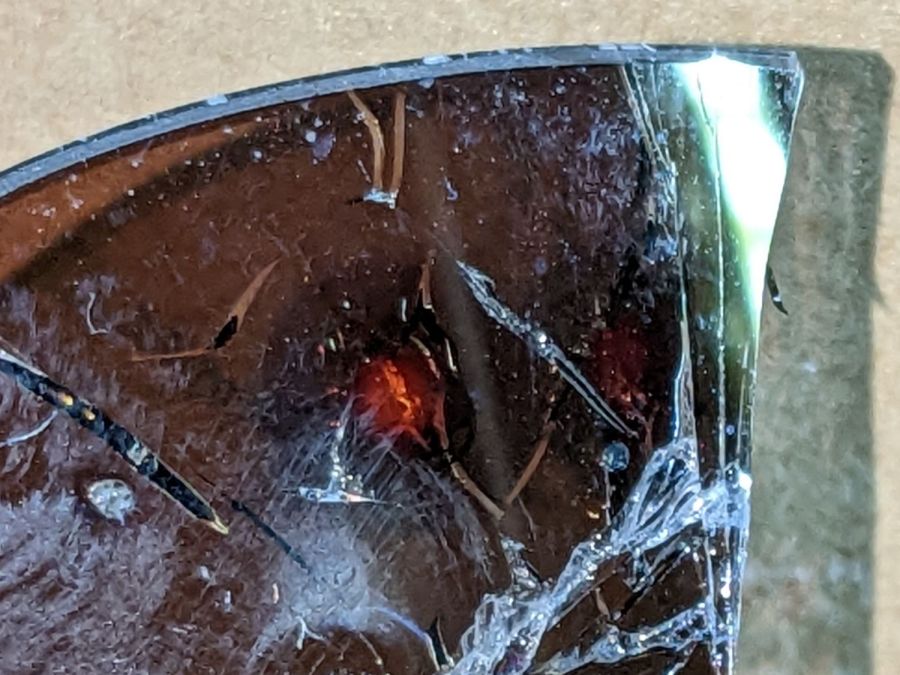
Laser vs sunglasses – beam rear – front overview The red disk in the middle of both wounds is new this time.
As seen from the rear, the first pulse shattered the rear glass layer:

Laser vs sunglasses – beam rear – A The image is about 7 mm from side to side.
A chip of glass popped out of the upper part of the fracture, but the other pieces remained in place.
The distinct blue ring is 3 mm OD and marks the inner boundary of a purple disk surrounding the central burn. The disk appears only in reflected light (which is impossible to photograph with any setup I can manage), suggesting it comes from diffraction in a surprisingly uniform air layer blown between the glass and the plastic polarizing sheet.
Also seen from the rear, the second pulse produced a neater wound:

Laser vs sunglasses – beam rear – B The blue ring is again 3 mm OD and the image is 7 mm across.
The central red spot probably comes from damage to the polarizing sheet.
The most surprising things, at least to me, didn’t happen:
- the glass lens didn’t disintegrate
- the laser beam didn’t punch completely through
Protip: Don’t depend on ordinary glasses, even fancy sunglasses, to protect your eyes from CO₂ laser beams.
-
Subscribe
Subscribed
Already have a WordPress.com account? Log in now.
 The Smell of Molten Projects in the Morning