-
Thing-O-Matic: Filament Diameter
What with printing this and that and those and some other things, we ran through a pound of red filament in short order. That’s fine with me, because I could never figure out a good combination of settings to photograph the objects; the cameras I have on hand seem blind to saturated red and overexpose the daylights out of it, even with the flash turned down a stop or two.
We picked yellow as our least favorite of the remaining colors, yanked out the last few feet of red filament as a show-n-tell for presentations, rammed in the yellow, and extruded a red-to-orange-to-yellow plastic tangle over the platform.
The two filaments had somewhat different diameters:
- Red: 2.91 mm dia → 6.65 mm2 area
- Yellow: 3.00 mm dia → 7.07 mm2 area
The area ratio is 1.06, so the yellow filament puts 6% more plastic through the nozzle at a given extruder speed. I’d been running the red filament at 1.40 rev/min for 20 mm/s feed, so the yellow should produce the same results at 1.40/1.06 = 1.32 rev/min.
My Shop Assistant designed some beads for a cloak she’s repairing and we tried one at 1.25 rev/min (better to err on the low side, I figured) that came out thoroughly overstuffed. She deemed it usable and whisked it off for painting before I could get a picture.
I ran another one at 1.15 rev/min that was still a bit overstuffed. A pair (using Multiply) looked better at 1.10 rev/min. This is a group photo:
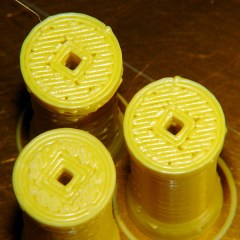
Bead – top fill 1.15 1.10 rpm So I ran off two polyhole test sheets at 1.15 and 1.10 rev/min, the latter of which looked much better. At 1.10 rev/min, the holes run a consistent 0.3 mm smaller than the programmed diameter: 3% on the 9 mm hole. Close enough!
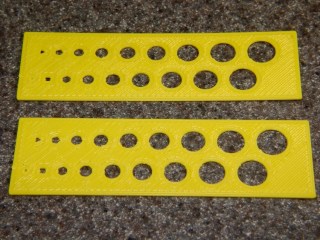
Polyholes – yellow 1.15 1.10 rpm Then it’s time for some things from coasterman’s calibration set.
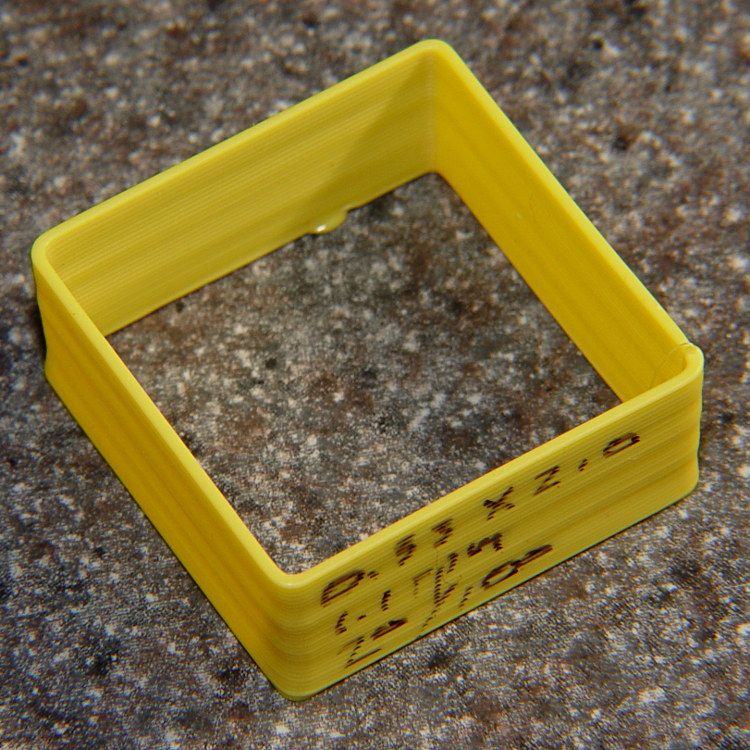
A thin-wall box at 1.10 rev/min and 20 mm/s came out with exactly 0.66 mm wall width, so that extrusion speed produces a physical thread that matches the Skeinforge thread parameters used to make the extrusion: 0.33 mm thickness and 2.0 w/t.
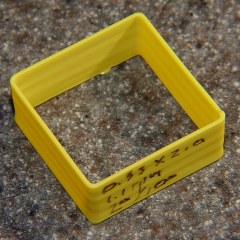
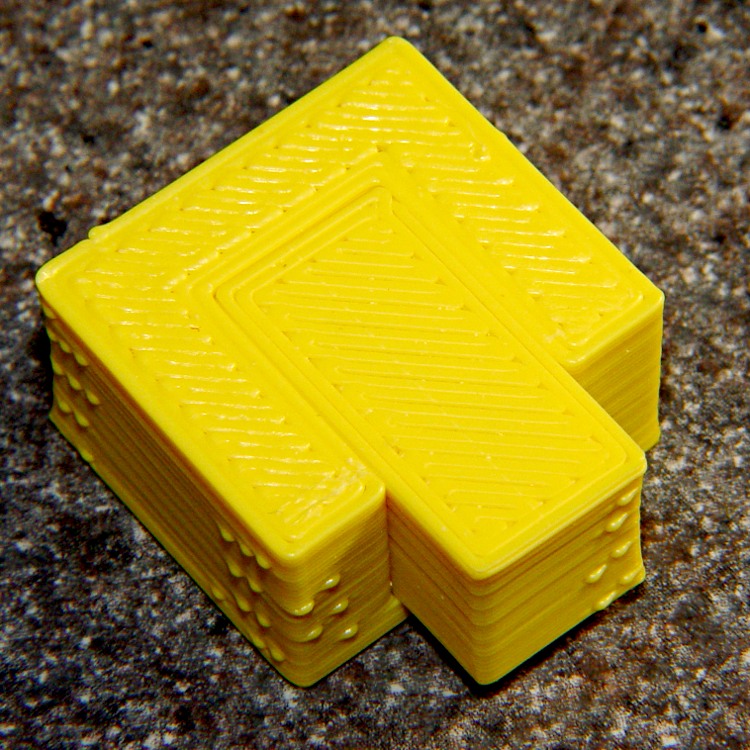
Thin wall box – yellow 1.10 rpm 0.33 x 0.66 mm And then a perimeter test box came out perfect. After scraping off some Reversal zits, the small block fits into the recess in all possible orientations. The base is slightly larger than the top, but that just makes for a somewhat more snug fit. The block is upside-down in the recess so you can see both sides of the printed objects:
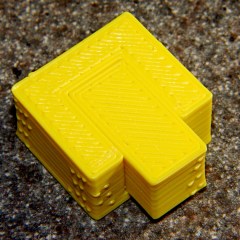
Perimeter Calibration Block – yellow 1.10 rpm 0.33 0.66 mm So.
The initial extrusion speed ratio based on the filament area gets you close, but it still takes a few calibration objects to achieve perfect results. What’s really nice: after that calibration, it’s spot on!


-
Subscribe
Subscribed
Already have a WordPress.com account? Log in now.
 The Smell of Molten Projects in the Morning