-
Kenmore 158: AC Motor Running on DC!
The sewing machine had a three-contact plug / terminal block that joins all the wiring:
- AC power from the wall
- Pushbutton power switch
- Foot pedal speed control (carbon-pile rheostat)
- AC motor
- Endcap light
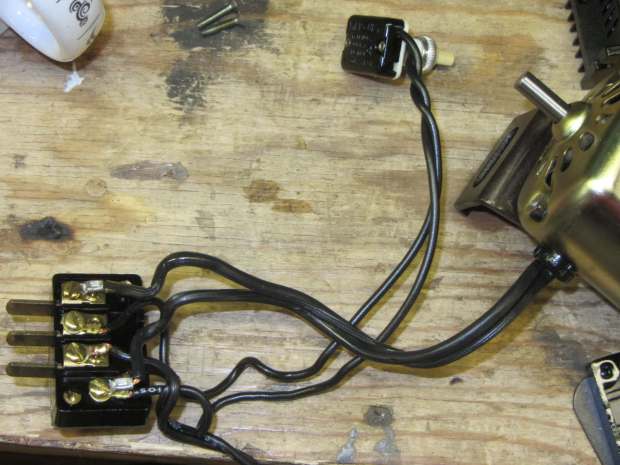
Kenmore 158 – terminal block For completeness, the matching socket (not shown) joins two cords:
- AC line cord (two wire, not polarized, no ground)
- Foot pedal
Extract the motor wiring from that block and connect it to a 50 V / 3 A bench supply, with the positive lead to the marked wire conductor:
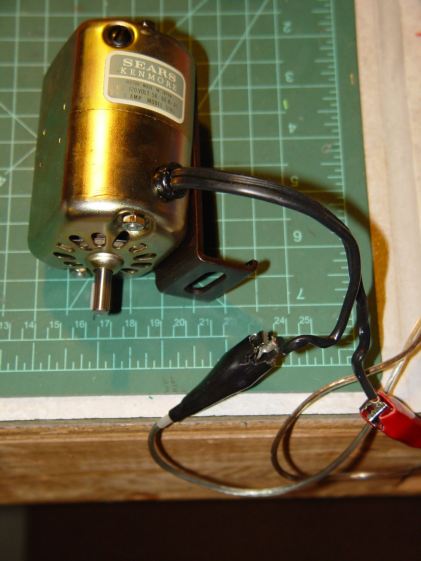
Kenmore 158 AC motor – DC power Cranking the voltage upward from zero:

Kenmore Model 158 AC Motor on DC – RPM vs V So that’s about 200 RPM/V, offset by 2800 RPM. Totally unloaded, of course.
The original data:
DC V DC A RPM Notes 15 0.29 690 Barely turning 20 0.28 1380 Finger-stoppable 25 0.29 2350 30 0.29 3450 35 0.30 4450 40 0.29 5740 45 0.29 6780 Still finger-holdable at start 50 0.29 8000 I can hold the shaft stopped between my fingers up through 45 V, with 0.54 A locked-rotor current at 25 V. The motor doesn’t have a lot of torque, although it’s operating at less than half the normal RMS voltage.
I should take those numbers with the motor driving the sewing machine to get an idea of the actual current under a more-or-less normal load.
Reversing the power supply leads shows that the motor rotates only counterclockwise, which is exactly what you’d expect: both polarities of the normal AC sine wave must turn the motor in the same direction.

-
Subscribe
Subscribed
Have a WordPress.com account? Log in now.

