-
Kenmore 158: ET227 Transistor Drive Gain
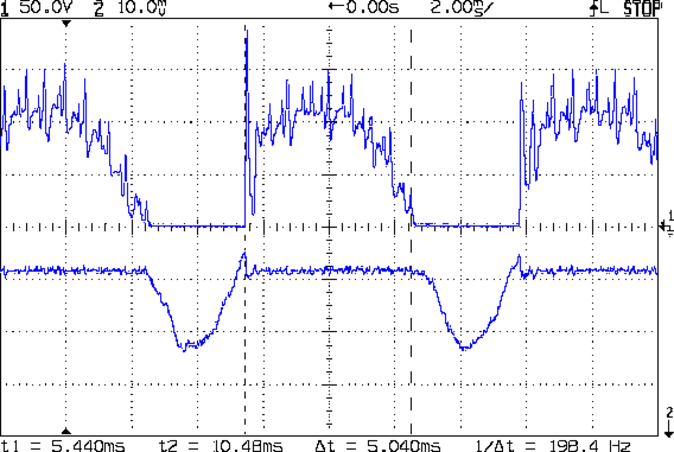
A closer look at the collector voltage and current for the brute-force ET227 NPN transistor motor drive:

Model 158 – 77 mA base VCE 200 mA div The motor current (200 mA/div) never goes to zero, but the ET227 collector voltage hits zero as the transistor saturates: the motor winding soaks up all the available line voltage and the transistor dissipation drops close to zero. The datasheet suggests VCE(sat) < 0.1 V for IC < 5 A, albeit with IB = 30 A (!).
The ET227 base drive was 77 mA, measured on a better meter than the low-resolution one in the power supply, and the transistor gain works out to 8 = 620 mA / 77 mA along those flat tops.
Eyeballometrically speaking, the dissipation averages 50 W = 90 V x 620 mA during those spiky sections where the transistor must absorb the difference between the line voltage and the motor voltage. The cursors say that takes 5 ms of the 8.3 ms period of the 120 Hz full wave rectified power, so the duty cycle is 42% and the average average dissipation works out to 20 W. That’s still enough to warm up that big heatsink; the motor driver will need a thermal sensor and a quiet fan.
That commutation noise looks pretty scary, doesn’t it?
The test setup:
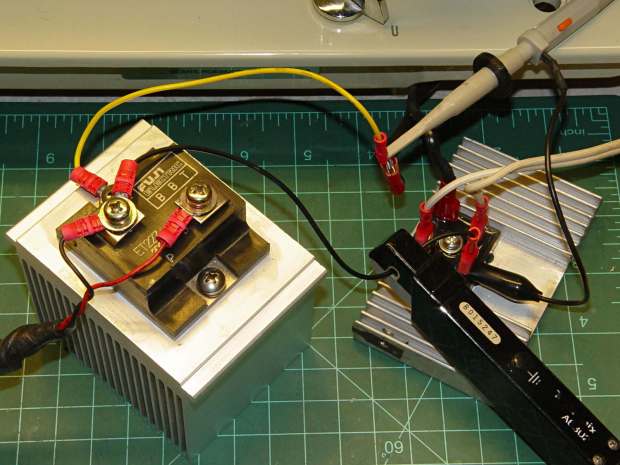
Kenmore 158 – AC motor FW ET227 drive – test setup The bridge rectifier doesn’t really need a heatsink, but it looked better for a Circuit Cellar picture…
-
Subscribe
Subscribed
Have a WordPress.com account? Log in now.

