-
Tour Easy Rear Fender Bracket
I’d originally secured the rear fender to the steel strap connecting the chainstays on Mary’s Tour Easy with a cable tie: small, simple, light weight, reliable. Unfortunately, that put the end of the fender just slightly lower than the strap and, I fear, sprayed water all over the strap, where it worked its way through a paint flaw and rusted the steel under the paint. A simple metal clip would chew its way through the pain[t] on the strap, so, seeing as how we’re living in the future…
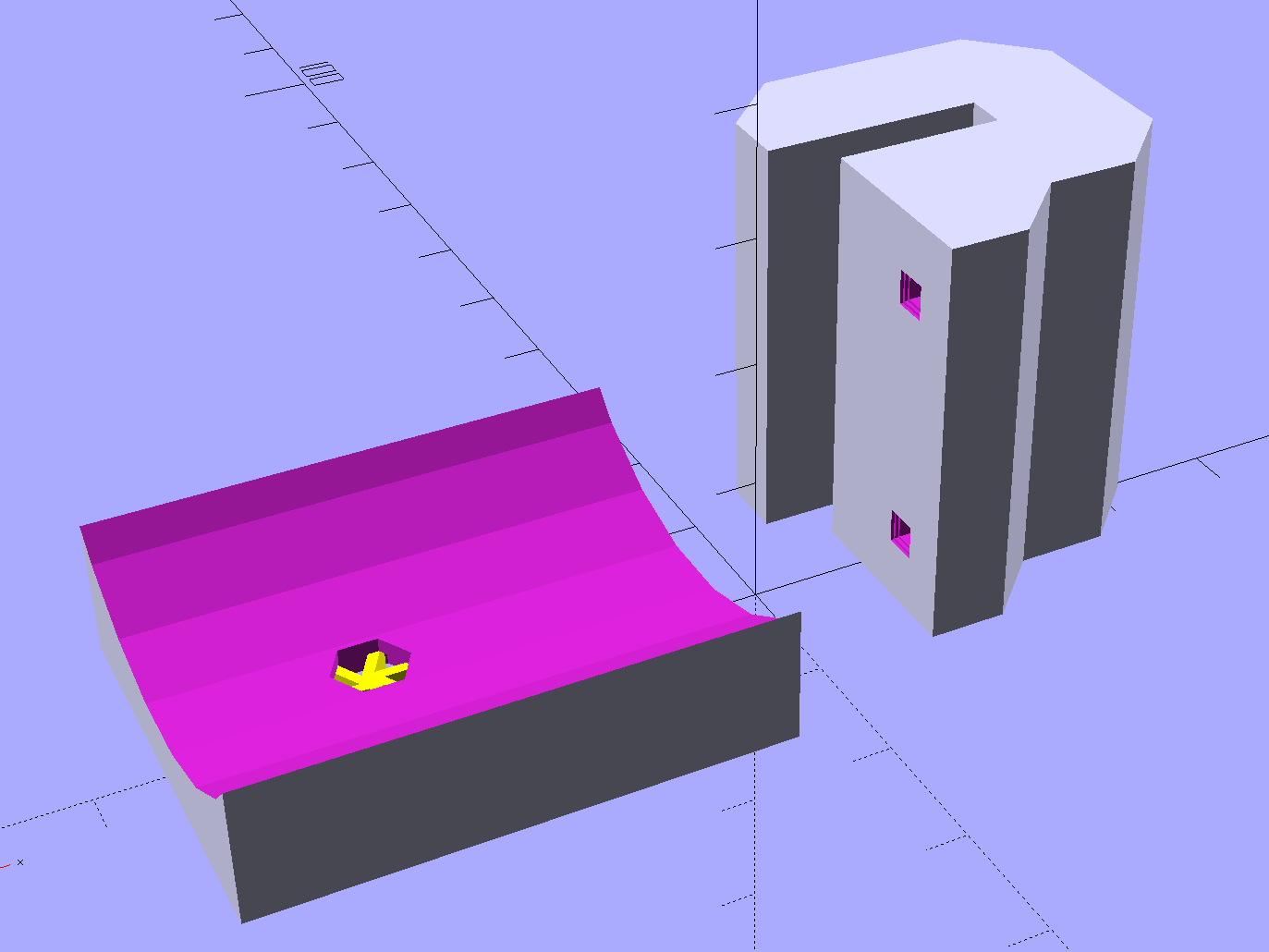
The C-shaped block on the top grips the steel cross-strap, the trough fits the fender’s curve, the little spider supports the inside of the nut recess, and a pair of alignment pin holes (one visible) help during gluing:
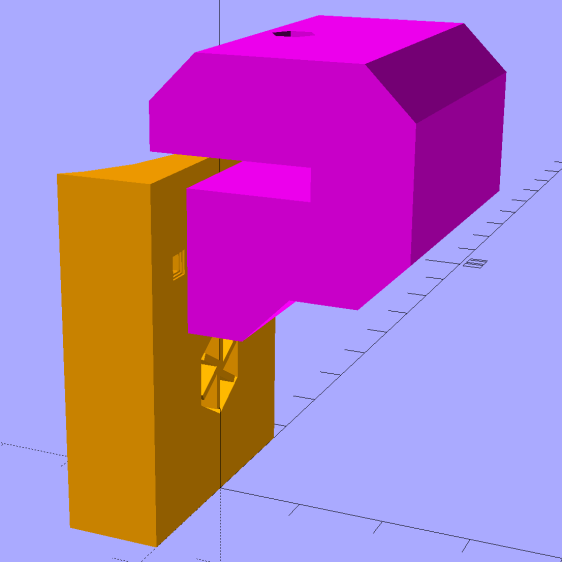
Tour Easy Rear Fender Bracket – solid model – show Although it’s tempting to 3D print both parts as a single unit, laying them out like this aligns the threads for best strength in each piece:
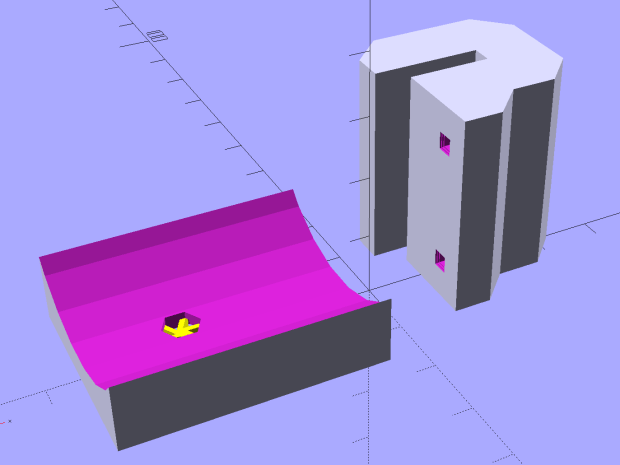
Tour Easy Rear Fender Bracket – solid model – build Pressing the bracket on the glass slab (flat side up, nubblies on the bottom) with the clamps in place finished the job. The slightly crushed support spider from the nut recess sits in the foreground:
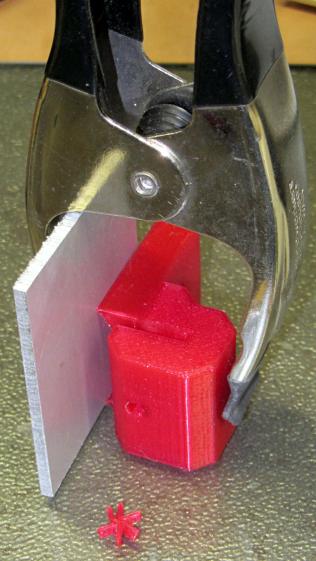
Tour Easy rear fender bracket – gluing Magenta PETG matches the red Tour Easy paint surprisingly well:
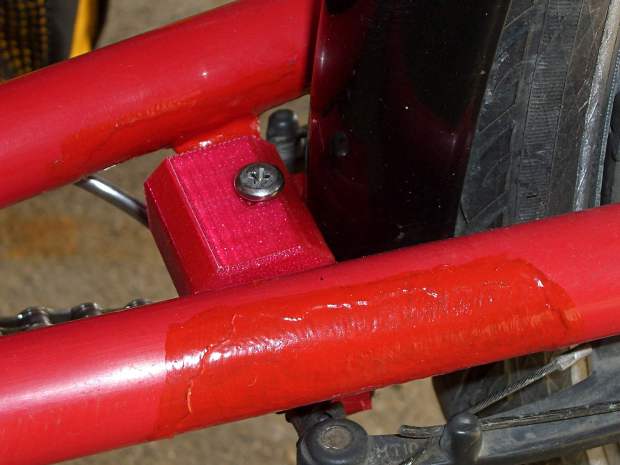
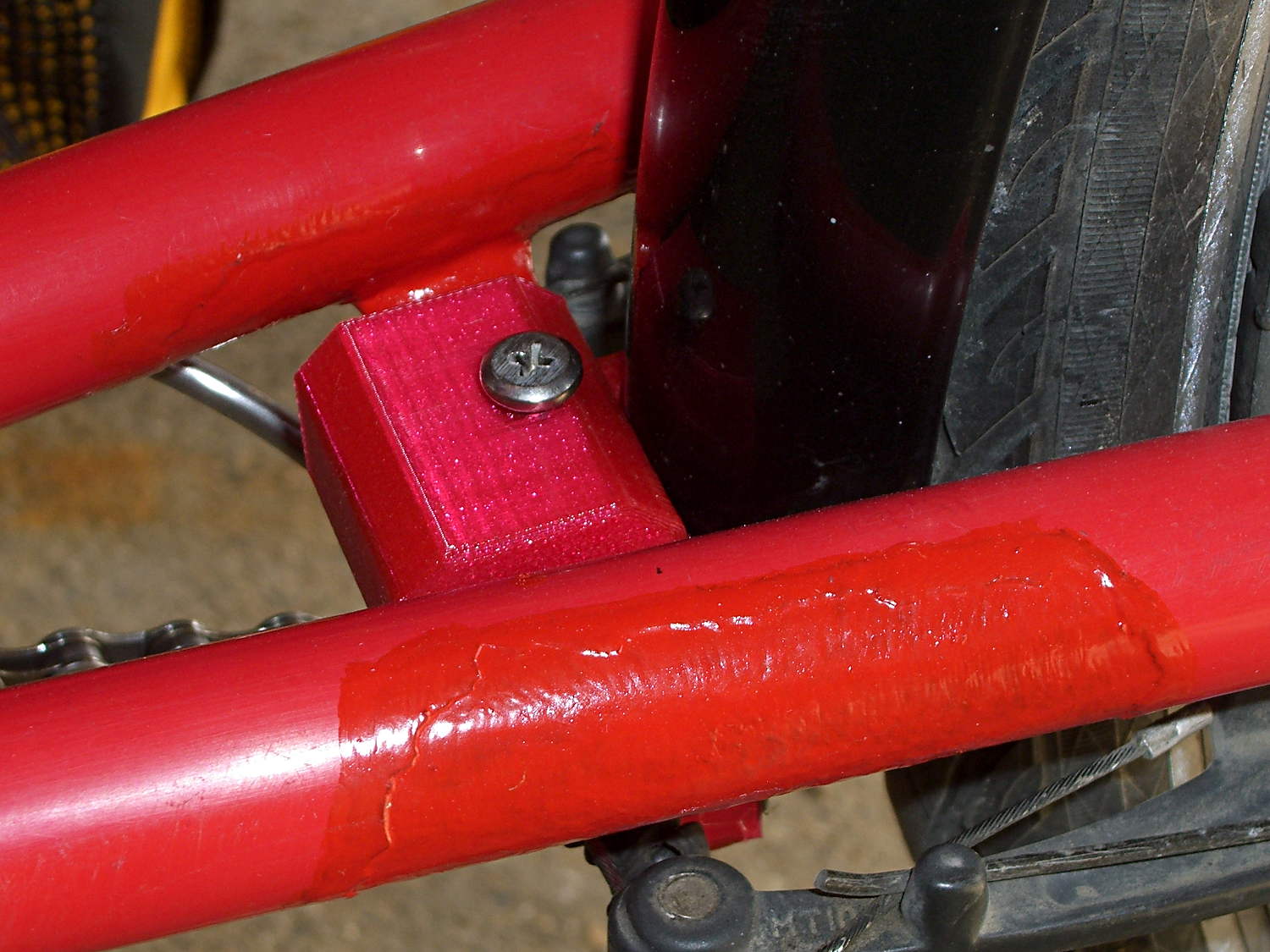
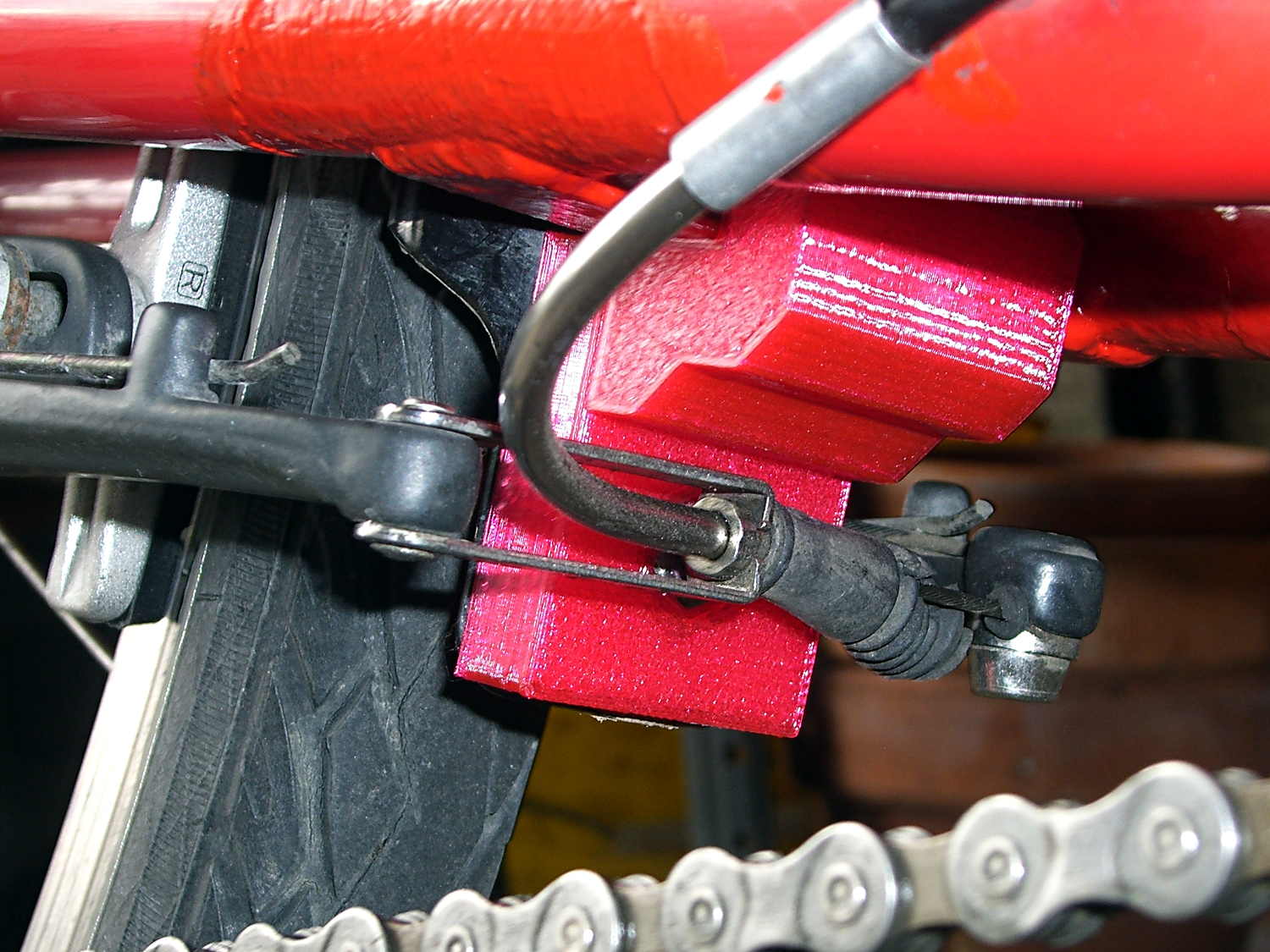
Tour Easy – rear fender bracket – installed – top From below, you can see why the top block can’t extend all the way to the bottom of the fender mount:
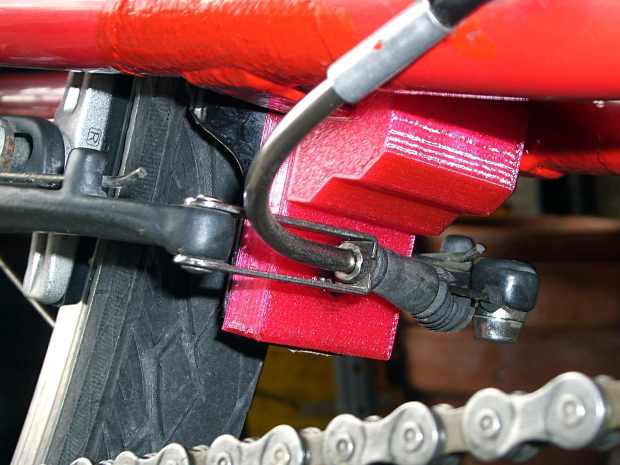
Tour Easy rear fender bracket – installed That rubber boot needs replacing in the worst possible way, but I didn’t have anything suitable on hand and wouldn’t dismount that cable even if I had; cables never go back on properly.
Alas, because the brakes weren’t mounted when I did the measurements, I had to build one to find out why a long block wouldn’t work:
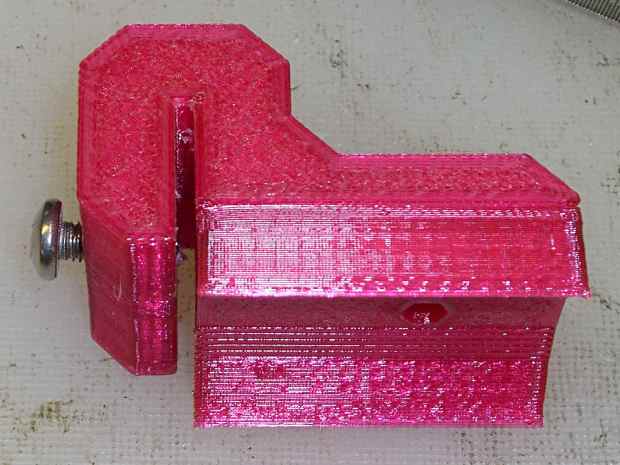
Tour Easy rear fender bracket – long back The screw atop the block (on the left in that picture) presses a small plastic slug against the steel strap, in the hopes it won’t chew through the paint quite as rapidly. The screws & nuts are stainless, so at least they’ll survive for a while.
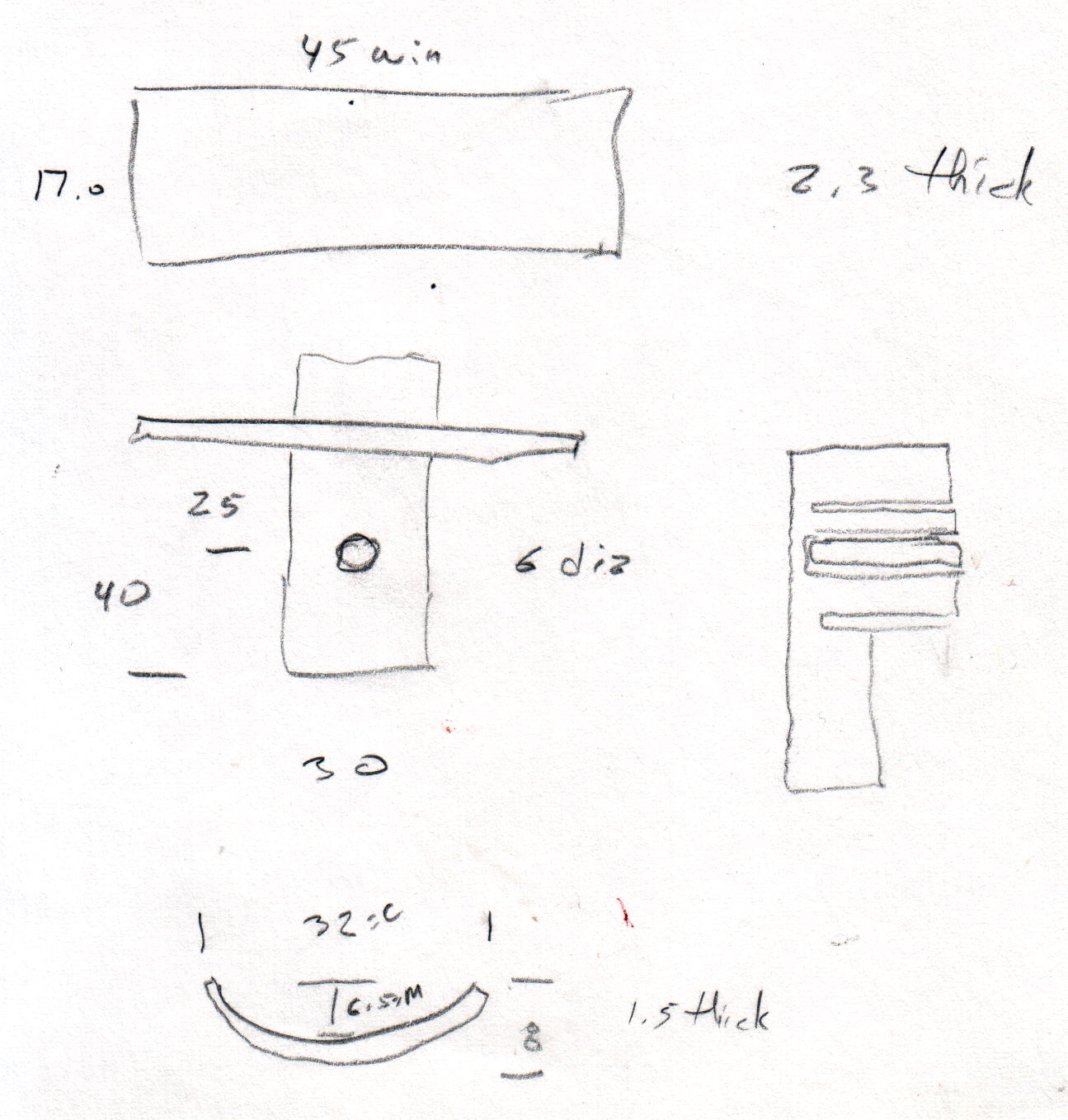
The curve in the trough comes from the chord equation applied to these crude measurements:
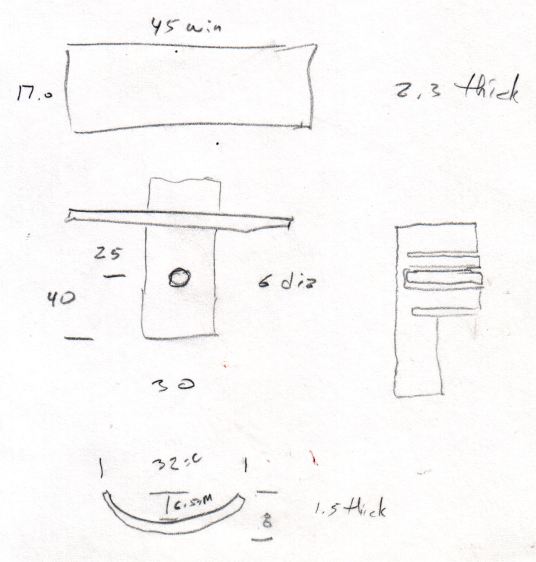
Tour Easy Rear Fender Bracket – measurement doodle Fortunately, it’s tucked into a spot where nobody ever looks…
The OpenSCAD source code:
// Tour Easy rear fender bracket
// Ed Nisley KE4ZNU March 2015

Layout = "Build";		// Build Show TabHolder Block

//- Extrusion parameters must match reality!

ThreadThick = 0.25;
ThreadWidth = 0.40;

HoleWindage = 0.2;

Protrusion = 0.1;			// make holes end cleanly

inch = 25.4;

function IntegerMultiple(Size,Unit) = Unit * ceil(Size / Unit);

//----------------------
// Dimensions

PlateWidth = 45;		// Tour Easy frame plate
PlateDepth = 17;
PlateThick = 3.3;		//  ... allow for a bit of crud

TabWidth = 32;			// fender tab
TabLength = 40;
TabThick = 1.5;
TabDepth = 8;

ChordM = TabDepth - TabThick;	// find fender tab's radius of curvature
ChordC = TabWidth;

TabRadius = ((ChordM * ChordM) + (ChordC * ChordC)/4) / (2 * ChordM);
echo(str("Fender radius: ", TabRadius));

FenderOffset = -25.0;		// from bottom of frame plate

ScrewClear = 5.0;			// close enough to 10-32
ScrewTap = ScrewClear - 1.0;

NutThick = 3.1;				// 10-32 nut
NutOD = 9.5;				//  ... across flats

Chamfer = 5.0;					// edge chamfer

BlockSlab = 10.0;
BlockWidth = TabWidth;
BlockDepth = PlateDepth + BlockSlab;
BlockHeight = TabLength + PlateThick + BlockSlab;

BlockOutline = [
	[TabDepth/2,0],
	[TabDepth/2,TabLength],
	[PlateDepth,TabLength],
	[PlateDepth,TabLength + PlateThick],
	[0,TabLength + PlateThick],
	[0,BlockHeight - Chamfer],
	[Chamfer,BlockHeight],
	[BlockDepth - Chamfer,BlockHeight],
	[BlockDepth,BlockHeight - Chamfer],
	[BlockDepth,TabLength - BlockSlab + Chamfer],
	[BlockDepth - Chamfer,TabLength - BlockSlab],
	[BlockSlab + Chamfer,TabLength - BlockSlab],
	[BlockSlab,TabLength - BlockSlab - Chamfer],
//	[BlockSlab,Chamfer],								// full-length tab (TrimBlock = false)
//	[BlockSlab - Chamfer,0],							//   ""
	[TabDepth/2,TabLength - BlockSlab - Chamfer]		// trim lower tab (TrimBlock = true)
	];

TrimBlock = true;

BuildGap = 5.0;

//----------------------
// Useful routines

module PolyCyl(Dia,Height,ForceSides=0) {			// based on nophead's polyholes

  Sides = (ForceSides != 0) ? ForceSides : (ceil(Dia) + 2);

  FixDia = Dia / cos(180/Sides);

  cylinder(r=(FixDia + HoleWindage)/2,
           h=Height,
	   $fn=Sides);
}

//- Locating pin hole with glue recess
//  Default length is two pin diameters on each side of the split

PinOD = 1.75;
PinOC = TabLength / 2;

module LocatingPin(Dia=PinOD,Len=0.0) {

	PinLen = (Len != 0.0) ? Len : (4*Dia);

	translate([0,0,-ThreadThick])
		PolyCyl((Dia + 2*ThreadWidth),2*ThreadThick,4);

	translate([0,0,-2*ThreadThick])
		PolyCyl((Dia + 1*ThreadWidth),4*ThreadThick,4);

	translate([0,0,-(Len/2 + ThreadThick)])
		PolyCyl(Dia,(Len + 2*ThreadThick),4);

}

module LocatingPins(Length) {
	for (i=[-1,1])
	translate([i*PinOC/2,0,0])
		rotate(180/4)
		LocatingPin(Len=Length);
}

//----------------------
// Pieces

module TabHolder() {

	difference() {
		translate([-TabWidth/2,-TabLength,0])
			cube([TabWidth,TabLength,2*TabDepth],center=false);

		translate([0,-TabLength/4,0])
			LocatingPins(5.0);

if (!TrimBlock)
		translate([0,-3*TabLength/4,0])
			LocatingPins(5.0);

		translate([0,FenderOffset,-Protrusion])
			rotate(180/6)
				PolyCyl(ScrewClear,3*TabDepth,6);

if (TrimBlock)
		translate([0,FenderOffset,-Protrusion])
			rotate(180/6)
				PolyCyl(NutOD,NutThick + Protrusion,6);

		translate([0,TabLength,TabRadius + TabDepth/2])
			rotate([90,0,0])
				rotate(180/(6*4))
					cylinder(r=TabRadius,h=3*TabLength,$fn=6*4);
	}

if (TrimBlock)
	color("Yellow")
	translate([0,FenderOffset,0])
		for (Seg=[0:5]) {
			rotate(30 + 360*Seg/6)
			cube([NutOD/2,
				2*ThreadWidth,
				(NutThick - ThreadThick)],center=false);
		}

}

module Block() {

	difference() {
		linear_extrude(height=BlockWidth,convexity=3)
			polygon(points=BlockOutline);

if (!TrimBlock)
		translate([TabDepth/2,TabLength/4,BlockWidth/2])
			rotate([0,90,0])
				LocatingPins(5.0);

		translate([TabDepth/2,3*TabLength/4,BlockWidth/2])
			rotate([0,90,0])
				LocatingPins(5.0);

		translate([-BlockDepth,TabLength + FenderOffset,BlockWidth/2])
			rotate([0,90,0])
				rotate(180/6)
					PolyCyl(ScrewClear,3*BlockDepth,6);

		translate([PlateDepth/2,BlockHeight - BlockSlab - Protrusion,BlockWidth/2])
			rotate([-90,0,0])
					PolyCyl(ScrewTap,2*BlockSlab,6);

if (!TrimBlock)
		translate([(BlockSlab - NutThick),(TabLength + FenderOffset),BlockWidth/2])
			rotate([0,90,0])
				rotate(180/6)
					PolyCyl(NutOD,NutThick + Protrusion,6);

	}

}

//----------------------
// Build it

if (Layout == "TabHolder")
	TabHolder();

if (Layout == "Block")
	Block();

if (Layout == "Show") {
	translate([0,BlockWidth/2,0])
		rotate([90,0,0]) {
			color("Magenta")
				Block();
			color("Orange")
				translate([0,TabLength,TabWidth/2])
					rotate([0,-90,0])
						TabHolder();
		}
}

if (Layout == "Build") {

	translate([-BuildGap,0,0])
		rotate(-90)
			TabHolder();

	translate([BuildGap,TrimBlock ? -BlockHeight/1.5 : -BlockHeight/3,0])
		Block();
}



-
Subscribe
Subscribed
Have a WordPress.com account? Log in now.

