-
Vacuum Tube LEDs: Halogen Lamp Base
This lamp needs a base for its (minimal) electronics:

Vacuum Tube LEDs – plate lead – overview The solid model won’t win many stylin’ points:
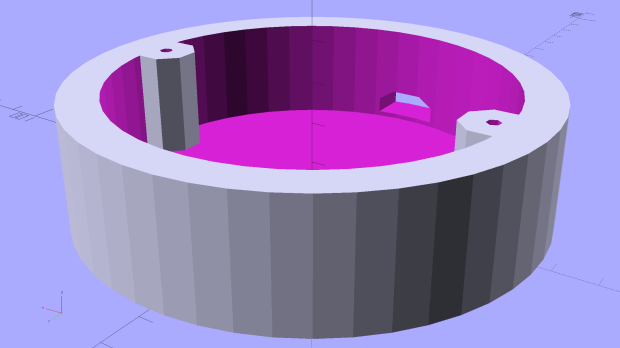
Vacuum Tube Lights – lamp base solid model It’s big and bulky, with a thick wall and base, because that ceramic lamp socket wants to screw down onto something solid. The screw holes got tapped 6-32, the standard electrical box screw size.
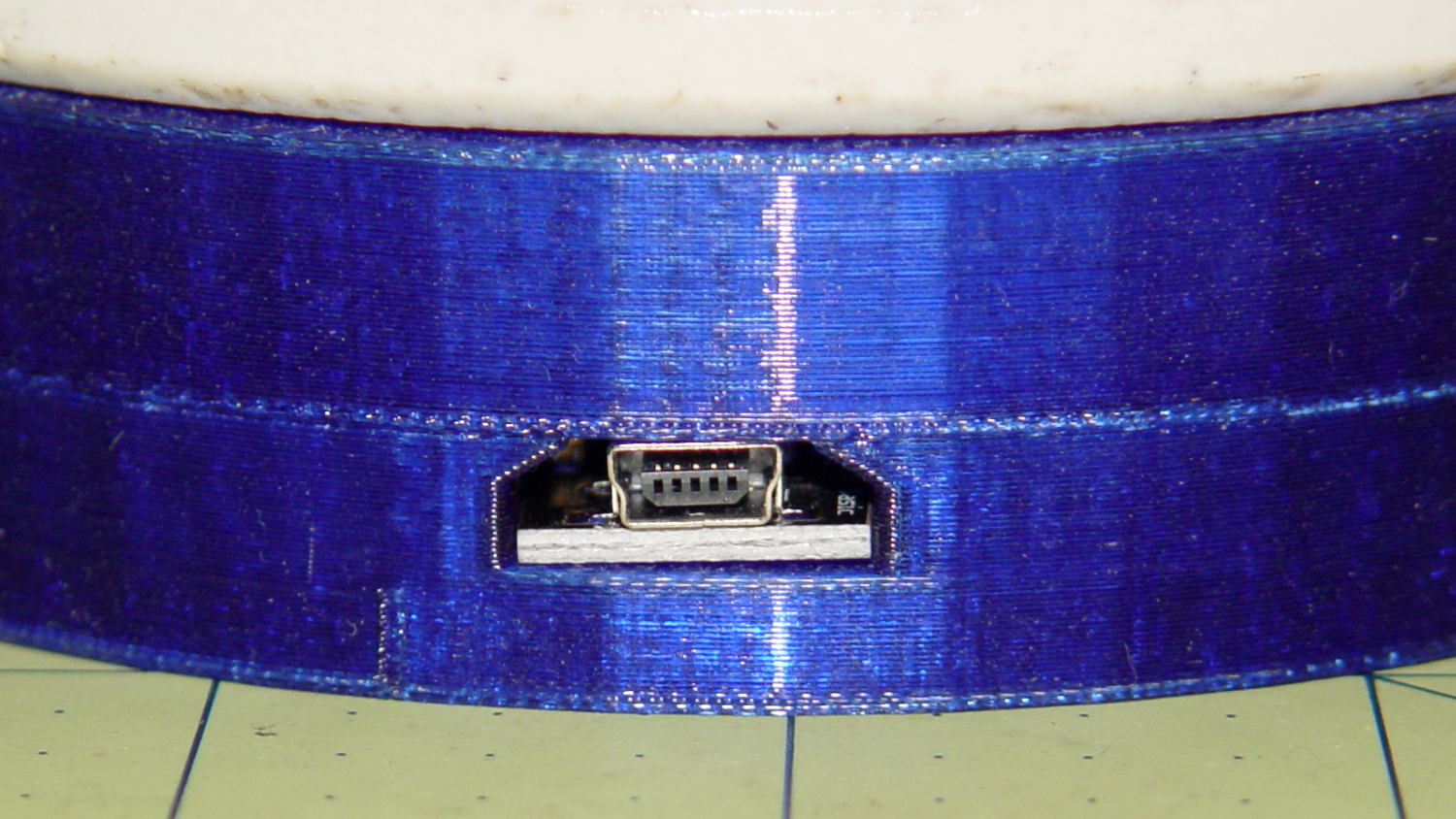
The odd little hole on the far side accommodates a USB-to-serial adapter that both powers the lamp and lets you reprogram the Arduino Pro Mini without tearing the thing apart:

Vacuum Tube Lights – USB adapter cutout The sloped roof makes the hole printable in the obvious orientation:
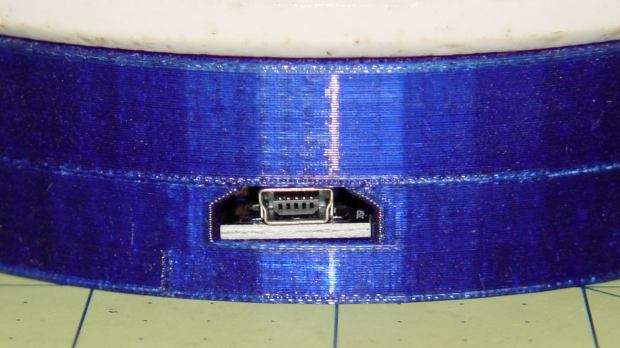
Lamp Base – USB port There’s an ugly story behind the horizontal line just above the USB adapter that I’ll explain in a bit.
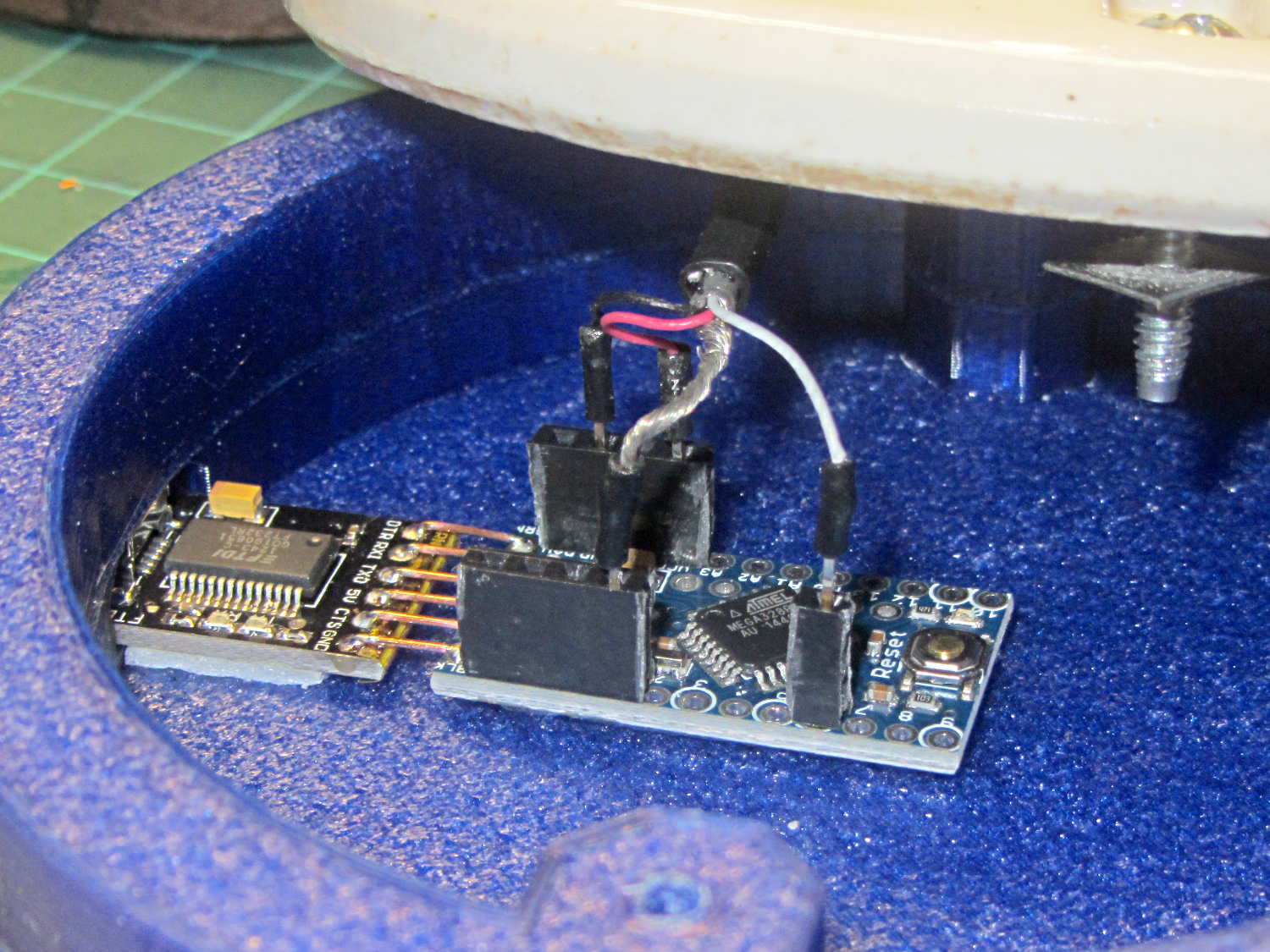
The adapter hole begins 1.2 mm above the interior floor to let the adapter sit on a strip of double-sticky foam tape. I removed the standard header socket and wired the adapter directly to the Arduino Pro Mini with 24 AWG U-wires:
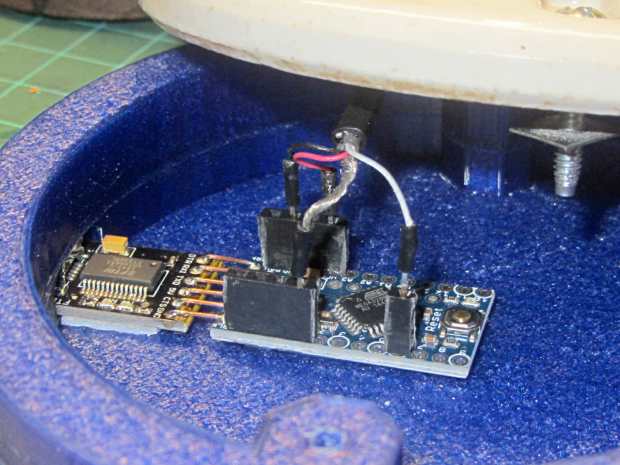
Lamp Base – interior I didn’t want to use pin connectors on the lamp cable leads, but without those you (well, I) can’t take the base off without un-/re-soldering the wires in an awkward location; the fact that I hope to never take it apart is irrelevant. Next time, I’ll use a longer wire from the plate cap and better connectors, but this was a trial fit that became Good Enough for the purpose.
And then It Just Worked… although black, rather than cyan, plastic would look spiffier.
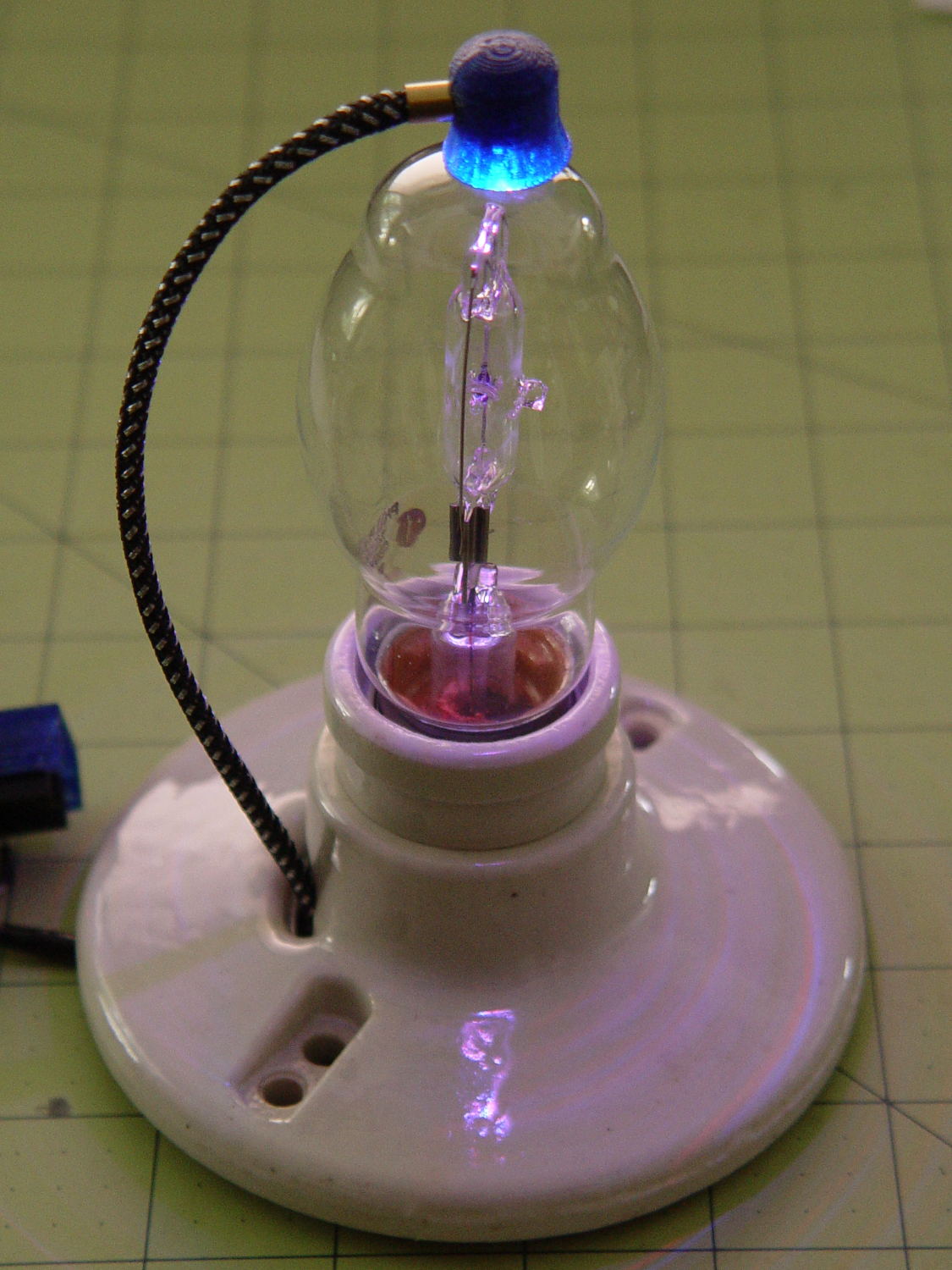
Bluish phases look icy cold:

Vacuum Tube LEDs – halogen lamp – purple phase Reddish phases look Just Right for a hot lamp:

Vacuum Tube LEDs – halogen lamp – red phase A ring of white double sided foam tape now holds the plate cap in place; that should be black, too.
The OpenSCAD source code adds the base to the plate cap as a GitHub gist:
This file contains hidden or bidirectional Unicode text that may be interpreted or compiled differently than what appears below. To review, open the file in an editor that reveals hidden Unicode characters. Learn more about bidirectional Unicode characters// Vacuum Tube LED Lights // Ed Nisley KE4ZNU January 2016 Layout = "LampBase"; // Show Build Cap LampBase USBPort Section = true; // cross-section the object //- Extrusion parameters must match reality! ThreadThick = 0.25; ThreadWidth = 0.40; HoleWindage = 0.2; Protrusion = 0.1; // make holes end cleanly inch = 25.4; function IntegerMultiple(Size,Unit) = Unit * ceil(Size / Unit); ID = 0; OD = 1; LENGTH = 2; Pixel = [7.0,10.0,3.0]; // ID = contact patch, OD = PCB dia, LENGTH = overall thickness //———————- // Useful routines module PolyCyl(Dia,Height,ForceSides=0) { // based on nophead's polyholes Sides = (ForceSides != 0) ? ForceSides : (ceil(Dia) + 2); FixDia = Dia / cos(180/Sides); cylinder(r=(FixDia + HoleWindage)/2, h=Height, $fn=Sides); } //———————- // Tube cap CapTube = [4.0,3/16 * inch,10.0]; // brass tube for flying lead to cap LED CapSize = [Pixel[ID],(Pixel[OD] + 3.0),(CapTube[OD] + 2*Pixel[LENGTH])]; CapSides = 6*4; module Cap() { difference() { union() { cylinder(d=CapSize[OD],h=(CapSize[LENGTH]),$fn=CapSides); // main cap body translate([0,0,CapSize[LENGTH]]) // rounded top scale([1.0,1.0,0.65]) sphere(d=CapSize[OD]/cos(180/CapSides),$fn=CapSides); // cos() fixes slight undersize vs cylinder cylinder(d1=(CapSize[OD] + 2*3*ThreadWidth),d2=CapSize[OD],h=1.5*Pixel[LENGTH],$fn=CapSides); // skirt } translate([0,0,-Protrusion]) // bore for wiring to LED PolyCyl(CapSize[ID],(CapSize[LENGTH] + 3*ThreadThick + Protrusion),CapSides); translate([0,0,-Protrusion]) // PCB recess with clearance for tube dome PolyCyl(Pixel[OD],(1.5*Pixel[LENGTH] + Protrusion),CapSides); translate([0,0,(1.5*Pixel[LENGTH] – Protrusion)]) // small step + cone to retain PCB cylinder(d1=(Pixel[OD]/cos(180/CapSides)),d2=Pixel[ID],h=(Pixel[LENGTH] + Protrusion),$fn=CapSides); translate([0,0,(CapSize[LENGTH] – CapTube[OD]/(2*cos(180/8)))]) // hole for brass tube holding wire loom rotate([90,0,0]) rotate(180/8) PolyCyl(CapTube[OD],CapSize[OD],8); } } //———————- // Aperture for USB-to-serial adapter snout // These are all magic numbers, of course module USBPort() { translate([0,28.0]) rotate([90,0,0]) linear_extrude(height=28.0) polygon(points=[ [0,0], [8.0,0], [8.0,4.0], // [4.0,4.0], [4.0,6.5], [-4.0,6.5], // [-4.0,4.0], [-8.0,4.0], [-8.0,0], ]); } //———————- // Box for Leviton ceramic lamp base module LampBase() { Bottom = 5.0; Base = [3.75*inch,4.5*inch,25.0 + Bottom]; Sides = 12*4; Stud = [0.107 * inch,15.0,Base[LENGTH]]; // 6-32 mounting screws, OD = ceramic boss size StudOC = 3.5 * inch; union() { difference() { rotate(180/Sides) cylinder(d=Base[OD],h=Base[LENGTH],$fn=Sides); rotate(180/Sides) translate([0,0,Bottom]) cylinder(d=Base[ID],h=Base[LENGTH],$fn=Sides); translate([0,-Base[OD]/2,Bottom + 1.2]) // mount on double-sided foam tape rotate(0) USBPort(); } for (i = [-1,1]) translate([i*StudOC/2,0,0]) rotate(180/8) difference() { cylinder(d=Stud[OD],h=Stud[LENGTH],$fn=8); translate([0,0,Bottom]) PolyCyl(Stud[ID],(Stud[LENGTH] – (Bottom – Protrusion)),6); } } } //———————- // Build it if (Layout == "Cap") { if (Section) difference() { Cap(); translate([-CapSize[OD],0,CapSize[LENGTH]]) cube([2*CapSize[OD],2*CapSize[OD],3*CapSize[LENGTH]],center=true); } else Cap(); } if (Layout == "LampBase") LampBase(); if (Layout == "USBPort") USBPort(); if (Layout == "Build") { Cap(); Spigot(); }




-
Subscribe
Subscribed
Have a WordPress.com account? Log in now.

