-
Vacuum Tube LEDs: First Light!
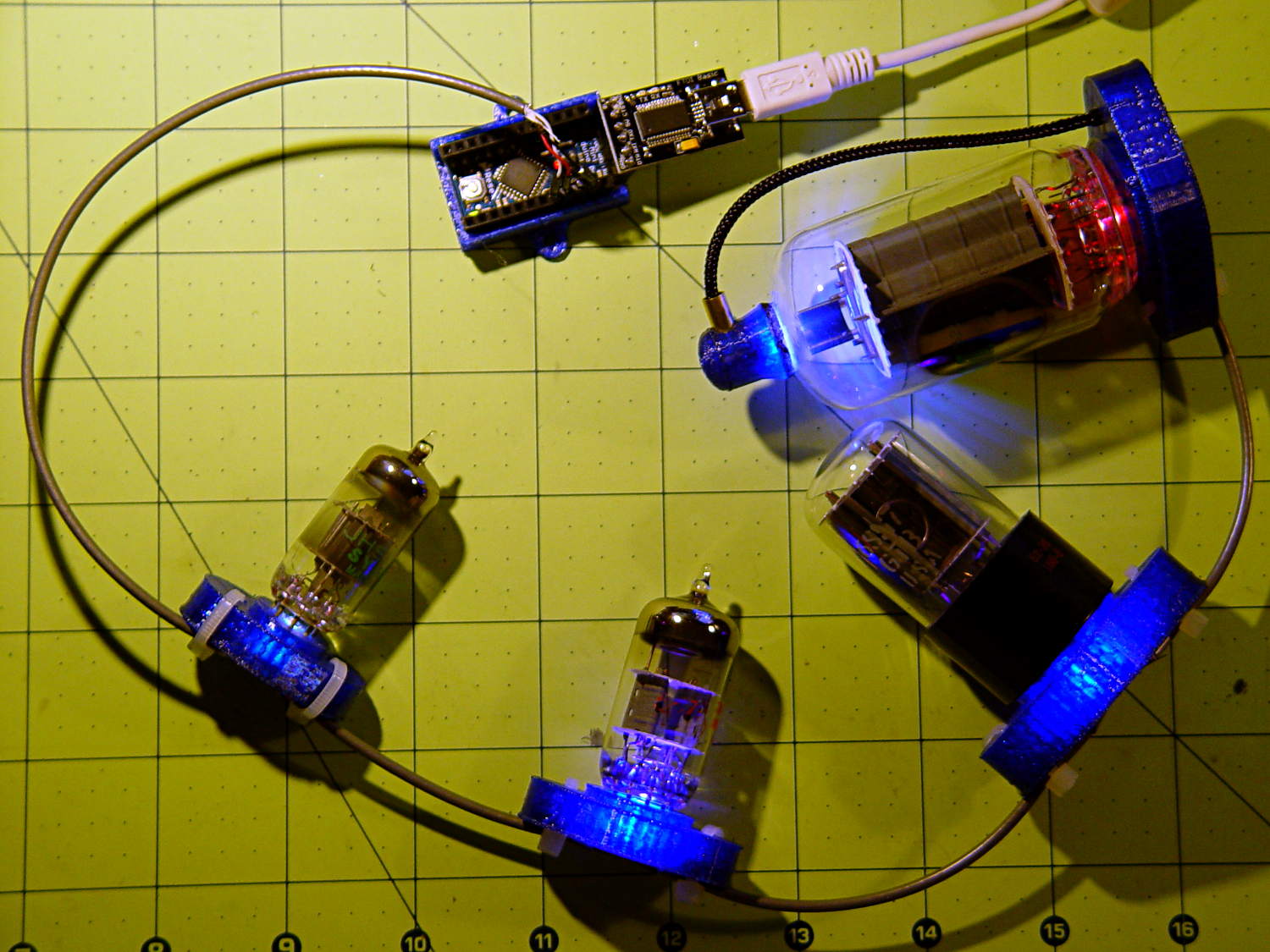
A test lashup to see how it all works, with an ersatz plate cap atop the IBM 21HB5A Beam Power tube on the far right end:
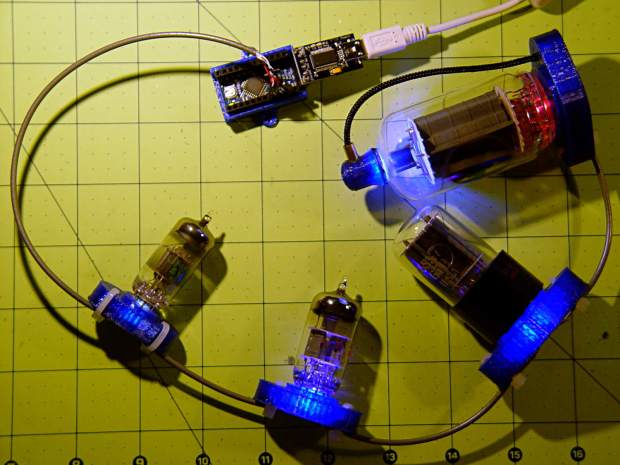
Vacuum Tube LEDs – test lashup Those sockets must mount in a chassis, not flop around loose on the cable.
I hacked the code out of the Hard Drive Platter Mood Light; there’s a lot to not like about what’s left and I must rethink the overall structure. The colors now run an order of magnitude faster than the Platter Mood Light, with a 90° phase angle between successive Neopixels.
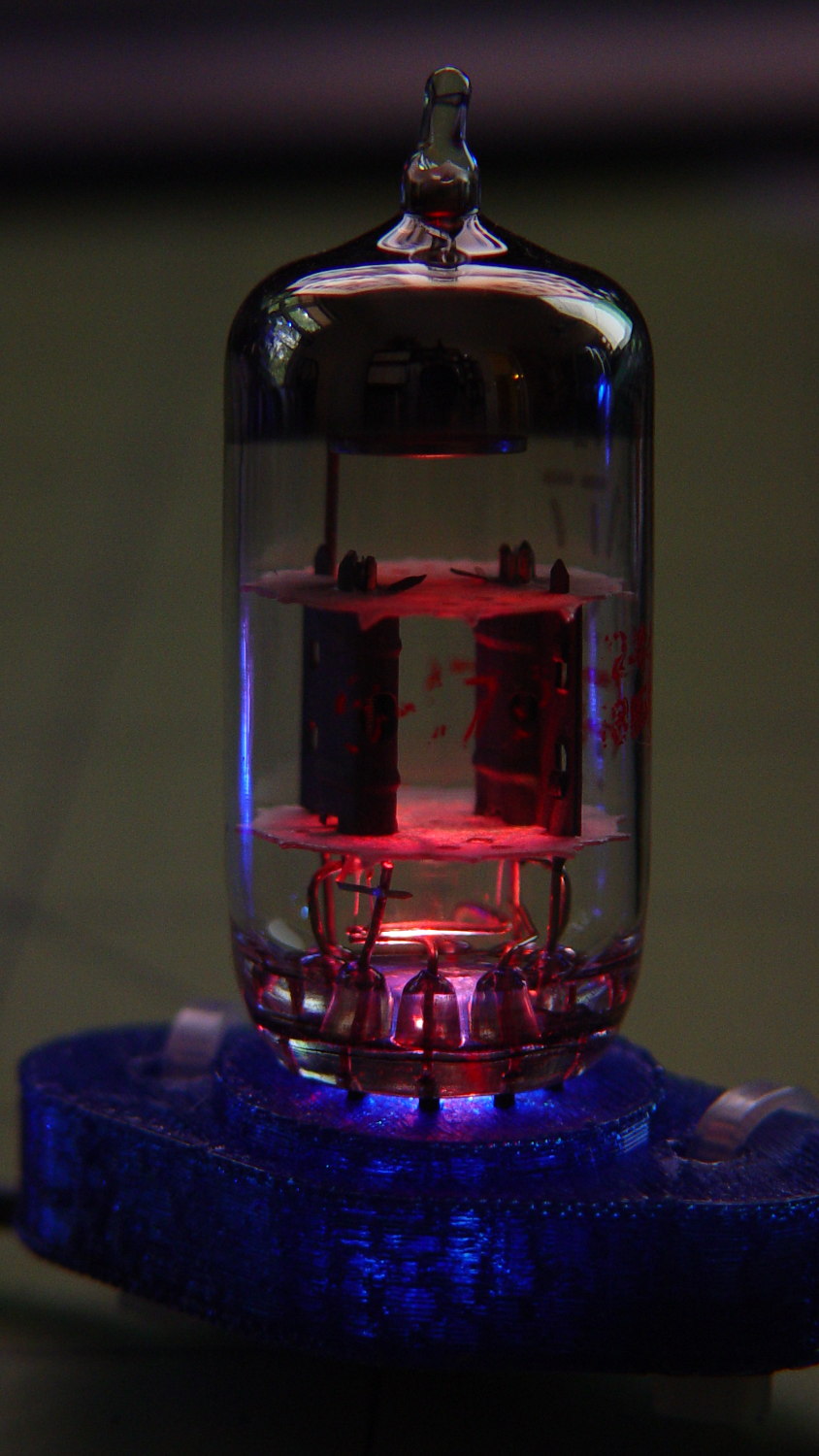
The mica spacers in the 12AT7 Dual Triode tube (second in the sequence, Noval socket) look cool & crystalline:
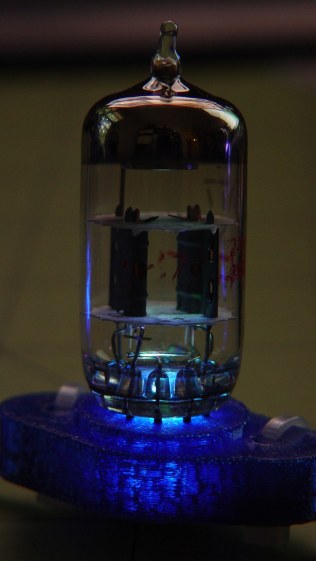
Vacuum Tube LEDs – Noval tube – blue phase When the red phase comes around, it becomes a firebottle:
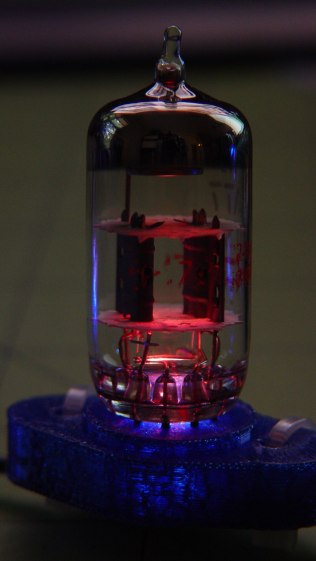
Vacuum Tube LEDs – Noval tube – red phase With a touch of fire in its hole, the IBM 21HB5A Beam Power tube looks just flat-out gorgeous, despite that translucent blue plate cap:
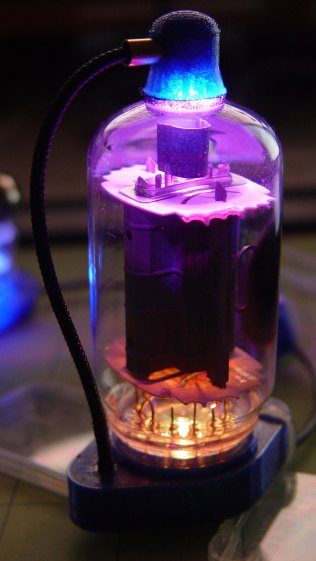
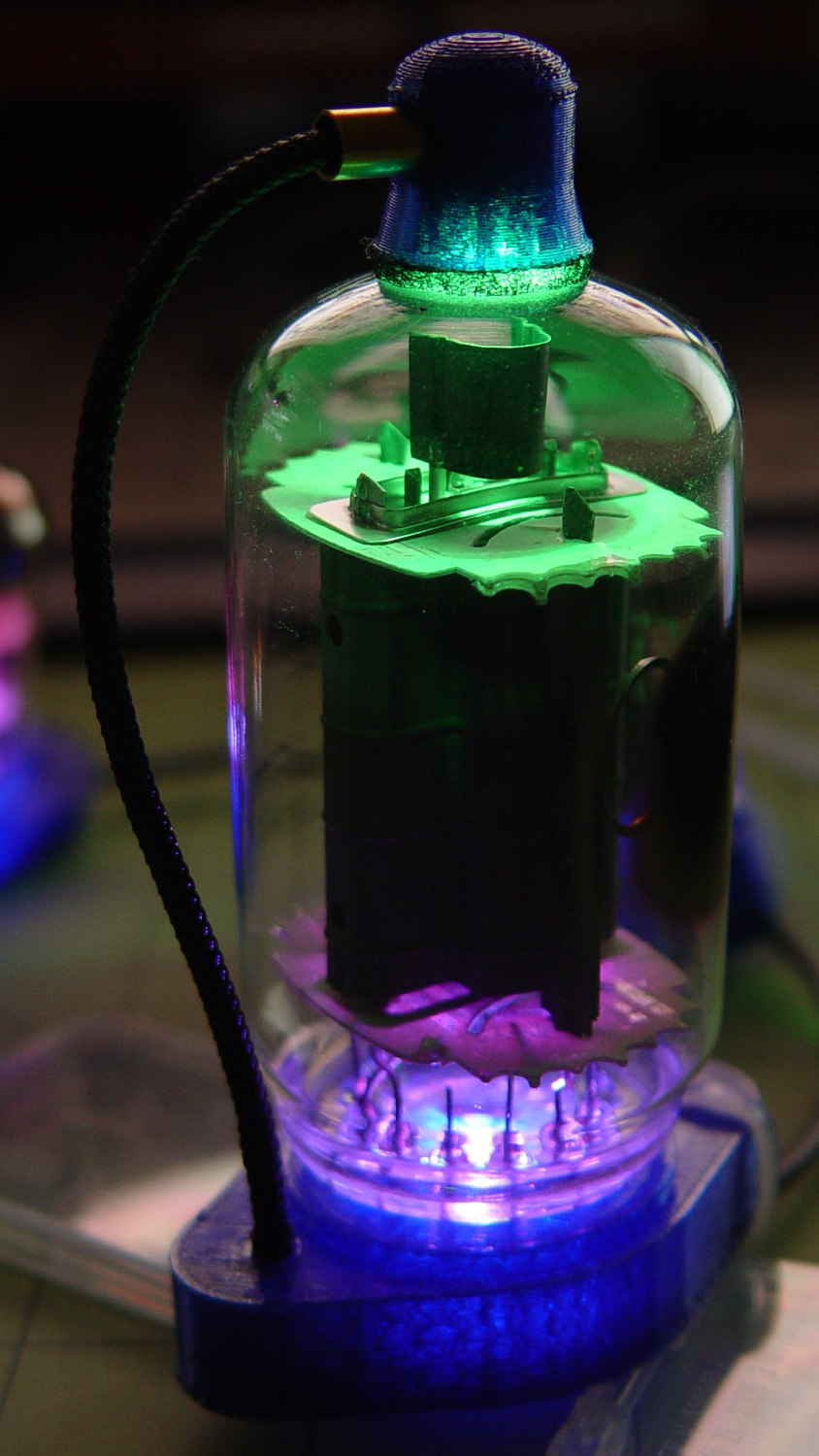
Vacuum Tube LEDs – IBM 21HB5A Beam Power Tube – violet amber phase Cool green works pretty well:
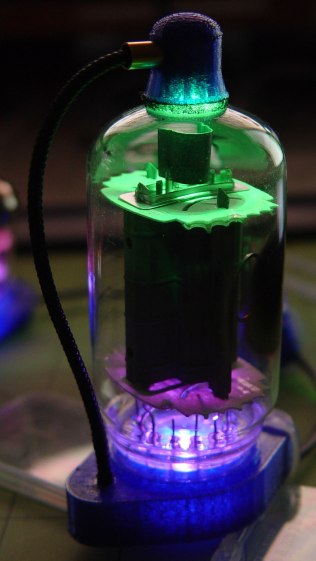
Vacuum Tube LEDs – IBM 21HB5A Beam Power Tube – green violet phase If you wait long enough, it’ll probably turn True IBM Blue.
This worked out even better than I expected!
The Arduino source code as a GitHub gist:
This file contains hidden or bidirectional Unicode text that may be interpreted or compiled differently than what appears below. To review, open the file in an editor that reveals hidden Unicode characters. Learn more about bidirectional Unicode characters// Neopixel lighting for multiple vacuum tubes // Ed Nisley – KE4ANU – January 2015 #include <Adafruit_NeoPixel.h> //———- // Pin assignments const byte PIN_NEO = A3; // DO – data out to first Neopixel const byte PIN_HEARTBEAT = 13; // DO – Arduino LED //———- // Constants #define UPDATEINTERVAL 25ul const unsigned long UpdateMS = UPDATEINTERVAL – 1ul; // update LEDs only this many ms apart minus loop() overhead // number of steps per cycle, before applying prime factors #define RESOLUTION 100 // phase difference between tubes for slowest color #define BASEPHASE (PI/4.0) // number of LED strips around each tube #define LEDSTRIPCOUNT 1 // number of LEDs per strip #define LEDSTRINGCOUNT 5 // want to randomize the startup a little? #define RANDOMIZE true //———- // Globals // instantiate the Neopixel buffer array Adafruit_NeoPixel strip = Adafruit_NeoPixel(LEDSTRIPCOUNT * LEDSTRINGCOUNT, PIN_NEO, NEO_GRB + NEO_KHZ800); uint32_t FullWhite = strip.Color(255,255,255); uint32_t FullOff = strip.Color(0,0,0); struct pixcolor_t { byte Prime; unsigned int NumSteps; unsigned int Step; float StepSize; float TubePhase; byte MaxPWM; }; // colors in each LED enum pixcolors {RED, GREEN, BLUE, PIXELSIZE}; struct pixcolor_t Pixels[PIXELSIZE]; // all the data for each pixel color intensity byte Map[LEDSTRINGCOUNT][LEDSTRIPCOUNT] = {{0},{1},{2},{3},{4}}; // pixel IDs around each tube, bottom to top. unsigned long MillisNow; unsigned long MillisThen; //– Figure PWM based on current state byte StepColor(byte Color, float Phi) { byte Value; Value = (Pixels[Color].MaxPWM / 2.0) * (1.0 + sin(Pixels[Color].Step * Pixels[Color].StepSize + Phi)); // Value = (Value) ? Value : Pixels[Color].MaxPWM; // flash at dimmest points // printf("C: %d Phi: %d Value: %d\r\n",Color,(int)(Phi*180.0/PI),Value); return Value; } //– Helper routine for printf() int s_putc(char c, FILE *t) { Serial.write(c); } //—————— // Set the mood void setup() { pinMode(PIN_HEARTBEAT,OUTPUT); digitalWrite(PIN_HEARTBEAT,LOW); // show we arrived Serial.begin(57600); fdevopen(&s_putc,0); // set up serial output for printf() printf("Multiple Vacuum Tube Mood Light with Neopixels\r\nEd Nisley – KE4ZNU – January 2016\r\n"); /// set up Neopixels strip.begin(); strip.show(); // lamp test: run a brilliant white dot along the length of the strip printf("Lamp test: walking white\r\n"); strip.setPixelColor(0,FullWhite); strip.show(); delay(500); for (int i=1; i<strip.numPixels(); i++) { digitalWrite(PIN_HEARTBEAT,HIGH); strip.setPixelColor(i-1,FullOff); strip.setPixelColor(i,FullWhite); strip.show(); digitalWrite(PIN_HEARTBEAT,LOW); delay(500); } strip.setPixelColor(strip.numPixels() – 1,FullOff); strip.show(); delay(500); // fill the layers printf(" … fill using Map array\r\n"); for (int i=0; i < LEDSTRINGCOUNT; i++) { // for each layer digitalWrite(PIN_HEARTBEAT,HIGH); for (int j=0; j < LEDSTRIPCOUNT; j++) { // spread color around the layer strip.setPixelColor(Map[i][j],FullWhite); strip.show(); delay(250); } digitalWrite(PIN_HEARTBEAT,LOW); } // clear to black printf(" … clear\r\n"); for (int i=0; i < LEDSTRINGCOUNT; i++) { // for each layer digitalWrite(PIN_HEARTBEAT,HIGH); for (int j=0; j < LEDSTRIPCOUNT; j++) { // spread color around the layer strip.setPixelColor(Map[i][j],FullOff); strip.show(); delay(250); } digitalWrite(PIN_HEARTBEAT,LOW); } delay(1000); // set up the color generators MillisNow = MillisThen = millis(); if (RANDOMIZE) randomSeed(MillisNow + analogRead(7)); else printf("Start not randomized\r\n"); printf("First random number: %ld\r\n",random(10)); Pixels[RED].Prime = 7; Pixels[GREEN].Prime = 5; Pixels[BLUE].Prime = 3; printf("Primes: (%d,%d,%d)\r\n",Pixels[RED].Prime,Pixels[GREEN].Prime,Pixels[BLUE].Prime); unsigned int TubeSteps = (unsigned int) ((BASEPHASE / TWO_PI) * RESOLUTION * (unsigned int) max(max(Pixels[RED].Prime,Pixels[GREEN].Prime),Pixels[BLUE].Prime)); printf("Tube phase offset: %d deg = %d steps\r\n",(int)(BASEPHASE*(360.0/TWO_PI)),TubeSteps); Pixels[RED].MaxPWM = 255; Pixels[GREEN].MaxPWM = 128; Pixels[BLUE].MaxPWM = 255; for (byte c=0; c < PIXELSIZE; c++) { Pixels[c].NumSteps = RESOLUTION * (unsigned int) Pixels[c].Prime; Pixels[c].Step = (RANDOMIZE) ? random(Pixels[c].NumSteps) : (3*Pixels[c].NumSteps)/4; Pixels[c].StepSize = TWO_PI / Pixels[c].NumSteps; // in radians per step Pixels[c].TubePhase = TubeSteps * Pixels[c].StepSize; // radians per tube printf("c: %d Steps: %d Init: %d",c,Pixels[c].NumSteps,Pixels[c].Step); printf(" PWM: %d Phi %d deg\r\n",Pixels[c].MaxPWM,(int)(Pixels[c].TubePhase*(360.0/TWO_PI))); } } //—————— // Run the mood void loop() { MillisNow = millis(); if ((MillisNow – MillisThen) > UpdateMS) { digitalWrite(PIN_HEARTBEAT,HIGH); for (byte c=0; c < PIXELSIZE; c++) { // step to next increment in each color if (++Pixels[c].Step >= Pixels[c].NumSteps) { Pixels[c].Step = 0; printf("Cycle %d steps %d at %8ld delta %ld ms\r\n",c,Pixels[c].NumSteps,MillisNow,(MillisNow – MillisThen)); } } for (int i=0; i < LEDSTRINGCOUNT; i++) { // for each layer byte Value[PIXELSIZE]; for (byte c=0; c < PIXELSIZE; c++) { // … for each color Value[c] = StepColor(c,-i*Pixels[c].TubePhase); // figure new PWM value // Value[c] = (c == RED && Value[c] == 0) ? Pixels[c].MaxPWM : Value[c]; // flash highlight for tracking } uint32_t UniColor = strip.Color(Value[RED],Value[GREEN],Value[BLUE]); if (false && (i == 0)) printf("L: %d C: %08lx\r\n",i,UniColor); for (int j=0; j < LEDSTRIPCOUNT; j++) { // fill layer with color strip.setPixelColor(Map[i][j],UniColor); } } strip.show(); MillisThen = MillisNow; digitalWrite(PIN_HEARTBEAT,LOW); } }


-
Subscribe
Subscribed
Have a WordPress.com account? Log in now.

