-
Mailing Tube End Caps: Screw-in Version
The mailing tube arrived with contents intact, although the USPS inlet scanning didn’t work and the tube pretty much teleported across several states without leaving any tracking data behind. The recipient suggested several modifications to the caps:
Review of user experience of tube end:
The ribs on the endcap are very good at holding the cap on, so much so that I had to use a prying implement to remove it, which cracked the flange.
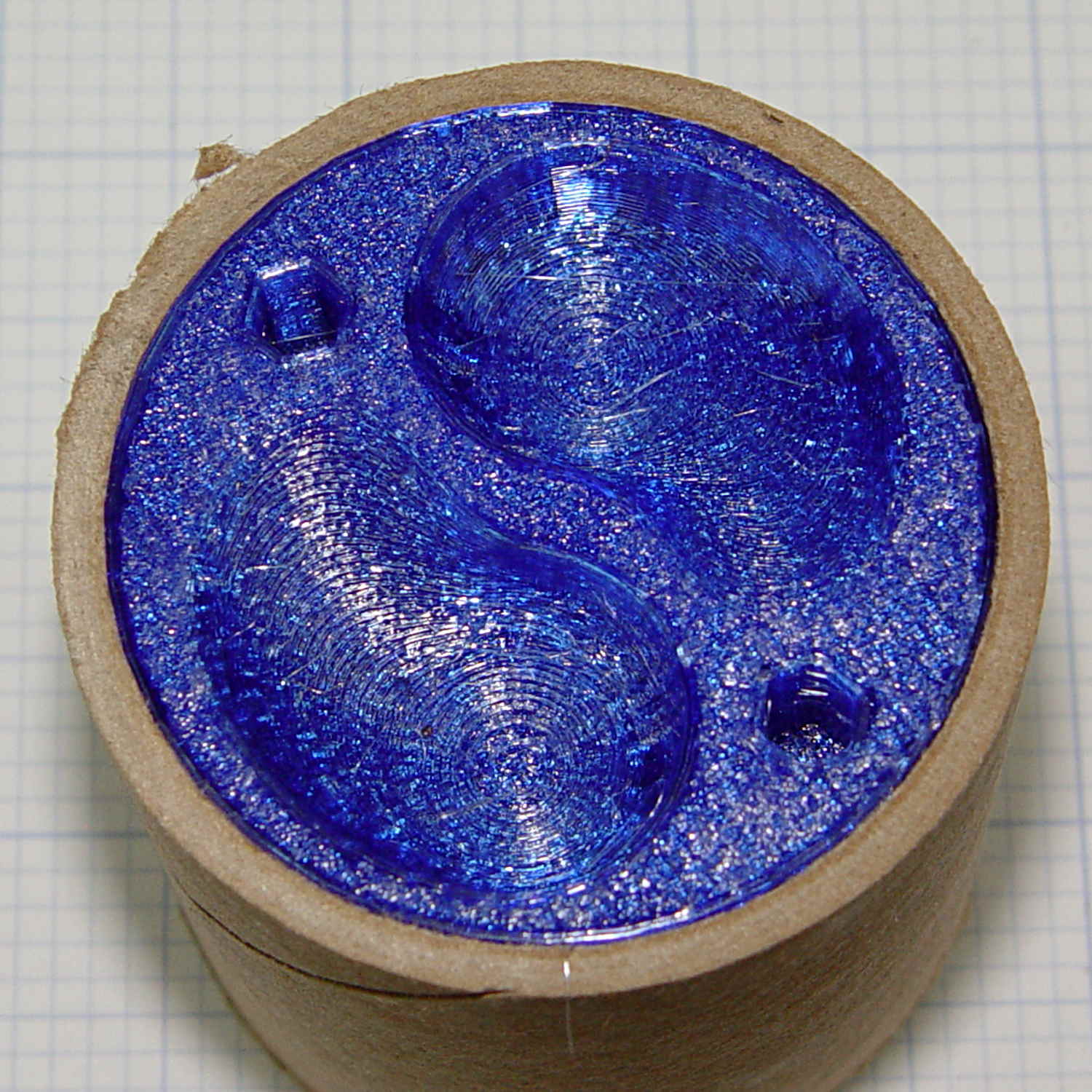
Would consider less depth on the cap, and possibly another layer on the flange.Some continuous process improvement (a.k.a OpenSCAD hackage) produced a swoopy threaded cap with thumb-and-finger grips:
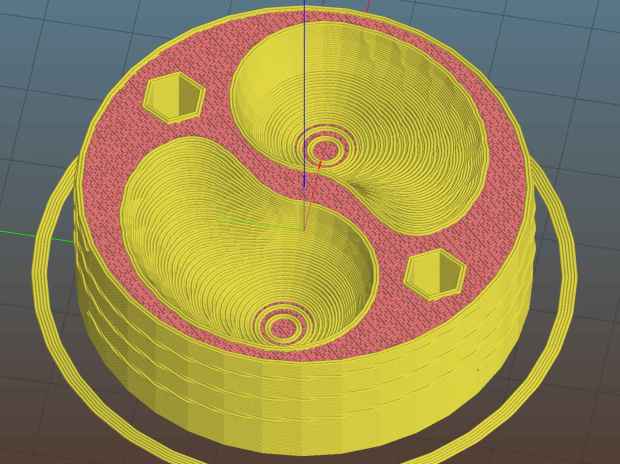
Mailing Tube Screw Cap – top – Slic3r The finger grips are what’s left after stepping a sphere out of the cap while rotating it around the middle:
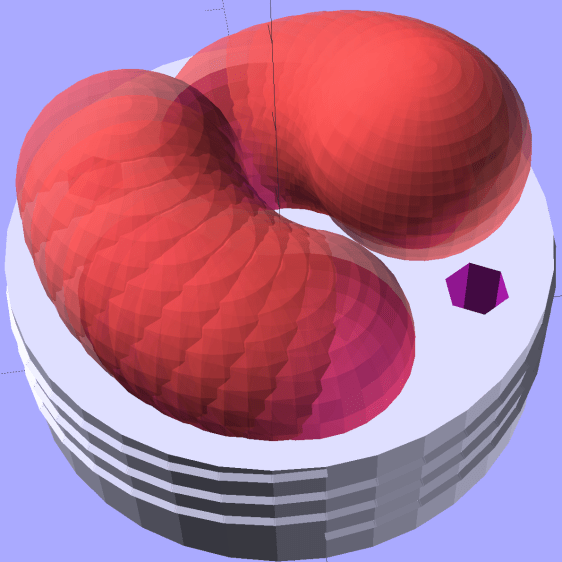
Mailing Tube Cap – finger grip construction That worked out surprisingly well, with the deep end providing enough of a vertical-ish surface to push against.
The two hex holes fit a pin wrench, because the grips twist only one way: outward. The wrench eliminates the need for a flange, as you can now adjust the cap insertion before slathering packing tape over the ends. Man, I loves me some good late binding action!
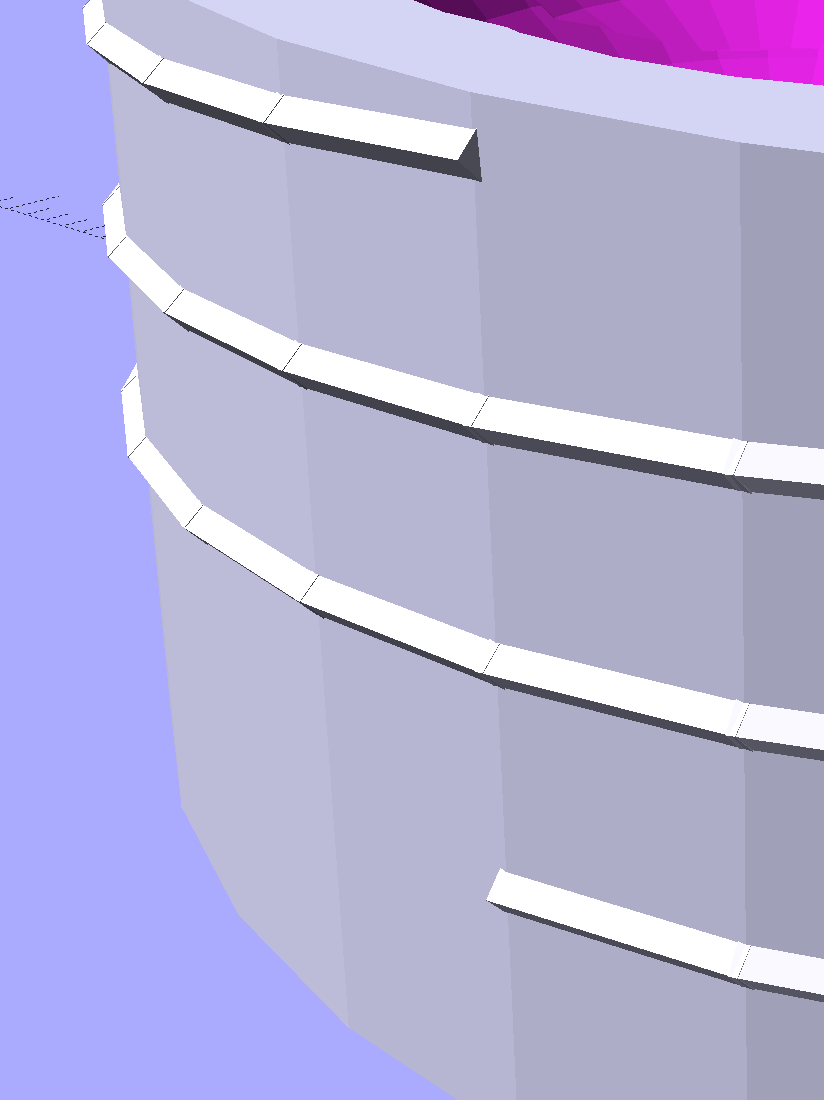
A three-start thread seemed like overkill, but was quick & easy. The “thread form” consists of square rods sunk into the cap perimeter, with one edge sticking out:
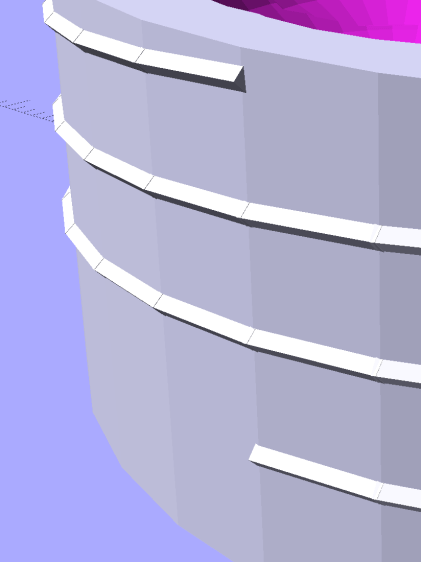
Mailing Tube Cap – thread detail They’re 1.05 times longer than the cap perimeter facets to make their ends overlap, although they’re not tapered like the ones in the broom handle dingus, because it didn’t (seem to) make any difference to the model’s manifoldhood.
Not needing any endcaps right now, I built one for show-n-tell:
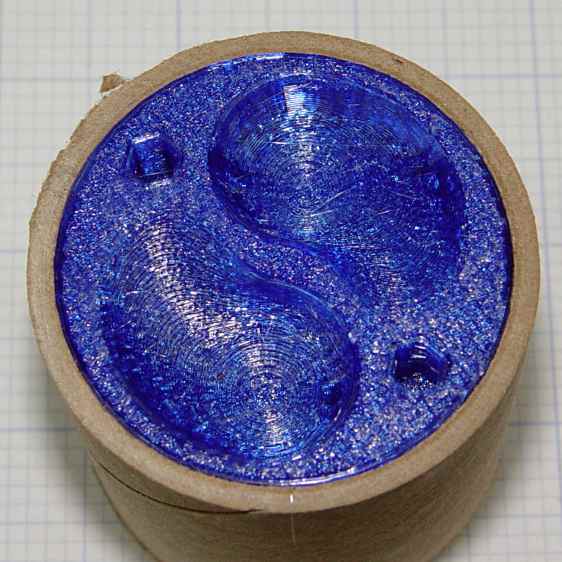
Threaded mailing tube end cap – installed The OpenSCAD source code as a GitHub Gist:
This file contains hidden or bidirectional Unicode text that may be interpreted or compiled differently than what appears below. To review, open the file in an editor that reveals hidden Unicode characters. Learn more about bidirectional Unicode characters// Mailing tube end cap // Ed Nisley KE4ZNU – June 2017 Layout = "Build"; Model = "Screw"; //- Extrusion parameters – must match reality! ThreadThick = 0.25; ThreadWidth = 0.40; function IntegerMultiple(Size,Unit) = Unit * ceil(Size / Unit); Protrusion = 0.1; HoleWindage = 0.2; //- Screw sizes inch = 25.4; TubeID = 2 * inch; TubeWall = 0.1 * inch; CapInsert = 15.0; CapRim = 6*ThreadThick; CapWall = 3*ThreadWidth; NumFlanges = 3; FlangeHeight = 3*ThreadThick; FlangeWidth = ThreadWidth/2; FlangeSpace = CapInsert / (NumFlanges + 1); ThumbHoleOD = 20.0; ThumbHoleAngle = 100; ThumbHoleSteps = 10; SpannerPinOD = 5.0; HelixOD = 4*ThreadThick; HelixHeight = 0.75*CapInsert; HelixAngle = atan(HelixHeight/(PI*TubeID)); HelixStarts = 3; OAHeight = CapInsert + CapRim; NumRibs = 3*4; NumSides = 3*NumRibs; //- Adjust hole diameter to make the size come out right module PolyCyl(Dia,Height,ForceSides=0) { // based on nophead's polyholes Sides = (ForceSides != 0) ? ForceSides : (ceil(Dia) + 2); FixDia = Dia / cos(180/Sides); cylinder(r=(FixDia + HoleWindage)/2,h=Height,$fn=Sides); } module ScrewCap() { union() { difference() { cylinder(d=TubeID,h=OAHeight,$fn=NumSides); for (a=[0,180]) for (i=[0:ThumbHoleSteps-1]) rotate(a + i*ThumbHoleAngle/ThumbHoleSteps) translate([TubeID/4,0,-i*ThumbHoleOD/(2*ThumbHoleSteps)]) sphere(d=ThumbHoleOD); for (a=[0,180]) rotate(a – 60) translate([0.75*TubeID/2,0,-Protrusion]) rotate(0*180/6) PolyCyl(SpannerPinOD,0.75*CapInsert,6); } for (s=[0:HelixStarts-1]) for (i=[0:NumSides-1]) rotate(i*360/NumSides + 180/NumSides + s*360/HelixStarts) translate([TubeID/2 – 0.25*HelixOD,0,i*HelixHeight/NumSides + HelixOD]) rotate([90 + HelixAngle,0,0]) cylinder(d=HelixOD,h=1.05*PI*TubeID/NumSides,center=true,$fn=4); } } module PushCap() { difference() { cylinder(d=TubeID,h=OAHeight,$fn=NumSides); translate([0,0,CapWall]) cylinder(d=TubeID – 2*CapWall,h=OAHeight,$fn=NumSides); } for (i=[1:NumFlanges]) translate([0,0,i*FlangeSpace]) difference() { cylinder(d=TubeID + 2*FlangeWidth,h=FlangeHeight,$fn=NumSides); translate([0,0,-Protrusion]) cylinder(d=TubeID – 2*CapWall,h=FlangeHeight + 2*Protrusion,$fn=NumSides); } for (i=[0:NumRibs-1]) rotate(i*360/NumRibs) translate([0,-ThreadWidth,CapWall + ThreadThick]) cube([TubeID/2 – CapWall/2,2*ThreadWidth,CapInsert + CapRim – CapWall – ThreadThick],center=false); translate([0,0,CapInsert]) { difference() { cylinder(d=TubeID + 2*TubeWall,h=CapRim,$fn=NumSides); translate([0,0,-Protrusion]) cylinder(d=TubeID – 3*2*CapWall,h=2*CapRim,$fn=NumSides); } } } //- Build things if (Model == "Push") if (Layout == "Show") PushCap(); else if (Layout == "Build") translate([0,0,OAHeight]) rotate([180,0,0]) PushCap(); if (Model == "Screw") if (Layout == "Show") ScrewCap(); else if (Layout == "Build") translate([0,0,OAHeight]) rotate([180,0,0]) ScrewCap();


-
Subscribe
Subscribed
Have a WordPress.com account? Log in now.

