-
MPCNC: Autolevel Probe, Endstop Edition
When in doubt, use an endstop switch:
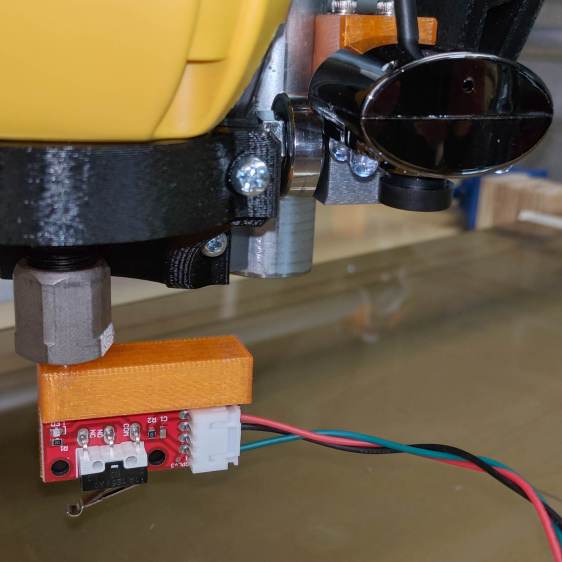
MPCNC – Endstop Z probe – USB camera The USB camera lurks in the upper right.
Just after that picture, I clipped off the NC switch terminal so I can wire this endstop in parallel with the tool length probe. Epoxy coating to follow.
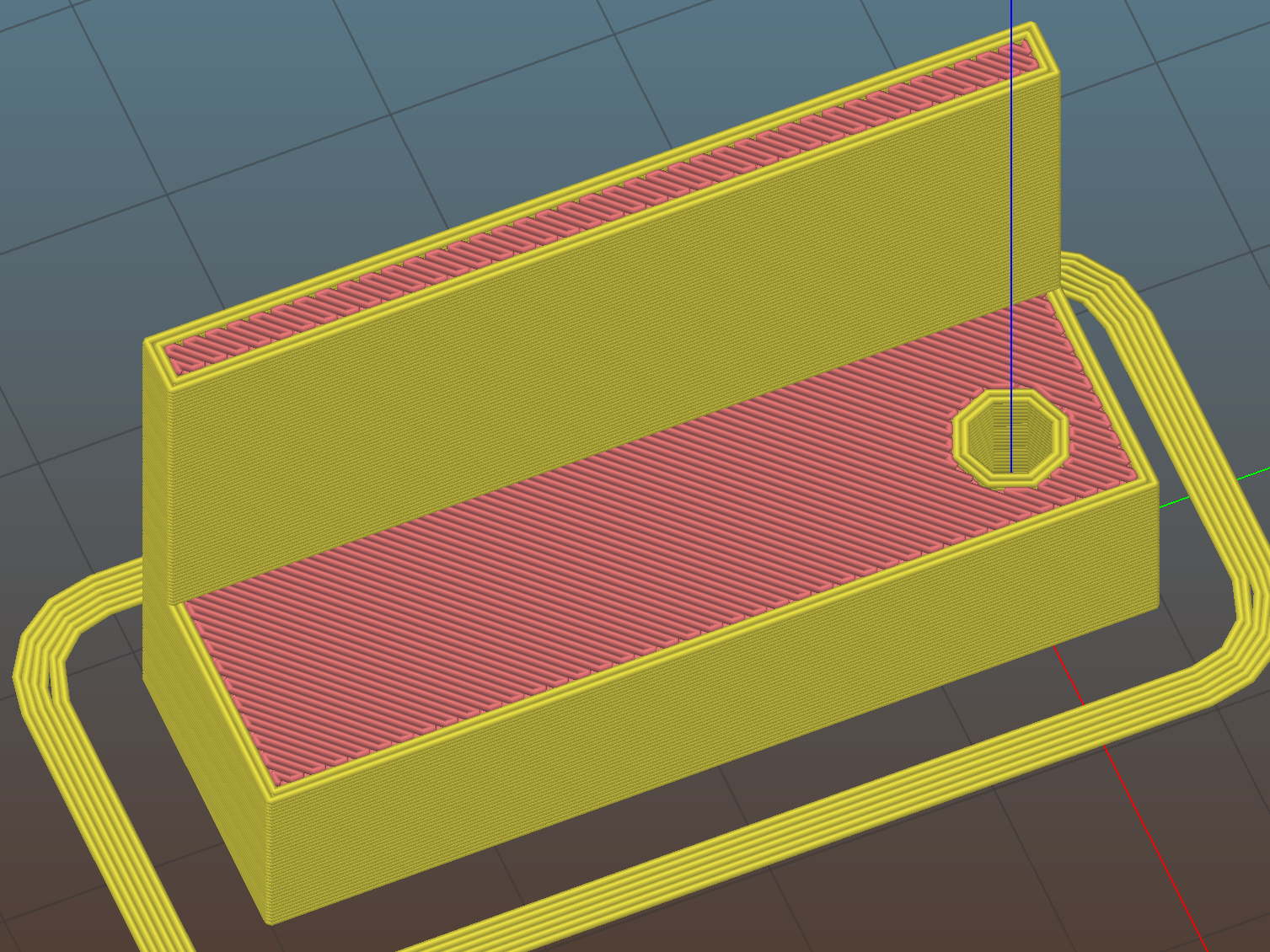
The DW660 collet grabs a length of 1/8 inch drill rod jammed into a hole positioned to put the switch actuator directly in line with the spindle axis when it trips the switch, so as to measure a known and useful location:
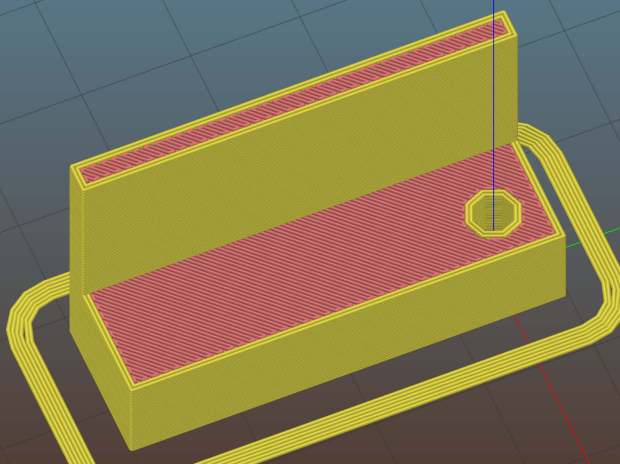
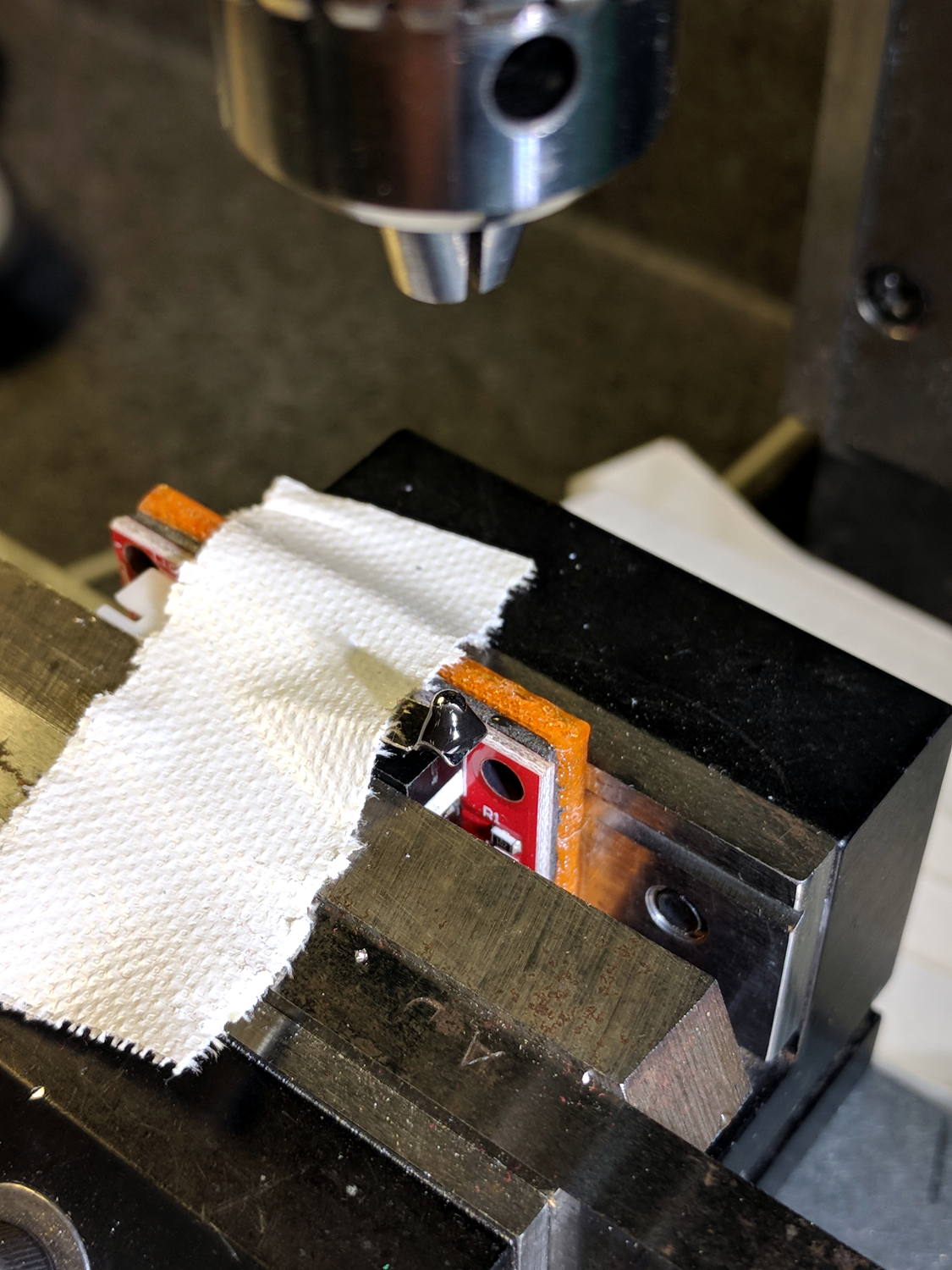
Z Axis Height Probe – MBI endstop – Slic3r After mulling things over for a while, I fired up the Sherline, drilled a #54 hole in the actuator, and epoxied a 3/32 inch bearing ball in the hole:
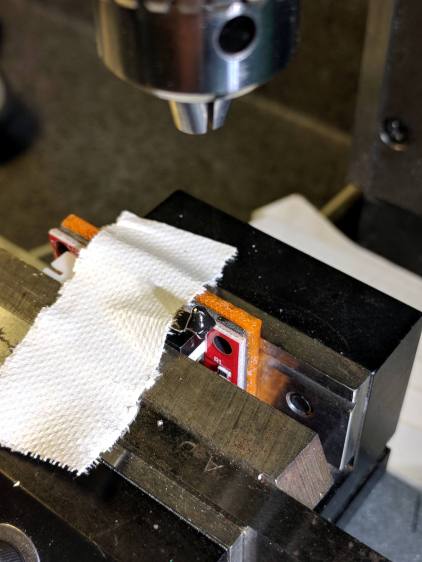
MPCNC – Endstop Z probe – bearing A #54 drill hole is half the diameter of the ball and, with a bit of luck, enough of the ball will stick through into the epoxy on the underside for a good grip:

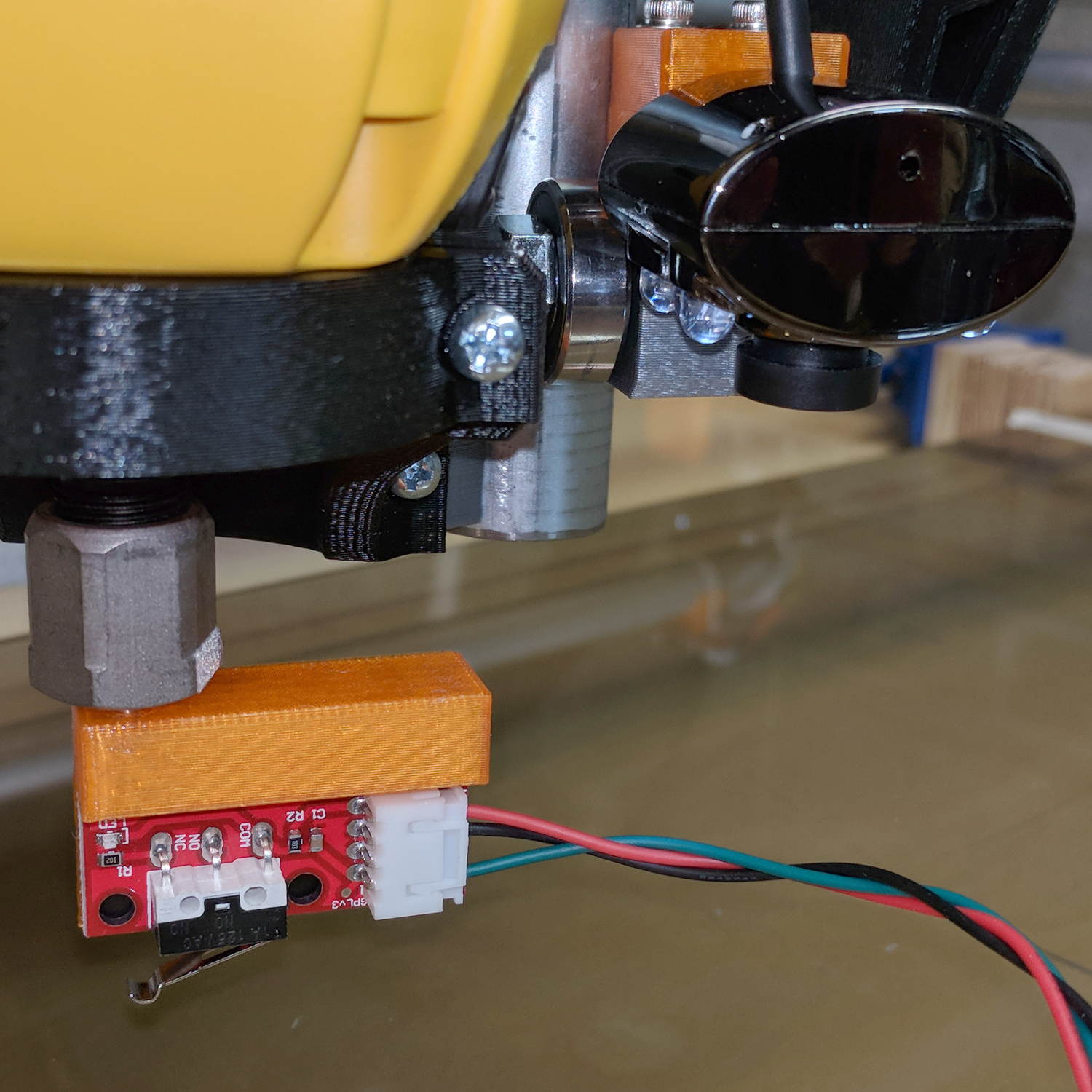
MPCNC – Endstop Z probe – bearing – detail The general idea is to convert the stamped steel actuator into a single, albeit not particularly sharp, contact point that can glide over the platform / PCB / sheet-of-whatever to measure the surface. The actuator pivots as it depresses, so the ball must slide horizontally just a bit. I prefer a rod-in-tube probe poking a linear button switch, but those weren’t getting me anywhere.
If I were really cool, I’d use a ruby ball. Maybe silicon nitride?
The OpenSCAD source code as a GitHub Gist:
This file contains hidden or bidirectional Unicode text that may be interpreted or compiled differently than what appears below. To review, open the file in an editor that reveals hidden Unicode characters. Learn more about bidirectional Unicode characters// MPCNC Z Axis Height Probe – MBI endstop in router collet // Ed Nisley KE4ZNU – 2018-02-17 Layout = "Build"; // Build, Show /* [Extrusion] */ ThreadThick = 0.25; // [0.20, 0.25] ThreadWidth = 0.40; // [0.40] /* [Hidden] */ Protrusion = 0.1; // [0.01, 0.1] HoleWindage = 0.2; inch = 25.4; function IntegerMultiple(Size,Unit) = Unit * ceil(Size / Unit); ID = 0; OD = 1; LENGTH = 2; //- Adjust hole diameter to make the size come out right module PolyCyl(Dia,Height,ForceSides=0) { // based on nophead's polyholes Sides = (ForceSides != 0) ? ForceSides : (ceil(Dia) + 2); FixDia = Dia / cos(180/Sides); cylinder(r=(FixDia + HoleWindage)/2,h=Height,$fn=Sides); } PCB = [40.0,1.6,16.5]; // endstop PCB, switch downward, facing parts Touchpoint = [4.8,4.8,-4.5]; // contact point from PCB edges, solder side TapeThick = 1.0; // foam mounting tape ShankOD = 0.125 * inch; // rod into tool collet ShankInsert = 3*ShankOD; // … insertion into switch holder WallThick = 3.0; // basic wall & floor thickness Mount = [PCB.x, (WallThick + TapeThick + Touchpoint.y) + (ShankOD/2 + WallThick), PCB.z + ShankInsert ]; NumSides = 2*4; //—– // Define shapes module SwitchMount() { difference() { translate([PCB.x/2 – Touchpoint.x, // overall block Mount.y/2 – (ShankOD/2 + WallThick), (PCB.z + ShankInsert)/2]) cube(Mount,center=true); translate([0,0,-Protrusion]) // collet shank hole PolyCyl(ShankOD,2*Mount.z,NumSides); translate([PCB.x/2 – Touchpoint.x, // PCB recess -Mount.y/2 + TapeThick + Touchpoint.y, PCB.z/2 – Protrusion/2]) cube([Mount.x + 2*Protrusion, Mount.y, PCB.z + Protrusion ] ,center=true); } } //—– // Build it if (Layout == "Show") SwitchMount(); if (Layout == "Build") { translate([0,0,Mount.z]) rotate([180,0,-90]) SwitchMount(); }

-
Subscribe
Subscribed
Have a WordPress.com account? Log in now.

