-
Garden Soaker Hose Connector Repair
Two of Mary’s garden soaker hoses failed their pre-installation checks with leaks from around their connectors. The problem seemed to be a break in the hose inside the connector, with water spewing out of the connector around the hose. Having previously fixed a gash in another hose, I figured I might have some success at fixing these leaks.
The general idea is to squish enough silicone rubber inside the connector to seal around the hose, then clamp the hose and connector snugly enough to hold the rubber in place:

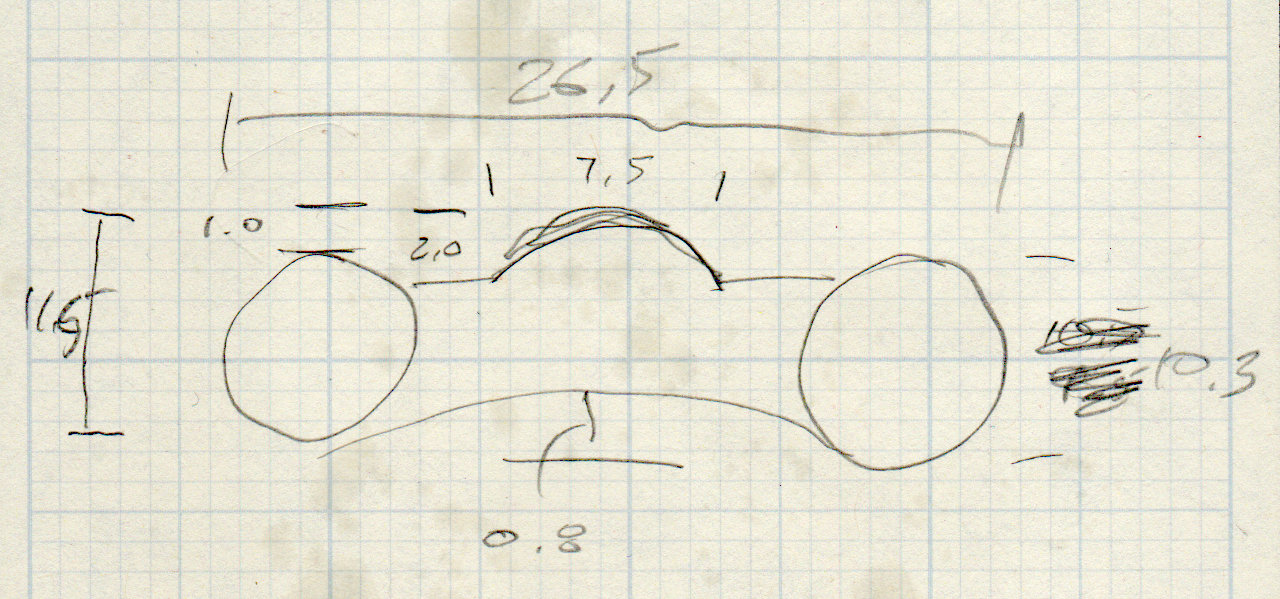
Soaker Hose Connector Clamp – Show view The enlarged recess fits around the brass connector shell, which is squashed loosely around the hose and from which the leaking water emerges. Of course, because this is a different hose, the previous model didn’t quite fit and I had to doodle up new geometry:
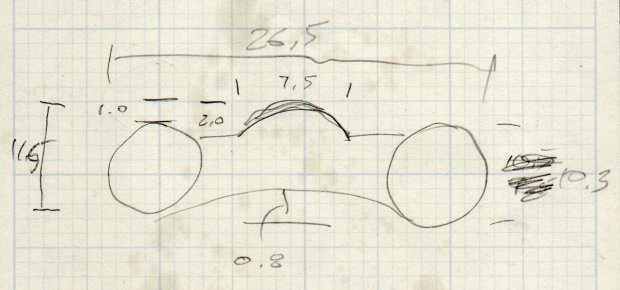
Soaker Hose Connector repair – Dimension doodle As before, I bandsawed aluminum backing plates to ensure the plastic didn’t get all bendy in the middle:
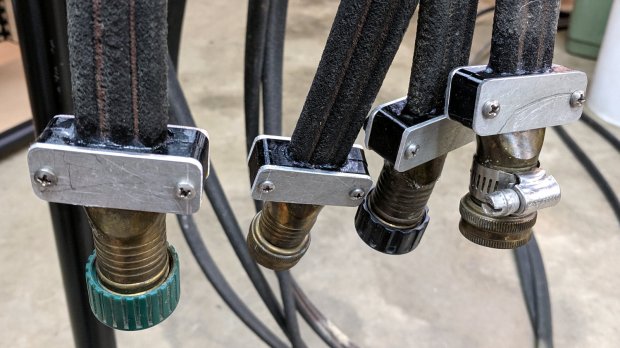
Soaker hose connector leak clamps The hose clamp (!) around the connector on the far right ensures a split in the brass shell doesn’t get any larger.
They’ll spend the rest of their lives under the garden mulch, where nobody will ever see those bulky lumps. Life is good!
The OpenSCAD source code as a GitHub Gist:
This file contains hidden or bidirectional Unicode text that may be interpreted or compiled differently than what appears below. To review, open the file in an editor that reveals hidden Unicode characters. Learn more about bidirectional Unicode characters// Rubber Soaker Hose End Connector Clamp // Helps hold silicone rubber in connector // Ed Nisley KE4ZNU June 2019 Layout = "Build"; // [Hose,Connector,Block,Show,Build] //- Extrusion parameters must match reality! /* [Hidden] */ ThreadThick = 0.25; ThreadWidth = 0.40; HoleWindage = 0.2; Protrusion = 0.1; // make holes end cleanly inch = 25.4; function IntegerMultiple(Size,Unit) = Unit * ceil(Size / Unit); //———- // Dimensions // Hose lies along X axis Hose = [200,26.5,11.6]; // X=very long, Y=width, Z=overall height RimThick = 10.3; // outer sections RimOD = RimThick; RimFlatRecess = 1.0; // recess to front flat surface OuterOC = Hose.y – RimOD; // outer tube centers RecessM = 0.8; // back recess chord RecessC = OuterOC; RecessR = (pow(RecessM,2) + pow(RecessC,2)/4) / (2*RecessM); RidgeM = 1.6; // front ridge chord RidgeC = 7.5; RidgeR = (pow(RidgeM,2) + pow(RidgeC,2)/4) / (2*RidgeM); HoseSides = 12*4; Connector = [5.0,33.0,13.0]; // oval brass: X=snout Y=width Z=dia Block = [20.0,50.0,4.0 + Hose.z]; // overall splice block size echo(str("Block: ",Block)); Kerf = 0.5; // cut through middle to apply compression ID = 0; OD = 1; LENGTH = 2; // 8-32 stainless screws Screw = [4.1,8.0,3.0]; // OD = head LENGTH = head thickness Washer = [4.4,9.5,1.0]; Nut = [4.1,9.7,6.0]; CornerRadius = Washer[OD]/2; ScrewOC = Block.y – 2*CornerRadius; echo(str("Screw OC: x=",ScrewOC.x," y=",ScrewOC.y)); //———————- // Useful routines module PolyCyl(Dia,Height,ForceSides=0) { // based on nophead's polyholes Sides = (ForceSides != 0) ? ForceSides : (ceil(Dia) + 2); FixDia = Dia / cos(180/Sides); cylinder(d=(FixDia + HoleWindage),h=Height,$fn=Sides); } // Hose shape // This includes magic numbers measured from reality module HoseProfile() { rotate([0,-90,0]) translate([0,0,-Hose.x/2]) linear_extrude(height=Hose.x,convexity=4) difference() { union() { for (j=[-1,1]) // outer channels translate([0,j*OuterOC/2]) circle(d=RimOD,$fn=HoseSides); translate([-RimOD/4,0]) // rear flat fill square([RimOD/2,OuterOC],center=true); translate([(RimOD/4 – RimFlatRecess),0]) // front flat fill square([RimOD/2,OuterOC],center=true); intersection() { translate([Hose.z/2,0]) square([Hose.z,OuterOC],center=true); translate([-RidgeR + RimOD/2 – RimFlatRecess + RidgeM,0]) circle(r=RidgeR,$fn=HoseSides); } } translate([-(RecessR + RimOD/2 – RecessM),0]) circle(r=RecessR,$fn=2*HoseSides); } } // Outside shape of splice Block // Z centered on hose rim circles, not overall thickness through center ridge module SpliceBlock() { difference() { hull() for (i=[-1,1], j=[-1,1]) // rounded block translate([i*(Block.x/2 – CornerRadius),j*(Block.y/2 – CornerRadius),-Block.z/2]) cylinder(r=CornerRadius,h=Block.z,$fn=4*8); for (j=[-1,1]) // screw holes translate([0, j*ScrewOC/2, -(Block.z/2 + Protrusion)]) PolyCyl(Screw[ID],Block.z + 2*Protrusion,6); cube([2*Block.x,2*Block.y,Kerf],center=true); // slice through center } } // Splice block less hose module ShapedBlock() { difference() { SpliceBlock(); HoseProfile(); Connector(); } } // Brass connector end module Connector() { translate([-(Block.x/2 + Protrusion),0,0]) rotate([0,90,0]) linear_extrude(height=Connector.x + Protrusion) hull() for (i = [-1,1]) translate([0,i*(Connector.y – Connector.z)/2]) circle(d=Connector.z); } //———- // Build them if (Layout == "Hose") HoseProfile(); if (Layout == "Block") SpliceBlock(); if (Layout == "Connector") Connector(); if (Layout == "Show") { ShapedBlock(); color("Green",0.25) HoseProfile(); } if (Layout == "Build") { SliceOffset = 0; intersection() { translate([SliceOffset,0,Block.z/4]) cube([4*Block.x,4*Block.y,Block.z/2],center=true); union() { translate([0,0.6*Block.y,Block.z/2]) ShapedBlock(); translate([0,-0.6*Block.y,Block.z/2]) rotate([0,180,0]) ShapedBlock(); } } }

-
Subscribe
Subscribed
Have a WordPress.com account? Log in now.

