-
CNC Kitchen Sink Strainer
Our Young Engineer recently rented a house, now knows why our sinks have CNC-machined strainers, and asked for something better than the disgusting stainless mesh strainer in the kitchen sink.
Being a doting father, I turned out a pair to get a pretty one:
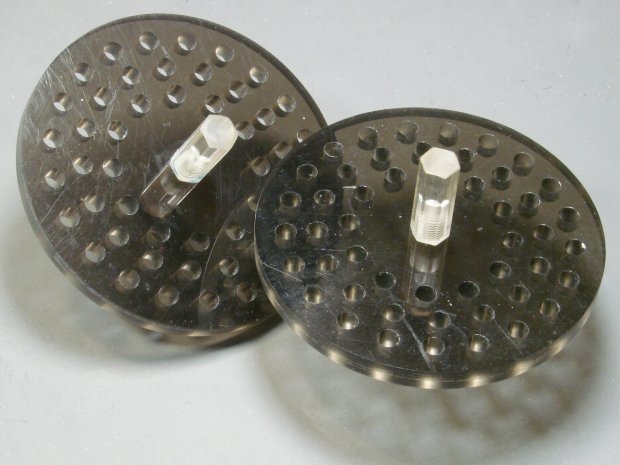
CNC Sink Strainer – overview They’re made from the same scrap smoked acrylic as the ones in our sinks:

CNC Sink Strainer They’re definitely upscale from the (not watertight!) 3D printed version I built for a Digital Machinist column to explain OpenSCAD modeling:

Strainer plate fill This time around, though, I rewrote the subtractive design in GCMC, with helical milling for all the holes to eliminate the need to change tools:
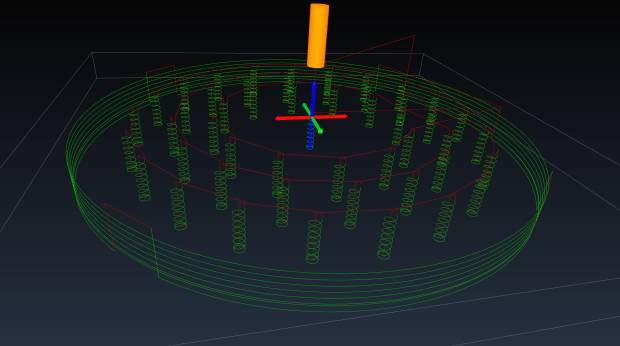
Sink Strainer – tool path simulation – CAMotics They’re done on the Sherline, because it has real clamps:
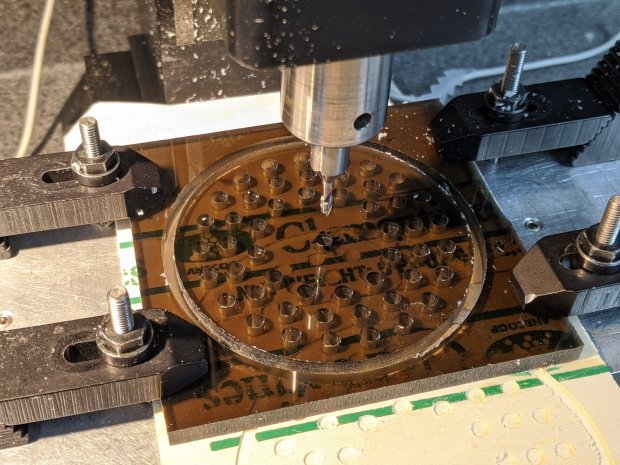
CNC Sink Strainer – on Sherline Four tabs eliminated the need to reclamp the stock before cutting the perimeter, but I should have ramped, not plunged, through the final cut between the tabs:

CNC Sink Strainer – tab surface fracture The handles come from the same chunk of hex acrylic as before, eyeballed to length, tapped 8-32, and secured with acrylic adhesive.
The GCMC source code as a GitHub Gist:
This file contains hidden or bidirectional Unicode text that may be interpreted or compiled differently than what appears below. To review, open the file in an editor that reveals hidden Unicode characters. Learn more about bidirectional Unicode characters// Drill & mill sink drain strainer // Ed Nisley KE4ZNU — Digital Machinist 15.2 Spring 2020 // polycarbonate or acrylic sheet // External clamps at corners // Origin at center of sheet //—– // Dimensions DiskOD = 80.0mm; // usual kitchen drain = 3-1/4 inch DiskRad = DiskOD/2; PlateThick = 6.0mm; // stock thickness MillOD = 3.170mm; // measured end mill OD HoleDia = 4.75mm; // 3/16 inch drain holes ScrewOD = 0.18in; // knob screw clearance NumRings = 3; // rings of drain holes RingSpace = 1.5 * HoleDia; // .. between rings MaxZCut = 0.25 * MillOD; // max cut depth MillSpeed = 1000mm; // horizontal feedrate NumTabs = 4; TabTilt = 45deg; TabLength = 5.0mm; TabThick = 0.5mm; SafeZ = 10.0mm; // above all obstructions TravelZ = 1.0mm; // within engraving / milling area MillZ = -(PlateThick + 0.5mm); // through disk into spoil board TwoPi = 2*pi(); //—– // Mill one hole function MillHole(ctr,radius,turns) { goto([-,-,TravelZ]); goto(head(ctr,2) + [radius,-,-]); goto([-,-,0]); // kiss surface circle_cw(ctr,turns); // helix downward circle_cw(head(ctr,2)); // remove last ramp goto(ctr); // get elbow room goto([-,-,TravelZ]); } //—– // Start cutting! goto([-,-,SafeZ]); goto([0,0,-]); goto([-,-,TravelZ]); feedrate(MillSpeed); // Mill center screw hole comment("– Center hole"); ctr = [0,0,MillZ]; MillHole(ctr,(ScrewOD – MillOD) / 2,ceil(abs(ctr.z) / MaxZCut)); // Mill hole rings comment("– Drain hole rings"); repeat (NumRings; ri) { comment("Ring: ",ri); rr = DiskRad – ri*RingSpace; // ring radius comment(" radius: ",rr); nh = to_int(floor(TwoPi*rr / (2*HoleDia))); // number of holes comment(" holes: ",nh); repeat(nh; h) { a = (h – 1) * TwoPi / nh; // angle of hole ctr = [rr*cos(a),rr*sin(a),MillZ]; // center point at ending Z MillHole(ctr,(HoleDia – MillOD)/2,ceil(abs(ctr.z) / MaxZCut)); } } // Mill perimeter comment("– Perimeter"); r = DiskRad + MillOD/2; goto([r,0,-]); goto([-,-,0]); ctr = [0,0,-(PlateThick – TabThick)]; circle_ccw(ctr,ceil(abs(ctr.z) / MaxZCut)); // ramp downward circle_ccw(ctr,1); // remove last ramp goto([-,-,TravelZ]); comment("– Tabs"); ta = 360deg / NumTabs; // between tabs tsa = to_rad(TwoPi*((TabLength + MillOD) / (TwoPi * r))); // subtended tab angle repeat (NumTabs; i) { comment(" # ",i); a = TabTilt + (i – 1)*ta; // tab center angle p0 = [r*cos(a + tsa/2),r*sin(a + tsa/2),MillZ]; // entry on ccw side p1 = [r*cos(a + ta – tsa/2),r*sin(a + ta – tsa/2),MillZ]; // exit at next tab if (0) { comment(" angle: ",a); comment(" entry: ",p0); comment(" exit: ",p1); } goto(head(p0,2)); // to entry point move(p0); // plunge through arc_ccw(p1,r); goto([-,-,TravelZ]); } goto([-,-,SafeZ]); goto([0,0,-]); All in all, a pleasant diversion from contemporary events …
-
Subscribe
Subscribed
Have a WordPress.com account? Log in now.

