-
ShopVac Nozzle Caddy
Shortly after acquiring the Greatest ShopVac, I zip-tied half a foot of cardboard tube to the handle to corral the nozzle and keep the ungainly hose from sprawling across the floor. While disembowling the Ottlite into a mini-lathe light, the plastic trim joining the baseplate to the vertical tube cried out to become a nozzle caddy:
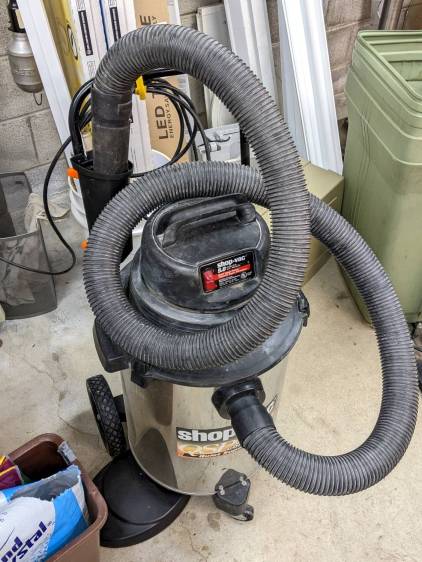
ShopVac Nozzle Caddy – front view It was exactly the right size and shape (by my admittedly slack standards) to hold the nozzle, plus being destined for the trash, so all it needed was a pair of clamp brackets conjured from the vasty digital deep:
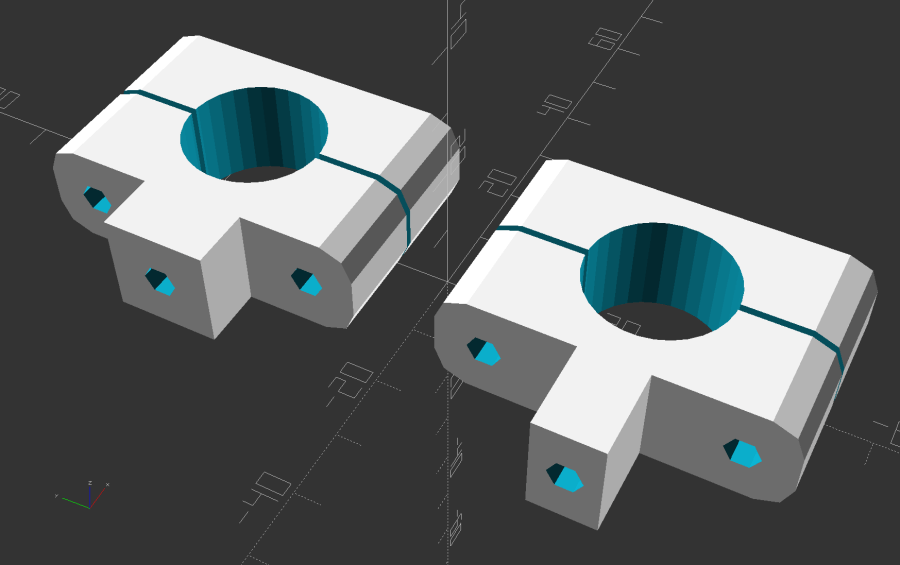
ShopVac Nozzle Caddy – solid model The bosses fit into a tapered slot along what was the rear side, with a pair of 4 mm holes at each end for screws into threaded brass inserts epoxied into the brackets:

ShopVac Nozzle Caddy – clamps mounted They obviously descend from the many clamp mounts I’ve made for everything from garden hoses to bike running lights. A pair of 4 mm SHCS squish the clamp around the handle, with a strip of electrical tape improving plastic-to-metal griptivity:
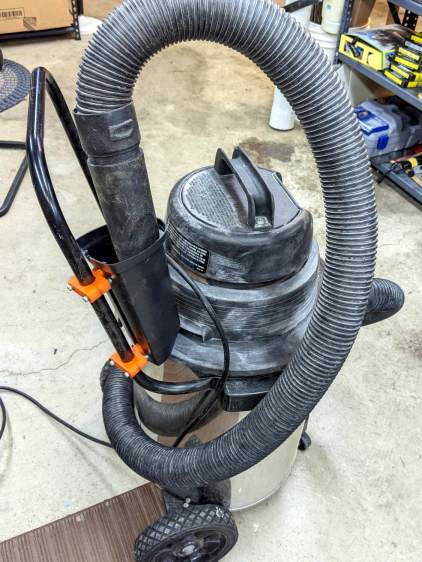
ShopVac Nozzle Caddy – side view The clearance just barely allows a nylock nut atop a washer and you’ll want to trim those 40 mm screws to an exact fit, but it came out pretty well.
The original dimension doodle with some modeling ideas that didn’t survive more thinking:
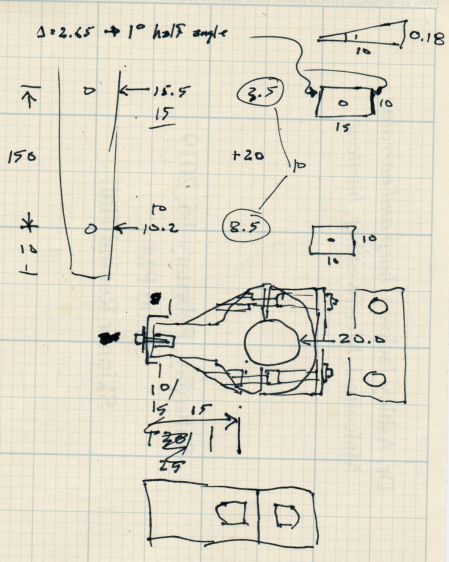
ShopVac Nozzle Caddy – Dimension Doodle 1 A more detailed doodle with brass inserts instead of the nylock nuts and an aluminum spreader plate that was obviously not necessary:

ShopVac Nozzle Caddy – Dimension Doodle 2 In retrospect, the inserts would make more sense.
The angle doodles convinced me not to bother modeling either the slot’s taper along its length or its mold draft.
Kinda looks like it grew there and makes one wonder why they don’t include a caddy as a standard option.
The OpenSCAD source code as a GitHub Gist:
This file contains hidden or bidirectional Unicode text that may be interpreted or compiled differently than what appears below. To review, open the file in an editor that reveals hidden Unicode characters. Learn more about bidirectional Unicode characters// ShopVac Nozzle Caddy // Ed Nisley KE4ZNU 2022-02 Layout = "Show"; // [Handle,Block,Show,Build] HandleOD = 20.0; //- Extrusion parameters must match reality! /* [Hidden] */ ThreadThick = 0.25; ThreadWidth = 0.40; HoleWindage = 0.2; Protrusion = 0.1; // make holes end cleanly inch = 25.4; function IntegerMultiple(Size,Unit) = Unit * ceil(Size / Unit); ID = 0; OD = 1; LENGTH = 2; //———- // Dimensions // Handle lies along X axis Handle = [200,HandleOD,HandleOD]; // X = longer than anything else WallThick = 5.0; // Thinnest printed wall Screw = [4.0,7.0,25.0]; // M4 socket head cap screw Washer = [4.5,9.0,0.8]; // M4 washer Insert = [4.0,5.9,10.0]; // M4 brass insert Block = [15.0,Handle.y + 4*WallThick + 2*Screw[ID],HandleOD + 2*WallThick]; // overall clamp block echo(str("Block: ",Block)); Bosses = [[Block.x,9.5,13.0],[Block.x,15.0,9.0]]; ScrewOC = Handle.y + 2*WallThick + Screw[ID]; Kerf = 1.0; // cut through middle to apply compression Gap = 1.25; CornerRadius = Washer[OD]/2; //———————- // Useful routines module PolyCyl(Dia,Height,ForceSides=0) { // based on nophead's polyholes Sides = (ForceSides != 0) ? ForceSides : (ceil(Dia) + 2); FixDia = Dia / cos(180/Sides); cylinder(d=(FixDia + HoleWindage),h=Height,$fn=Sides); } // Shopvac handle module Handle() { rotate([0,90,0]) translate([0,0,-Handle.x/2]) rotate(180/(4*8)) PolyCyl(Handle.y,Handle.x,4*8); } // Clamp block module ClampBlock(BossID=0) { difference() { union() { hull() for (i=[-1,1], j=[-1,1]) // rounded block translate([i*(Block.x/2 – CornerRadius),j*(Block.y/2 – CornerRadius),-Block.z/2]) cylinder(r=CornerRadius,h=Block.z,$fn=8); translate([0,0,-(Block.z/2 + Bosses[BossID].z/2 – Protrusion)]) cube(Bosses[BossID],center=true); } for (j = [-1,1]) // screw holes translate([0,j*ScrewOC/2,-(Block.z/2 + Protrusion)]) rotate(180/6) PolyCyl(Screw[ID],Block.z + 2*Protrusion,6); cube([2*Block.x,2*Block.y,Kerf],center=true); Handle(); translate([0,0,-Block.z]) rotate(180/6) PolyCyl(Screw[ID],Block.z,6); translate([0,0,-(Handle.z/2 + Insert[LENGTH])]) rotate(180/6) PolyCyl(Insert[OD],Handle.y,6); } } // Splice block less handle bore module ShapedBlock() { difference() { ClampBlock(); Handle(); } } //———- // Build them if (Layout == "Handle") Handle(); if (Layout == "Block") ClampBlock(BossID=0); if (Layout == "Show") { color("Green",0.25) Handle(); xofs = -((len(Bosses) – 1)/2 * Gap*Block.x); for (i=[0:len(Bosses) – 1]) translate([xofs + i*Gap*Block.x,0,0]) ClampBlock(i); } if (Layout == "Build") { yofs = -((len(Bosses) – 1)/2 * Gap*Block.y); for (j=[0:len(Bosses) – 1]) translate([0,yofs + j*Gap*Block.y,0]) translate([0,0,Block.x/2]) rotate([0,90,0]) ClampBlock(j); }
-
Subscribe
Subscribed
Already have a WordPress.com account? Log in now.
 The Smell of Molten Projects in the Morning