Ed Nisley's Blog: Shop notes, electronics, firmware, machinery, 3D printing, laser cuttery, and curiosities. Contents: 100% human thinking, 0% AI slop.
Just like fire extinguishers and bike helmets, you never know when you’ll need to use this thing in a hurry… then it’s too late to clean out all the crap that accumulates on any flat (or concave) spot.
Not that I’m completely innocent, of course.
The DSC-H5 had been outdoors for a few hours, hiking with us at 25 °F, so the lens fogged instantly when we walked through the greenhouse door.
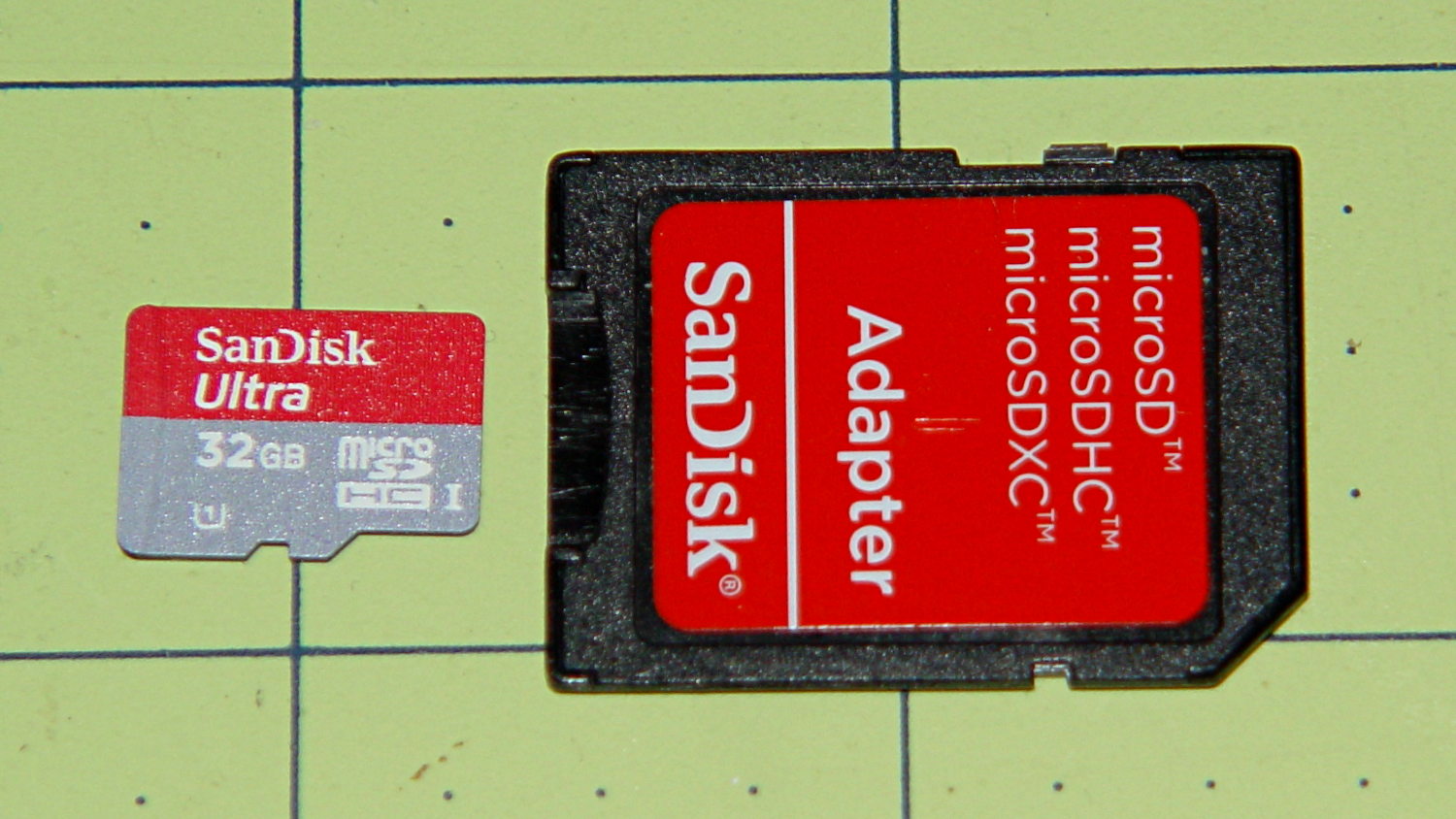
Picked up a Sandisk 32 GB Micro SD Card from a reputable supplier for $0.62/GB, in the hope that Santa will deliver a helmet camera:
Sandisk 32 GB microSD card
Until that happy event, I verified that it can store and return 32 GB of white noise with absolute fidelity.
It came formatted with an empty FAT32 filesystem that allows single files up to 4 GB. Reformatting with exFAT supports vastly larger capacities and, in this case, allows single files up to 32 GB. Whether it’s actually legal to use exFAT on a Linux box remains up for grabs, but installing exfat-utils, which drags in exfat-fuse, does the trick.
Verifying the SD Card capacity went swimmingly, much along the lines of the original recipe. The data file size came from the card’s FAT-32 formatting and is a smidge less than the capacity after reformatting the card with exFAT. Close enough for this purpose.
dd bs=1K count=31154656 if=/dev/urandom of=/mnt/part2/Testdata/Testdata.bin
(This took the better part of an hour; I didn't record it.)

sudo mkexfatfs -i babeface -n SanDisk32GB /dev/sdb1
mkexfatfs 1.0.1
Creating... done.
Flushing... done.
File system created successfully.

sudo dumpexfat /dev/sdb1
dumpexfat 1.0.1
Volume label             SanDisk32GB
Volume serial number      0xbabeface
FS version                       1.0
Sector size                      512
Cluster size                   32768
Sectors count               62325760
Free sectors                62317504
Clusters count                973719
Free clusters                 973711
First sector                       0
FAT first sector                 128
FAT sectors count               7616
First cluster sector            7744
Root directory cluster             7
Volume state                  0x0000
FATs count                         1
Drive number                    0x80
Allocated space                   0%

time rsync --progress /mnt/part2/Testdata/Testdata.bin /mnt/part/Test.bin
Testdata.bin
 31902367744 100%    9.15MB/s    0:55:24 (xfer#1, to-check=0/1)

sent 31906262150 bytes  received 31 bytes  9594425.55 bytes/sec
total size is 31902367744  speedup is 1.00

real	55m25.791s
user	3m16.088s
sys	2m7.808s

df -h /mnt/part
Filesystem      Size  Used Avail Use% Mounted on
/dev/sdb1        30G   30G  4.0M 100% /mnt/part

time diff /mnt/part2/Testdata/Testdata.bin /mnt/part/Test.bin

real	28m43.878s
user	0m4.044s
sys	0m42.902s

ll /mnt/part/Test.bin
-rwxr-xr-x 1 ed root 31902367744 Dec  2 18:32 /mnt/part/Test.bin*

rm /mnt/part/Test.bin

df -h /mnt/part
Filesystem      Size  Used Avail Use% Mounted on
/dev/sdb1        30G  4.1M   30G   1% /mnt/part
I’m probably easily impressed, but wow that’s a lot of data in a little chip of plastic… for $20 delivered.
While the rest of the Master Gardener tour group walked on to the Island, I lay face-down on the Channel Bridge at Innisfree for a frog’s eye perspective:
Innisfree water lilies – stages
Painting these pastels would pose a challenge:
Innisfree water lily – pink
Hand-held with the Sony DSC-H5 on an overcast day that accentuated those colors.
The trio of batteries I built for the Sony DSC-F505V two years ago faded away; that camera seems particularly hard on the batteries, perhaps because they’re two cells in parallel that don’t share well. Two of the three seem pretty well gone:
Sony NP-FS11 2011 Packs – 2013-11 tests
Back then, I bought 12 cells, built six into those batteries, and left six charged cells sitting in a bag. After rebuilding the two worst batteries with those new-old-stock cells, it seems they maintained a substantial fraction of their charge while resting in the cool and the dark:
Sony NP-FS11 2011 Cells – 2013 packs – 2013-11-24
However, the camera would regard them as discharged, because it infers charge state from voltage. Squinting at the curves, their condition after a few minutes is roughly equal to a new & freshly charged battery produces over on the right when it’s nearly discharged.
The other curves show the result after their first charge in two years: basically, full capacity. The fact that both pairs of curves come pretty close to overlaying means they’re still well matched.
Sony NP-FS11 batteries – rebuilt
The third cell isn’t up to their spec, but it’s close enough to not bother rebuilding right now: 1.2 vs 1.4 A·h.
The Kapton tape pull tabs work wonderfully well, as the rebuilt batteries fit the compartment rather more snugly than the un-hacked cases.






 The Smell of Molten Projects in the Morning