Ed Nisley's Blog: Shop notes, electronics, firmware, machinery, 3D printing, laser cuttery, and curiosities. Contents: 100% human thinking, 0% AI slop.
As mentioned there, I have a pair of ERRC’s Easy Reacher underseat packs. They’re supported by an Easy Reacher rack that’s specifically designed for Tour Easy bikes.
Perhaps because I carry dense stuff in the packs, they tend to flop side-to-side. I added a rear strut across the bike frame and a pair of lengthwise plastic (acrylic?) struts to stabilize the packs.
A pair of padded clamps holds the crosswise strut to the bike frame and a washer captures the rear fender’s mounting bracket.
Looks hideous, works fine.
The black tit hanging down from the strut clamp is a bit of heatshrink tubing that cushions the kickstand when it’s up; otherwise, it rattles against the stub end of the aluminum rod.
Yeah, the bike’s pretty grubby. I’d rather ride it than wash it… and, anyway, I follow my father’s advice: “If you have to move it to clean behind it, don’t move it!“
I have a pair of underseat packs on my Tour Easy that have sagged rather badly over the years. That might have something to do with the fact that my toolkit and other odds & ends weighs more than some bike frames; while I don’t need that stuff very often, it’s good to have around.
Tools & suchlike live in the left-side pack, the near one in the photo, and you can see the problem. The right-side pack holds HT batteries, my belt pack, and other relatively lightweight stuff; I’ll fix that one when I see whether this works. The panniers at the rear wheel are for groceries and other bulky items. The trailer, well, that’s how we do groceries…
Broken Pack Backplate
Anyway, the underseat packs have a black plastic (styrene?) backing that cracked under the stress of the stuff inside, allowing the top corners to cave in and the bottom to droop.
The hooks holding the pack to the underseat rack were riveted through the backing sheet and the hardware, but a couple of good shots with a punch broke them free.
Some rummaging in the Parts Heap turned up a big acrylic sheet (“100 times stronger than glass!”) that’s absolutely the wrong material for the job: it’s too brittle. However, I’d like to see whether a stiff backplate will solve the problem or if I’m going to have to get ambitious and build an internal pack frame.
Acrylic Plate and Aluminum Stiffener
It’s essentially impossible to get a picture of a project built largely from acrylic sheet, but here goes.
I traced the outline of the old backplate onto the new sheet’s protective paper, introduced it to Mr Belt Sander to get those nice round corners, then drilled the holes. It turns out to not be quite symmetric, so there’s a right way and a wrong way to insert it into the pack.
All the hardware is stainless steel. They used aluminum rivets, which is the only reason I could punch them out without too much difficulty, that I’m replacing with SS 10-32 machine screws & nuts.
The aluminum stiffener is a random chunk of ribbed extrusion from the Heap; the original was almost exactly twice as long as one backplate, so the two halves (one for the other pack) are precisely right. I milled out the center rib around the nuts to get enough clearance for a nut driver.
Stiffener Hardware Detail
Herewith, a closeup of the hardware. There’s an acrylic sheet in there, honest, it’s under the aluminum extrusion and fender washer. Really!
I put an automobile license plate in the bottom of each underseat pack to act as a floor for all the crap inside; it’s an almost perfect fit and should give you an idea of the pack’s size. It also maintains the bottom’s rectangular shape and keeps heavy stuff from sagging; there’s a hole scuffed in the bottom from the intersection of a high curb and just such an oversight.
Tour Easy Underseat Pack Detail
Having washed the pack while it was apart (there’s a first time for everything), it looks a lot better than it did before. The yellow block in the front pocket is the kickstand plate mentioned there. It used to have a mesh pocket along the side, too, but that snagged on something and got pretty well ripped, so Mary trimmed it off when she sewed a patch over the aforementioned hole.
It’s still saggy, but the top corners of the plate are holding it up a lot better now. If they crack again, I might just have to go with some aluminum sheet.
These packs seem to be obsolete. The ERRC Lloonngg panniers (search for them) seem to be, well, too long for most purposes; they look as though they would interfere with ordinary rack packs. If I were doing it over, I’d look into hacking a pair of smallish duffel bags.
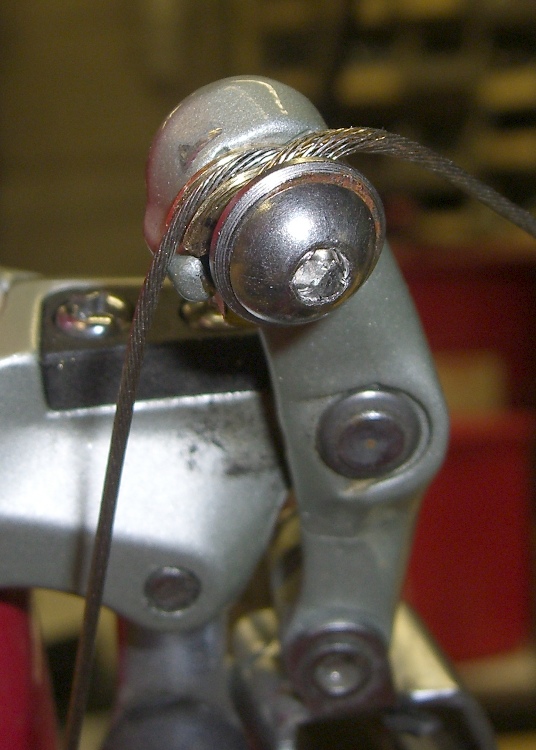
This cable guide / pulley may work better than the one described there, because it puts the cable a bit closer to the original location.
To recap, the problem is that the cable bends around the small finger at about 8 o’clock on the derailleur arm. After a few zillion shifts, the concentration of stress at that point breaks the cable, strand by strand, until it snaps at the most inconvenient moment.
The small brass disk (about 0.43″ dia) has a groove machined around the perimeter that’s roughly the size of the shifter cable. The hole (Number 8 or 9 drill) is a slip fit for the 5 mm bolts, but it’s off-center enough that the cable passes roughly where it would without the disk.
A notch in the side of the disk rests on the finger, guiding the cable over the finger without (I hope) bending it at that point.
The cable just wraps around the screw under the original stainless-steel washer, which pretty much crushes the poor thing flat.
Shift at Large Chainring
Here’s another look with the derailleur pretty much over the large chainring. You can see the disk and groove in action.
This was another quick-and-dirty lathe project, with everything done to eyeballometric accuracy. If it works better than the previous half-assed effort, I might actually get around to making a third one and recording the dimensions.
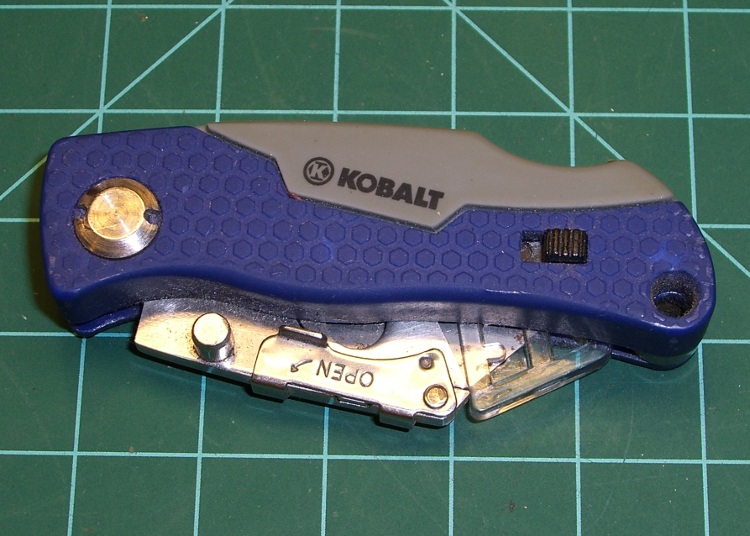
I added a miniature razor knife to my belt pack a while ago and was struck by the fact that the blade didn’t lock shut. While having it pop completely open is unlikely, just the thought of a razor blade sliding around next to my hip was unsettling.
But that’s easy to fix…
Blade closed in notch
With the knife closed, use a carbide scriber to mark the blade holder at the end of the locking lever that extends across the back of the knife. You’ll be grinding / filing a notch in the blade holder behind that, just large enough for the locking cam to snap into when the blade is closed. The only vital measurement is the line you just scribed.
Lock the blade holder open, then remove the sharp blade before you do something truly stupid.
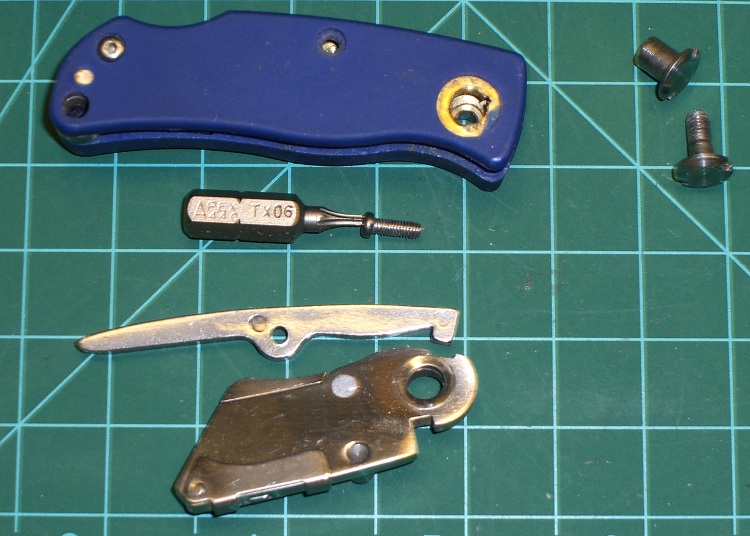
Unscrew the Torx-06 screw that holds the locking lever in place, then remove the lever. It’s spring-loaded and will probably bind on the screw, so display some adaptability.
Knife parts
Use a pin spanner to unscrew the blade pivot bolt from the front panel of the knife; hold the corresponding rear nut in position with another spanner or just jam a screwdriver blade into one of the notches. Pretty much everything falls apart at that point, although you may have to do some wiggly-jiggly to get the blade holder out. The washer seems to be swaged into the blade holder hole on my knife, which may be poor production QC.
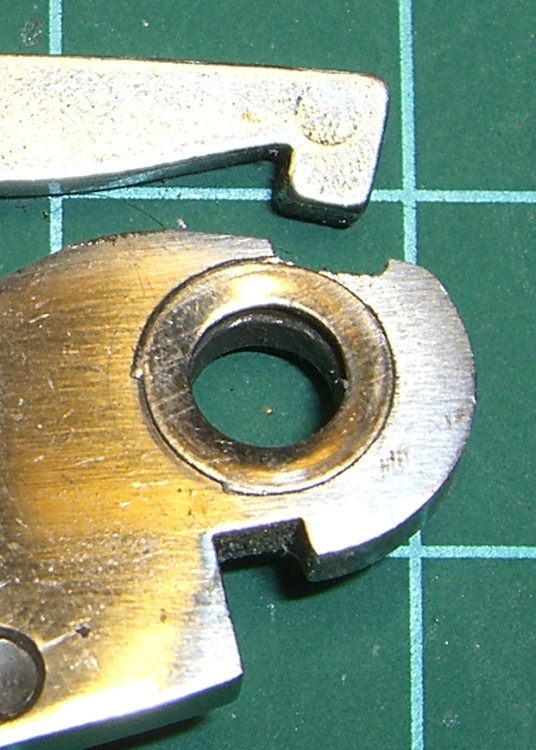
Using a file or a Dremel-class grinder, gnaw a notch into the back of the blade holder that just barely accepts the cam on the locking lever. This will probably take a few trial assemblies to get right; the notch on mine is slightly too long on the body side (left in the pix), which is OK because the blade holder doesn’t pivot in that direction. If you go beyond the line you scribed earlier (to the right in the pix), the blade holder can pivot open just slightly… and it turns out that the point of the razor blade isn’t all that far inside the knife body.
Notch detail
Anyhow, here’s a detail of the notch. It’s not nearly as pretty as the notch on the other side of the hole that locks the blade open, but it works just fine.
When you get everything back together, the blade holder should snap into the new notch when you close the blade. To open the knife, press down on the far end of the locking lever to pull the cam out of the notch, open it as usual, and the cam should snap into the old notch to hold the blade open as usual.
I keep the goofy plastic safety dingus on the blade anyway, being a belt-and-suspenders kind of guy about that sort of thing.
For what it’s worth, you can’t get into concerts with one of these in your belt pack… for well and good reason, I suppose. They let me hotfoot it back to the van, rather than confiscate it, which is probably one benefit of being an Olde Farte.
We spent four days biking along the Pine Creek Valley rail trail with a Rails-to-Trails Conservancy group ride on our Tour Easy recumbent bikes. Because a crushed-stone path creates a lot of noise that the fairings direct right into our ears and because we weren’t going very fast, we left the fairings at home. As a result, the bikes were wonderfully quiet.
Some years ago, Mary sewed up “bubble wraps” to store our fairings on those rare occasions when they’re not on the bikes. She had some red flannel left over from another project and a hank of cheery Christmas-themed edging, so they turned out to be rather conspicuous.
The trick is to get the size right when the fairing is rolled up. With the fairing in its natural bubble shape, the wrap is rather limp, so you need pockets on both ends to hold the wrap in place. The toes are, she admits, an affectation, but didn’t take much figuring to get right. The width is just slightly more than the fairing’s flat width; you find that by rolling it up and measuring the roll.
She actually made a paper template first to sort out all the curves, then transferred that to the flannel for final cutting.
Tuck in the fairing’s head & toes, roll it up toes first, tie the (attached) strap in a neat bow, and it’s done!
We have three fairings and they roll up together, each in its own wrap, into one tidy, albeit rather heavy, package.
We’ve been using Cateye Astrale “computers” on our bikes for decades, mostly to get the cadence function. After all this time, we pretty much know how fast to pedal, but old habits die hard.
The cadence sensor counts pedal revolutions per minute, which requires a magnet on the crank arm. They provide a small plastic-encased magnet with a sticky-tape strip that’s worked fine on our previous crank arms.
Our daughter’s Tour Easy arrived with fancy curved pedal crank arms that put the cadence sensor magnet much too far from the frame. You really want the magnet & sensor close to the bottom bracket so that it doesn’t get kicked and doesn’t snag anything as you pedal, but that just wasn’t going to work out here.
A turd of JB Weld epoxy putty solved the problem: mix up a generous blob, shape it into a pedestal, glom the magnet atop it, adjust so the magnet is parallel to and properly spaced from the sensor, then smooth the contours a bit.
Add the cable tie for extra security; you don’t want to lose the magnet by the side of the road!
The black electrical tape is mildly ugly, but serves the purpose of keeping the cable from flapping in the breeze. The adhesive lasts about a year, then it’s time for routine maintenance anyway.
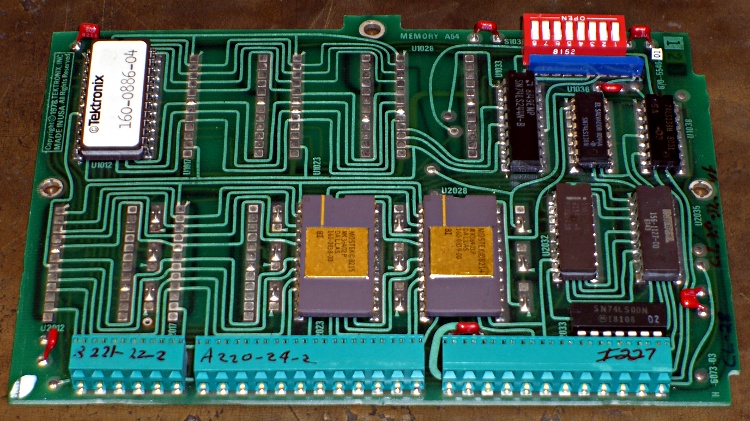
My buddy Eks asked me to help fix his new-to-him and guaranteed broken Tek 492 spectrum analyzer, which turned into a tour-de-force effort. One sub-project involved sucking the bits out of an existing “known-good” Tek memory card, which meant building a backplane connector and a circuit that behaved like a 6800 microcontroller… fortunately, it could be a lot slower.
[Update: It seems searches involving “Tektronix 492” produce this page. You may also be interested in these posts…
The HEX files you’ll need to replace failed ROMs and EPROMs
If those aren’t what you’re looking for, note that the correct spelling is “Tektronix“.
Good luck fixing that gadget: it’s a great instrument when it works!]
You can tell just by looking that this board was designed back in the day when PCB layout involved flexible adhesive tape traces and little sticky donut pads. Ground plane? We don’t need no stinkin’ ground plane!
Actually, it’s a four-layer board done with the usual Tek attention to detail. They didn’t need a ground plane because they knew what they were doing. Remember, this is in a spectrum analyzer with an 18-GHz bandwidth and 80 dB dynamic range; a little digital hum and buzz just wouldn’t go unnoticed.
Tek 492 Backplane Geometry
Anyhow, the backplane pins are on a 0.150-inch grid within each block. The center block (pins 13-36) is 0.200 inches from the left block (pins 1-12) and 0.250 from the right block (pins 37-60).
That means the left and right blocks are neatly aligned on the same 0.150-inch grid, with the middle block offset by 50 mils. You can’t plug the board in backwards unless you really work at it.
Of course, Eks had some genuine gold-plated Tek pins in his stash: 24 mils square and 32 mils across the diagonal. They have 1/4″ clear above the crimped area that anchors them to the black plastic spacer and are 1/2″ tall overall. They’re not standard header pins, but I suspect you could use some newfangled pins in a pinch.
Here’s what the reader board finally looked like, hacked traces and all, with the board connector to the rear. The memory board didn’t use all the backplane pins, so I only populated the ones that did something useful. The power-and-ground pins (left side of right pin block) stand separately from the other because I had to solder them to both the top and the bottom of the board: no plated-through holes!
Tek 492 Memory Board Reader
I cannot imagine this being useful to anybody else, but I defined an Eagle part for the connector so I could CNC-drill the board. Drop me a note and I’ll send it to you.








 The Smell of Molten Projects in the Morning