Ed Nisley's Blog: Shop notes, electronics, firmware, machinery, 3D printing, laser cuttery, and curiosities. Contents: 100% human thinking, 0% AI slop.
I had to drive the old brakes off the mounting studs with a drift punch; the studs were pretty well rusted after a decade of continuous use under the hostile conditions that pass for normal around here. Shined them up, applied a generous layer of Never-Seez, and bolted the new brakes in place.
Turns out that the rear brakes on a Tour Easy are backwards from their orientation on an upright bike: the studs point spinward, so the cable exits on the right side of the frame. Doesn’t make any difference, as that’s how the front brake studs work, but if you’re thinking of buying some fancy brake with odd mounting requirements, you probably shouldn’t.
The installation specs require “more than 39 mm” of cable between the clamp bolt and the bracket on the other arm. The Tour Easy frame tubes are closer together than that, allowing a bare 25 mm of cable.
Rear brake cable and boot
I trimmed the boot to fit, but the real problem is that the arms aren’t at quite the right angle with respect to the braking surface on the rim and provide a bit less leverage than you’d like; the pad alignment is also trickier. I tried adding spacers to the brake pads, but the mounting studs aren’t quite long enough for that.
The first road test indicates the new brakes work much better than the old ones…
Of course, it broke at the first pedal stroke while pushing off across an intersection, which is why I never try to ace out oncoming cars.
This was, mercifully, on the left side of the bike, so I could replace it without removing the rear wheel. Being that sort of bear, I now carry spare screws and we were back on the road in about ten minutes.
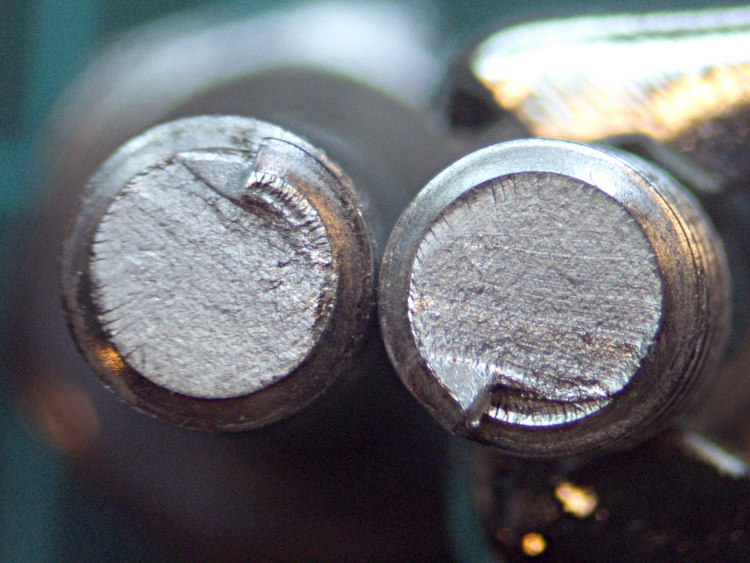
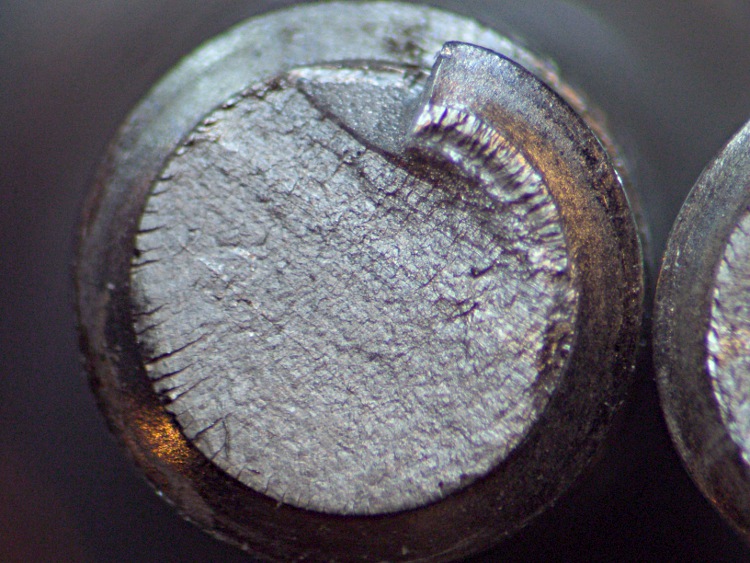
A closer look at the head end of the screw shows some interesting details:
Fractured screw – head
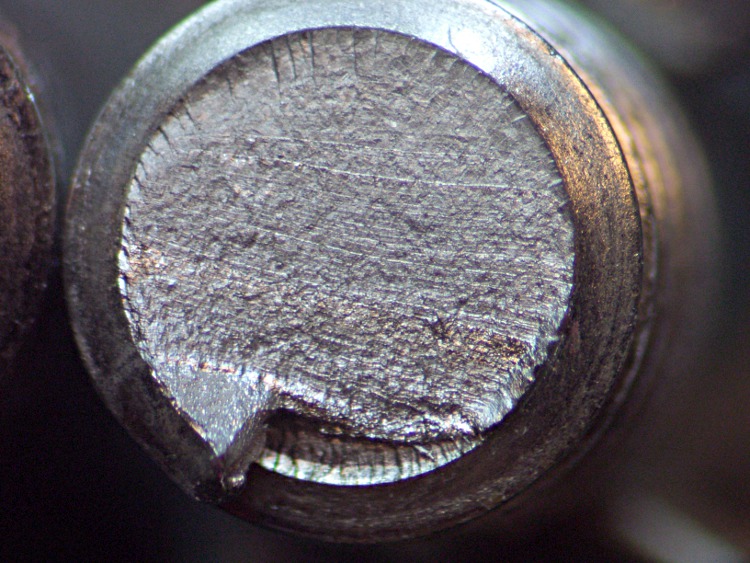
The tail end has matching cracks:
Fractured screw – tail
Notice how the cracks are all oriented in the same direction. The screw fractured at the edge of the brazed-on frame fitting, so I suspect the seat stay clamp must be moving just enough to flex the screw across that plane.
I mooched a pair of hardened socket head cap screws from Eks, ground down the head of the right-side screw for better chain clearance around the sprockets, buttered ’em up with Never-Seez, and we’ll see how long Real Steel lasts.
Right-side screw with ground-down head
I really should conjure up a clamp that mounts to the frame tubing, rather than depend on that puny brazed-on fitting, shouldn’t I?
It appears that new Tour Easy ‘bents come with more brazed-on fittings and a more secure seat stay mounting bracket. A photo was there when I looked.
The big one is rated 50 W @ 25 °C ambient. Use two, derated by 50%, times three air-cooled heatsinks for 150 W of low-temperature heating. The little one is 25 W @ 25 °C.
The derating curve is linear from 100% @ 25 °C down to 10% @ 250 °C, when mounted to a square foot of flat aluminum plate: -0.40% / °C.
Assuming a max heater ambient of 150 °F = 65 °C, you can use 84% of full power. Derating by 50% isn’t all that unreasonable.
The relevant hole locations:
50 W: X=1.562 inch / 39.67 mm Y=0.844 inch / 21.44 mm
25 W: X=0.719 inch / 18.26 mm Y=0.781 inch / 19.84 mm
10 W: X=0.562 inch / 14.27 mm Y=0.625 inch / 15.88 mm
Divide those by 2.0 for from-the-center offsets, which may be more useful for manual CNC operations: zero at the resistor mounting center, then back-and-forth from there.
The mounting hole size for 25 & 50 W resistors: 0.125 inch / 3.18 mm diameter, just exactly what you want for a 4-40 mounting screw. Tap drill #43, clearance drill #32 (close fit) or #30 (loose fit).
The mounting hole size for 10 W resistors: 0.094 inch / 2.39 mm to fit a 2-56 screw. Tap drill #50 (better: #49 for 50% threads), clearance drill #43 (close) or #41 (loose).
To get an idea of how those recycled heatsinks performed, I soldered a pair of 8 Ω 25 W power resistors in series, clamped them to the first heatsink out of the dishwasher, fired up a bench power supply, and took some quick data.
Ambient is about 63 °F with more-or-less still air. Temperature measured with an IR non-contact thermometer aimed at a strip of masking tape on the edge of the heatsink. The resistors (and the center of the heatsink) are somewhat hotter than that, as you’d expect. The numbers include the resistor case-to-heatsink thermal coefficient, too.
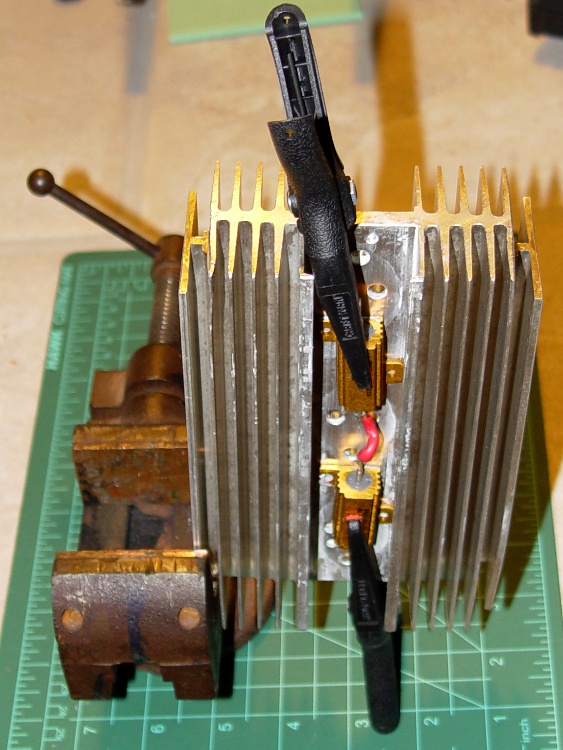
Held edgewise in a vise with the fins horizontal (like this: ===, the second-worst possible orientation), a few inches above the bench, the temperature stabilizes in about an hour:
16 W -> 101 °F: 2.4 °F/W
32 W -> 132 °F: 2.2 °F/W
64 W -> 188 °F: 2.0 °F/W
The alert reader will note that 64 W is somewhat excessive, given that the resistors are 25 W each. The temptation to run the supply at constant currents of 1.0, 1.4, and 2.0 amps was just impossible to resist, OK?
Heatsink – vertical
Held edgewise with the fins vertical (like this: |||), also with a few inches of clearance to the bench, the temperature stabilized in a matter of 10-20 minutes. I didn’t bother with the lower power tests:
64 W -> 166 °F: 1.6 °F/W
Putting a bare CPU case fan 2 inches from one side of the heatsink, aimed directly at the middle, with no attention whatsoever to ducting or air flow rates, produced a stable temperature in a few minutes:
64 W -> 85 °F: 0.3 °F/W
That’s under 0.2 °C/W with airflow on only one side. Zowie!
While I must run these tests again with the resistors & fans I intend to use (and better control over the air flow), things are looking good.
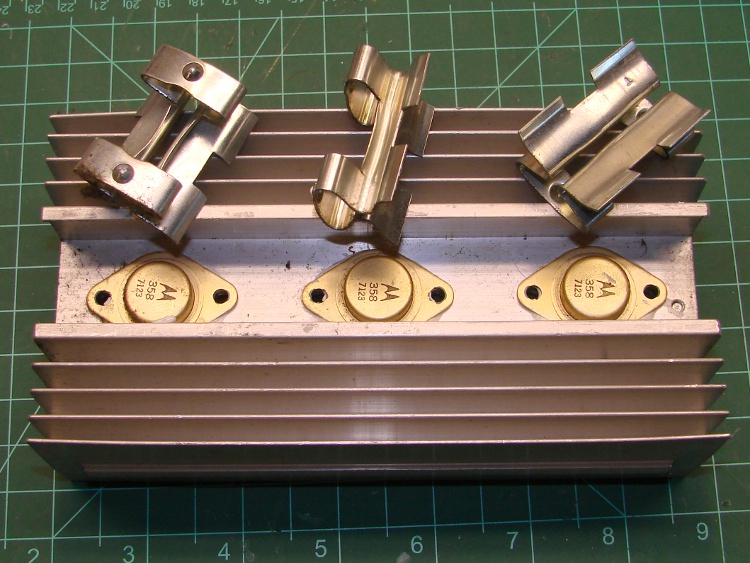
Some diligent rummaging turned up a trio of heatsinks that I think will work nicely for the Hot Box Disinsector. As nearly as I can tell from the date codes, they started life at IBM in the early 70s and are built to take a direct hit; the bent fins show they’ve taken a few shots along the way. Those clips applied direct clamping pressure to the transistor cases: much better than screws that can will eventually deform the aluminum and stop forcing the case against the heatsink.
Heatsink with TO-3 transistors
To judge from the crud built up on the fins and the fact that some of the transistors are now completely open, these puppies were run hard and put up wet.
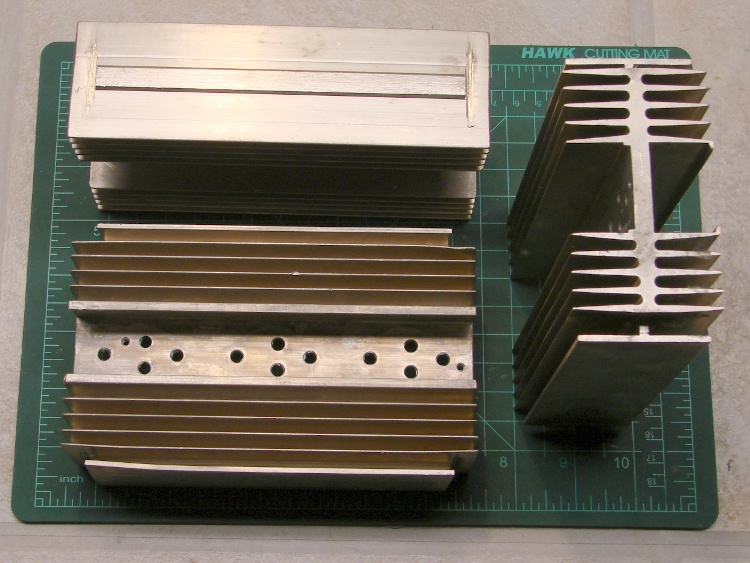
I wiped off the heatsink grease, cleaned off the bigger chunks of crud, and popped them in the dishwasher for a good scrubbing.
Heatsinks ready for reuse
Lovely! The web across the middle is 1/4-inch thick; they don’t make ’em like that any more. The rear heatsink lost its mounting flanges along the way; I have no idea if I sawed those off or somebody else got there first.
I’ll probably plug the holes, just because it’s a nice idea; the sinks are certainly overqualified for their next job as they stand. TO-3 transistors have power ratings over 100 W: these are at least 300 W heatsinks, albeit with an unknown operating temperature. Egad & similar remarks.
In round numbers, I need maybe 150 W of heat at 140 °F ambient. Each heatsink will dissipate 50 W, which is certainly well under its original rating. Figuring 0.5 °C/W sink-to-ambient (call it 1 °F/W) with decent air flow, dissipating 50 W will raise the heatsinks to 190 °F.
That’s higher than I want, so more doodling & measurements are in order.
I want to measure the air flow from some fans, which means I need an air flow straightener to smooth out the wind enough to make the numbers less error-prone. You can, of course, buy cute little straighteners that bolt onto the outlet side of the fan, but what’s the fun in that?
Air flow straightener – overview
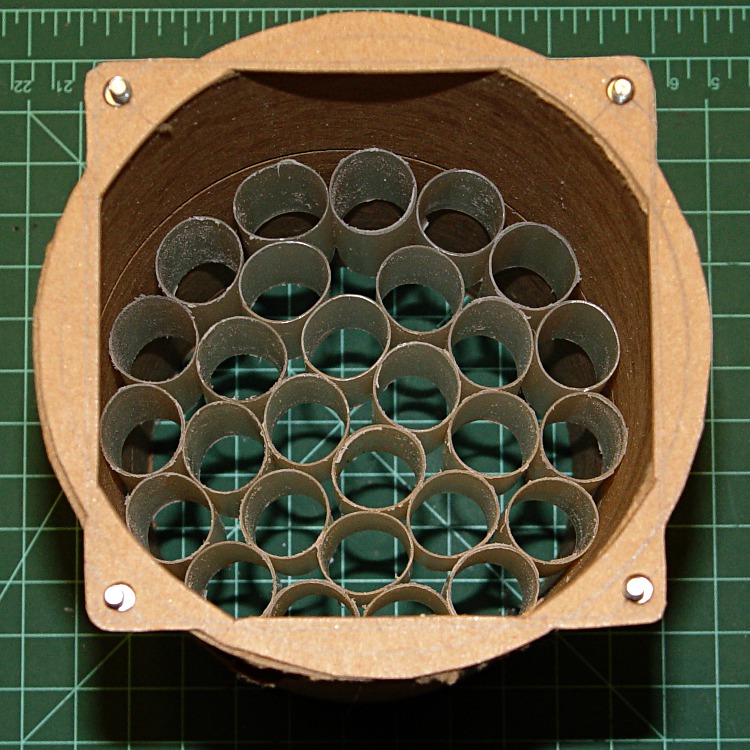
The general idea is to pass the air through a set of thinwall tubes to damp out the turbulence. A downstream gap between the fan outlet and the passages eliminates / reduces the dead spot caused by the fan rotor. About 1 diameter downstream of the tubes, the air flow becomes reasonably uniform and a few more diameters produces the familiar parabolic velocity profile found in HVAC ducts.
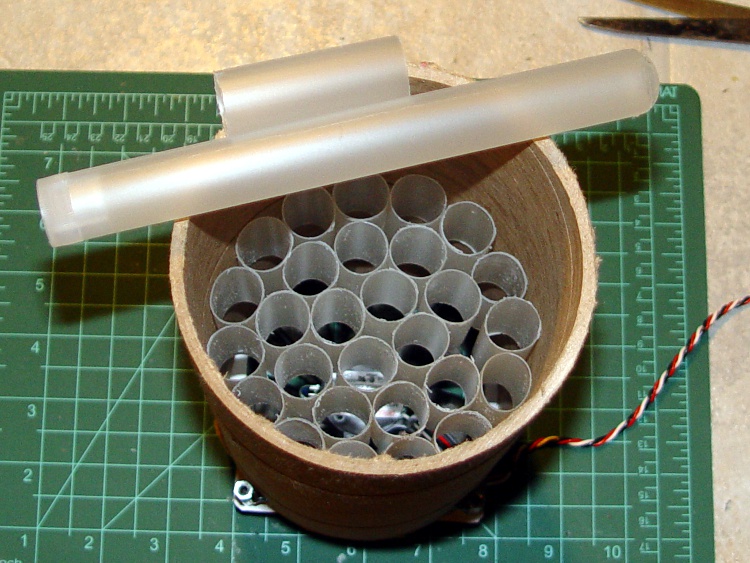
A few minutes with a bandsaw extracted a 2-diameter-long tube from a 4-inch diameter heavy cardboard mailing tube. A pull saw and a miter box converted some surplus cigar tubes (which I got a long time ago for just such an occasion; I’m not a cigar smoker!) into 3-diameter lengths. Lay as many cigar tubes into the mailing tube as will fit, jam in one more, and they’ll remain in place with sufficient tenacity for my purposes. I suppose, if you were fussy, you could dribble in some adhesive.
I pushed the cigar tubes to the middle of the mailing tube, mostly because that seemed sensible. As nearly as I can tell, this is one of those things where it’s easy to get a reasonable result (as witness the variety of straighteners used by overclockers) and nearly impossible to get a truly trustworthy quantitative setup (as witness the bizarre vanes used in real wind tunnels by actual engineers). An overclocker discussion lives there.
Air straightener – cigar tubes
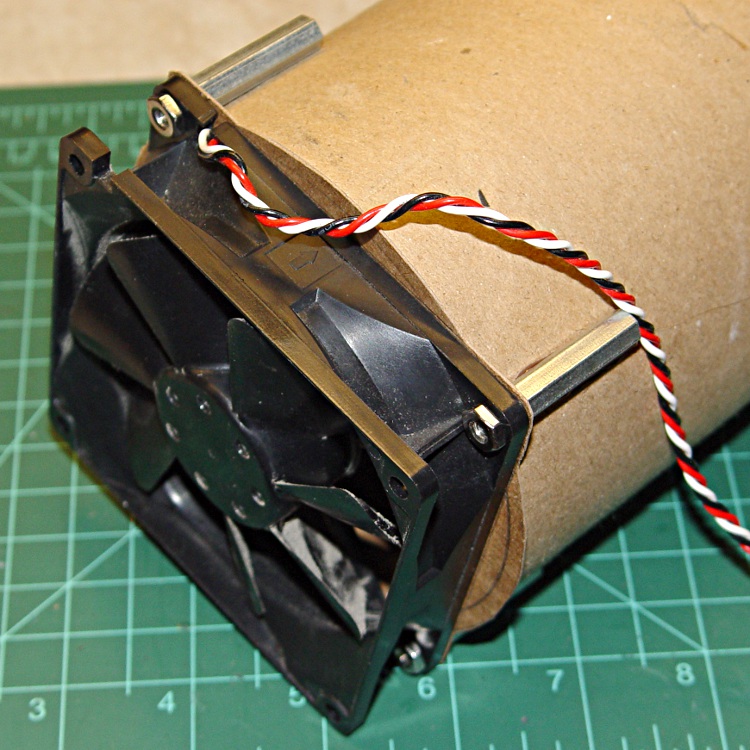
A quartet of board spacers screwed into 90-mm (92-mm, whatever) fan fit neatly around the mailing tube’s OD, where I simply hot-melt-glued them into place.
Air flow straightener – fan mount
A cardboard gasket seals off the gaps between the fan and the tube.
Fan gasket in place
The gasket looks like this; the next time I will print this picture and cut it out, rather than repeating some fussy layout and getting it wrong twice. Scissors around the outside, a hollow punch for the four screw holes, and a razor knife for the interior. I considered a CNC project, but …
Air flow straightener gasket
And then it Just Worked.
The “before” flow, measured about 1 diameter downstream of the bare fan standing in mid-air, ranged from 0.8 to 1.4 m/s, with the expected completely dead zone in the center. The “after” flow, 1 diameter downstream of the tube, was 0.9 to 1.1 m/s across the entire width, with no decrease in the middle.
The cross-section area is 12.5 in2 and the flow is maybe 40 in/sec, so the fan is pushing 17.5 ft3/min. More or less, kinda-sorta; it’s a quiet CPU case fan from an ancient Dell PC. I have a box of 60 cfm fans arriving shortly, so we’ll see how they stack up.
The anemometer is a La Crosse EA-3010U, which may be the wrong hammer for the job, but it doesn’t require me to dope out a hot-wire anemometer just to get a few numbers…
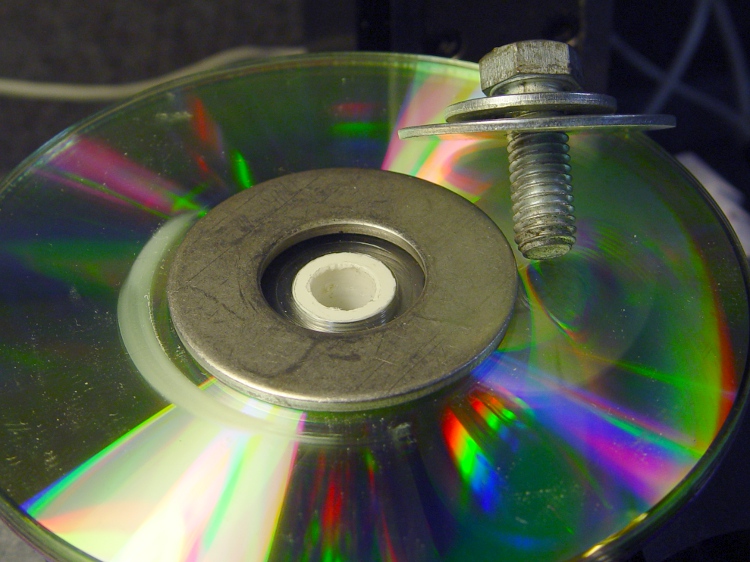
CDs being such a useful source of raw material, I cooked this up on the lathe while puttering around in the shop thinking about something else. The general idea is to align a short stack of CDs on the Sherline rotary table, close enough to the center, so that you can gnaw away on the top platter and get nearly concentric results. If you really care about concentricity, this isn’t the way to go, but …
CD adapter bushing in place
The washer clamps the CDs in place with the bushing sticking up a bit from the top layer, so it need not be more than eyeball-aligned; the air gap eliminates the need to get the bushing height Exactly Right. If you’re perpetrating fancy machining on the CD, you probably want a form-fitting metal plate atop the stack to hold it down near the perimeter to prevent getting swarf jammed underneath. Note the stack of washers require to reduce that gaping hole to meet a 3/8-16 bolt threaded into the table.
All by itself, the bushing looks like this:
CD Adapter Bushing
The dimensions, roughly as-built:
Rotary Table CD Adapter Bushing
I used a random plastic cylinder from the scrap pile and cleaned up the edges with a razor knife. Next time, I’d put the fat end near the lathe tailstock, so as to make the chamfer easier.








 The Smell of Molten Projects in the Morning