Ed Nisley's Blog: Shop notes, electronics, firmware, machinery, 3D printing, laser cuttery, and curiosities. Contents: 100% human thinking, 0% AI slop.
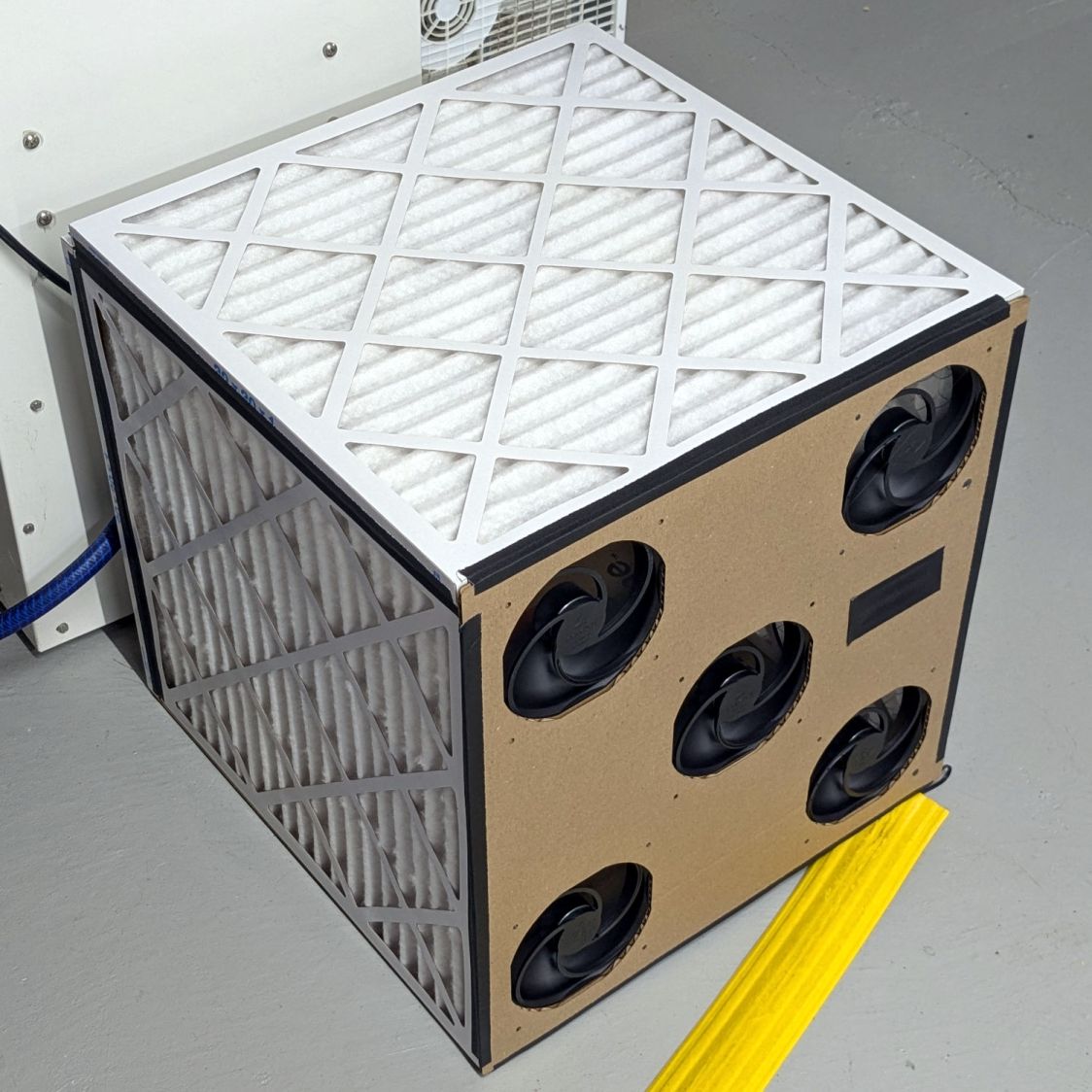
A box of air filters that Came With The House™ (and fit nothing therein) surfaced during a recent heap probe and prompted a quick-n-dirty project:
Basement Air Filter Box – installed
It replaces a tired box fan (barely visible at the top) that’s been shoving air around the basement to equalize the humidity.
The quintet of 140 mm fans seems quieter, although they don’t move quite as much air. Given that I have no way to know how much air circulation is enough, it’s likely sufficient.
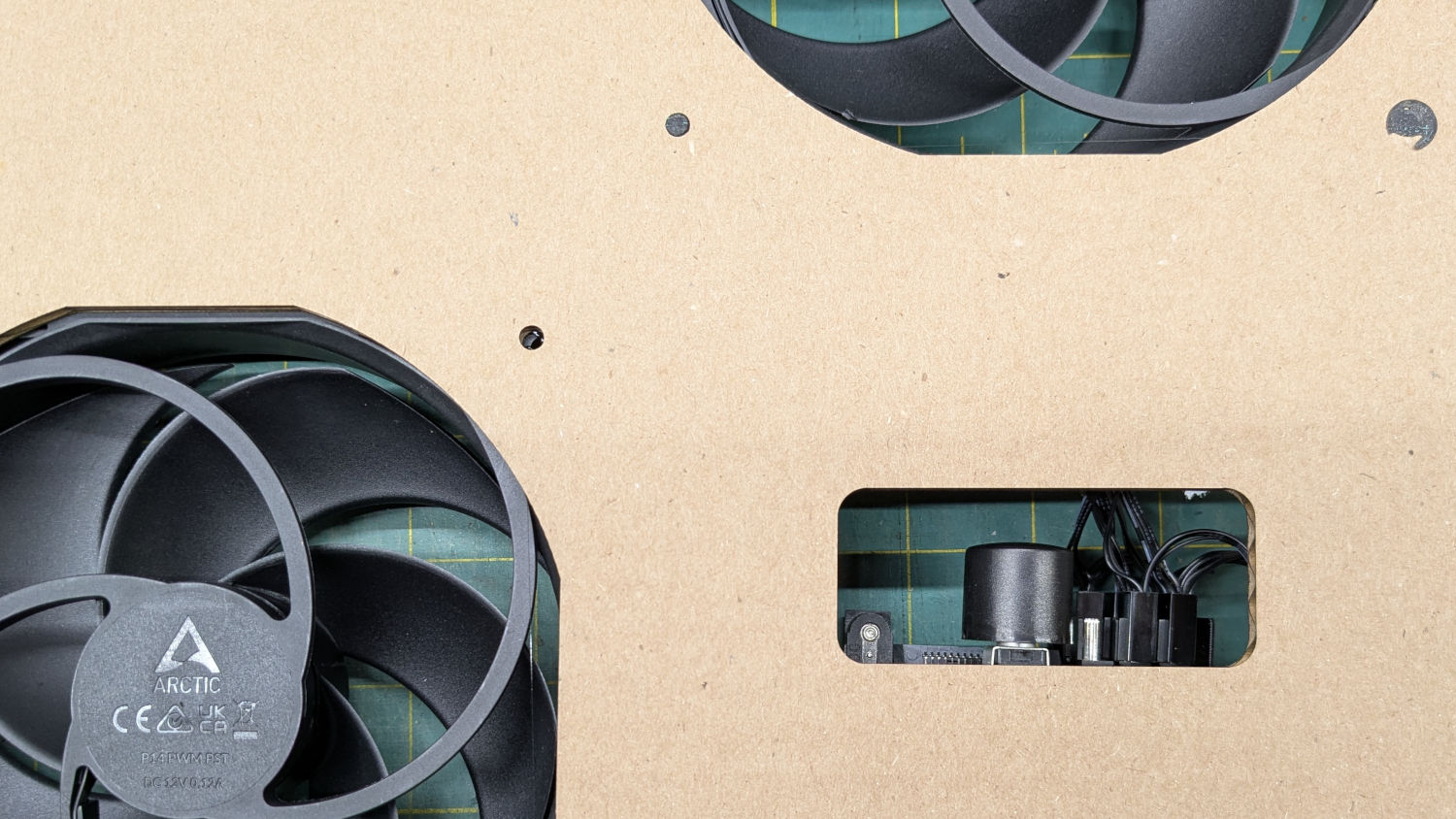
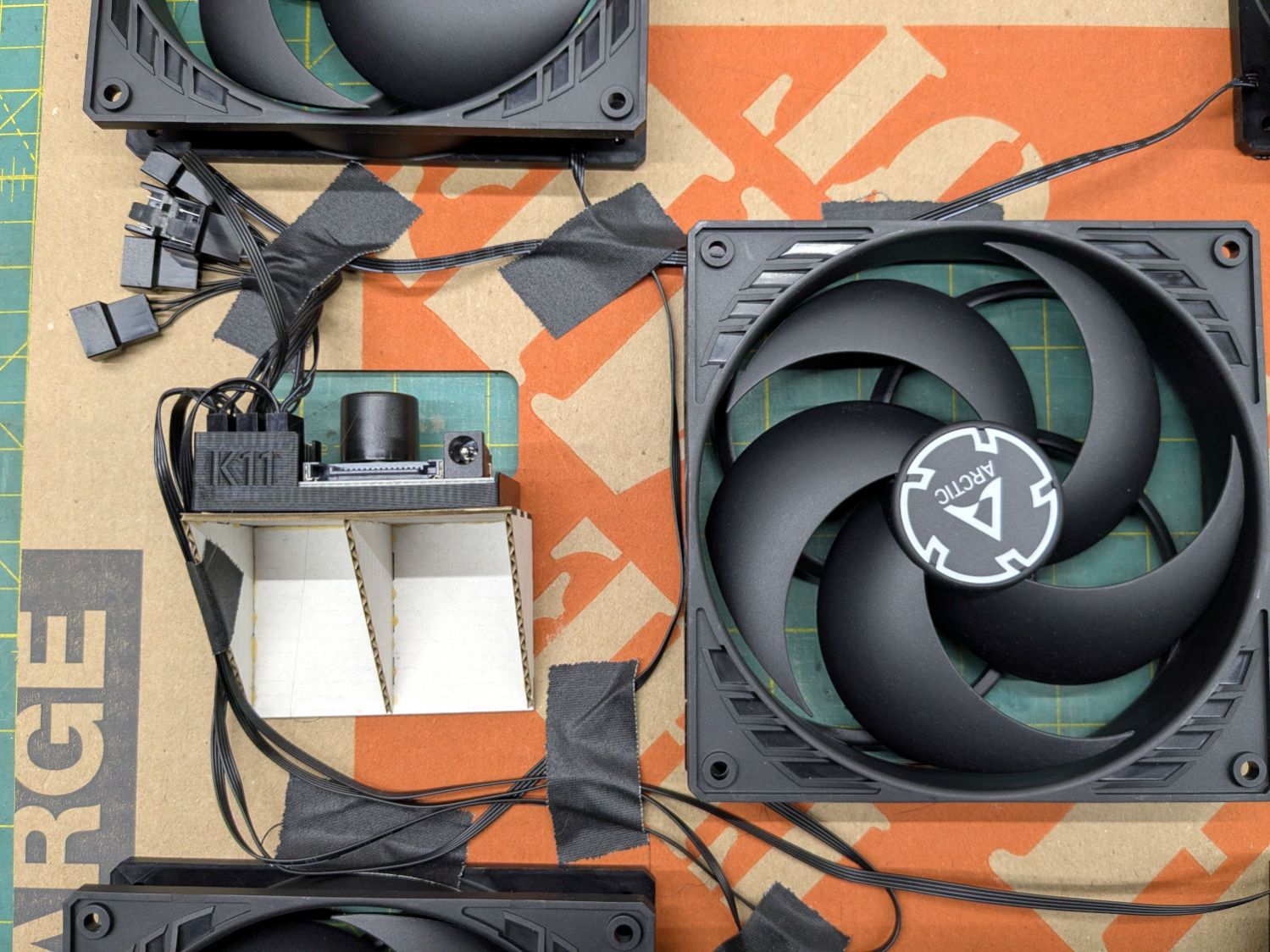
The strip of black tape covers a hole for the knob on the fan power / speed control, although I cranked it up to full throttle and expect to leave it there:
The 3D printed holder came with the controller. I cannot imagine how they have enough time to print a holder for each controller; maybe it’s a QC check for a 3D printer manufacturer.
I intended the controller to sit on the other side of the middle fan, but realized I had to cut the opening after mounting the fans and got the chirality wrong; the wiring in there layout leaves something to be desired.
The fans mount on a sheet of cardboard cut from one side of a Home Depot Extra Large Box and the bottom of the filter box comes from the other side. Because I don’t have a deep emotional attachment to the filters, they’re attached to each other (and the bottom sheet) with hot melt glue. I do have a slight attachment to the fans, but four dabs of glue hold each one in place. More gaffer tape holds the fan sheet to the front of the assembled box, in the unlikely event I must get in there again.
Hey, it’s Christmas: good things come in boxes, right?
The nozzle is 18.5 (-ish) mm above the surface with the laser beam focused to a tight spot. The brass (-ish) tip of the pen flew about 5 mm above the material, requiring considerable attention to the placement of magnets, clamps, and similar accoutrements around the material on the platform.
Having dismantled the pen while replacing its wiring, this seemed like a good time to figure out how to get more clearance under its tip.
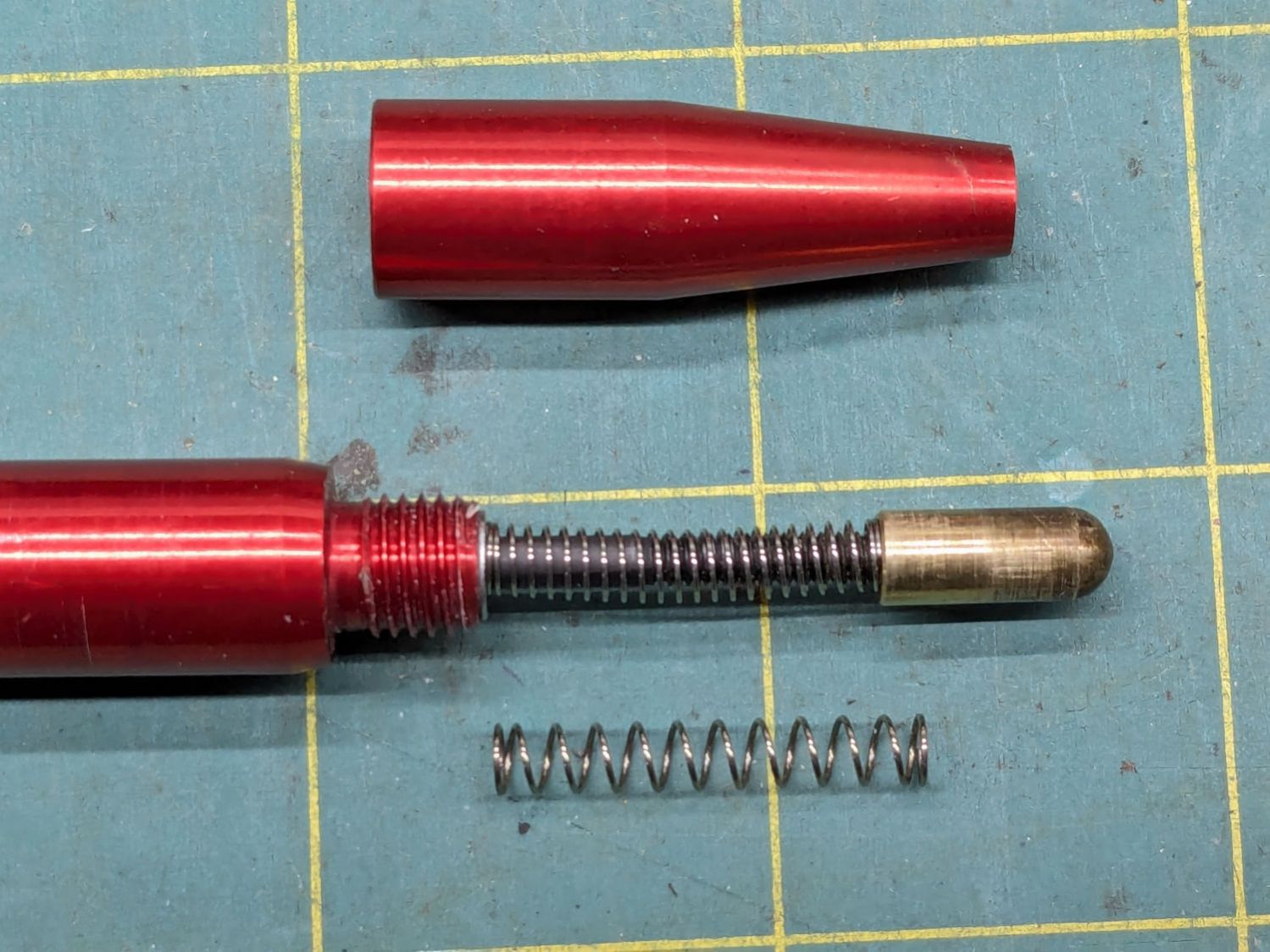
Removing the pen nose shows the tip on its 3 mm screw inside the spring pushing the tip downward:
OMTech focus pen – soft spring – installed
I replaced the original spring (on the bottom) with a softer spring, mostly because the tip exerted what seemed like entirely too much force on the material. That makes no difference for acrylic & plywood, but anything squishier required deploying the focus gauge after I remembered the problem.
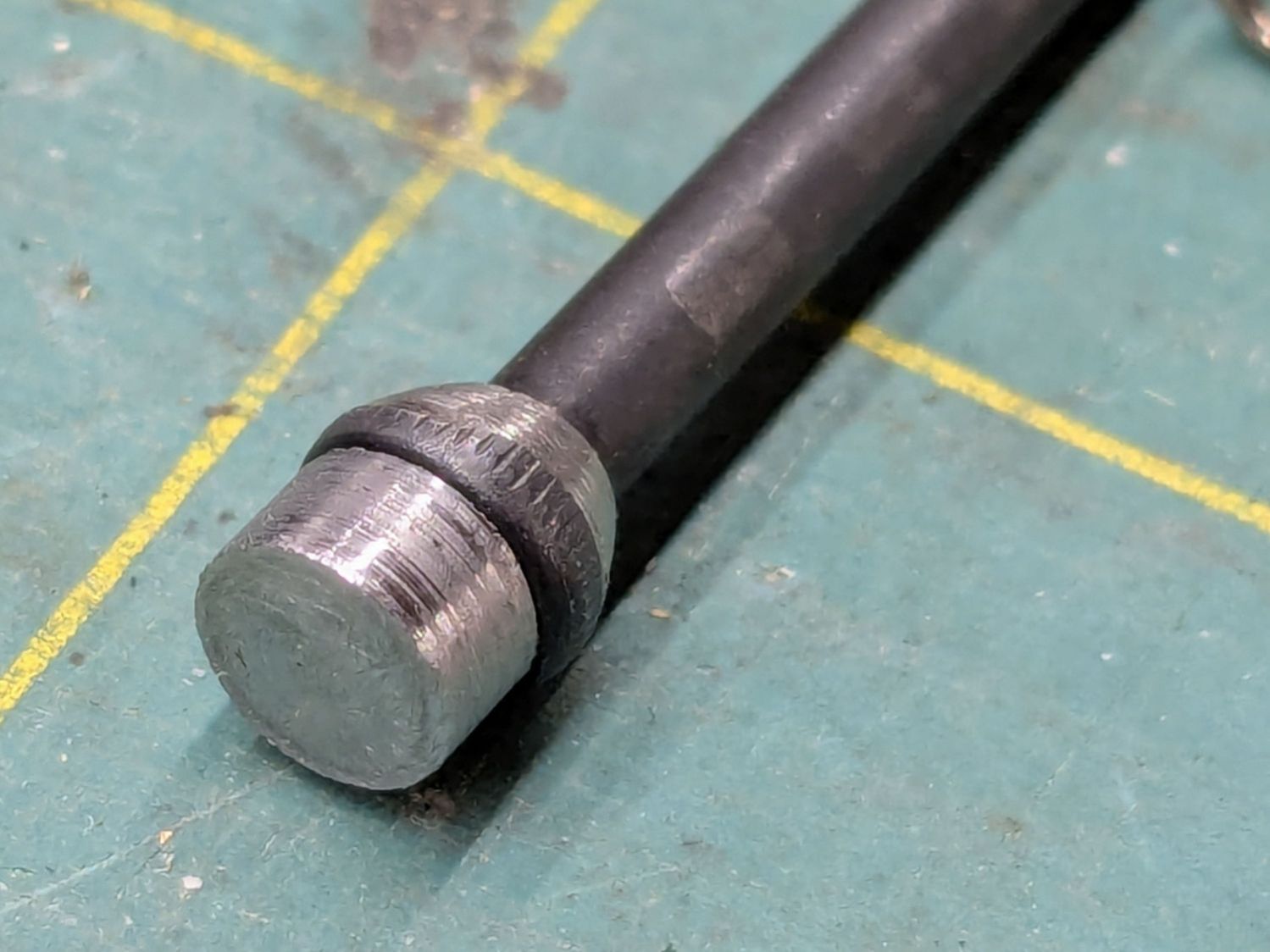
The other end of the screw is impossible to photograph in situ, but the tapered head seats in a recess leaving several millimeters of air below the proximity sensor. I made a little steel slug to reduce the pretravel by filling that gap:
OMTech focus pen – pretravel filler
The spigot on the slug (turned from 7/32 inch steel rod) aligns it with the screw head, with high-viscosity cyanoacrylate adhesive holding it in place:
OMTech focus pen – pretravel filler – installed
The surface finish of my slug matches their tapering, so I figure it’s about right.
A setscrew near the top of the pen clamps the proximity sensor with a few millimeters of adjustment:
OMTech laser focus pen – detail
The slug reduces the pretravel to nearly zero with the sensor at the bottom of its range.
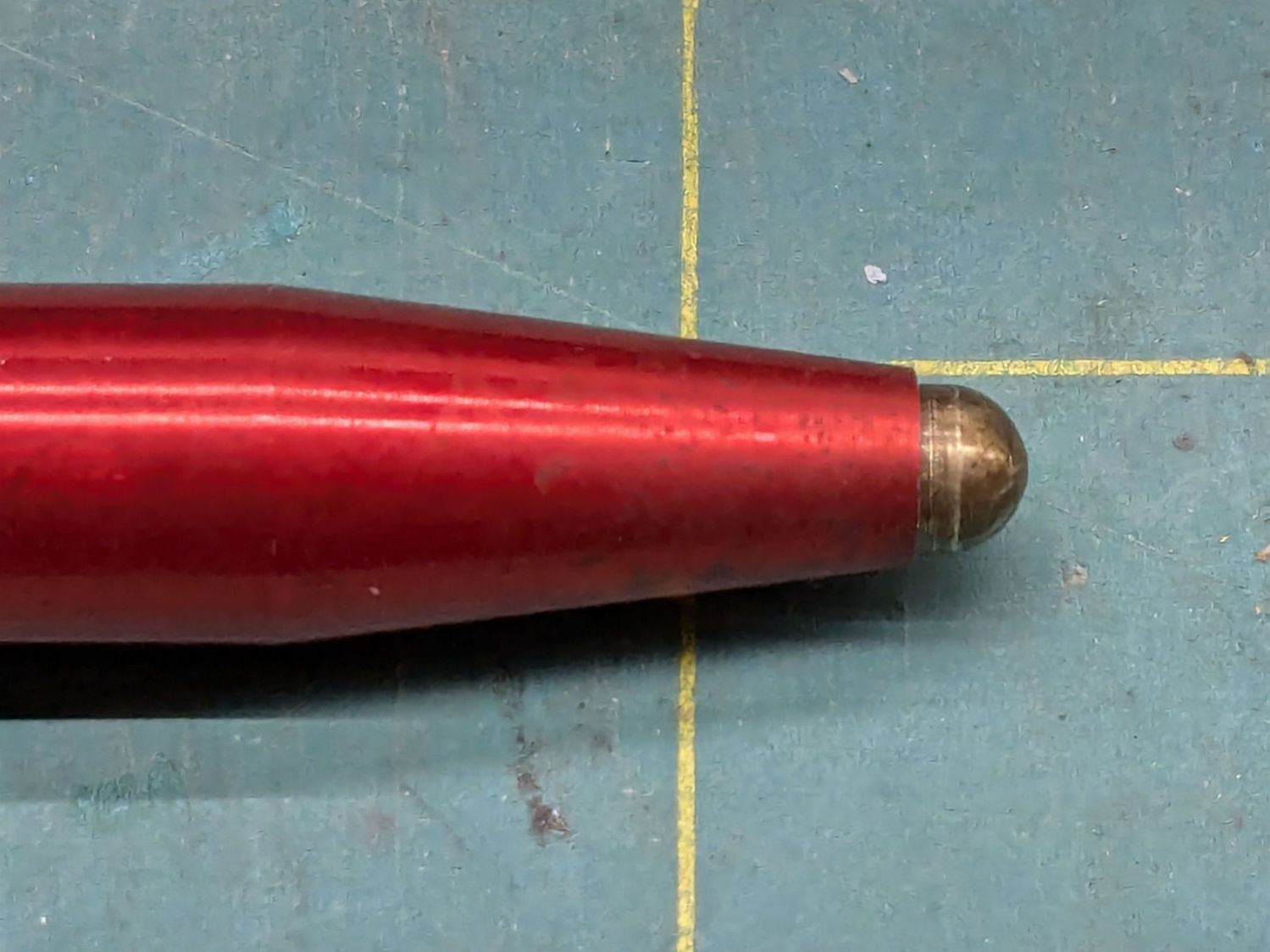
The brass tip had been twisted onto the screw as far as it would go, so I cut a few millimeters off the screw to put the tip closer to the pen nose:
OMTech focus pen – minimal stickout
Even with reduced pretravel, the tip nearly vanished into the pen body before tripping the sensor, so I unscrewed it two turns = 1.4 mm.
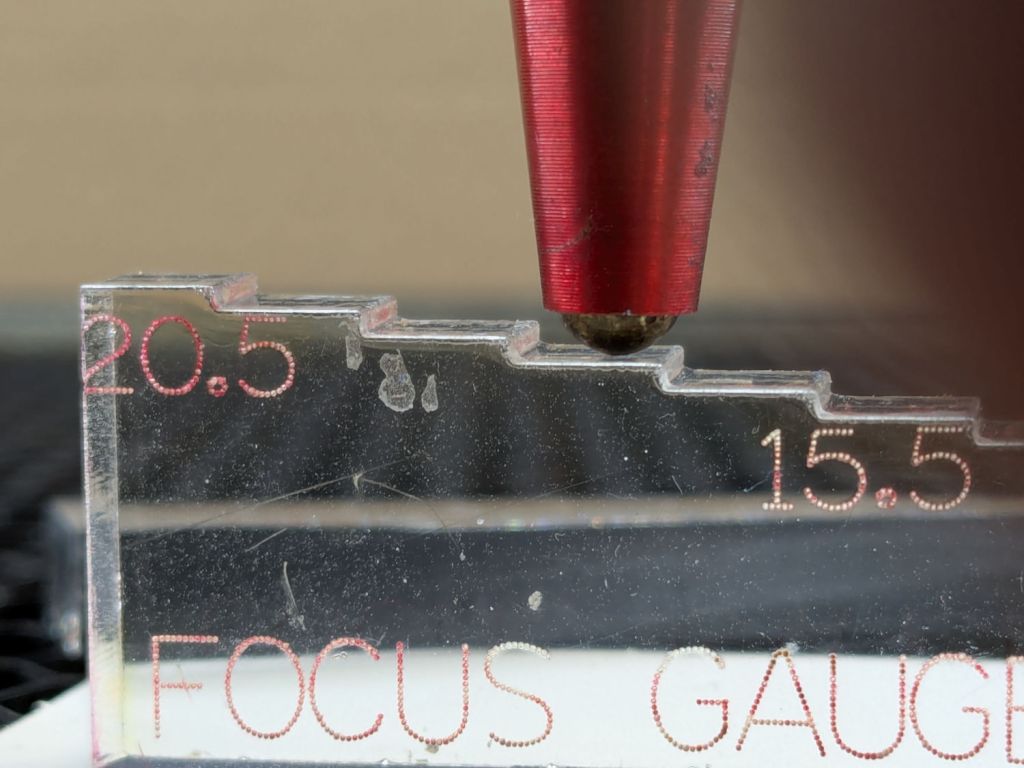
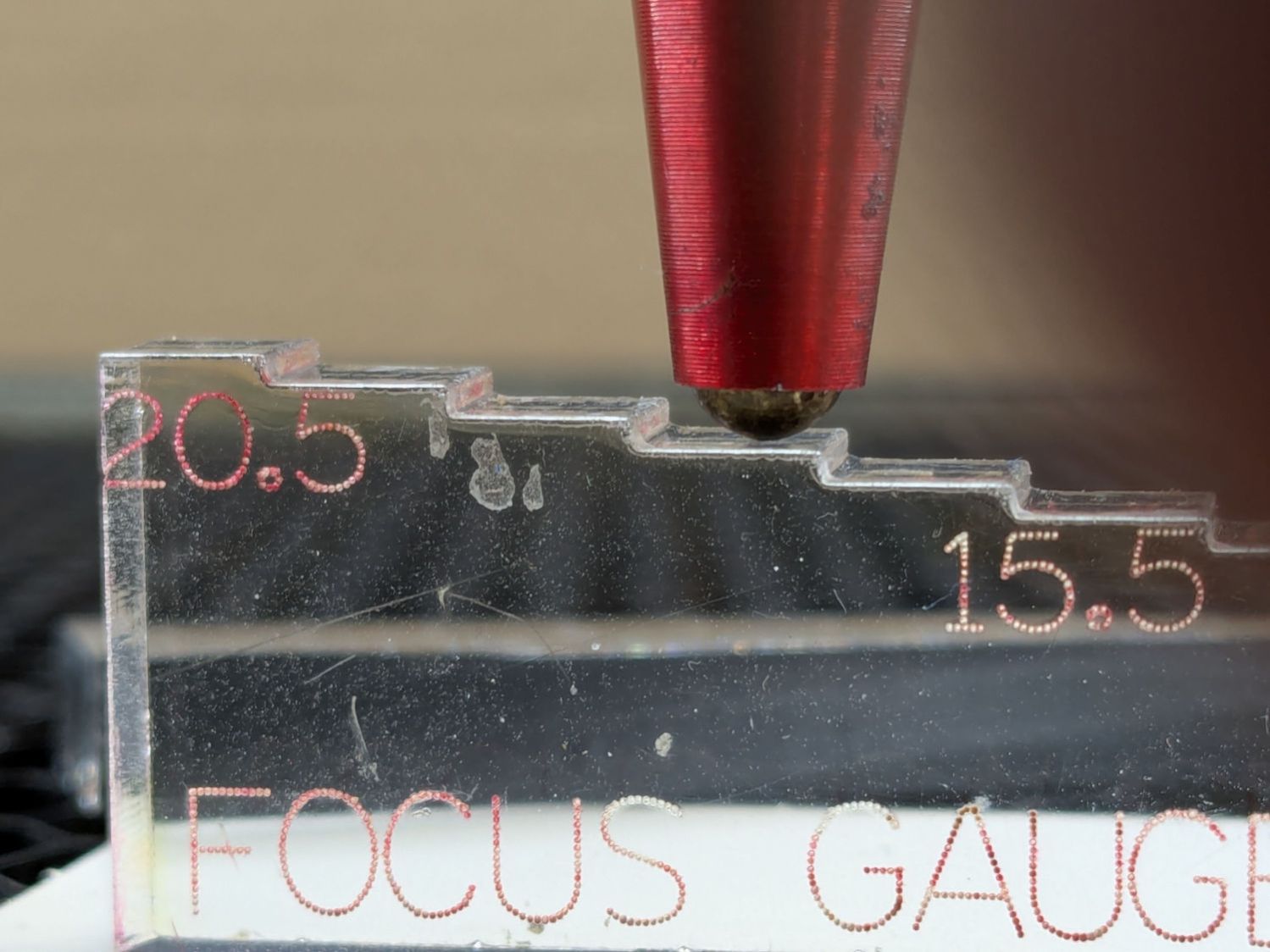
With the pen back in the machine and plugged in, measure the switch travel with a step gauge:
OMTech focus pen – revised stickout
Protip: Measure the as-cut height of those steps, then either shim the bottom of the gauge with tape of a suitable thickness or add that much to the layout and cut another set.
With a good step gauge in hand:
Slide it underneath to just touch the tip
Note the measurement = A
Slide it further until the switch trips (red LED on)
Note the measurement = B
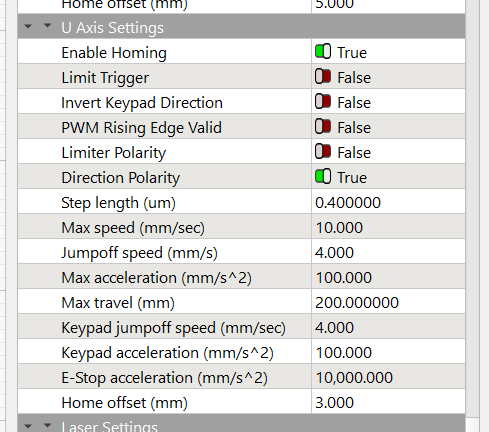
Figure B-A, round up to the next millimeter, then set that value as the Home Offset for whatever axis moves the platform. My tweaked pen had 2.5 mm of travel, so I used 3.0 mm:
Settings – Home Offset
Adjust the pen position to put the tip more than the Home Offsetbelow the nozzle (I picked 5 mm) to ensure the switch will trip before the nozzle contacts the platform, then do an Autofocus.
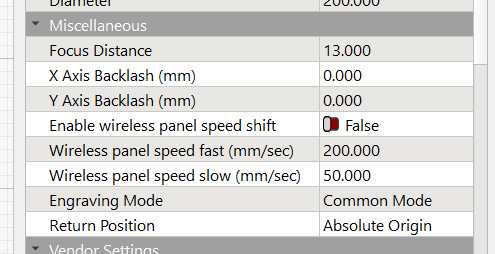
Measure the distance from the nozzle to the platform (mine was 5.5 mm), subtract that from 18.5 mm (the known focused distance for my laser head, as above), and set that as the Focus Distance:
Settings – Focus Distance
Another Autofocus should then put the nozzle exactly 18.5 mm (or whatever your machine needs) off the platform / material.
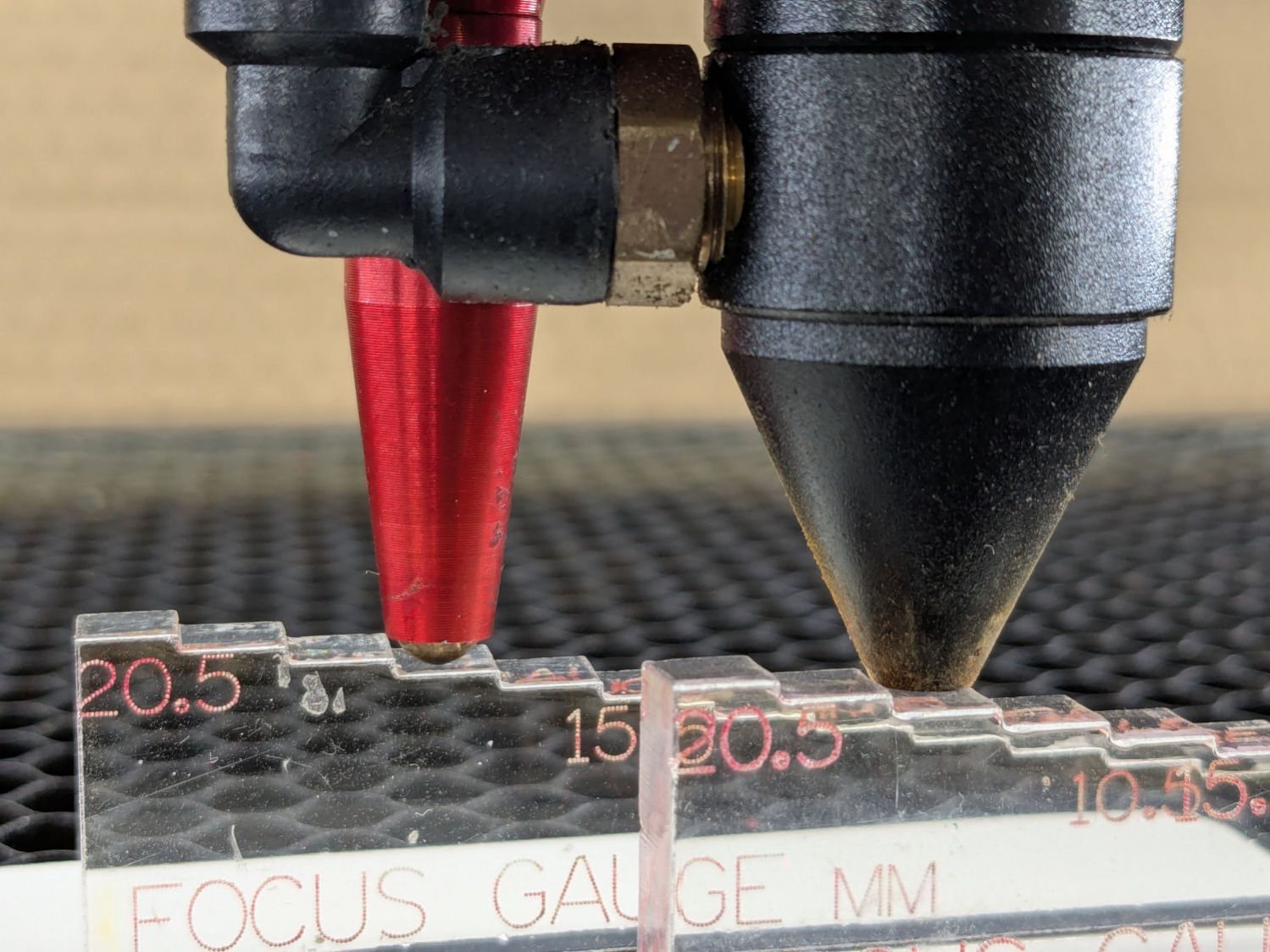
This shows the pen now flies 5 mm below the nozzle:
OMTech focus pen – normal vs nozzle
The step gauge shows it’s 13.5 mm above the platform, much better than the previous 5 mm.
The switch trips juuuust before the nozzle hits the material:
OMTech focus pen – tripped vs nozzle
I should lower the pen a millimeter, but that’s in the nature of fine tuning.
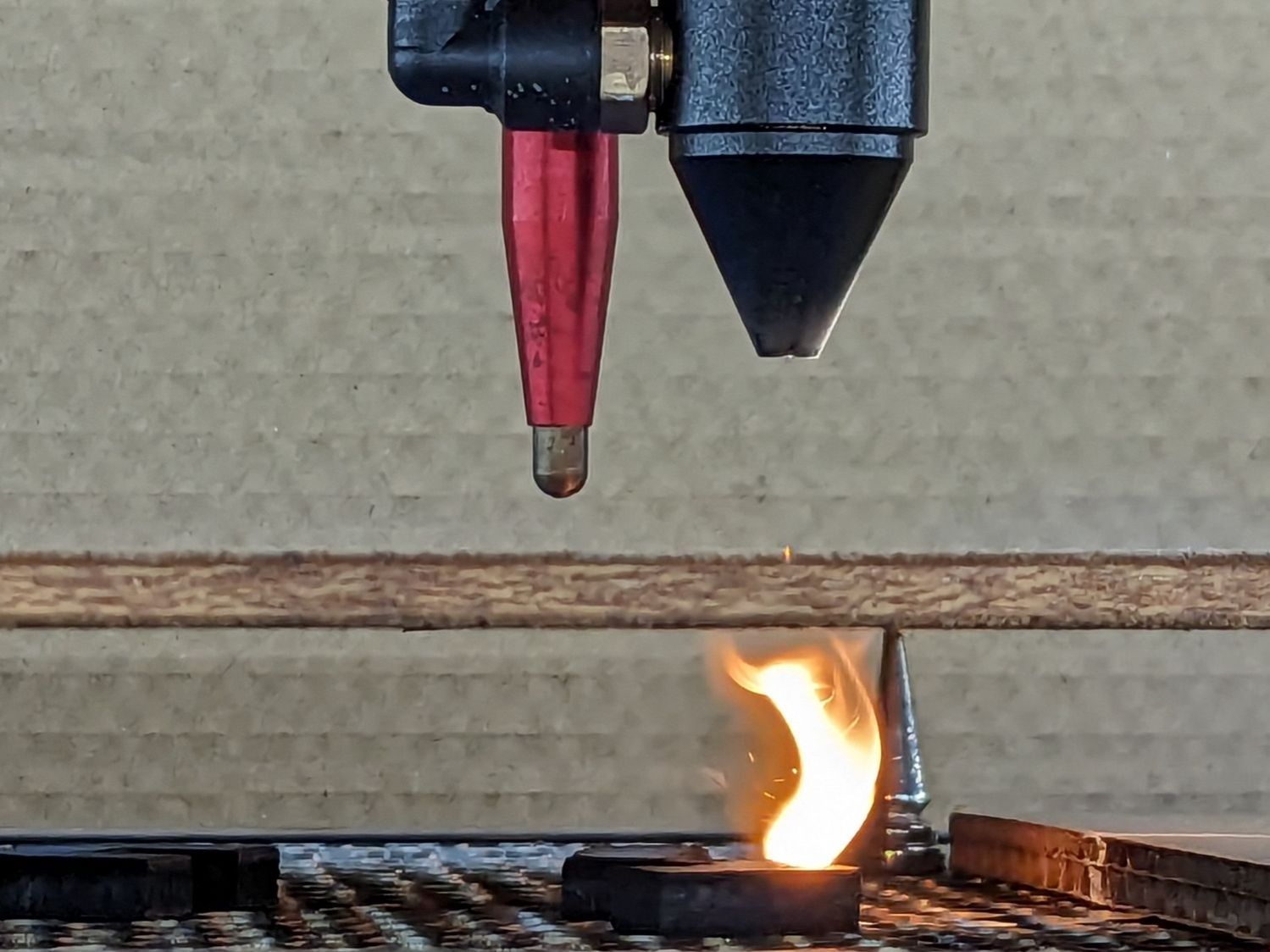
This happened while focusing the laser before cutting the cardboard fixture for the chuck rotary:
OMTech focus pen – failed operation
The autofocus “pen” = switch did not operate when the rising platform pushed the cardboard against its tip, so the controller continued raising the platform. Seconds later, the platform rammed the cardboard against the laser head and I slapped the Big Red Button.
Yeah, the platform shoved that pen straight up through its clamp until both punched through the cardboard.
The pen has a red LED (barely visible through the opening around the cable when you’re looking down into it) that did not light up when I manually triggered the switch: either the switch was dead or it wasn’t getting 24 V power.
Having spent considerable time diagnosing similar problems on the LightBurn forum, I was pretty sure the PVC-insulated wire connecting the pen to the controller had failed somewhere in the drag chain.
Update Yup, the 24 V wire was broken:
OMTech focus pen – failed 24V wire
Another discussion there showed how to dismantle the pen, so I (turned off the power and) cut the cable a few inches from the top of the pen body.
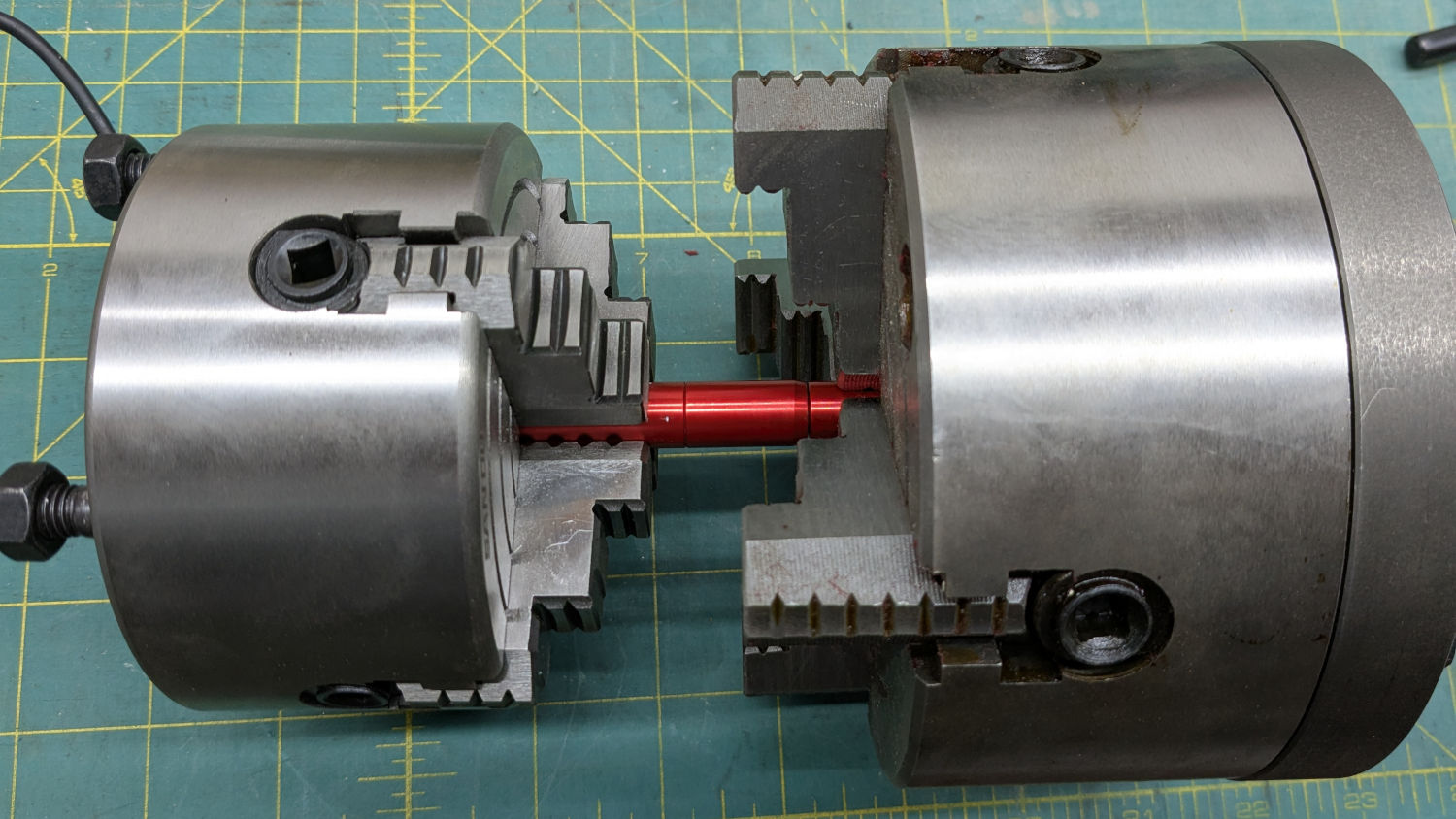
The pen body has three parts screwed together with generous application of threadlock. After demonstrating I lack enough grip strength to break the bonds, I deployed a pair of lathe chucks designed for a death grip on cylindrical objects:
OMTech focus pen – double chuck setup
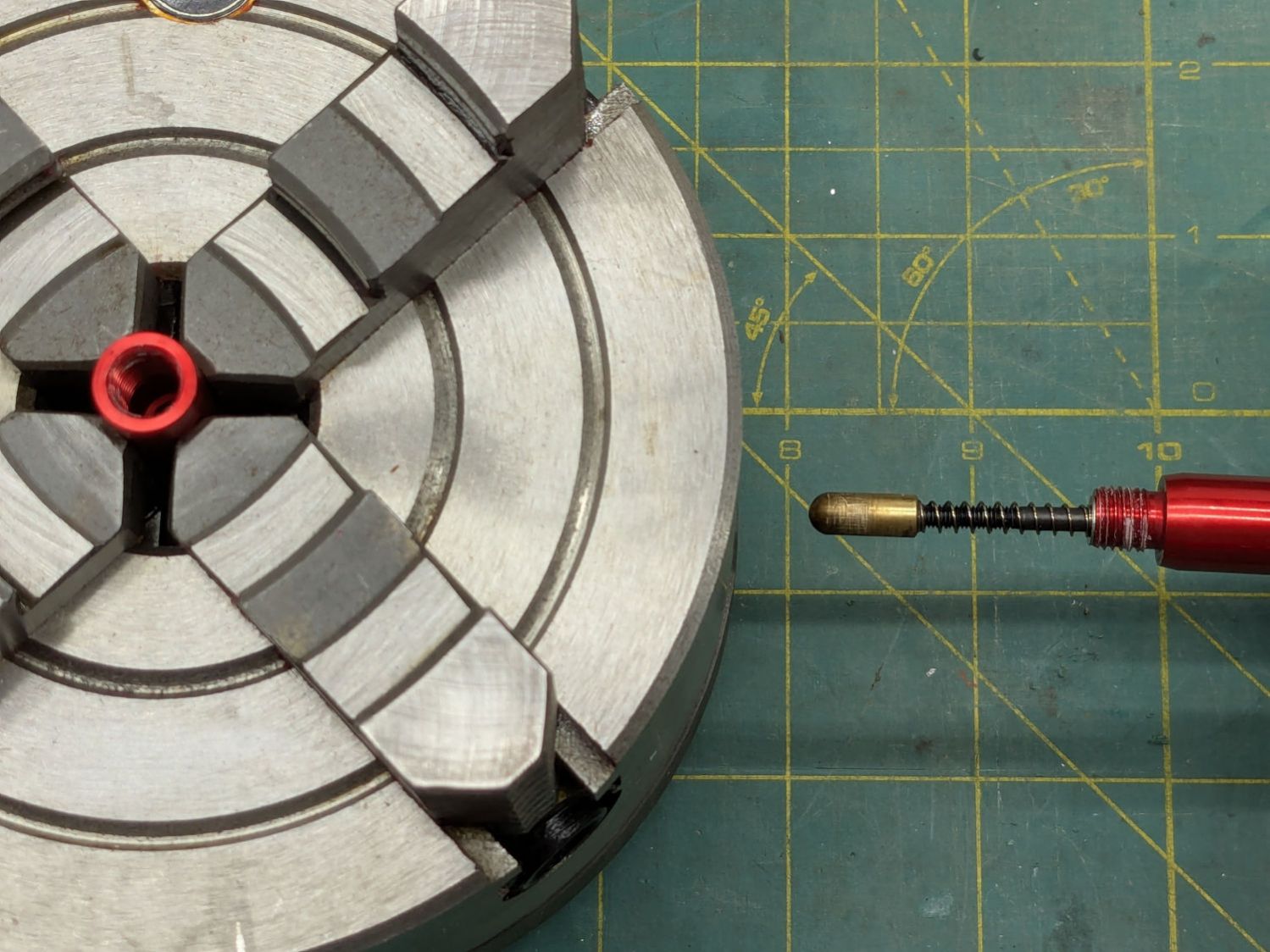
The tip came off readily enough:
OMTech focus pen – nose unscrewed
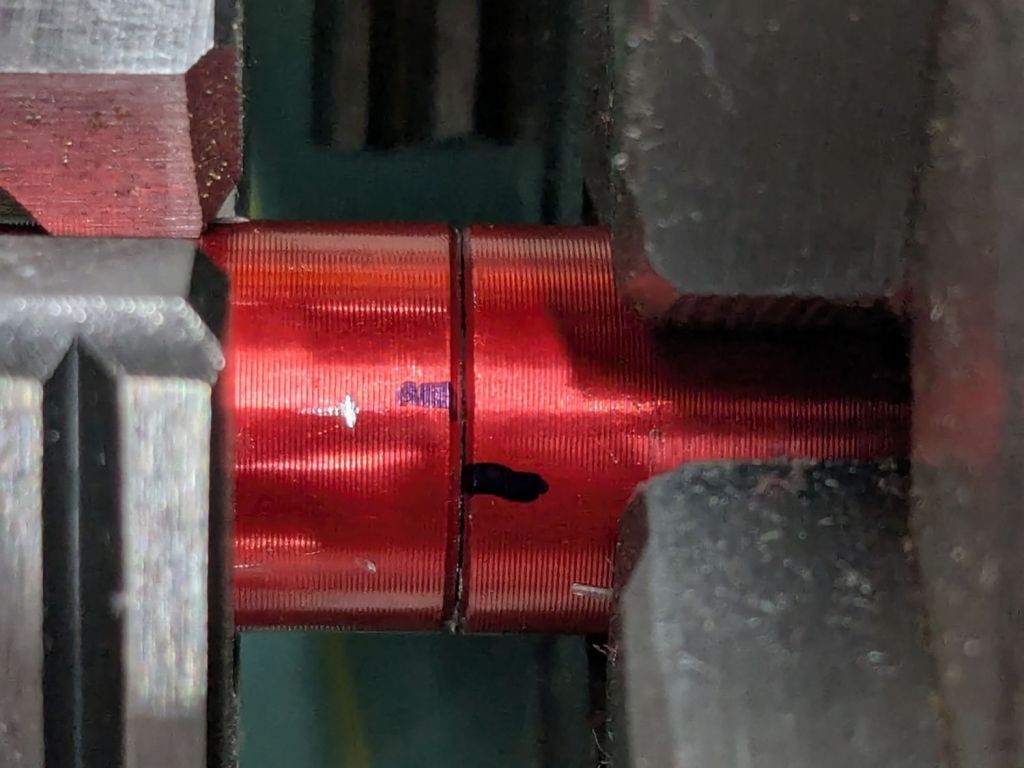
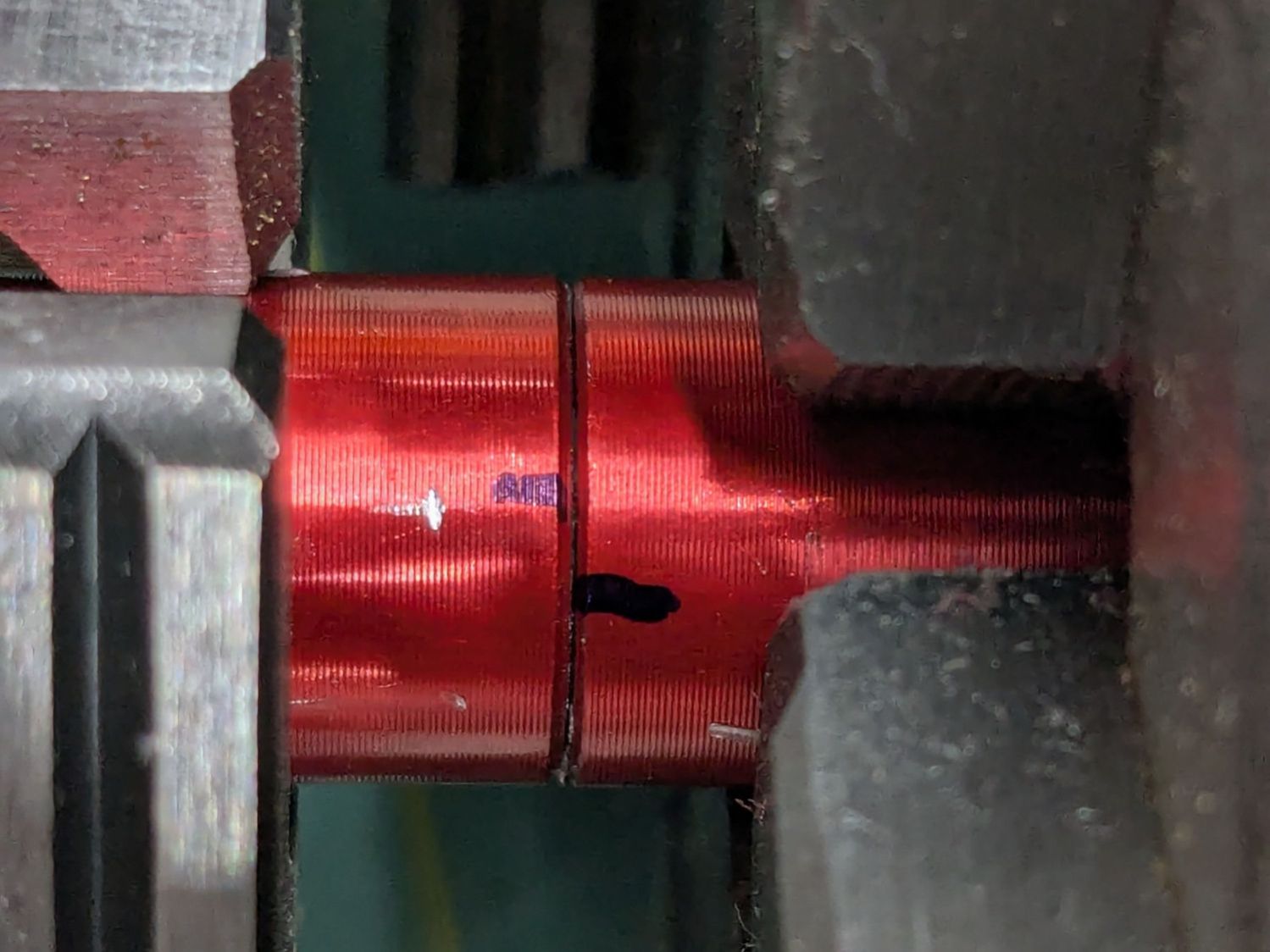
The upper joint was more reluctant, to the extent I needed witness marks to show progress:
OMTech focus pen – unscrewing witness marks
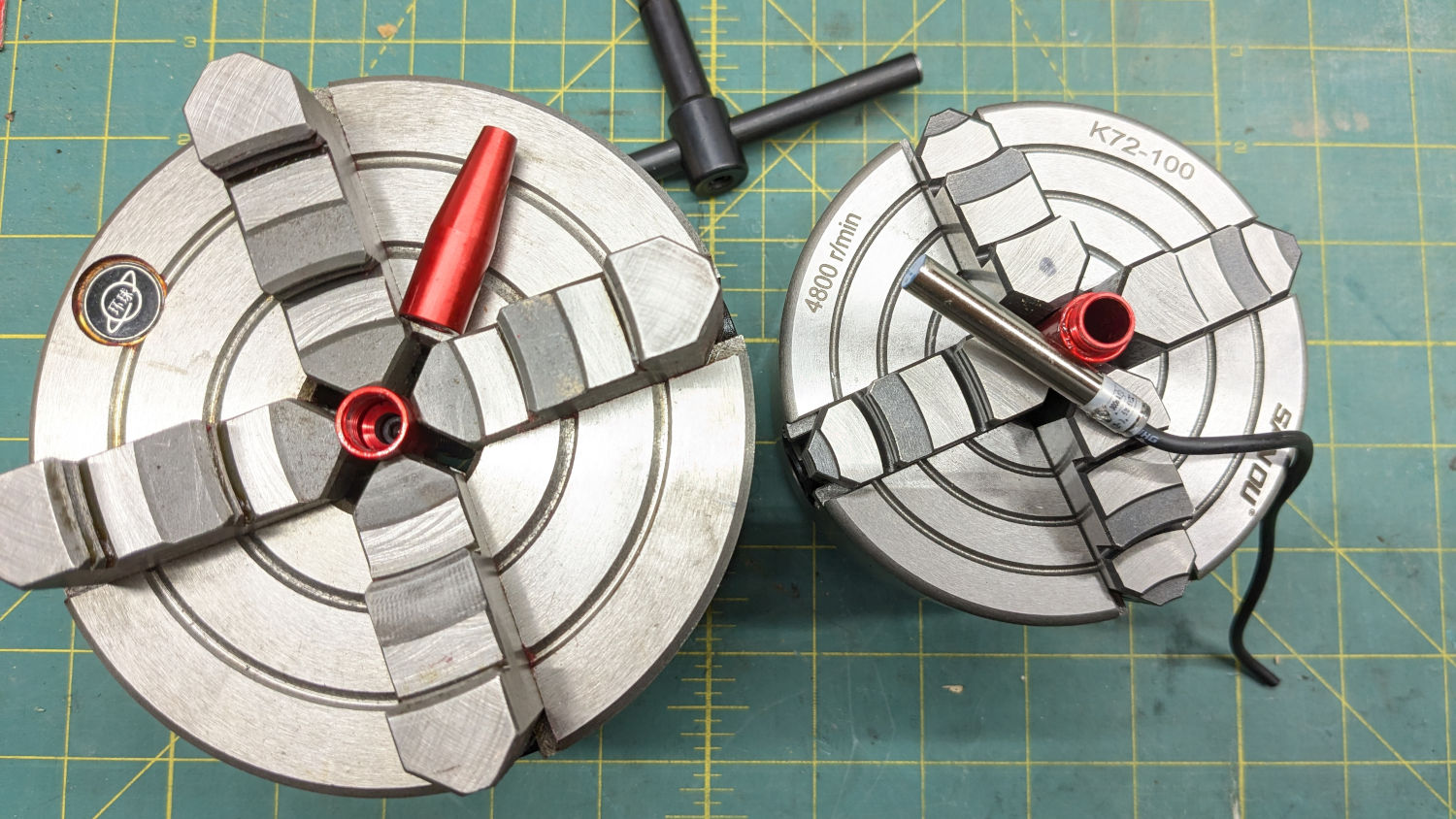
Dripping Kroil into the slightly loosened joint while twisting it back and forth eventually separated the parts:
OMTech focus pen – body unscrewed
I persuaded the last chunks of threadlock out with a stout pin (in a pin vise), eventually letting me screw the pen body together without a struggle.
Contrary to what I originally thought, the switch is a proximity sensor triggered by the reshaped head of an M3 socket-head screw also holding the brass-colored tip. Wiring it to a bench power supply verified proper operation, with the open-collector (actually, open-drain) output going low with any ferrous metal closer than about 3 mm to the sensor tip.
Which put the fault somewhere along the wiring from the controller through both drag chains to the pen, as expected.
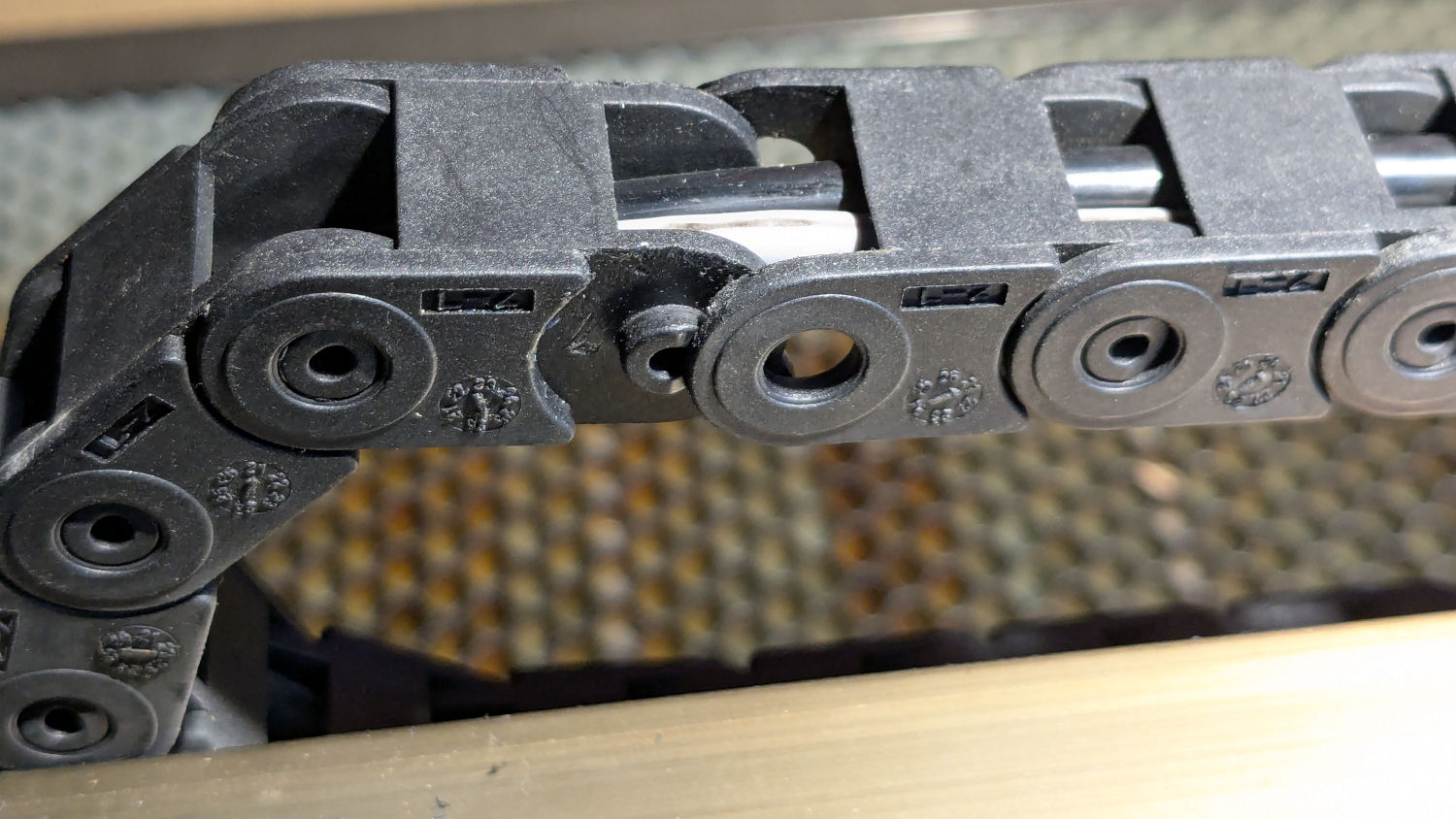
Unlinking the X axis drag chain involved a pair of small screwdrivers prying the side plates off their pivots in the next link:
OMTech focus pen – drag chain unlinked
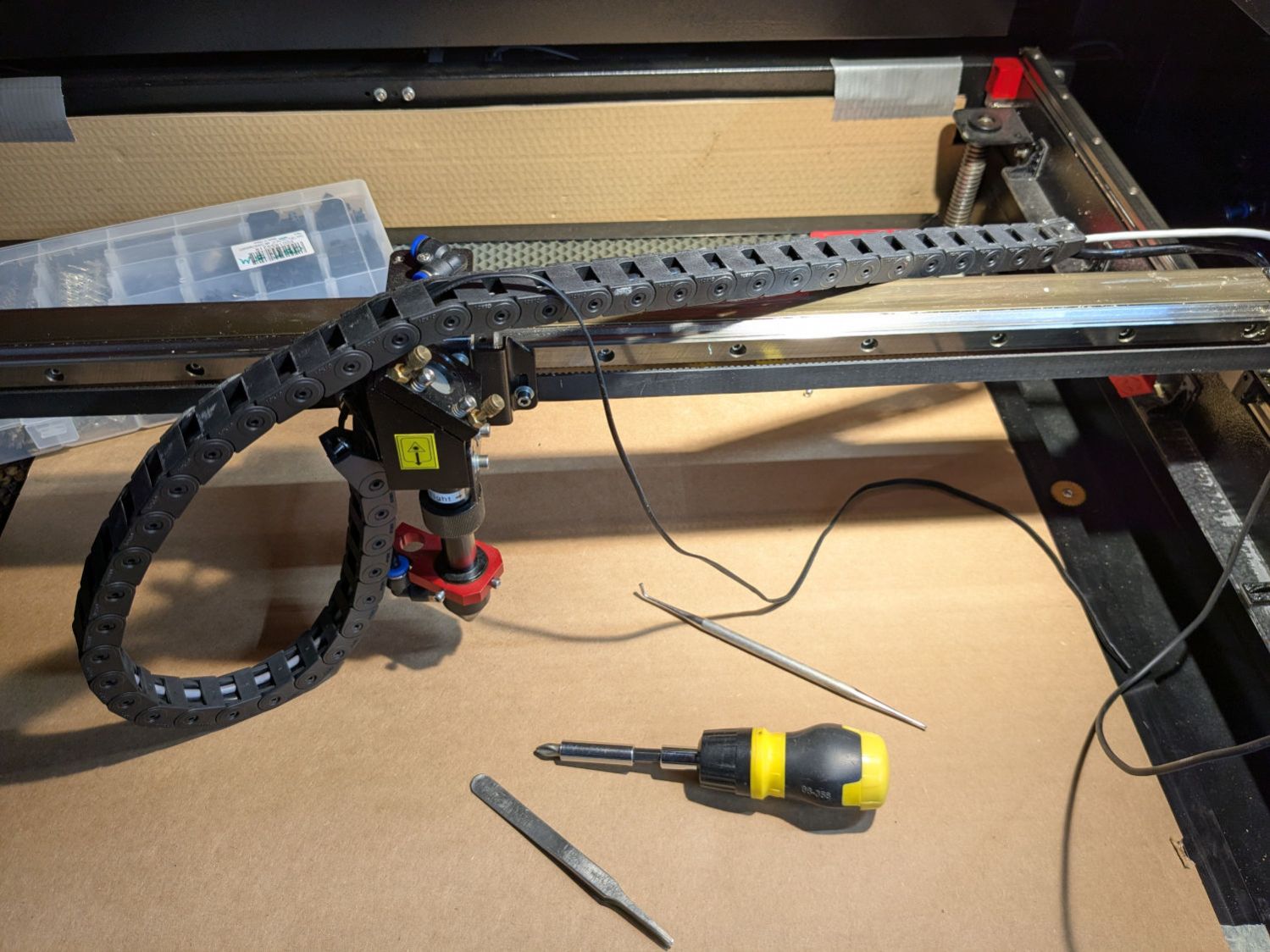
The slightly enlarged opening let me pull enough of the cable through to verify I needed more elbow room, so I dismounted the entire drag chain:
OMTech focus pen – X axis drag chain unmounted
The Y axis drag chain was short enough to pull the cable out without drama.
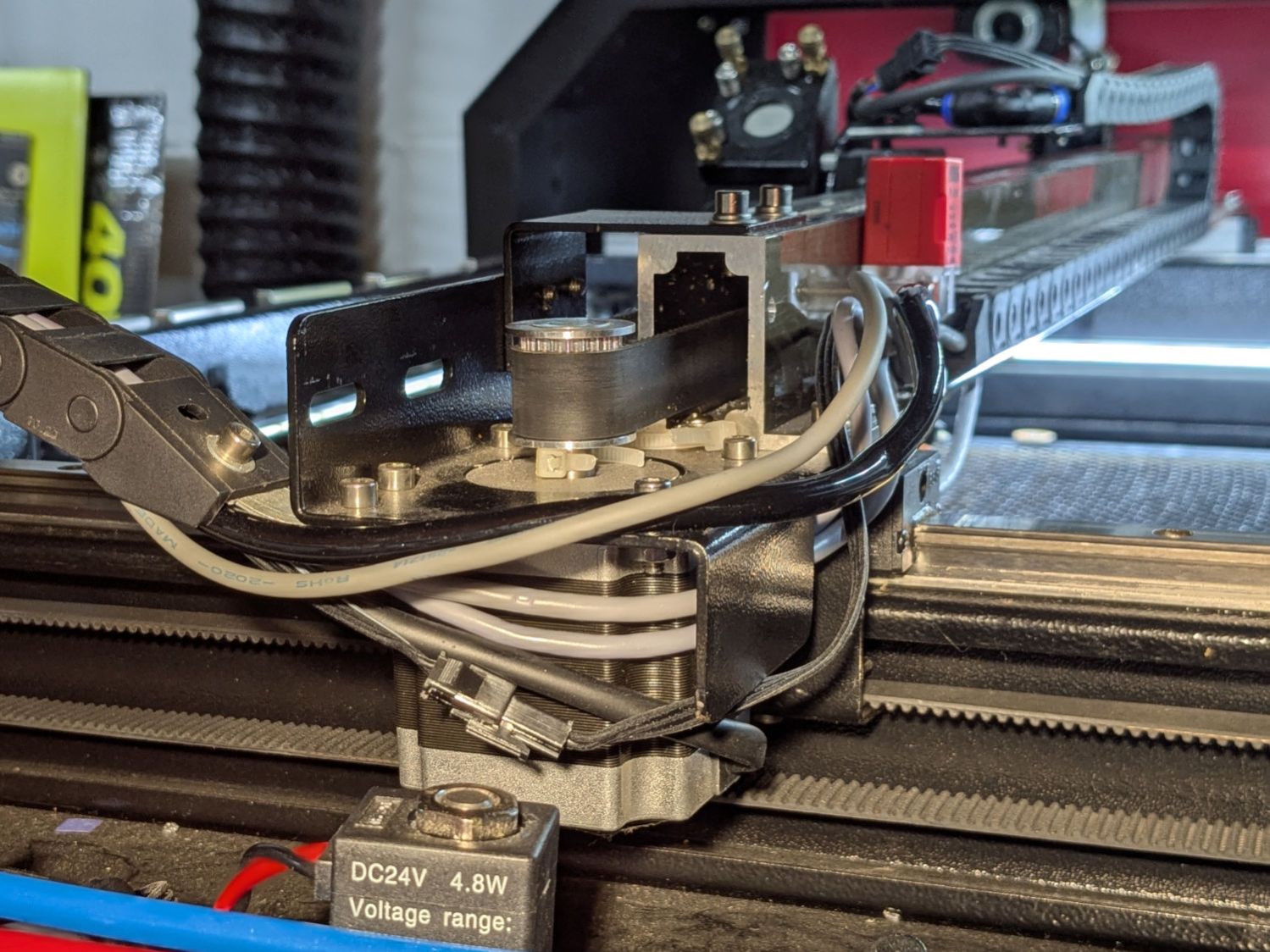
I guesstimated the overall length from laser head to controller, cut a six conductor 26 AWG silicone ribbon cable generously longer than half of that, peeled it down the middle, then put a JST SM connector where the sections meet at the end of the gantry:
OMTech focus pen – gantry wiring
Obviously, those connector halves went on before snaking the other end of the cable sections through their drag chains. I paid considerable attention to keeping the ribbons flat and untwisted throughout their lengths, in hope they’d flex easily as the chain bends.
AFAICT there was no good way to use the old wire to pull the new wire through the chain, so running flexy silicone ribbon cable through a drag chain required tweezers, patience, and persistence. I had to realign the existing wires & tubes at various points so they didn’t twine around each other and block the path.
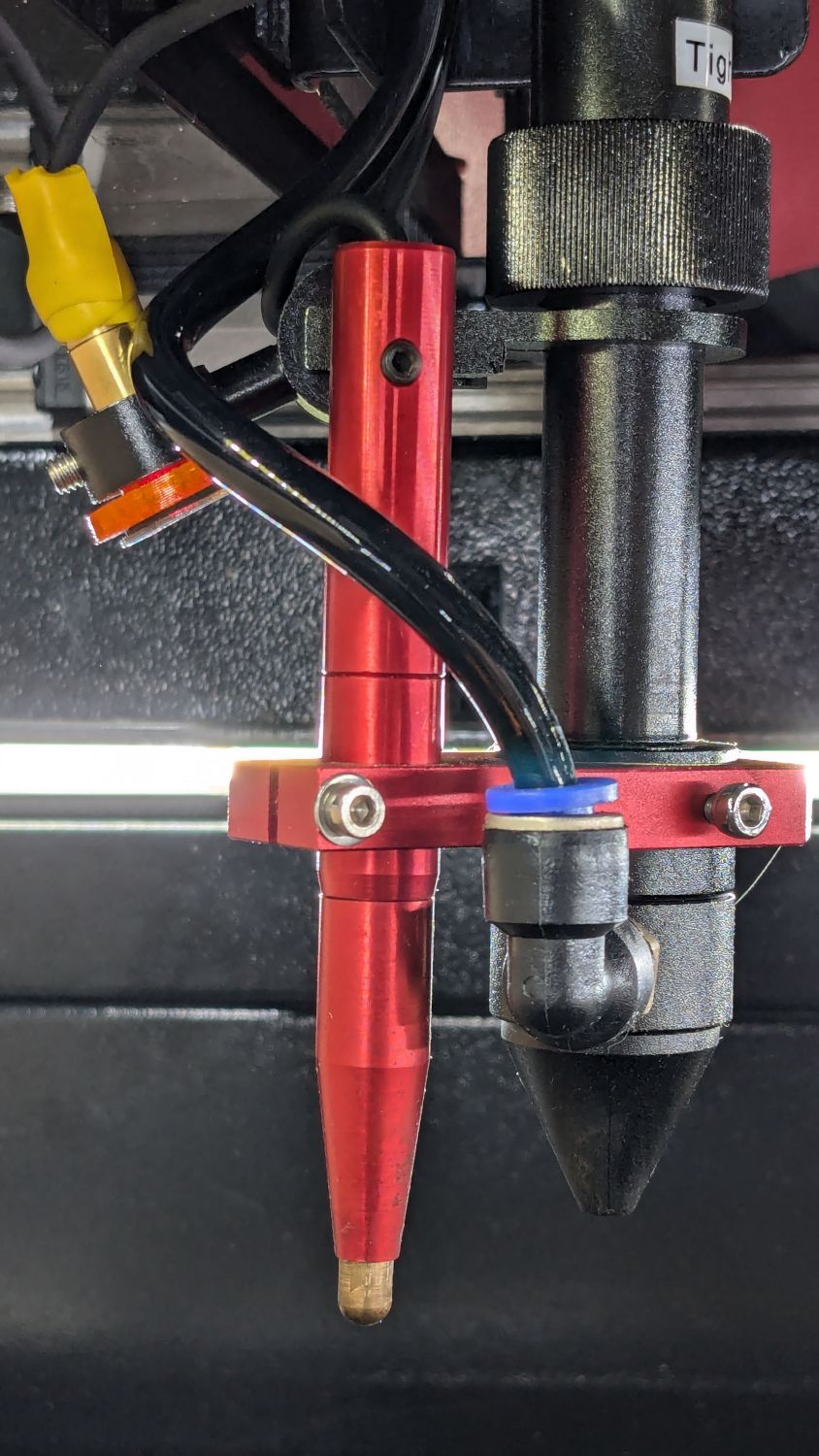
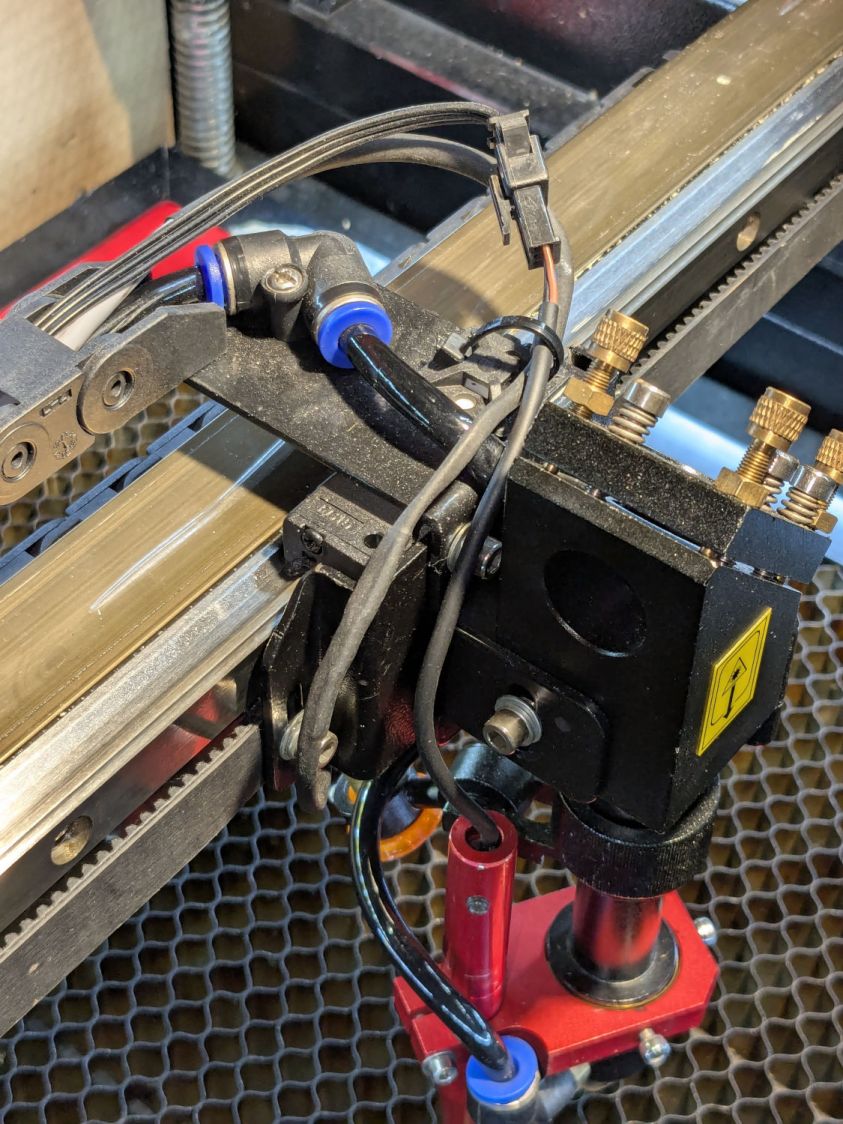
Another JST SM connector at the laser head allows removing / installing the pen as needed:
OMTech focus pen – reinstalled
The connector pins and sensor wire colors:
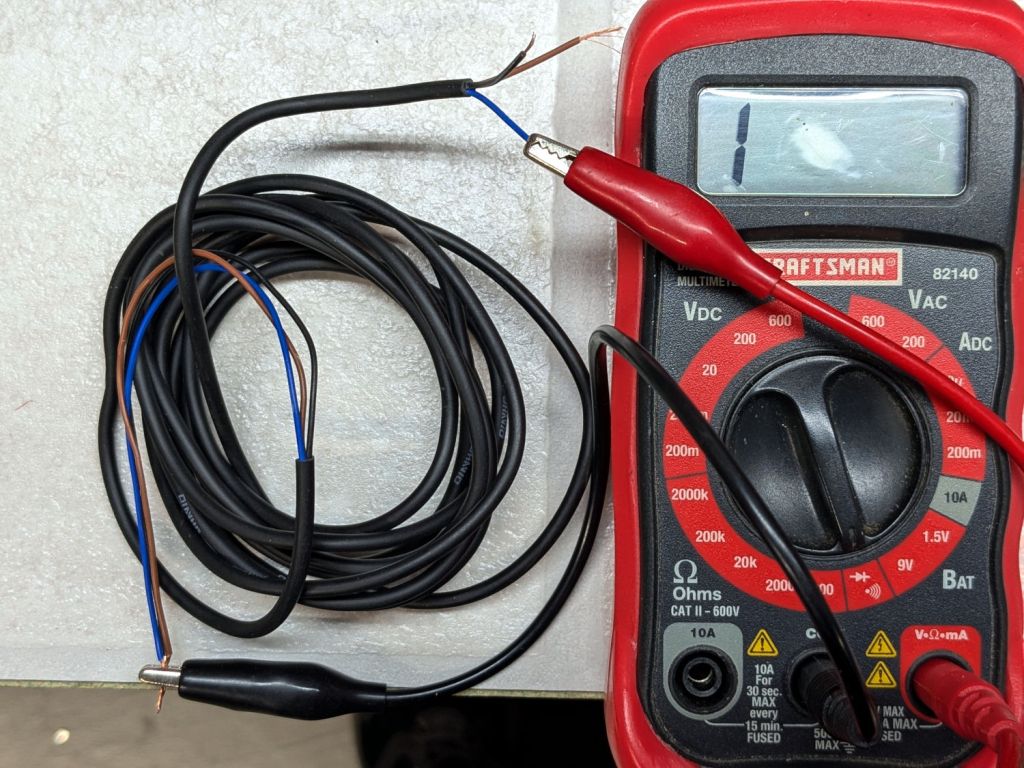
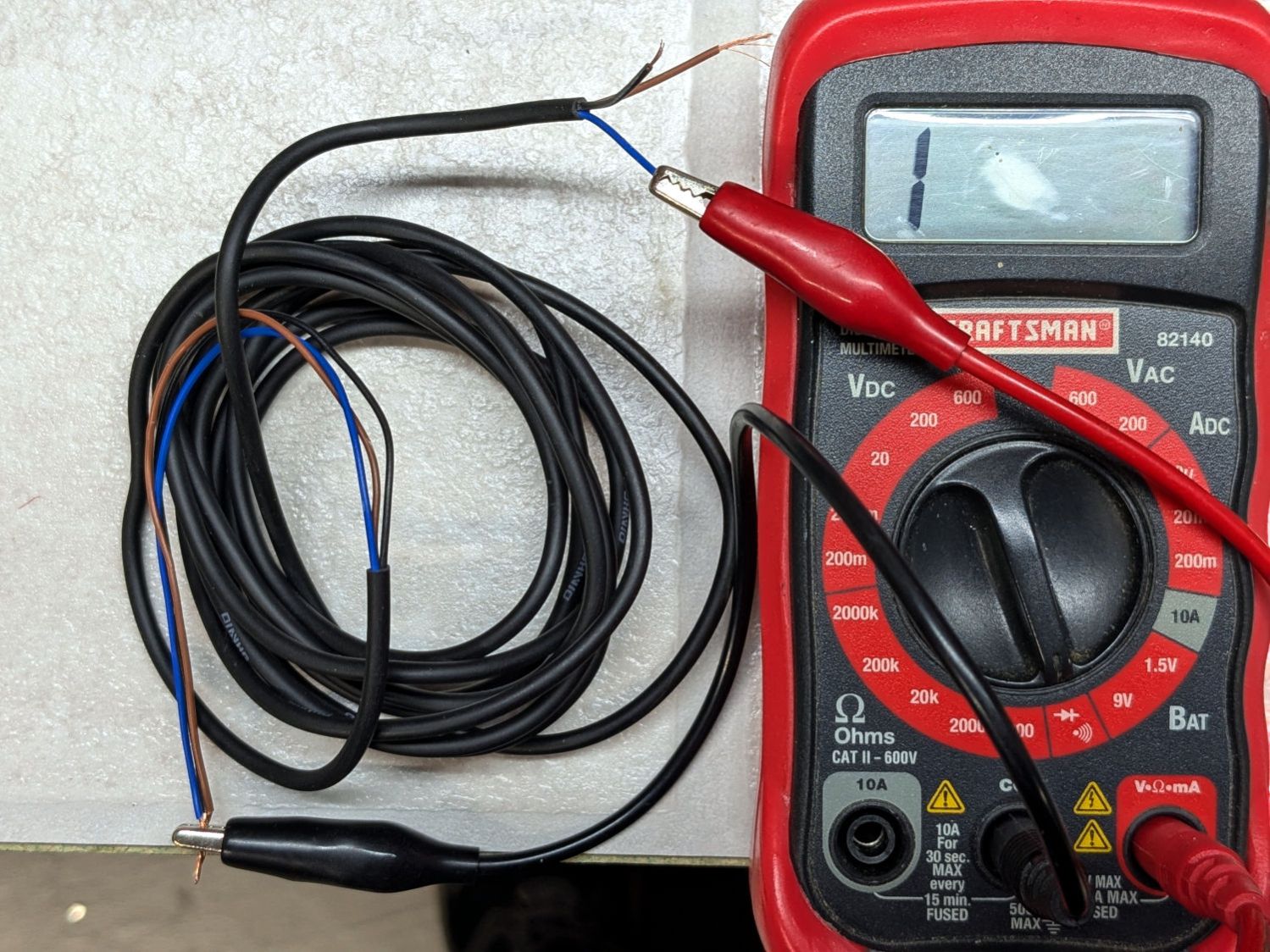
GND = blue = common = marked cable conductor
OUT = black = sensor output
24V = brown = power
Wiring the new cable to the controller’s 24 V / GND / LmtU- terminals showed it now worked perfectly.
Reducing the vertical offset between the tip of the pen and the tip of the nozzle was then straightforward …
Although the Ortur YRC-1 chuck rotary comes with a long cable, the connector doesn’t match anything in my heap, so an adapter of some sort was in order. The box includes three different adapters for various machines, none of which I have, but which served as raw material.
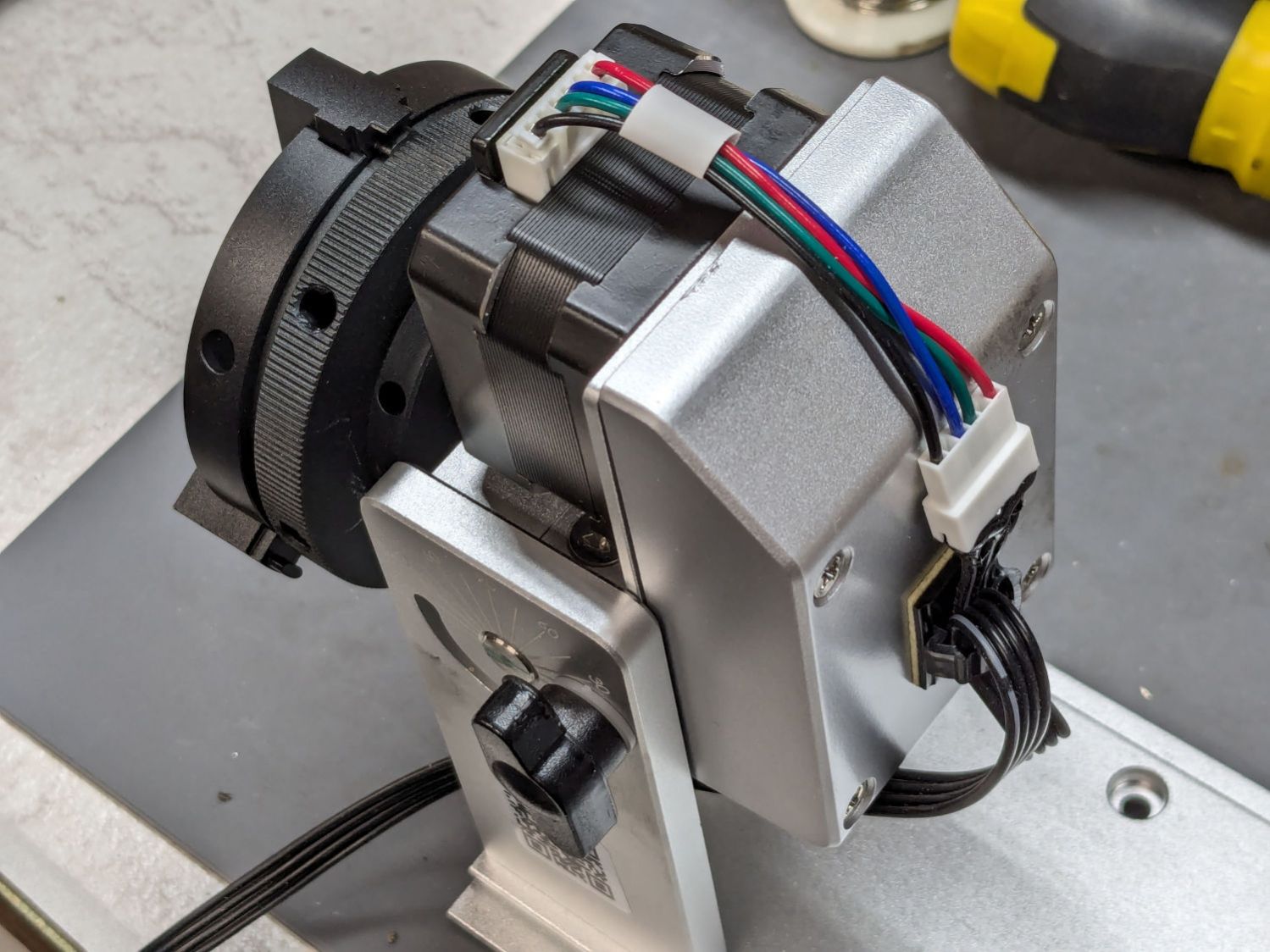
One of the adapters put the motor winding pairs together, which seemed like a Good Idea™:
Ortur Chuck Rotary – cable routing
That view has the stepper motor flipped 180° from its normal orientation; the motor cable connector normally points downward from the bottom.
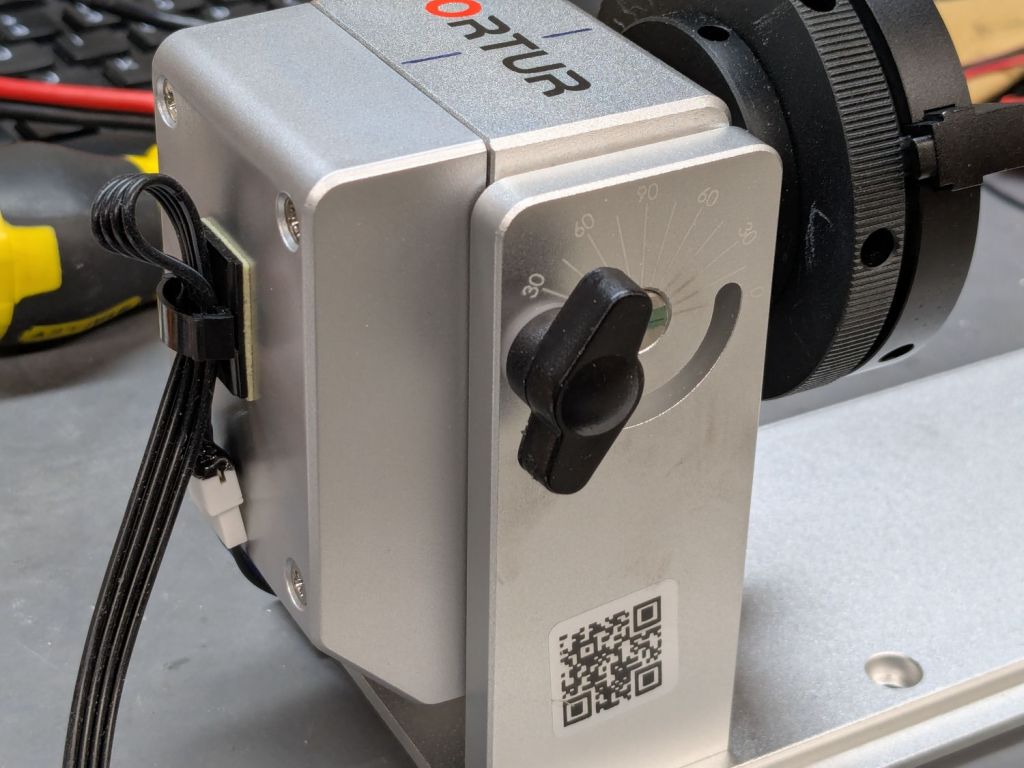
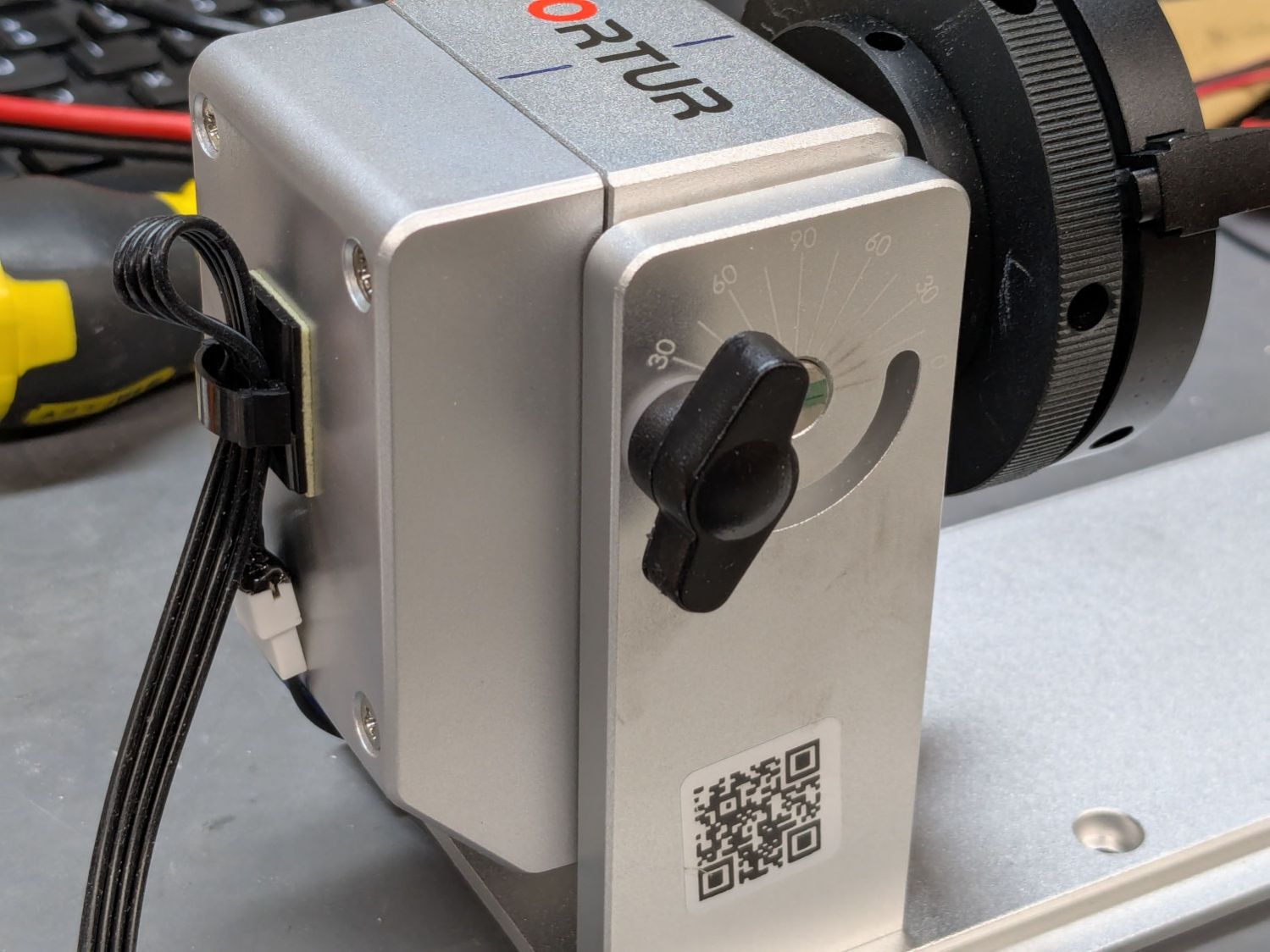
The rotary has no strain relief for the cable, so I stuck a cable clip on its left side (in the normal orientation):
Ortur Chuck Rotary – cable clip
That arrangement captures the adapter, immobilizes the wiring at the motor, and puts all the strain on the more easily replaced cable, which is now a length of flexy 24 AWG silicone ribbon cable.
I don’t have a connector matching the Ortur adapter, but JST SM pins seemed about the right size:
Ortur Chuck Rotary – cable pins
Entombing that mess with a squirt of hot melt glue should keep them out of trouble.
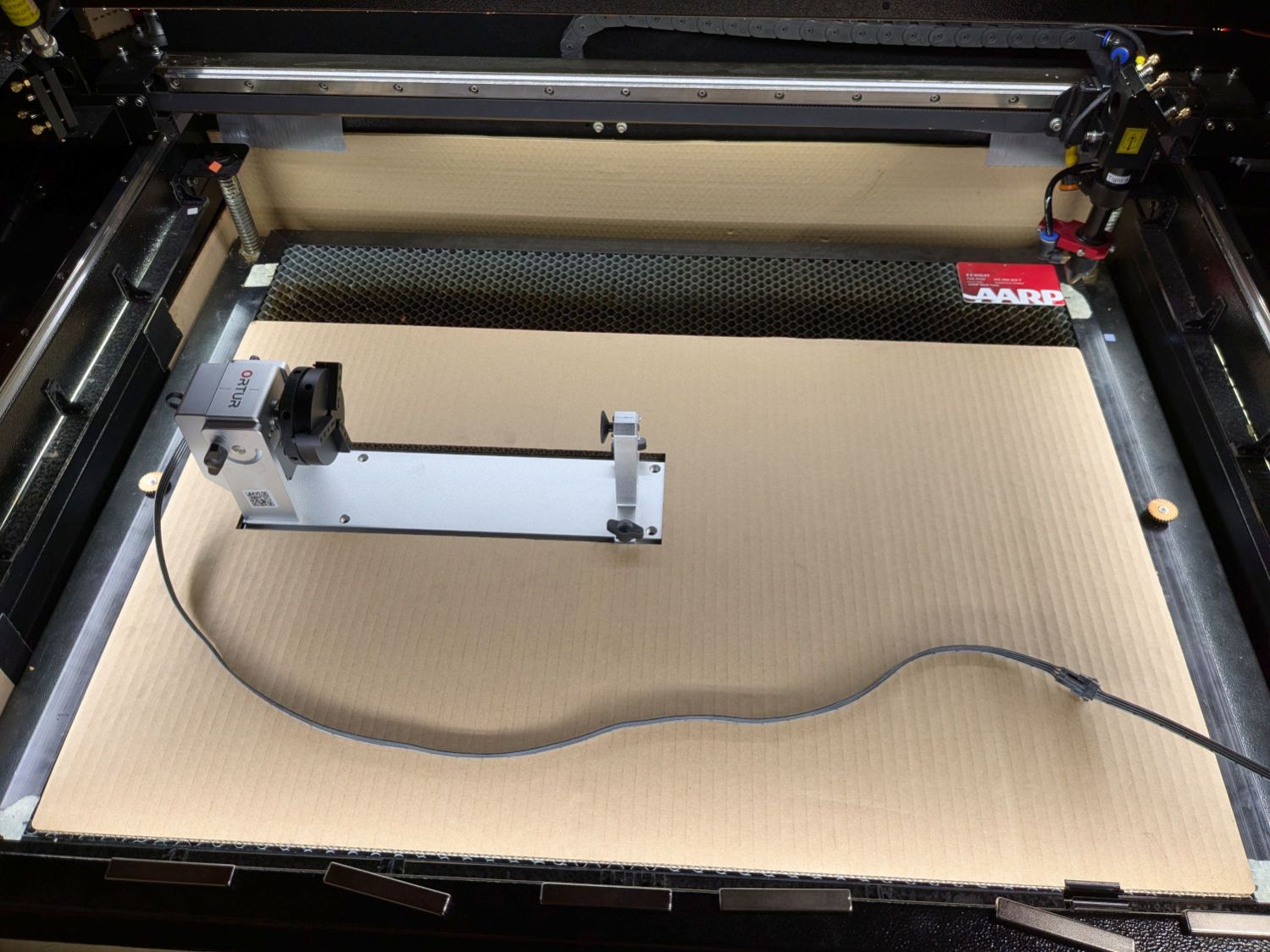
You can see my matching JST SM connectors on the right end of the ribbon cable :
Laser Rotary – on platform
A cable clip stuck to the front cross member of the machine frame (just beyond the angled magnet) holds the unplugged end out of harm’s way when the rotary isn’t present.
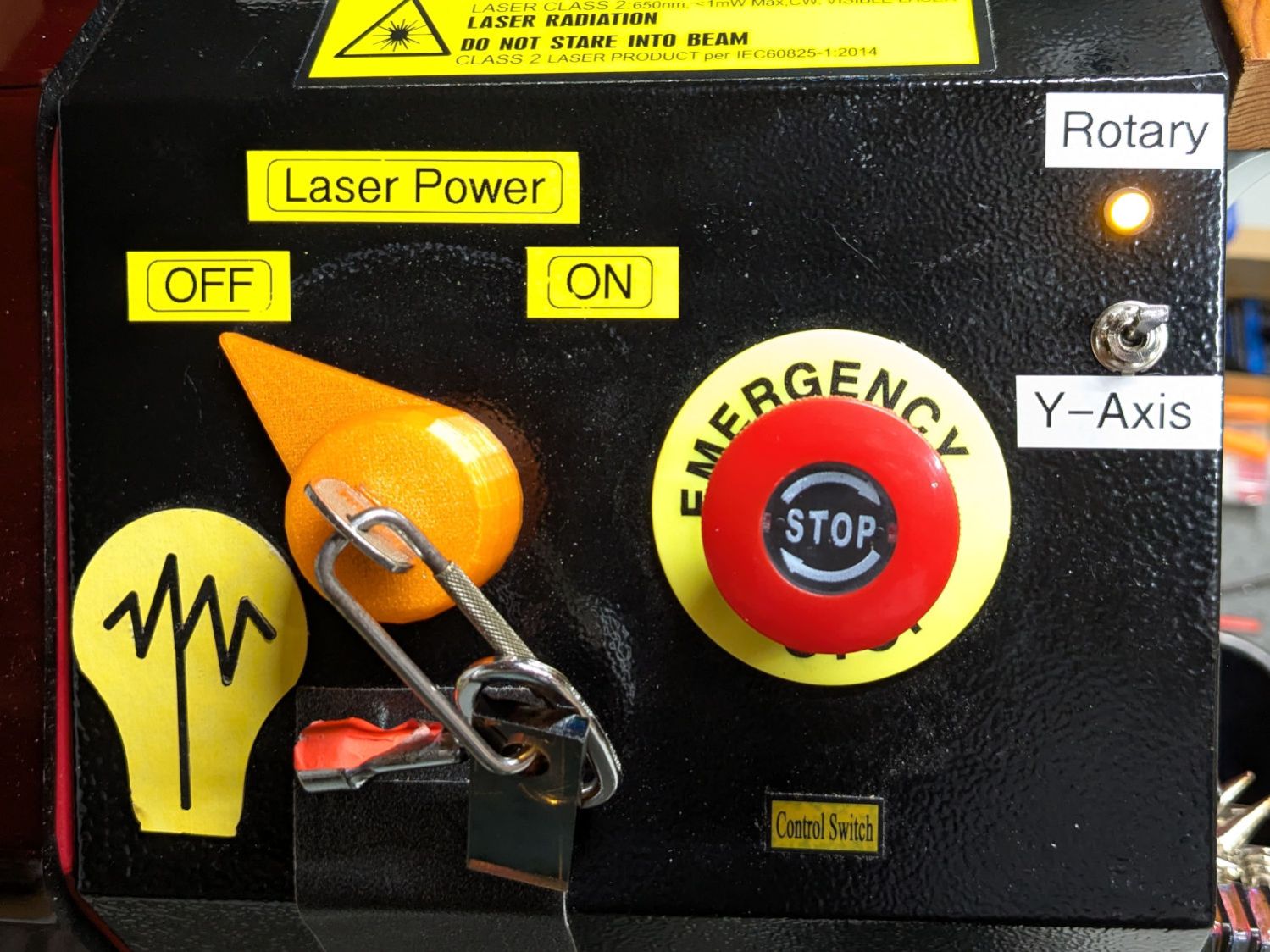
Flipping the front-panel switch to enable the rotary driver / disable the Y axis driver enthusiastically spins the chuck when the controller thinks I’m jogging the Y axis:
Laser Rotary – control switch
Making it do something useful requires more pondering.
Having picked up a small rotary intended for Ortur diode laser machines during Black Friday, I knew using it with my OMTech 60 W CO₂ laser wasn’t going to be plug-n-play. The usual connection for a rotary in a CO₂ laser is directly into the stepper motor driver for the Y axis, so the stepper motor in the rotary must handle the same current as the Y axis motor. The OMTech laser has NEMA 23 steppers set for 3.5 A, which would quickly fry the NEMA 17 stepper in the Ortur rotary.
So the general idea was to run the rotary from another stepper driver set for an amp or so. A separate driver would also let me choose microstep settings more suitable for a rotary.
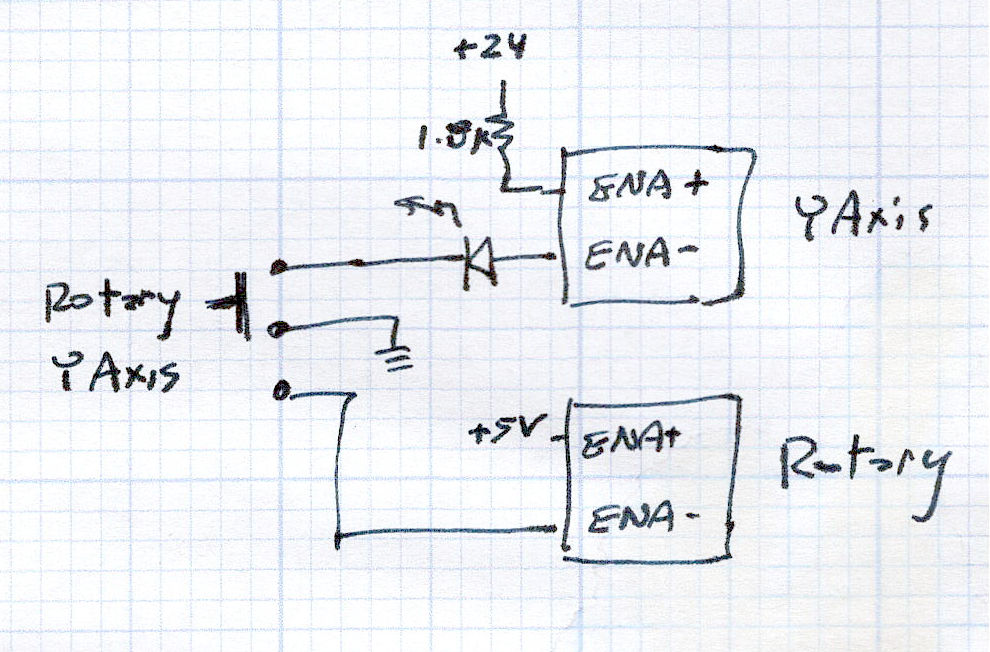
A simple SPDT switch enables the appropriate driver:
Laser Rotary Enable doodle
NB: Leaving the ENA pins of a stepper driver disconnected enables the motor output and passing current through them disables the motor; why that function was not labeled DISABLE remains a mystery.
So the switch looks bassakwards, but it connects the -ENA pin of the disabled driver to GND / common, with its +ENA pin tied to the supply.
Translating that doodle into hardware required drilling holes in what passes for the laser’s front panel:
Laser Rotary – control switch
The new driver stands up in bottom of the electronics bay:
Laser Rotary – R driver – detail
The loose wire over on the left is a remnant of the discovery that the KT332N controller’s General output bits do not behave as expected. While you (well, I) can set their state through the display’s MENU → DIAGNOSES screen, the controller unilaterally slams them low = active while running a job. To be fair, the manual does say “General output, reserved”, but I had to find out the hard way.
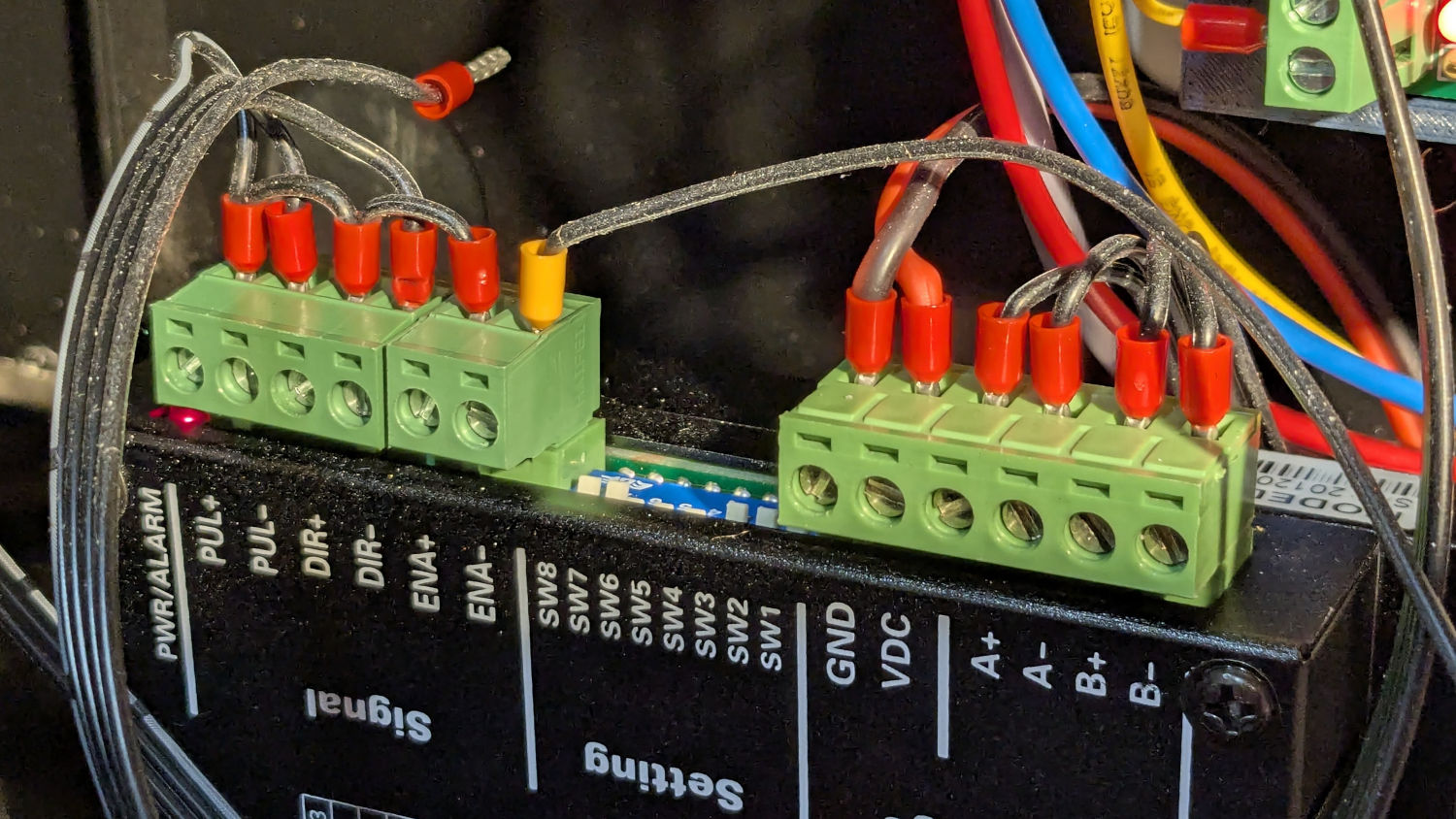
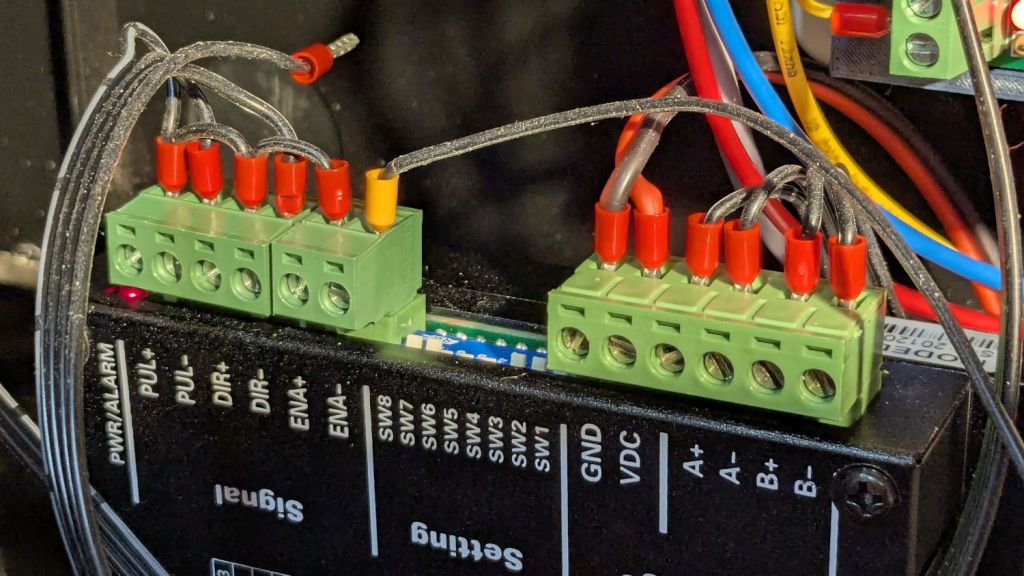
The +ENA terminal comes from the +5V supply, along with the other + terminals. The -ENA terminal goes off to the switch, along with two wires from the existing Y axis stepper driver:
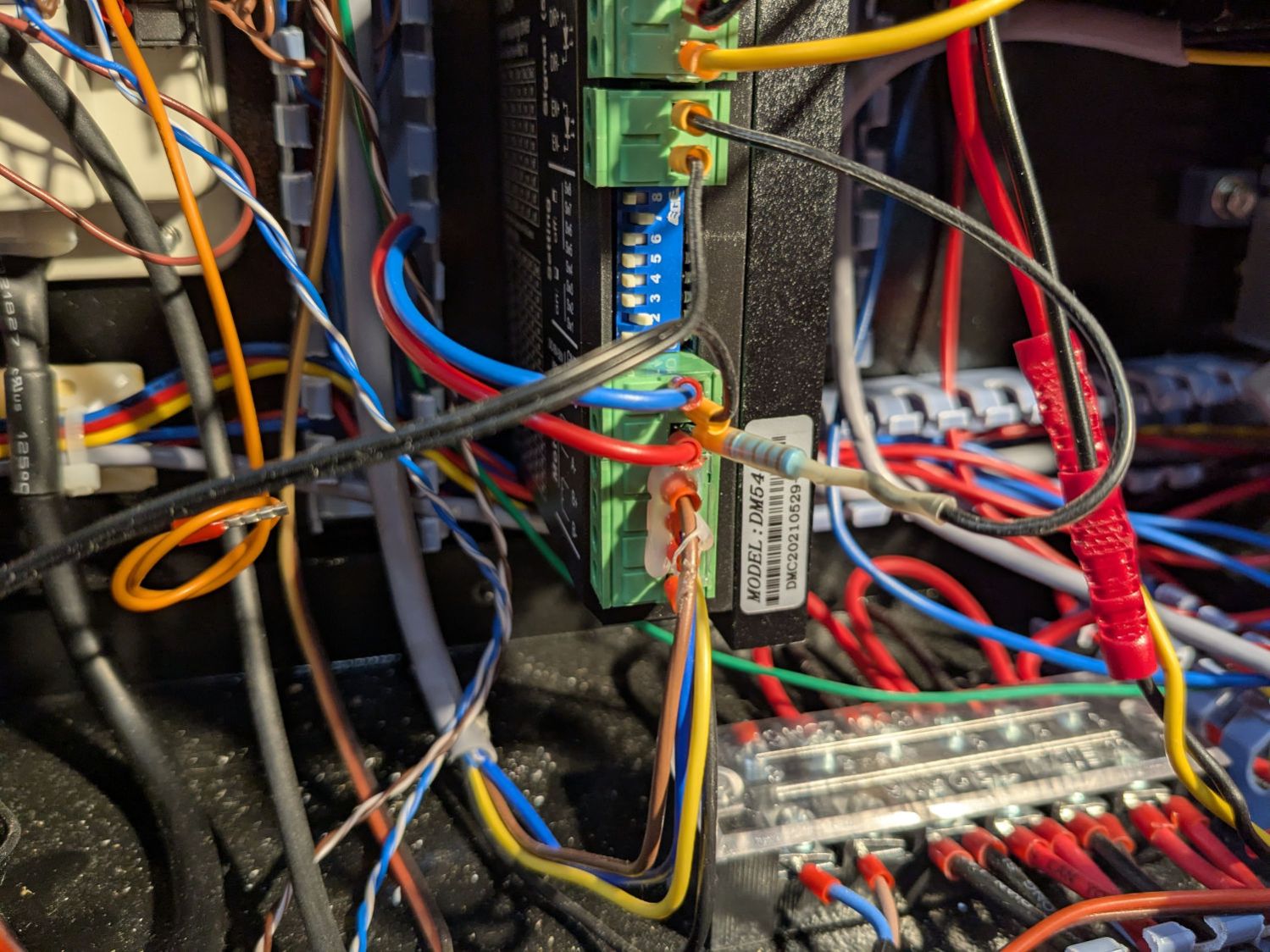
Laser Rotary – Y driver wiring
The 1.8 kΩ resistor sticks out of a ferrule doubled up in the 24V terminal feeding the driver and connects to a wire into the +ENA terminal. Two wires from the switch connect to the -ENA and GND terminals, join the -ENA wire from the rotary driver, and crawl through the machine to the front panel.
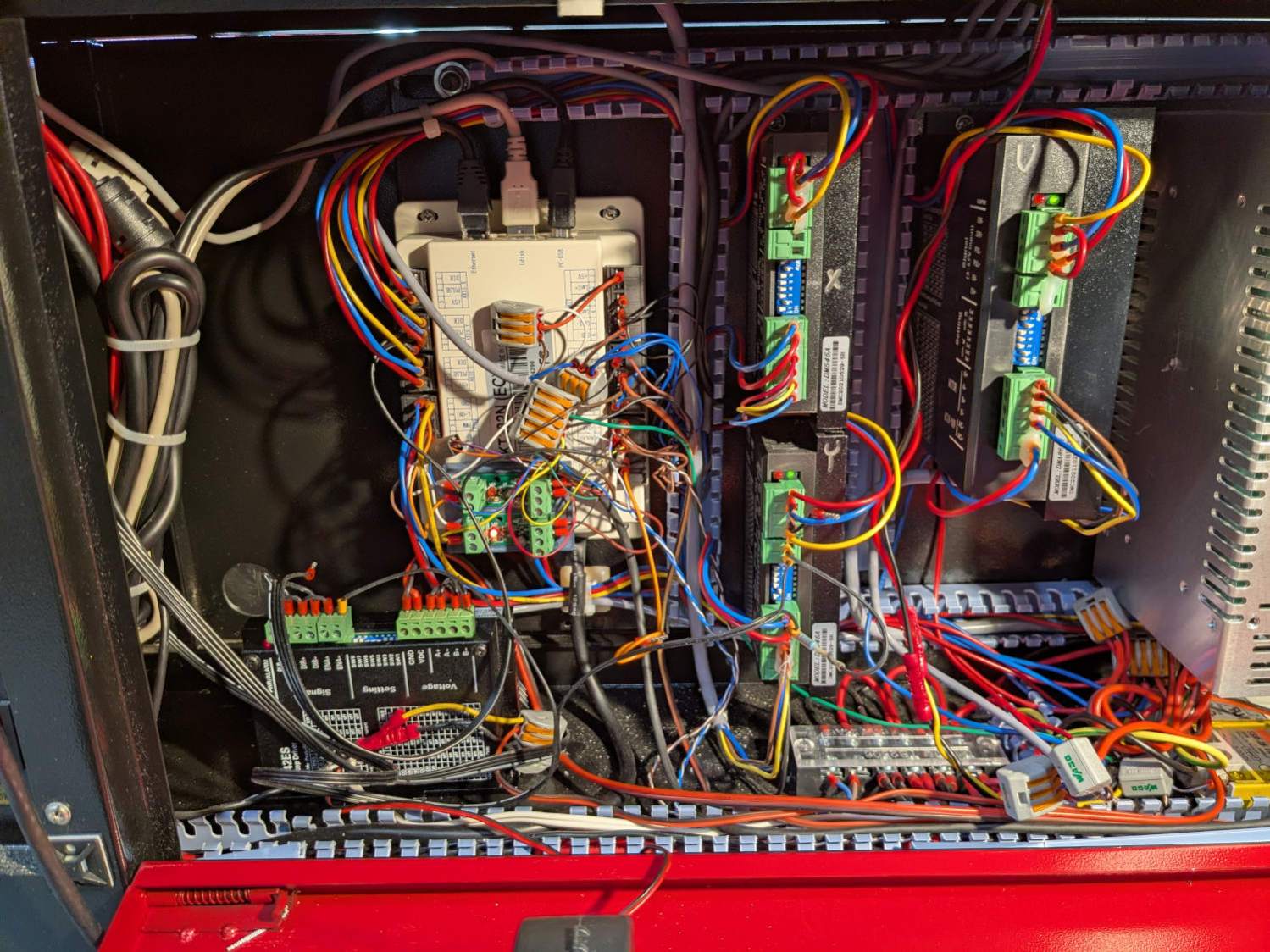
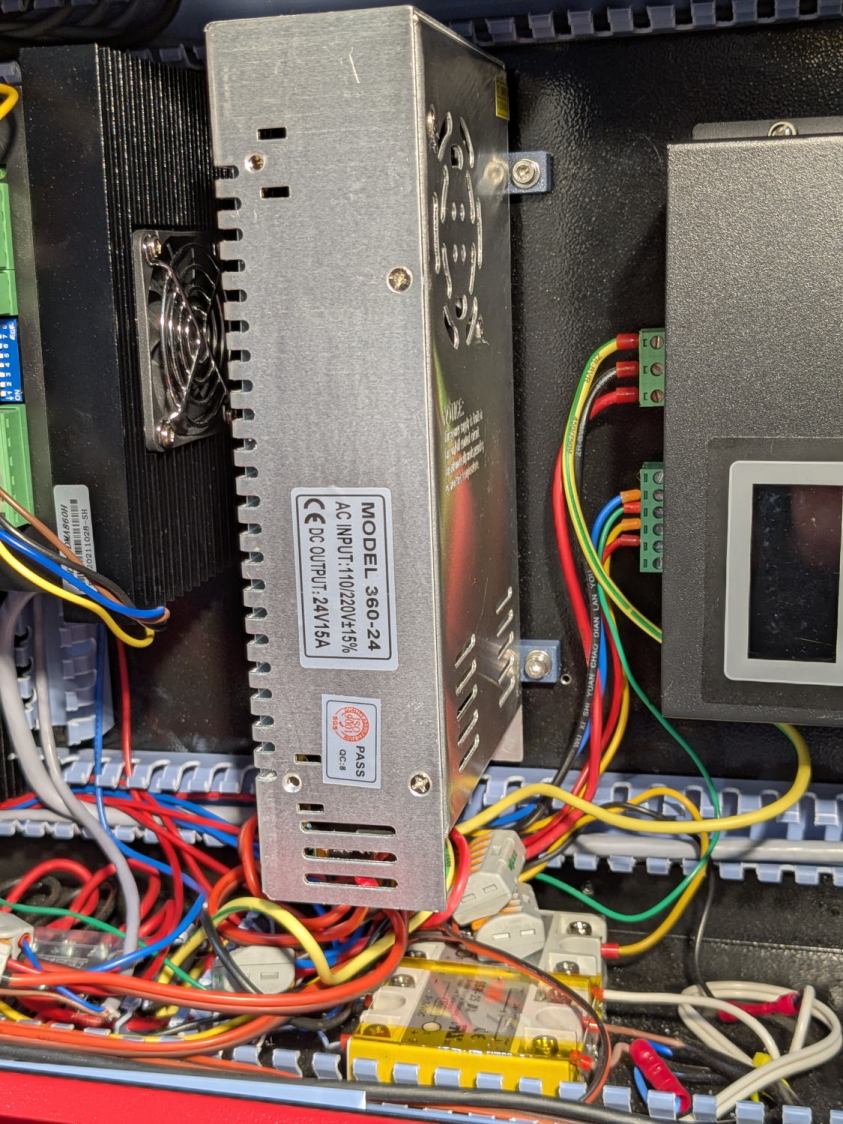
The new power supply on the far right completes the electronics bay installation:
Laser Rotary – electronics bay
Obviously, the wiring situation is completely out of control.
Up top, though, it looks like it grew there:
Laser Rotary – on platform
Now, to figure out the settings …
Edit: The rotary has a pulley ratio of 1:3, so the step/rev value is three times the DIP switch setting on the stepper driver. For this setup, 1600 → 4800 step/rev.
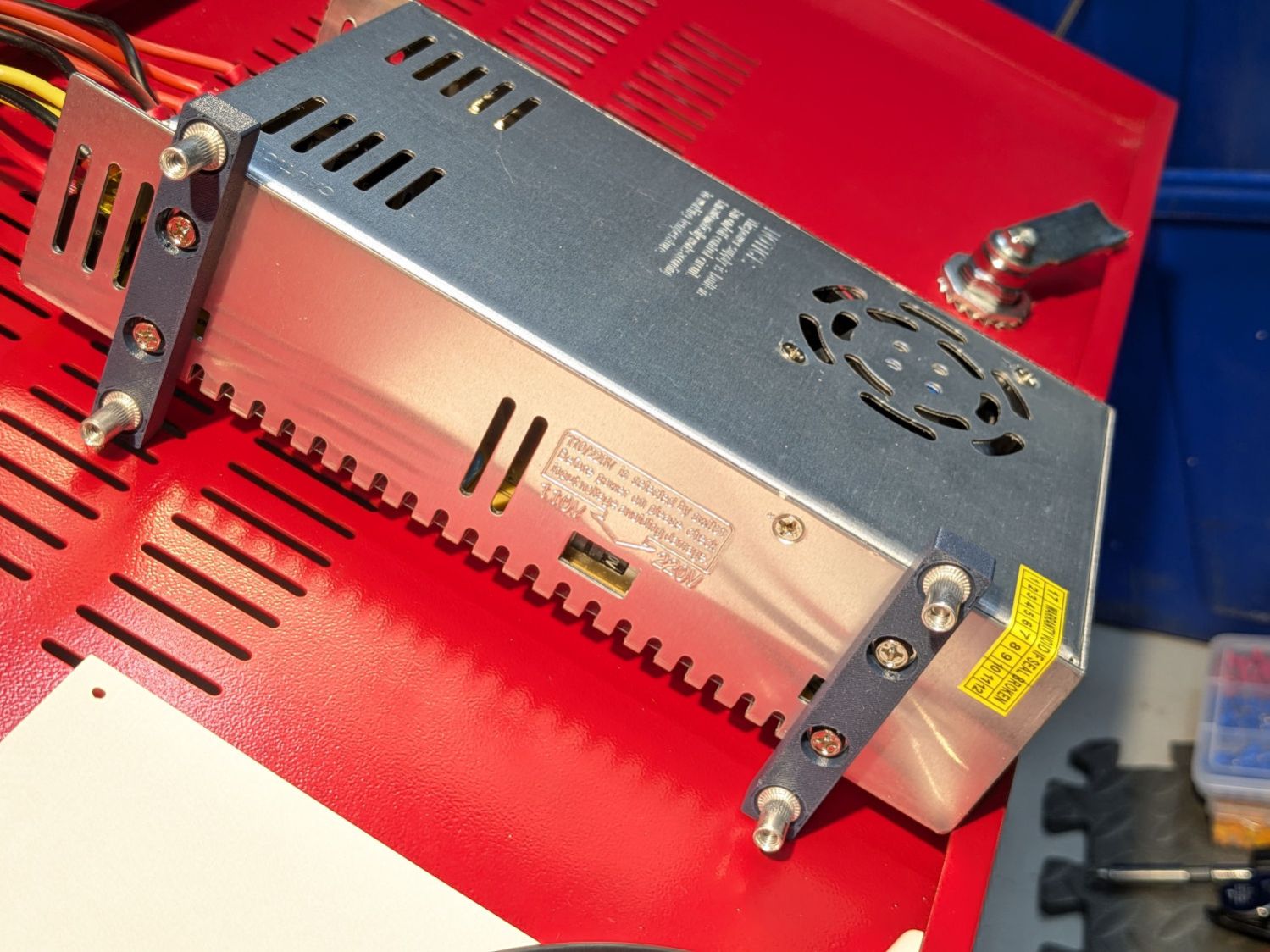
Unlike the OEM 24 V supply in the laser, the “new” supply from my heap does not have mounting flanges; it’s intended to be attached to a mounting plate from the back side. It turns out the laser does have a mounting plate with All The Things screwed onto it, but there is no way I am going to disconnect all the wiring just to drill four more holes in that plate.
So I made a pair of brackets to screw into the back of the supply and then into suitable holes in the mounting plate:
Laser 24V Power Supply Mount – solid model
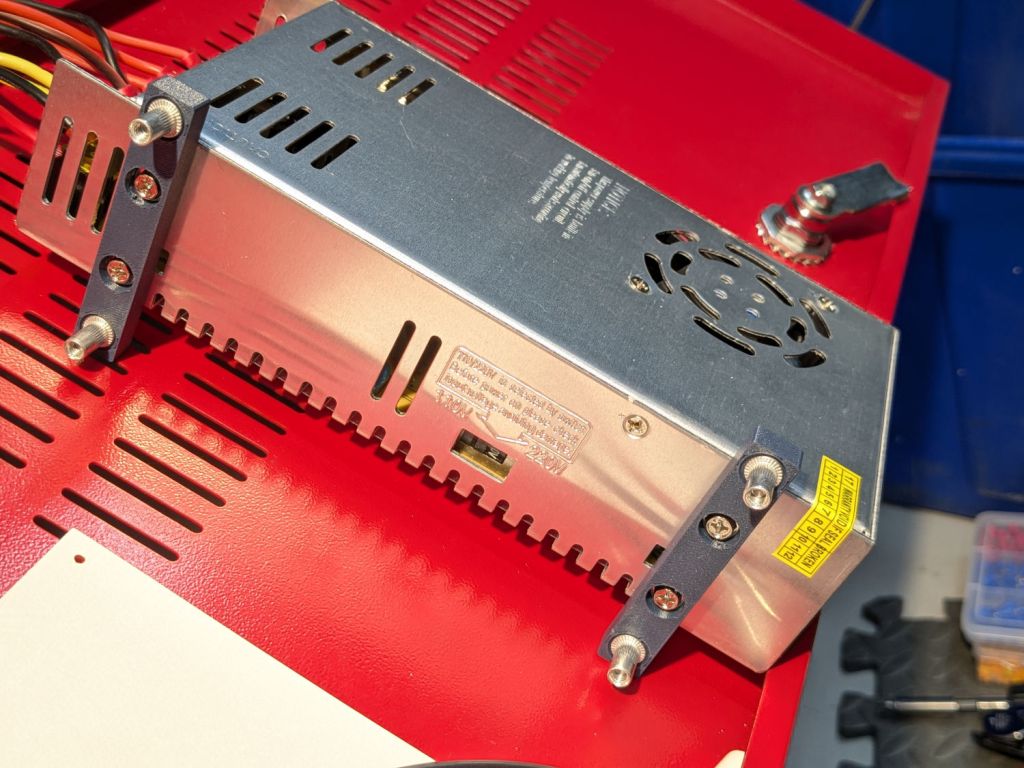
Which look like this in real life:
Laser 24V Power Suppy – mounts installed
Those M4 rivnuts just beg for 6 mm holes in the mounting plate.
However, it turns out that their unsquished length exceeds the distance behind the panel, which means there’s no way to install them flush to the panel with the proper backside squish.
So:
Loosen the four nuts holding the panel to the bolts welded to the machine frame
Ease it forward a bit
Tuck 6 mm acrylic scraps behind all four corners
Snug the nuts again to hold the plate against the acrylic with plenty of room behind it
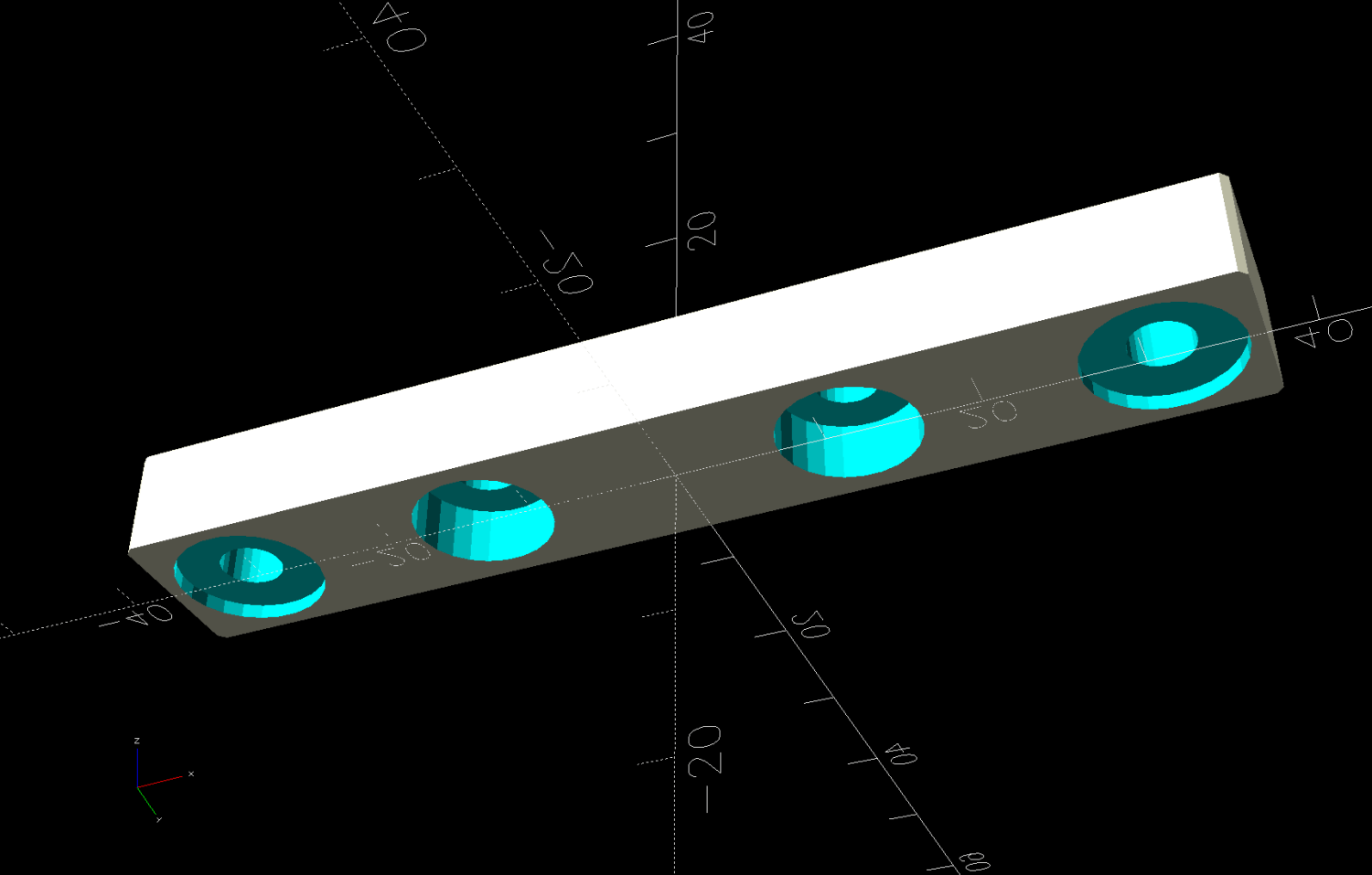
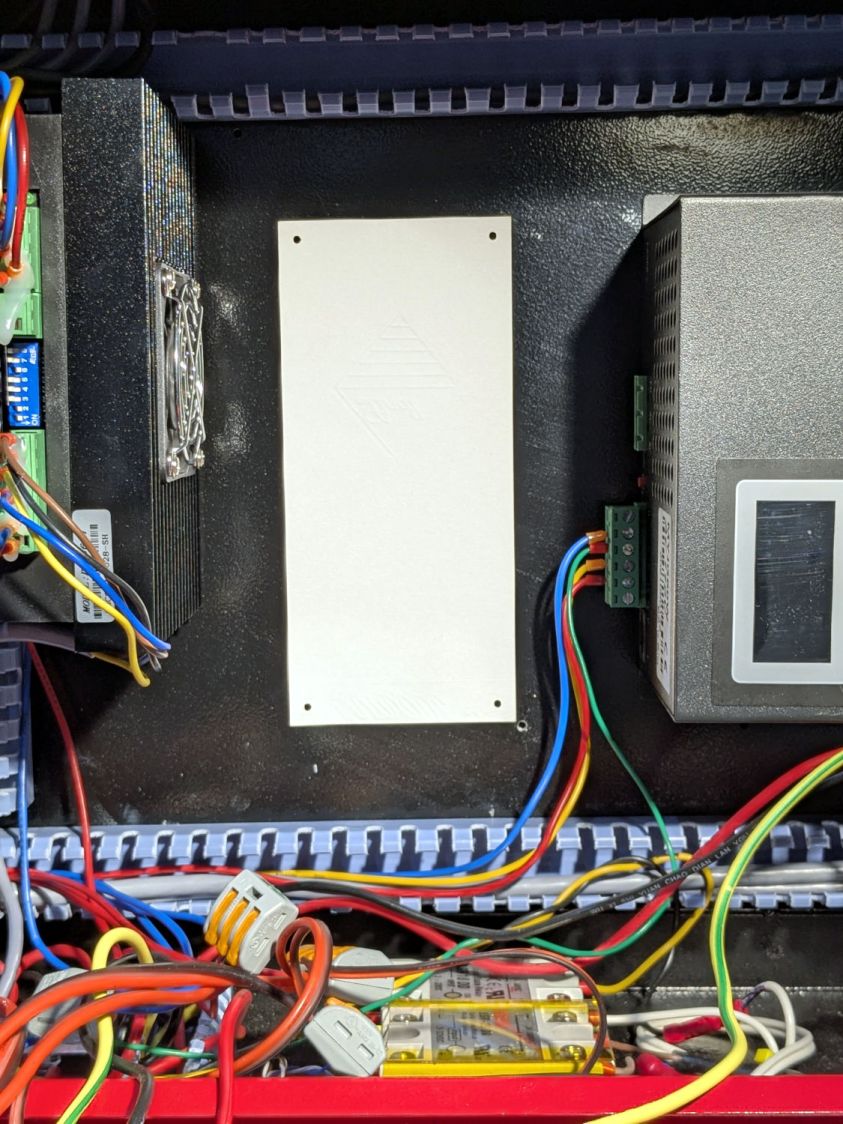
The OpenSCAD code generates a simpleminded drill template:
Laser 24V Power Suppy – drill template
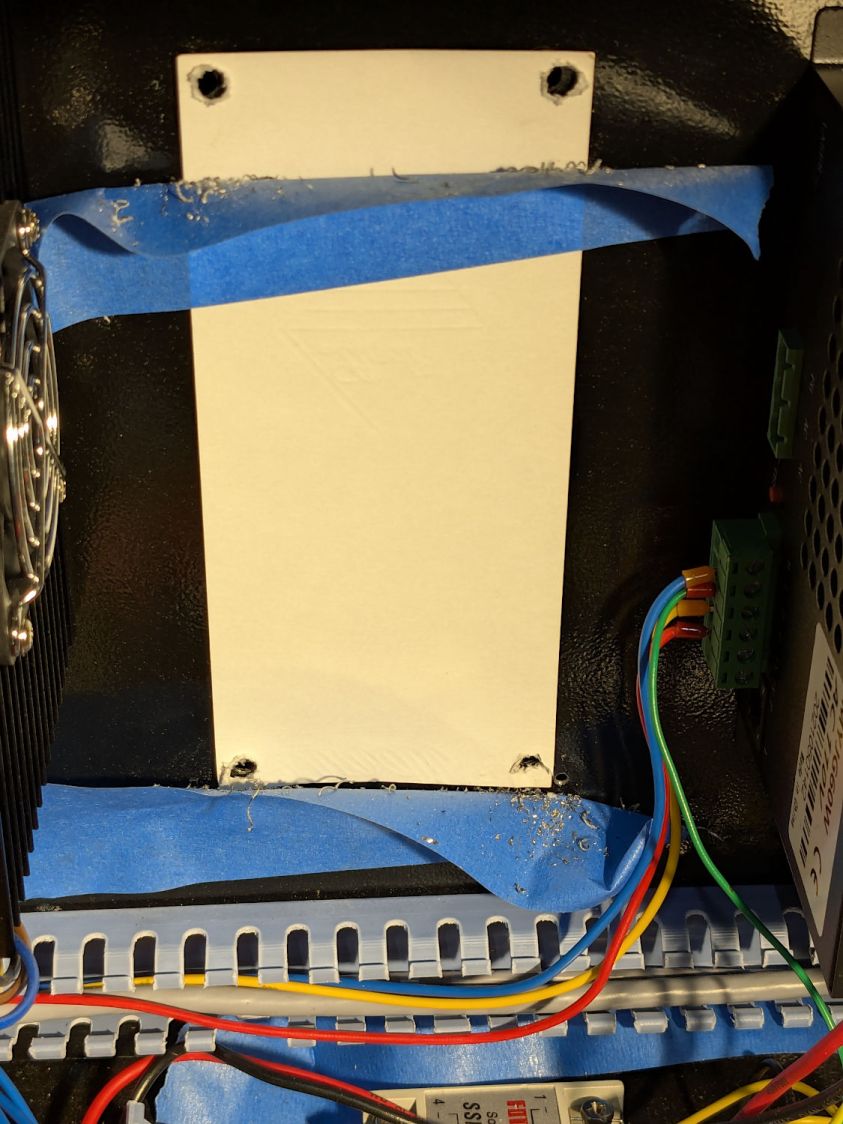
Press a scrap of rubber firmly against the plate to dampen vibrations and thwack each hole with an automatic center punch set to stun. Deploy a succession of drills up through 6 mm, catching most of the swarf in tape strips:
Laser 24V Power Suppy – drill chip catchers
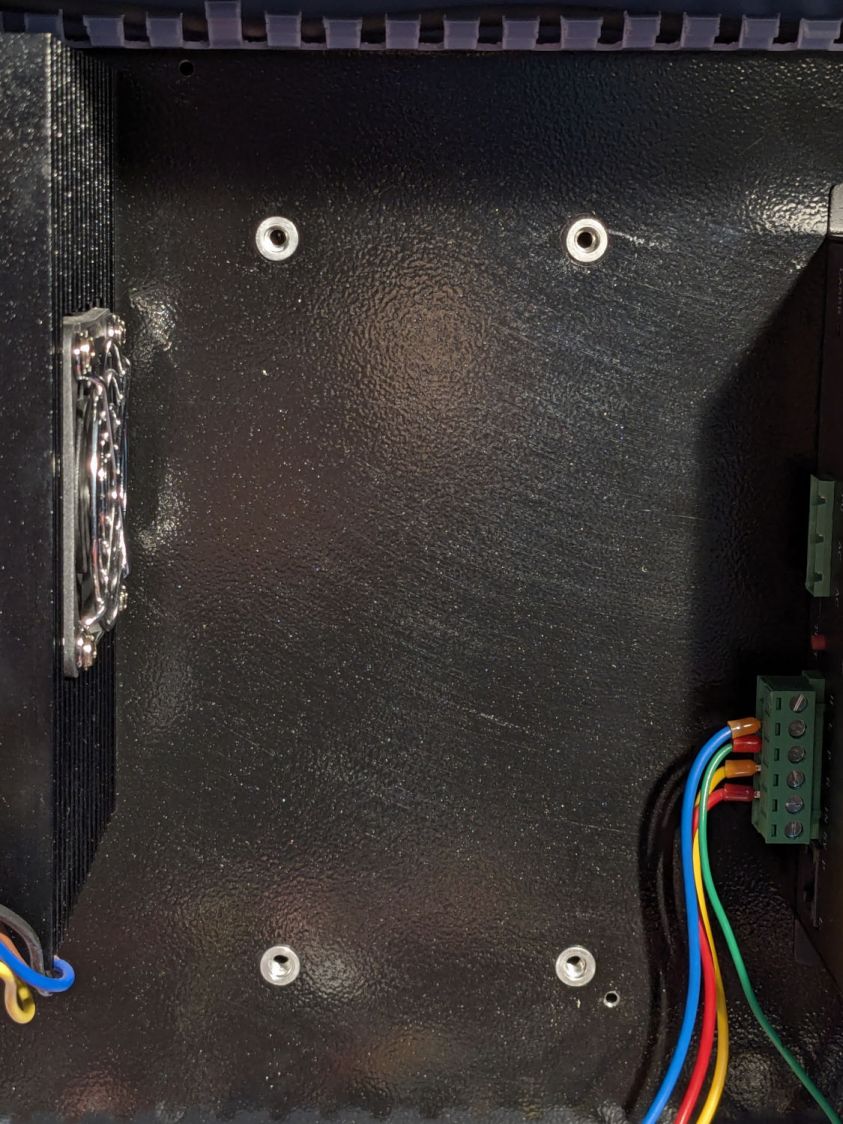
Squish the rivnuts in place:
Laser 24V Power Suppy – rivnuts in place
The small, vaguely tapped hole on the lower right was the “good” screw for the OEM power supply; the “bad” screw hole is invisible to the upper left, just under the raceway.
Remove the plastic spacers, snug the nuts holding the plate again, install the power supply, and it looks like it grew there:
Laser 24V Power Suppy – installed
The wires and Wago connectors scrunched underneath aren’t anything to be proud of, but longer wires didn’t seem likely to improve the outcome.
This file contains hidden or bidirectional Unicode text that may be interpreted or compiled differently than what appears below. To review, open the file in an editor that reveals hidden Unicode characters.
Learn more about bidirectional Unicode characters