The Smell of Molten Projects in the Morning

Ed Nisley's Blog: Shop notes, electronics, firmware, machinery, 3D printing, laser cuttery, and curiosities. Contents: 100% human thinking, 0% AI slop.

Category: Amateur Radio

Using and building radio gadgetry

  • Byonics TinyTrak3+ GPS Power Control

    GPS power from MOSFET relay
    GPS power from MOSFET relay

    The Byonics TinyTrak3+ GPS encoder has a “Power Control” output that can switch the power to a radio or GPS interface. J6 provides the interface: pin 1 = common, pin 2 = high active.

    With the “Power Switch” option enabled in the config program, you can set the number of seconds to allow the GPS unit to get up to speed before the next scheduled transmission.

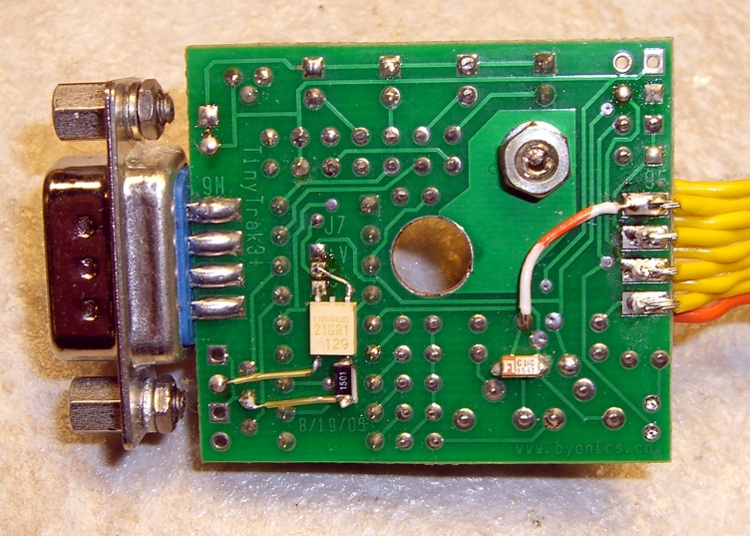
    I glued a surface-mount MOSFET relay to the back of the PCB with urethane adhesive; it fits neatly between the DIP microcontroller’s pins with one output lead soldered to the 5V pad of J7. The other lead goes to the center +V pad; because the relay uses back-to-back MOSFETs, the polarity doesn’t matter.

    That replaces the normal solder bridge across J7 that provides power (on pin 4) to the GPS2 plugged into the DB9 connector. When the relay’s on, it connects the GPS to the power supply. When it’s off, the GPS goes dark.

    The relay input is an LED with a forward drop of 1.3 V max and requires 4 mA to turn on: figure 3.7 V / 4 mA = 925 Ω max. I kludged an 890 Ω resistor by paralleling (stacking!) 1.5 k and 2.2 k resistors; you could probably use anything near that and it’d work fine.

    The relay is an OMRON G3VM-21GR1, part number A11171 from Electronics Goldmine, but I suspect any teeny little solid-state relay would work. The max on resistance is about 1 Ω and the receiver draws about 65 mA. I measured about 20 mV of drop, so the actual resistance is a lot lower than the spec.

    I initially set the power-on delay to 10 seconds, which seemed to be OK: the GPS (green) LED would blink a few times, then go solid. Alas, the warm-start spec for the Byonics GPS2 (see the GPS3 for details) receiver is really 38 seconds, average, and it was definitely producing bogus position data. So I set the delay to 60 seconds and we’ll see how that works; early reports indicate the coordinates still have plenty of jitter.

    [Update: 60 seconds is iffy. 90 seconds seems to work pretty well. A bit of rummaging says that the satellites broadcast their ephemeris data every 30 seconds, so 90 seconds allows for two complete update cycles. Maybe 100 seconds would be even better. Some old background info for Garmin hand-held receivers is there.]

    It’s obviously a tradeoff between accuracy and battery life. This is for use on a bicycle and, believe me, I don’t want to tote a huge battery!

    If the control signal was low-active, then you could use a cheap PNP transistor as a high-side power switch.

    The white/orange wire routes regulated 5 V through an otherwise unused pin to the homebrew interface that combines the GPS data with helmet mic audio. The tiny rectangle is a 1 µF cap that helps cut down digital noise. There’s no need for a connector on that end, as it’s wired directly to the interface circuit board inside a small enclosure.

  • Radio-Equipped Turtle

    Radio-Equipped Turtle
    Radio-Equipped Turtle

    We met this lass while walking around the high school one evening.

    My first thought was that eliminating the Morse Code requirement has definitely broadened the amateur radio population, but it turns out she’s part of the Hudsonia Blanding’s Turtle study. Perhaps the new construction around the school has opened pathways for her to explore the world.

    She seemed to be looking for a way up-and-over the curb to return home. We figured she was big enough to figure this out on her own and old enough to have done so many times before, so we left her to her own devices. When last seen, she was chugging along the curb at a pretty good clip.

    Listen for tag 123122 (or 817) on 150.888 MHz… she’s running AM QRP with a bad antenna.

    Update: It’s hard to tell with turtles, but it’s a girl! When I reported the tag number to Hudsonia, they said “817 is one of our old-timers; we’ve been tracking her for at least 10 years now.”

    Go, turtle, go!

  • AA Cell Dimensions

    Ever wonder why rechargeable AA cells don’t quite fit in older flashlights & gizmos? Somewhat to my surprise, the dimension specs for alkaline and rechargeable cells aren’t quite the same.

    At the bottom of the Wikipedia AA battery page, we find “brand-neutral” drawings (allegedly) based on ANSI specs:

    • Alkaline: 14.0 ± 0.5 dia x 49.85 ± 0.65
    • Rechargeable: 14.1 ± 0.6 dia x 48.9 ± 1.6

    A rechargeable cell can thus be 0.2 mm larger in diameter, but should have the same maximum length.

    Based on my collection, alkalines seem to be near their nominal and NiMH cells near their maximum. Across a four-cell layer, the difference adds up to 1 mm or so, which is enough to strain the plastic.

    8-cell NiMH AA pack
    8-cell NiMH AA pack

    Hint: Put some paper on the negative terminal when you measure the cell length. Steel calipers are pretty good conductors and the short-circuit ratings (even for alkalines) are surprisingly high  …

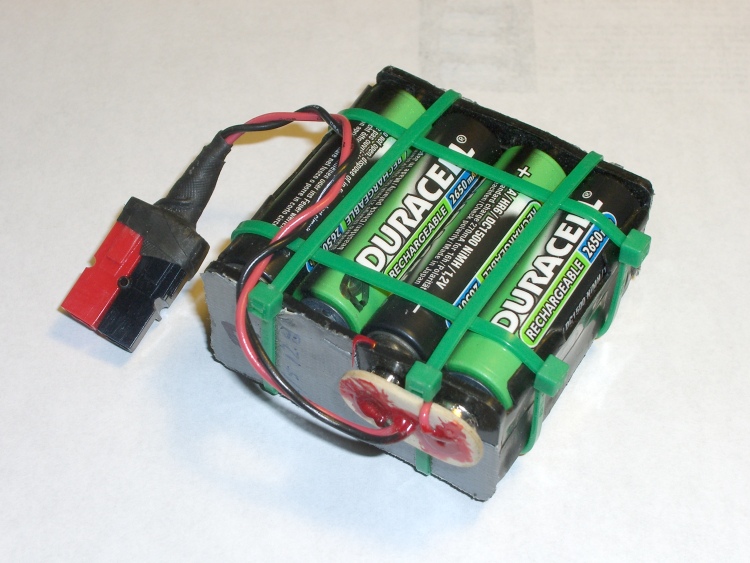
    When I make up NiMH packs for our bike radios, I lash the cells in place with cable ties. It’s not pretty, but the plastic cases don’t split.

    Connector? Anderson Powerpoles FTW! Make sure you align them properly to mate with anybody’s radio.

  • Bicycle Performance

    Back in 2006 I biked to the Main Event Criterium in Po-town to watch real bicycle crazies in action. Despite the name, the course was literally around the blocks near the Poughkeepsie High & Middle Schools on Forbus St & College Ave: about 0.75 miles per lap.

    Now, most places, folks give ‘bent riders a smile and maybe chat ’em up. Not here. Talk about a cold shoulder: the local-resident bystanders were friendly, but the real riders and their main squeezes obviously regarded my pimped-out recumbent as a Hostile Gesture. Barely even a sideways look; it’s as if I didn’t exist.

    I timed a few laps of the Masters 40/50+ race: Olde Fartes like me, but still players. They did 15 laps (maybe a dozen miles) at 16-17 mph. Two guys duked it out for the lead all the way to the finish, with the rest of the pack half a lap behind and fading.

    In my ordinary rides I can cover a dozen or so miles at 15-16 mph, riding with vigor but not an all-out, my-eyeballs-will-explode effort. That’s on open roads with actual hills, traffic signals, and no pace car to clear the way.

    Obviously, I’m nowhere near their well-chiseled physical condition.

    There’s no comparing the bikes, either.

    They’re riding the latest carbon-fiber weight-weenie frames on exotic aero wheels with pitifully few spokes. One guy blew a tire with a bang that sounded like a gunshot.

    I’m riding a steel-frame Tour Easy recumbent bicycle with a fairing, fat Kevlar-belted tires, tire liners, steel spokes (and lots of ’em), a rack, two baggage packs, a water bladder, ham radio, blinky lights, spare batteries, a tool kit, and fenders. Not to mention an aerobelly. Heck, my tool kit probably weighs more than their frame.

    Imagine what they could do on real bikes…

    Somebody mentioned that the TdF guys hit 70+ mph on downhills. I forebore to mention that the human-powered speed record is nearly 80 mph on the flats… I figured that would definitely be regarded as a Hostile Gesture.

    [Update: a friend accused me of riding while carrying more smug than legally permitted, even for Prius drivers. Guilty as charged.

    You’ll find more ‘bent posts by clicking on the “Recumbent Bicycling” category.]