Ed Nisley's Blog: Shop notes, electronics, firmware, machinery, 3D printing, laser cuttery, and curiosities. Contents: 100% human thinking, 0% AI slop.
I recently bought two dozen Tenergy Ready-to-Use NiMH cells, rated at 2.3 Ah, with the intent of making up three 8-cell packs (identified as A, B, and C, for lack of anything smarter) for the amateur radio HTs we use on our bikes. However, one of the packs measured a consistently short runtime and I suspected one weak cell.
So I ran pairs of cells from the weak pack and found these results:
DSC-H5 Battery – Tenergy RTU NiMH AA Cells
Observations…
These are all measured just after charging, so they’re all the best you can expect from the cells. I haven’t done any self-discharge tests yet.
The overall capacity at 1 A load is roughly 65% of the 2.3 Ah rating.
The red trace falls far short of the others, so that’s the pair with the weak cell. I charged & tested those two cells individually, which are the lower two traces: cell A4 has 58% of nominal capacity. Admittedly, that’s 90% of the capacity of the rest, but, still …
I’ll use the other three pairs of cells through the Sony DSC-H5 camera, for reasons described there. Cell A4 is destined for the shelf…
Now, the question becomes: who should I buy the next batch of cells from?
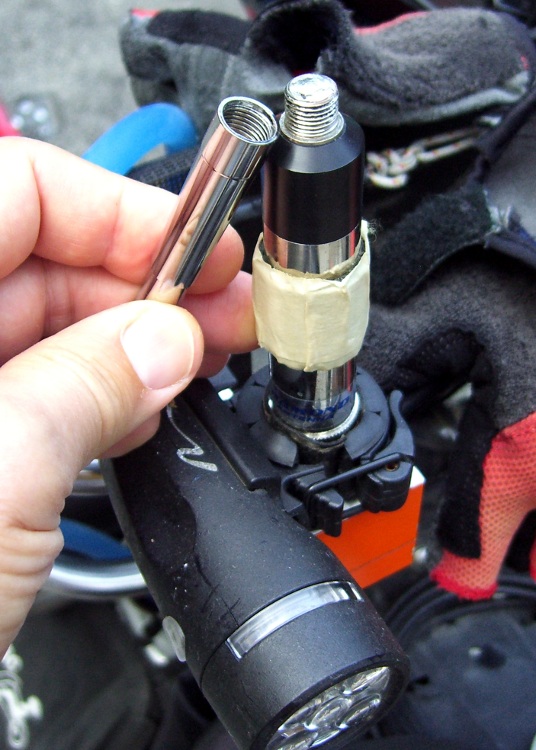
Vibration is a real killer for bike-mounted hardware. The antenna mast on my bike has been unscrewing itself, despite my repeated attempts to tighten it. Fortunately, I’ve managed to notice the rattle before the mast falls off into traffic.
We’ll see if a dab of medium strength (blue) Loctite will do the job.
One thing to worry about: this is an electrical as well as a mechanical joint. I hope there’s still enough metal-to-metal contact to get RF energy to the radiating part of the whip!
[Update: Yup, works just like you’d expect. Problem solved.]
The antennas on the other two bikes have remained tight, so maybe it’s just that my riding style generates more vibration? Hard to imagine; it’s not like I venture off-road.
More details on the homebrew mount are there and how commercial mounts fail are there.
The unsightly masking tape wrap is where I attached a reflector for a (rare) after-dark ride a while ago. Making a set of bushings for the reflector clamps is a low-priority job in the queue right now.
I have a pair of underseat packs on my Tour Easy that have sagged rather badly over the years. That might have something to do with the fact that my toolkit and other odds & ends weighs more than some bike frames; while I don’t need that stuff very often, it’s good to have around.
Tools & suchlike live in the left-side pack, the near one in the photo, and you can see the problem. The right-side pack holds HT batteries, my belt pack, and other relatively lightweight stuff; I’ll fix that one when I see whether this works. The panniers at the rear wheel are for groceries and other bulky items. The trailer, well, that’s how we do groceries…
Broken Pack Backplate
Anyway, the underseat packs have a black plastic (styrene?) backing that cracked under the stress of the stuff inside, allowing the top corners to cave in and the bottom to droop.
The hooks holding the pack to the underseat rack were riveted through the backing sheet and the hardware, but a couple of good shots with a punch broke them free.
Some rummaging in the Parts Heap turned up a big acrylic sheet (“100 times stronger than glass!”) that’s absolutely the wrong material for the job: it’s too brittle. However, I’d like to see whether a stiff backplate will solve the problem or if I’m going to have to get ambitious and build an internal pack frame.
Acrylic Plate and Aluminum Stiffener
It’s essentially impossible to get a picture of a project built largely from acrylic sheet, but here goes.
I traced the outline of the old backplate onto the new sheet’s protective paper, introduced it to Mr Belt Sander to get those nice round corners, then drilled the holes. It turns out to not be quite symmetric, so there’s a right way and a wrong way to insert it into the pack.
All the hardware is stainless steel. They used aluminum rivets, which is the only reason I could punch them out without too much difficulty, that I’m replacing with SS 10-32 machine screws & nuts.
The aluminum stiffener is a random chunk of ribbed extrusion from the Heap; the original was almost exactly twice as long as one backplate, so the two halves (one for the other pack) are precisely right. I milled out the center rib around the nuts to get enough clearance for a nut driver.
Stiffener Hardware Detail
Herewith, a closeup of the hardware. There’s an acrylic sheet in there, honest, it’s under the aluminum extrusion and fender washer. Really!
I put an automobile license plate in the bottom of each underseat pack to act as a floor for all the crap inside; it’s an almost perfect fit and should give you an idea of the pack’s size. It also maintains the bottom’s rectangular shape and keeps heavy stuff from sagging; there’s a hole scuffed in the bottom from the intersection of a high curb and just such an oversight.
Tour Easy Underseat Pack Detail
Having washed the pack while it was apart (there’s a first time for everything), it looks a lot better than it did before. The yellow block in the front pocket is the kickstand plate mentioned there. It used to have a mesh pocket along the side, too, but that snagged on something and got pretty well ripped, so Mary trimmed it off when she sewed a patch over the aforementioned hole.
It’s still saggy, but the top corners of the plate are holding it up a lot better now. If they crack again, I might just have to go with some aluminum sheet.
These packs seem to be obsolete. The ERRC Lloonngg panniers (search for them) seem to be, well, too long for most purposes; they look as though they would interfere with ordinary rack packs. If I were doing it over, I’d look into hacking a pair of smallish duffel bags.
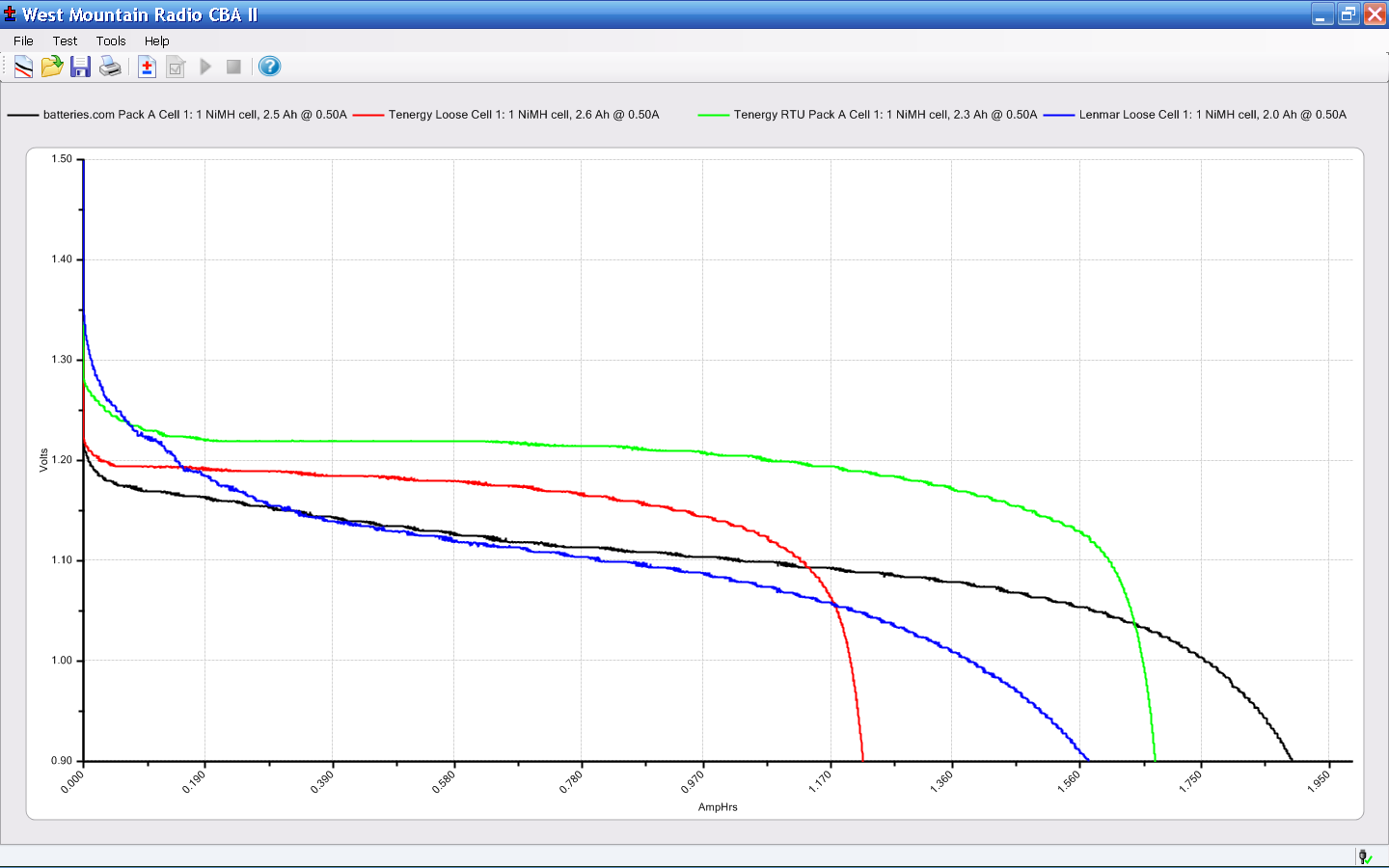
I collected some loose cells and pulled some cells from the packs to see how they compared individually.
These are discharging at 500 mA, rather than 1 A, mostly because there were fewer tests and I could run ’em overnight. Other than the Tenergy RTU cell, they’re all old and wearing out…
Single Cell Comparison – Aug 2009
The green line is a new Tenergy RTU 2.3 Ah cell; it has a higher voltage, but still isn’t delivering anything close to its rating even at a load only slightly higer than C/5. I have three packs of those that will be cycling through the amateur radios on the bikes, but I don’t like the relatively low capacity. I’ll run these eight cells through the fast charger and do some rundown tests to see if they improve; I have my doubts.
The black line comes from an old batteries.com 2.5 Ah cell. It has the highest capacity of the group, but a rather low voltage. I’ll start cycling those through the blinky lights on the bikes.
The red line is a Tenergy 2.6 Ah cell. I think these are a year or two old, so they’re not faring well at all. OK voltage, but very low capacity. I think the batteries.com cells will work better in the lights, as they have 50% more capacity at a slightly lower voltage.
The blue line is an ancient Lenmar 2.0 Ah cell. As a fraction of its rated capacity, it’s doing OK, but the low voltage is a dealbreaker. Scrap.
Given the poor results from the old & new Tenergy cells, I’m not sure quite what to do. The advertised ratings are obviously optimistic, shipping charges pretty much wipe out any incentive to sample a batch of new cells, and cells get reformulated often enough that old tests you find on the web (this one included!) are useless.
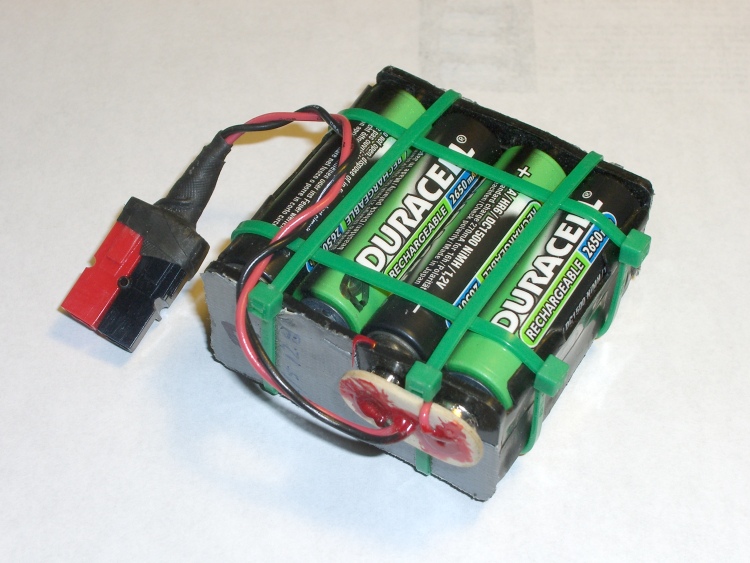
I’ve been using NiMH AA cells to power the amateur radio HTs on our bikes for the last several years, using homebrew 6- and 8-cell packs like this one. In addition, I cycle a handful of loose cells through the LED blinky headlights we use as rear markers.
I don’t lavish much care on the packs, although they generally get recharged before they’re completely flat… if only because the radios automatically enter a low-power mode that takes some fiddling to cancel. They’re charged on a homebrew C/10 charger, typically overnight, and are uniformly warm to the touch when I take them off the charger. Slow charging is reputedly bad for the cells, although everybody seems to agree that fast charging isn’t much better; I have a 4C charger that really puts the screws to 4 cells at once.
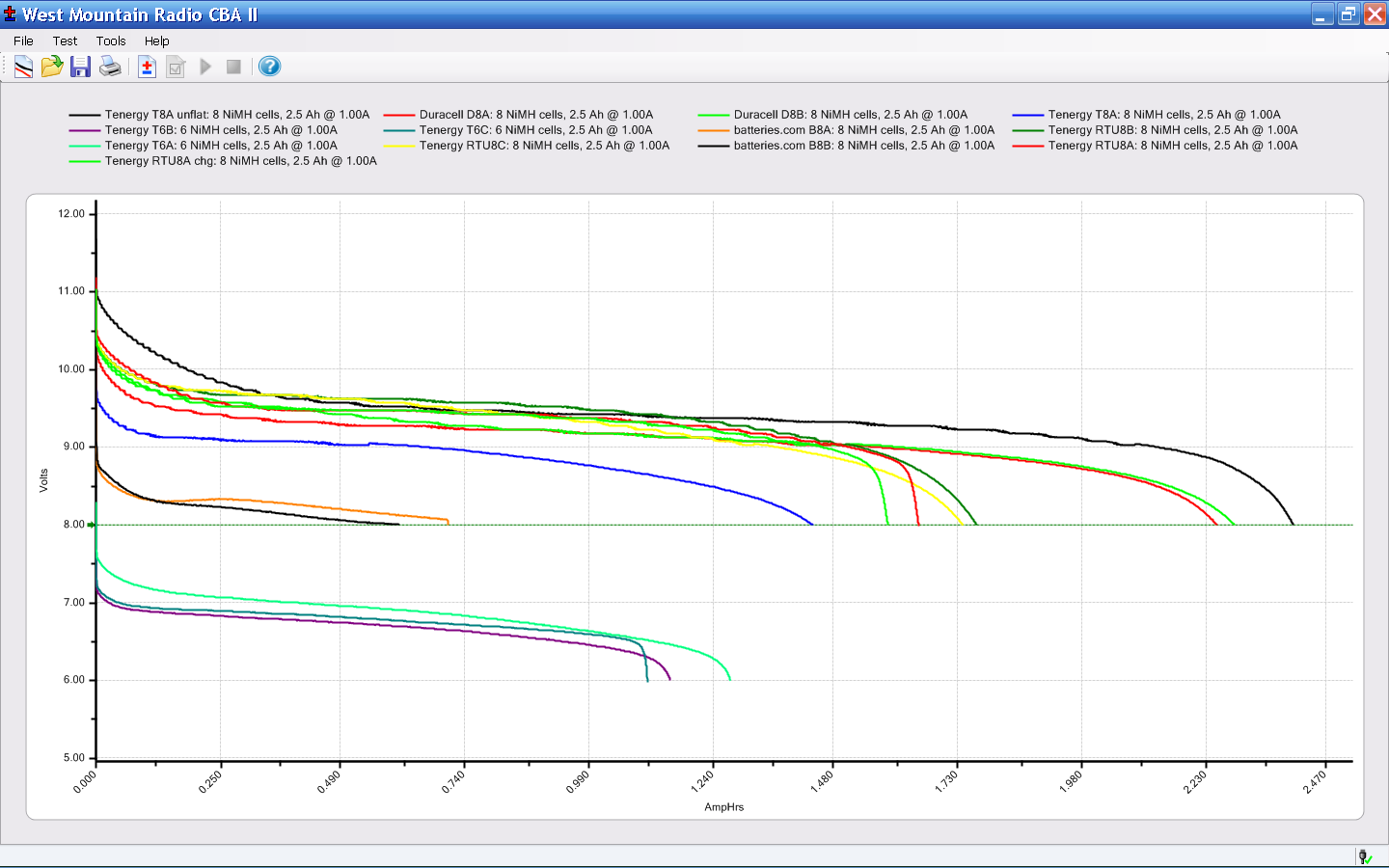
Over time the cells wear out and I’ve recently started figuring out which packs & cells to replace. I’m using a West Mountain Radio CBA II for the tests, running on our Token Windows Laptop. The X-axis divisions are its idea of how to do it; Gnuplot does a better job, but you get the general idea and exact numbers aren’t really important here.
Here’s a screen shot with all the discharge tests in one convenient lump. You’ll surely want to click on it for a legible legend…
Pack Comparison – August 2009
Some observations…
I’m using a 1 A (roughly C/2) discharge rate, because the radios draw about that much during transmit, although they run at 30-100 mA during receive. Battery capacity is inversely related to discharge rate and the usual highly over-optimistic advertised cell capacity is usually based on (at most) a C/5 or a much lower rate.
The shortest curves, the orange & black ones under 0.74 Ah, are two ancient 8-cell packs made from batteries.com cells. The cells actually have decent capacity, but the discharge voltage is much lower than it should be.
The black curve to the far right near 2.47 Ah is a freshly charged set of Tenergy 2.6 Ah cells that had been oops discharged completely flat. Other than this run, the Tenergy cells have been a major disappointment: the 6-cell packs near the bottom are running less than half their rated capacity and the 8-cell pack in blue isn’t much better.
The green & red traces out there to the right at 2.23 Ah are Duracell 2.65 Ah cells that are holding up remarkably well. Recent reviews indicate that Duracell (or whoever owns them these days) reformulated the chemistry early in 2009 and the new cells are crap. These cells are colored black-and-green, which seems to be different than the new ones.
The cluster of traces around 1.73 Ah are three 8-cell packs made from two dozen shiny-new Tenergy Ready-To-Use 2.3 Ah cells. I’m unimpressed so far, although they are still in their first dozen cycles. There’s obviously one weak cell in pack A that causes the abrupt fall-off in the two shortest times, but they’re all pretty much the same.
Given that we have three bikes and I want a backup pack for each bike, that works out to
8 cells/pack x 2 packs/bike x 3 bikes = 48 cells
I’d like to think that spending four bucks per cell bought you better cells, but the Duracell reformulation puts the kibosh on that notion. In any event, you can see this gets spendy pretty quickly…
I’ll run the best of the old cells in the blinky headlights, which run at a 50% duty cycle of 400 mA or so.
As I mentioned there, we have white LED bike headlights clamped to the amateur radio antennas on our bikes, facing rearward to eliminate the “But, Officer, I didn’t see him” line from the accident investigation. That works fine during daylight hours, but it’s rather blinding after dark and, in any event, taillights are supposed to be red (after 1 Nov 2009, they may also be amber).
The easiest way to get that result, without having to tote along Yet Another Light, is to slip a red filter over the white LED lens. This dramatically reduces the light output, because the yellow phosphor used to get white light out of what’s basically a blue LED doesn’t emit much energy in the red end of the spectrum, but it’s plenty good enough to be seen from the requisite 300 feet.
Amber filters would be a much, much better match to the phosphor and I’ll use them next year when they’re legal.
For what it’s worth, we’ve discovered that the more we look like UFOs after dark, the more clearance we get. The bikes are extensively reflectorized and lighted, plus we have reflective arm and leg bands. If somebody hits us, it’s because they did it intentionally; that’s usually the story with drunks and punks, alas.
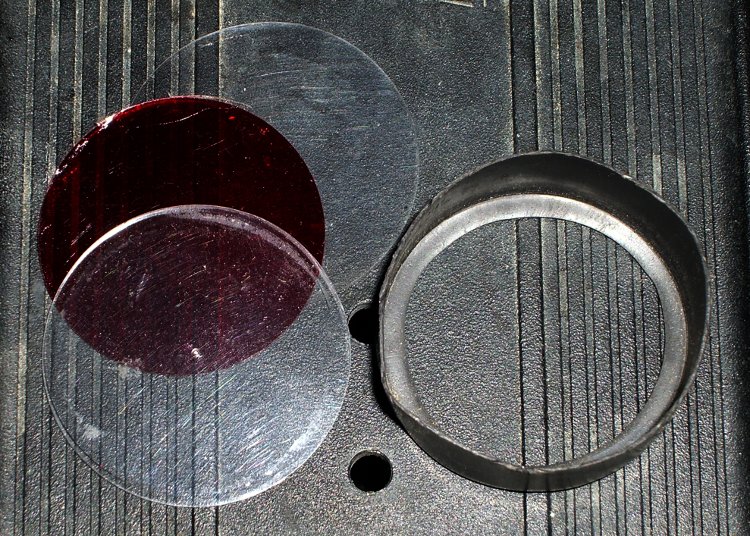
Red filter components
I cut two transparent disks from ordinary electronics packaging material, plus a red disk from the Primary Red filter material mentioned there, stacked them on the headlight, and fired some big heat stink shrink tubing around them. The tubing extended maybe 3 mm past the end of the headlight and shrank into a neat lip that matched the bezel around the lens.
The tool to have for this sort of job is an Olfa Compass Circle Cutter. It leaves a pin prick in the center of the circle, but if you’re gentle that won’t be a problem in this application.
The shrunken tubing will be exceedingly difficult to pull off the headlight, so you may want to wrap a layer of tape around the bezel before shrinking. Peel the tape off when you’re done and the tubing will have a few mils more clearance.
No adhesive on earth will stick to both the polypropylene disks and the heatshrink tubing, but you can try silicone snot if you want. I made the disks just slightly larger than the bezel so that the tubing captures them as it shrinks. These things spend much of their lives in a ziplock baggie, so durability isn’t an issue.
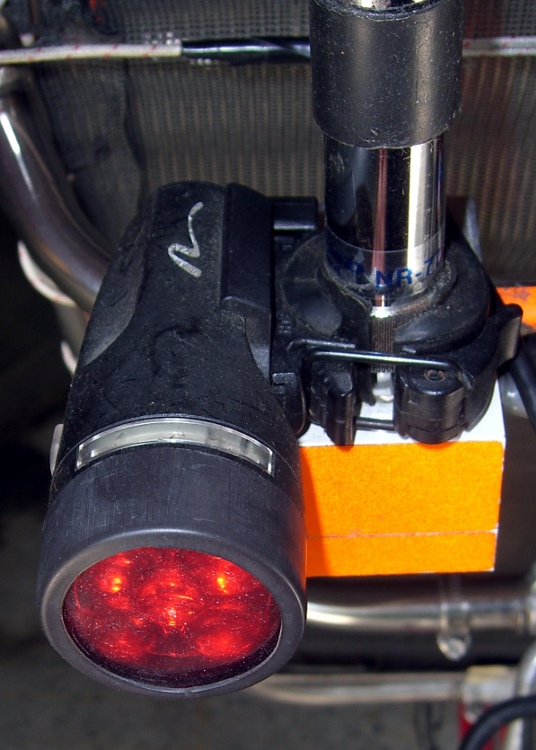
Red filter installed
In any event, the filter looks like this when it’s installed. Because of the odd way I mounted the headlights, the side lenses aren’t visible (and they’re white, not red), but we have plenty of other light visible from the side.
For the straight dope on current NYS bicycle laws, go there, click on the “Laws of New York” link, search for “bicycle”, then click on section 1236. It’s New York’s idea of a useful Web interface: get over it.
The bezels on our lights are beginning to crack, so it’s probably time to start thinking about a killer street-legal day/night amber taillight. High intensity LEDs are dirt cheap these days…
Having had both of our commercial antenna mounts fail, I decided to make something that could survive a direct hit. It turns out that the new mounts are utterly rigid, which means the next failure point will be either the antenna mast or its base structure. We’ve occasionally dropped the bikes and when the antenna hits something on the way down, the mount is not the thing that bends…
Incidentally, the Nashbar 5-LED blinky white light aimed rearward seems to push motorists over another few feet to the left. Nobody quite knows what we are from a distance, but they do notice that something is up ahead. That’s just about as good as it gets; we tend to not ride in the wee hours of the morning when bike lights just give drunks an aiming point.
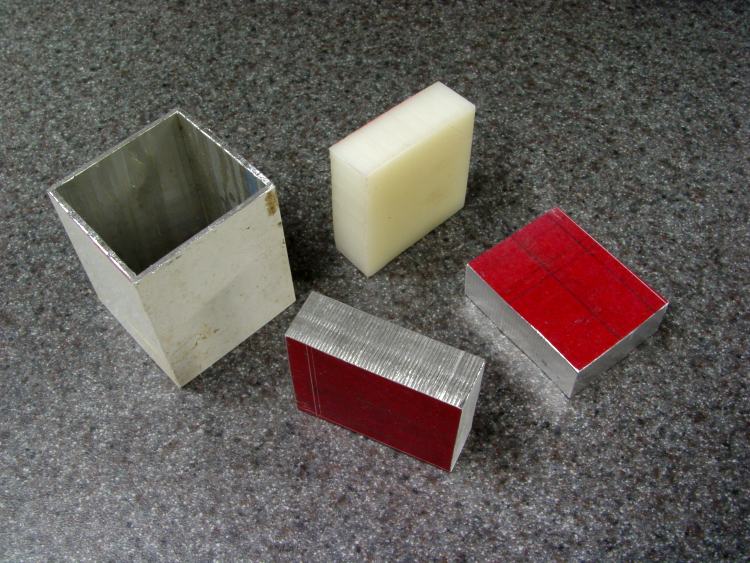
Rough-cut stock
The overall structure is a 2-inch square aluminum extrusion, with a hole in the top that matches the right-angle SO-239 base connector salvaged from the Diamond mount and a 1/2″ nylon stiffener plate in the middle. A pair of relentlessly square circumferential clamps attach it firmly to the top seatback rail. A coaxial cable pigtail ensures that the antenna base makes good electrical contact with the seat. I’m not convinced the bike makes a good counterpoise, so we’re now using dual-band antennas that are half-wave on VHF.
Stainless-steel hardware holds everything together, as I’m sick and tired of rust.
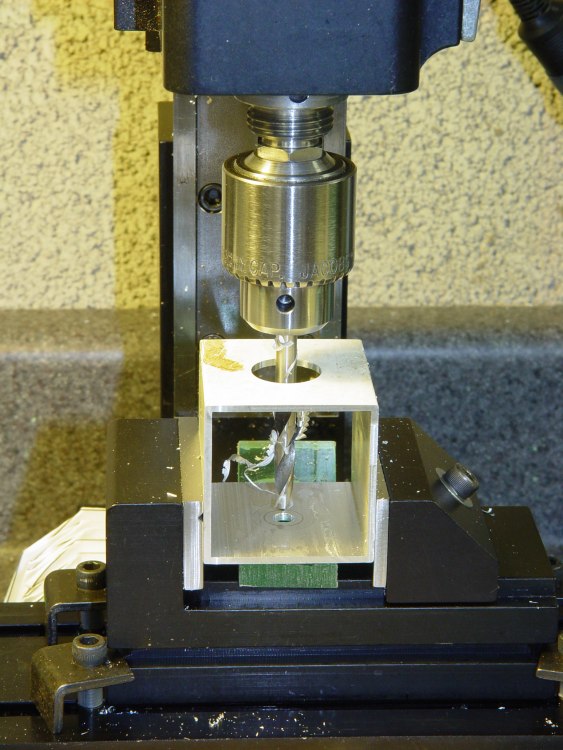
Drilling box beam
Not having a huge drill, I helix-milled the SO-239 hole, then reached down through the box to drill the hole for the plastic block retainer screw. Flip the box in the vise, drill four holes for the clamps (I love manual CNC for that sort of thing), manually deburr the holes, and it’s done.
The block of plastic is a tight slip fit inside the box extrusion, with slightly rounded corners to suit. I milled the slot across the top to a slip fit around the SO-239 connector.
The two clamps were the most intricate part of the project and got the most benefit from CNC.
Helix-milling the seat-bar clamp
The clamp hole must have exactly the same diameter as the seat top tube. I helix-milled the hole to an ordinary 5/8″; I have trouble drilling holes that large precisely in the right spot with the proper final diameter. Milling takes longer, but the results are much better.
Helix-mill the other block while you have the position set up, then flip and reclamp to drill the pair of holes that match the box extrusion. Drill 10-32 clearance (#9) all the way through.
Flycutting the Clamp Slit
Bandsaw the blocks in half, paying some attention to getting the cut exactly along the midline, then flycut the cut edge to make it nice & shiny & even. That should result in 1 or 2 mm of slit between the blocks when they’re clamped around the seat rail.
Finished seat-bar clamps
Break those relentlessly sharp edges & corners with a file.
I finagled the dimensions so a 1-1/2″ socket-head cap screw would have just enough reach to fill a nut, with washers under the screw and nut. Your mileage may vary; I’ve gotten reasonably good at cutting screws to length.
Normally, you tap one side of each clamp for the screws, but in this situation I didn’t see much point in doing that: the box must attach firmly to the clamps and I was going to need some nuts in there anyway.
Finished parts
With all those parts in hand, assembly is straightforward. Secure the SO-239 with its own thin nut, screw the plastic block in place, hold the clamps around the seat bar, poke the cap screws through, dab some Loctite on the threads, install nuts, and tighten everything. That all goes much easier with four hands!
The grounding braid fits into a huge solderless connector that must have been made with this application in mind. It originally fit a 1/2″ lug, but with enough meat that I could gingerly file it out to 5/8″ to fit the SO-239 inside the aluminum extrusion. I’ve had those connectors for years without knowing what they were for!
I eventually came up with a simpler and even more ruthlessly rugged mount that’ll appear in my column in the Autumn 2009 Digital Machinist. More on that later… [Update:There]








 The Smell of Molten Projects in the Morning