The Smell of Molten Projects in the Morning

Ed Nisley's Blog: Shop notes, electronics, firmware, machinery, 3D printing, laser cuttery, and curiosities. Contents: 100% human thinking, 0% AI slop.

Category: Amateur Radio

Using and building radio gadgetry

  • Opening a Quartz Crystal Can: Effects Thereof

    A comment on yesterday’s post about quartz crystal measurements prompted me to destroy a crystal in the name of science…

    The question is, what effect does exposing a crystal to the air have on its performance? I would have sworn it would never work right again, because it’s normally running in an inert atmosphere and maybe a partial vacuum. One measurement being worth a kilo-opinion, here’s what happened.

    I picked random crystal from the bottom of the crystal box, based on it having a solder seal that I could dismantle without deploying an abrasive cutoff wheel or writing some G-Code to slice the can off with a slitting saw. The crystal was labeled HCI-1800 18.000 MHz and probably older than most of the folks who will eventually read this… younger than some of us, though.

    The overall response, measured in the same fixture as shown yesterday (click the pix for more detail):
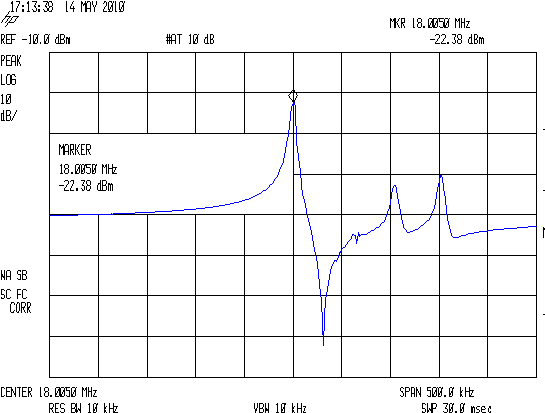
    HCI-1800 18 MHz - Baseline Overview
    HCI-1800 18 MHz – Baseline Overview

    The center frequency is 18.0050 MHz (at this rather broad span) and it has some ugly spurs out there to the right.

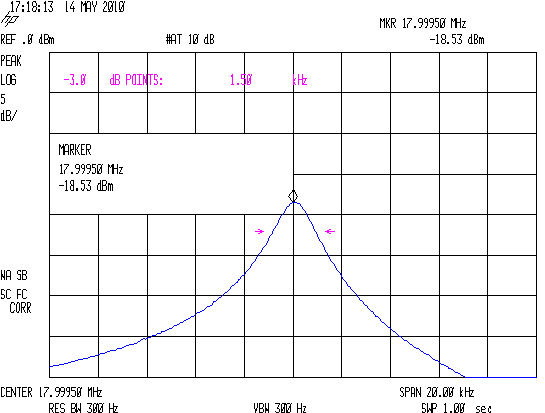
    A closeup of the series-resonant peak:
    HCI-1800 18 MHz - Baseline BW
    HCI-1800 18 MHz – Baseline BW

    The bandwidth is 1.50 kHz at 17.99950 MHz at this span.

    Naked HCI-1800 18.0 MHz Crystal
    Naked HCI-1800 18.0 MHz Crystal

    Then I applied a soldering iron around the seal and yanked the case off. I think that didn’t involve whacking the crystal with the case en passant, but I can’t be sure. In any event, it looks undamaged and seems to operate properly.

    A pair of spring clips attach to the electrodes and hold the quartz disk in position. They’re just the cutest little things and quite unlike the other holders I’ve seen. I think the solder blobs fasten the spring ends together and don’t bond to the electrodes, but what do I know?

    HCI-1800 Crystal Overview
    HCI-1800 Crystal Overview

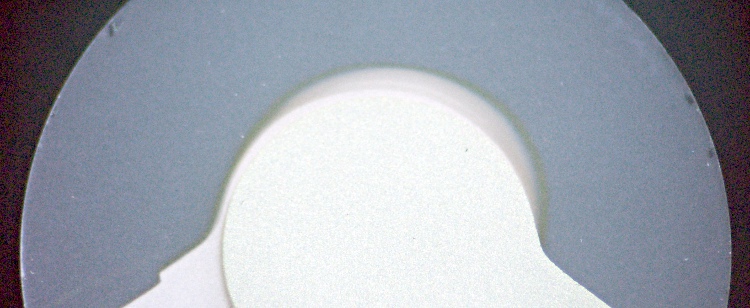
    The quartz disk has a few small chips near the edge:
    HCI-1800 Crystal Edge Chips
    HCI-1800 Crystal Edge Chips

    I think those are Inherent Vice… simply because:

    1. They’re not in a position where I could have whacked the disk and
    2. I doubt I could whack it that delicately

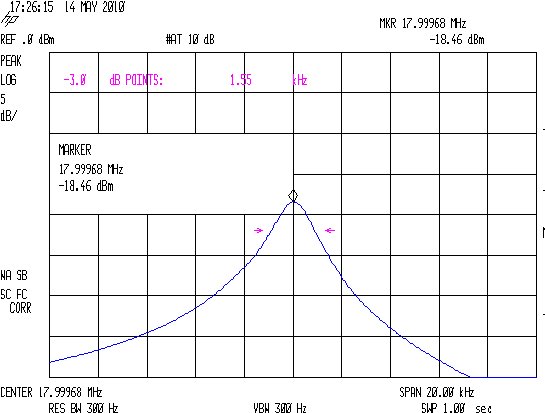
    Anyhow, with the can off, here’s what the series resonant peak looks like:
    HCI-1800 18 MHz - Opened BW
    HCI-1800 18 MHz – Opened BW

    The resonant frequency is now 17.99968, 180 Hz higher, which may be due to instability in the HP8591 spectrum analyzer’s not-stabilized-for-ten-hours ovenized oscillator. The bandwidth is 1.55 kHz, 50 Hz wider, although I think that’s one resolution quantum of difference.

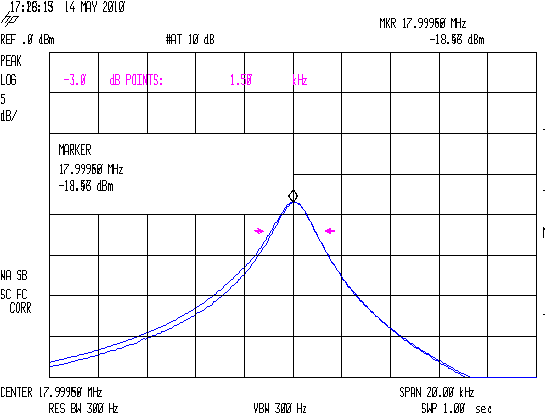
    Here are the two bandwidth traces overlaid.
    HCI-1800 18 MHz - Overlaid BW
    HCI-1800 18 MHz – Overlaid BW

    The peak has been centered in both, so you can’t tell they’re slightly different. The interesting point is the difference in the slope to the low-frequency side of the peak, which is slightly higher for the open-case condition. Seeing as how the missing case completely changes the usual stray capacitance situation, I’m not surprised.

    Anyhow, I admit to being surprised: there’s not that much difference after opening the case. I’ll put the naked crystal in a small container in a nominally safe place for a while, then retest it to see what’s happening.

    Memo to Self: A “safe place” is nowhere near the Electronics Workbench!

    Here are some other naked crystals:

    Naked Crystals
    Naked Crystals

    Notice the tarnished (presumably) silver electrodes on the crystal in the lower left. That one’s been sitting on my monitor and in other hazardous locations for a few years. I can’t find these anywhere right now, but if they turn up I’ll test them, too.
  • Crystal Properties

    Spent some Quality Shop Time measuring an assortment of crystals, some data from which will make up a Circuit Cellar column.

    And the raw numbers will come in handy one of these days, so here they are…

    12 MHz Asst HC-49/U Co+Cc/2 2Cc Fs BW Rs
    ECS 1 4.85 1.47 12.000162 787.5 40.1
    ECS 2 4.50 1.42 12.000150 725.0 40.1
    ECS 3 4.70 1.42 12.000325 1100.0 50.0 Rs out of range
    HC1 4 4.34 1.11 11.999000 600.0 36.0
    HC1 5 4.24 1.06 12.000137 537.5 36.9
    Sentry 6 5.14 0.96 12.000250 625.0 31.8 many spurs
    11.0592 MHz HC-49/U
    1 4.90 1.42 11.059275 562.5 9.3
    2 4.99 1.46 11.059112 575.0 14.7
    3 4.87 1.42 11.059275 512.5 9.6
    4 4.87 1.41 11.059125 550.0 10.0
    5 4.29 1.43 11.058935 750.0 18.1
    6 4.93 1.47 11.059000 537.5 10.7
    7 4.95 1.47 11.059200 525.0 8.1
    8 5.03 1.45 11.059037 575.0 11.1
    10 MHz HC-49/U spur +150 kHz
    1 2.57 1.36 9.997888 200.0 14.2
    2 2.61 1.30 9.997738 225.0 16.7
    3 2.75 1.30 9.997788 225.0 20.0
    4 2.67 1.30 9.997750 225.0 16.1
    5 2.75 1.26 9.997725 250.0 22.7
    6 2.69 1.27 9.997788 225.0 21.0
    7 2.69 1.26 9.997825 212.5 16.5 Circuit Cellar example
    8 2.69 1.22 9.997832 212.5 18.4
    9 2.72 1.24 9.997788 250.0 23.4
    10 2.68 1.20 9.997738 225.0 18.0
    18.43 MHz HC-49/US many spurs +10 +76 kHz
    1 3.86 1.33 18.432425 1.56 24.1
    2 3.79 1.22 18.432987 1.21 10.9
    3 3.93 1.39 18.432050 2.44 46.3
    4 3.97 1.40 18.431175 1.90 27.7
    5 3.89 1.33 18.431888 2.11 32.2
    6 3.92 1.39 18.430888 1.39 16.5
    7 3.99 1.35 18.431500 1.36 11.8
    8 3.97 1.35 18.431675 2.18 38.4
    9 3.95 1.31 18.430512 1.30 10.1
    10 4.04 1.50 18.431427 1.36 11.8

    The 18.43 MHz crystals are in the short /US cans with surprisingly high stray capacitance. Their bandwidths are in kHz and all over the map, as are the series resistances. Weird. Bad crystals? Bad technique?

    Capacitance measured with that fixture.

    Frequency & bandwidth from HP8591 spectrum analyzer with a fixture similar to the K8IQY design; the bandwidths seem to come in 12.5 Hz increments despite a (very narrow) 2 kHz span. The general process is there. Resistance measured from a cermet trimpot using a multimeter good for 0.1 Ω around 10 Ω.

    Crystal Test Fixture
    Crystal Test Fixture

    Useful equations, with column headings in boldface:

    • Lead-to-can capacitance for each lead: Cc = 2Cc / 2
    • Lead-to-lead capacitance: Co = Co+Cc/2 – Cc/2
    • Circuit Q: Q = Fs/BW
    • Circuit resistance: R = Rs + 25 (assuming 4:1 transformers)
    • Reactance XL = XC at series resonance: X = Q R
    • Motional inductance: Lm = X / (2 π Fs)
    • Motional capacitance: Cm = 1 / (2 π Fs X)
    • Parallel resonance Fp = Fs √(1 + (Cm / Co))

    More equations there.

    Memo to Self: Zero the capacitance fixture before critical measurements!

  • Li-Ion Battery Pack for the Bike Radios

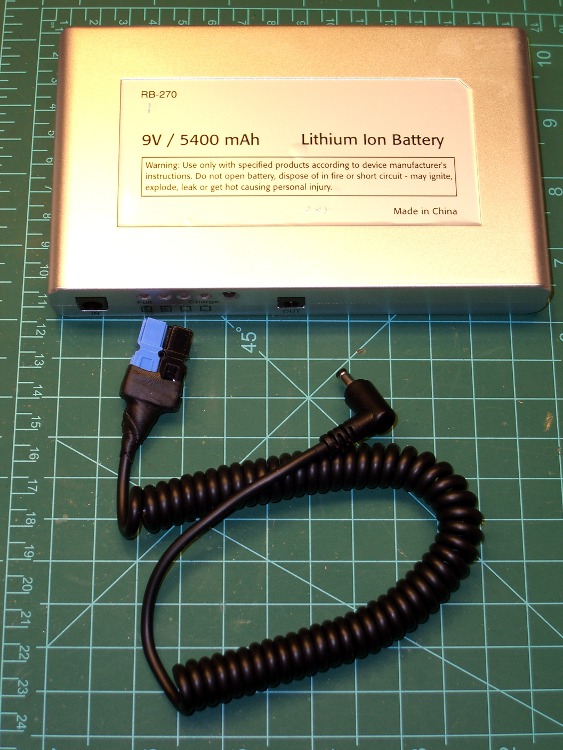
    Battery Pack and Hacked Cable
    Battery Pack and Hacked Cable

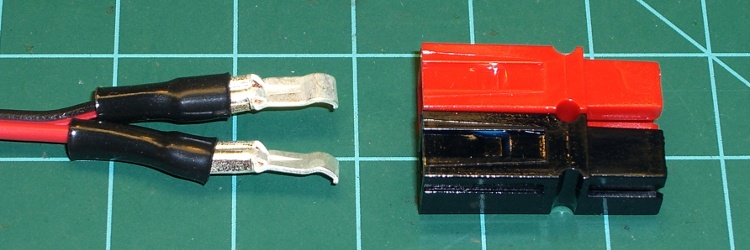
    Finally got around to hacking PowerPoles into the coily cable from those Li-Ion packs, suitable for powering the amateur radio HT on my Tour Easy. The cable has surprisingly fat conductors, on the order of 22 AWG, that (when doubled over) half-filled the 30 A PowerPole terminals. I remembered to use the blue-and-black color code for 9 volt power on the second and third cables…

    The right-angle connector activates a switch that turns on the pack’s voltage regulator, which means that leaving the cable plugged in slowly discharges the battery. They self-discharge by about half in two weeks, which means that it’s not absolutely urgent to unplug the battery at every stop, but … I’d rather have an actual power switch.

    I also want to bypass that regulator, so as to get more voltage out of the pack. That may not be feasible, as I suspect they’re using the pass transistor as part of the over-current shutdown circuit, but it’ll be interesting to find out. So this is in the nature of a test to find out how well the lashup works before cracking the case.

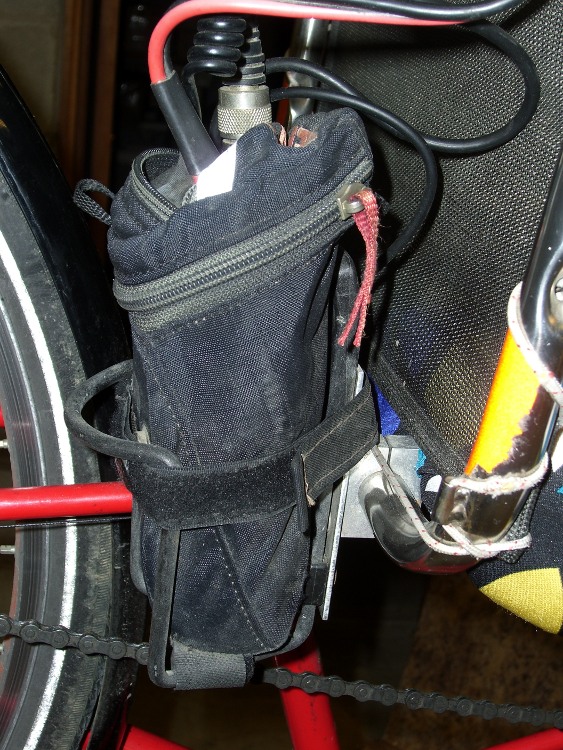
    This view of the installed pack is looking down on the butt end of the bike, which is leaning against the Shelf O’ Crap in the garage.

    Battery on Tour Easy Rack
    Battery on Tour Easy Rack

    A four-inch length of adhesive-backed Genuine Velcro mates the battery to the rack, although I stuck both Velcro strips to some carpet tape in the hopes that’ll stick better than the OEM goo. Hooks on the bike and loops on the battery, which means the battery won’t affix itself to everything else in the universe while off the bike.

  • Bicycle Reflector Adaptor Bushing

    Reflector on bushing
    Reflector on bushing

    After replacing the seat strut screws, I found a Round Tuit lying there on the workbench, right next to the rear reflectors I’ve been meaning to install for a truly embarrassing period.

    Recumbents don’t have the usual assortment of standard-sized tubing in the usual road-bike places, making common items like reflectors difficult to attach. The ideal spot on our bikes is at the base of the VHF/UHF antennas, right next to the white blinky LEDs, but, alas, that’s 20 mm in diameter and the reflector clamp barely shrinks down to a bit under 28.

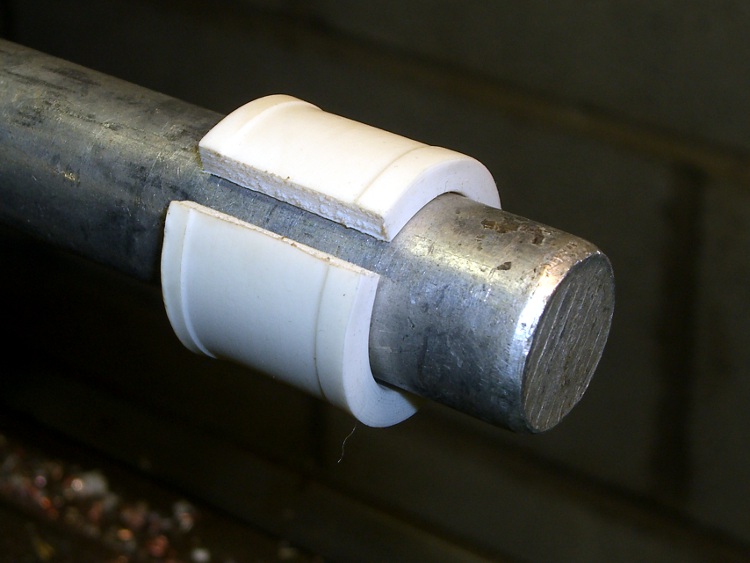
    Turns out that a chunk of 1.5 inch PVC pipe has a 4 mm wall thickness, so wrapping a layer of that around the antenna base will do the trick. I whacked off a length of pipe, faced off both ends in the lathe, and put a shallow recess around the middle of the ring to capture the reflector clamp.

    By another rare coincidence, 1.5 inch PVC pipe has an ID of exactly 40 mm… so cutting the ring exactly along a diameter produces the right length. The catch is that the pipe isn’t flexible at all, but brandishing a heat gun in a threatening manner solves that problem.

    Reshaped bushing on mandrel
    Reshaped bushing on mandrel

    A random hunk of 3/4-inch aluminum rod is about 19 mm in diameter, so I chucked that in the lathe and shaped the saggy strip around it… wearing thick leather gloves.

    It springs out to 20 mm with no problem, slides right on, and grips reasonably well. I may add a strip of tapeless sticky (think double-sided tape without the tape: just the adhesive!) under the bushing if it wants to walk away.

    I made two of ’em, of course, and put a reflector on Mary’s bike while I was at it. Our young lady’s bike already has a reflector, although I should upgrade that bushing as well… it’s a layer of self-vulcanizing rubber tape that works perfectly, so this may take a while.

    I suppose I should buy a length of gray or black PVC pipe, but that’s in the nature of fine tuning.

  • DVD Player External Li-Ion Pack: A Pleasant Surprise!

    A friend mentioned a sale at Overstock.com (likely gone by now) that offered an Initial RB-270 9 V, 5.4 Ah lithium-ion battery pack, with a built-in charger, for $16. The pack was intended to keep a DVD player alive for long enough to avoid back-seat mayhem on long trips (for those toting undisciplined brats, anyway), but I saw it as a plug-in replacement for the NiMH AA-cell packs I’ve been using with the HTs on our bikes.

    The NiMH cells have been a major disappointment, as described there and there and there, with barely 1.5 Ah of capacity from nominal 2.4 Ah cells.

    Much to my surprise, all three of the Li-Ion packs delivered pretty nearly their advertised ratings. I varied the discharge level, but they’re all quite close…

    Initial External Li-Ion packs
    Initial External Li-Ion packs

    It looks like the packs include an internal regulator and over-discharge monitor, as the voltage is bar-flat right up to the point where it drops to zero. I’m mildly surprised at the regulator; I’d expect that they’d just deliver whatever the cells were producing, rather than waste any energy in the regulator.

    Notice that the 200 mA rate produced a lower total capacity than the 1 A rate. I’m guessing that’s power lost in the regulator over the protracted run time; 4.9 Ah at 200 mA added up to nearly a day of testing, far over the “up to six hours play per charge” rating.

    Let’s see: 5.4 Ah @ 6 hours makes the nominal load about 900 mA. So it delivered maybe 4.8 Ah at 1 A. Not what’s claimed, but much closer than those Tenergy NiMH cells.

    Next steps:

    1. Butcher the nice coily-cord cables to add Powerpole connectors that will click right into the bike radios
    2. Take one apart to see what bypassing the regulator would entail
  • Tour Easy Recumbent: Amateur Radio HT Mount

    Mary sewed up a new seat cover for her Tour Easy, so I dismantled the seat and cleaned things up. This is a good opportunity to show how I mounted an amateur radio HT on the bike…

    Bottle holder on seat frame
    Bottle holder on seat frame
    Clamp mount detail
    Clamp mount detail

    The general idea is simple: a water bottle holder attached to the lower seat rail with a circumferential clamp made from a chunk of half-inch aluminum plate. An aluminum spreader adapts the wider hole spacing on the bottle holder to the teeny little clamp.

    With the bottle holder in place, I put the radio in a wedge seat pack, atop a block of closed-cell foam to more-or-less cushion some of the bumps. The wedge pack seatpost strap secures it to the bottom of the holder and the rail straps wind their way through the holder and lash around the aluminum spreader plate. It doesn’t move very much at all.

    The radio is a long-obsolete ICOM IC-Z1A, bought specifically for this purpose: it has a remote head on the end of a coily cord. That puts the power, volume, and channel buttons out where you can actually use them.

    Radio in seat wedge pack in bottle holder
    Radio in seat wedge pack in bottle holder

    The lump behind the seat looks moderately suspicious in this day & age: a black package with wires! The grossly oversized red-and-black pair in the foreground is the power coming from a 6-AA pack attached to the rack with a Velcro strap; it’s a jumper with Anderson PowerPoles on both ends. Coily cord to the HT head, BNC-to-UHF adapter to the mobile antenna mount, one skinny cord to the headset and the other to the PTT button on the handlear.

    Other pieces of the puzzle:

  • Anderson Powerpoles: Stress Relief

    This is quick & easy. When you’re making a Powerpole connector, shrink a length of small heatshrink tubing over the end of the terminal after crimping.

    Heatshrink tubing stress relief for Anderson Powerpole terminals
    Heatshrink tubing stress relief for Anderson Powerpole terminals

    You can’t cover the entire crimped region, lest the terminal not snap into the housing, but halfway seems to work fine.

    The goal is to keep the wires from flexing right at the end of the terminal, which is exactly where they’ll break.

    I’ve also wrapped a length of self-vulcanizing rubber tape around the entire connector housing and the wire, which is appropriate for high-stress applications. Looks hideous, though, not that that matters much.