The Smell of Molten Projects in the Morning

Ed Nisley's Blog: Shop notes, electronics, firmware, machinery, 3D printing, laser cuttery, and curiosities. Contents: 100% human thinking, 0% AI slop.

Author: Ed

  • Battery Charger Thermistor: Magnetic Attachment Thereof

    Magnet and thermistor position
    Magnet and thermistor position

    A new fast NiMH pack charger that uses a thermistor to detect the abrupt temperature rise at full charge just arrived on my Electronics Workbench. The instructions say to tape (“Use rubberized fabric …”) the thermistor to a cell in the middle of the pack, a process which loses its charm fairly quickly.

    The intent is to have the thermistor bead in intimate thermal contact with the cell, but air is a rather crappy thermal conductor. We can do better than that.

    Sooo, off to the Basement Laboratory Adhesives Division we go…

    NiMH cells have a steel shell, so holding the sensor in place with a magnet makes at least some sense. I used a pair of teeny rare-earth magnets (Electronic Goldmine G16913) bridged by a snippet of steel strap. One magnet points up, the other points down, the strap provides a magnetic path, and the whole assembly sticks to the cell like glue.

    First epoxy setup
    First epoxy setup

    I trimmed the heatshrink tubing surrounding the thermistor back a bit, then applied enough epoxy to secure the magnets to the strap and smooth out the edges, leaving the thermistor sticking out in mid-air.

    Although it looks risky, the epoxy doesn’t bond well to the (sacrificial, dead) cell. Doing it this way produces a nearly perfect AA-cell-shaped contour in the epoxy on the bottom of the magnets.

    It’s JB-Kwik fast-curing epoxy, not quite so runny as its slower-setting and much stronger JB-Weld relative.

    Epoxy covering thermistor
    Epoxy covering thermistor

    After the epoxy cured, I bent the thermistor down to contact the cell and dabbed epoxy over the bead. This puts the thermistor in good thermal contact with the cell. Epoxy isn’t a great thermal conductor, but it’s a lot better than air.

    The alert reader will note that I wrapped a layer of masking tape around the cell for this operation. I wasn’t convinced I could pop the epoxy off the cell without cracking the thermistor leads, but that turned out not to be a problem.

    Trimming the edges of the epoxy around the bead gave it a certain geeky charm.

    And it works like a champ: get the assembly close to a cell and it snaps right in place. I align the thermistor more-or-less in the middle of the cell, although I suspect the temperature gradient from the middle to either end isn’t all that large.

    Magnetically attached thermal sensor
    Magnetically attached thermal sensor

    Now, one could argue that this lump increases the thermal mass surrounding the thermistor, thus slowing the charger’s reaction time. That might be true, but the pack’s end-of-charge temperature rise seems considerably subdued now; the charger used to cook the living piss right out of the cells (with the thermistor taped down): I couldn’t hold them in my hand, so they were well over 150 °F.

    Now they become just uncomfortably warm, which says they’re closer to 130 °F.

    The charger’s single page instructions (two pages if you count the sheet illustrating the rubberized fabric taping thing) cautions “Stop charging when [the cell’s surface temperature] is over 70C or it feels very hot”.

    Indeed!
  • Why You Need a 6-Point Socket to Remove a Water Heater Anode Rod

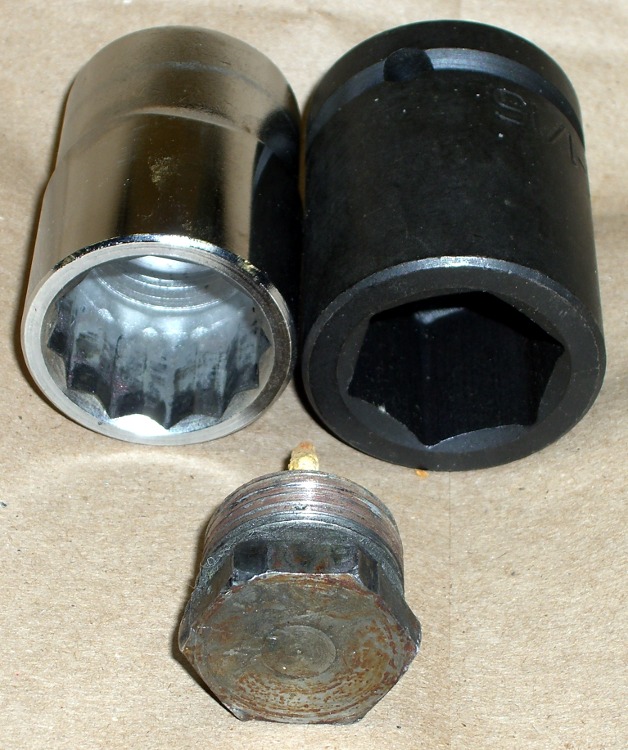
    Anode rod head with sockets
    Anode rod head with sockets

    As mentioned there, removing a water heater anode rod generally requires considerable, umm, persuasion. I used a 12-point socket wrench, as I didn’t have a 1-1/16″ impact wrench on hand. Now I do…

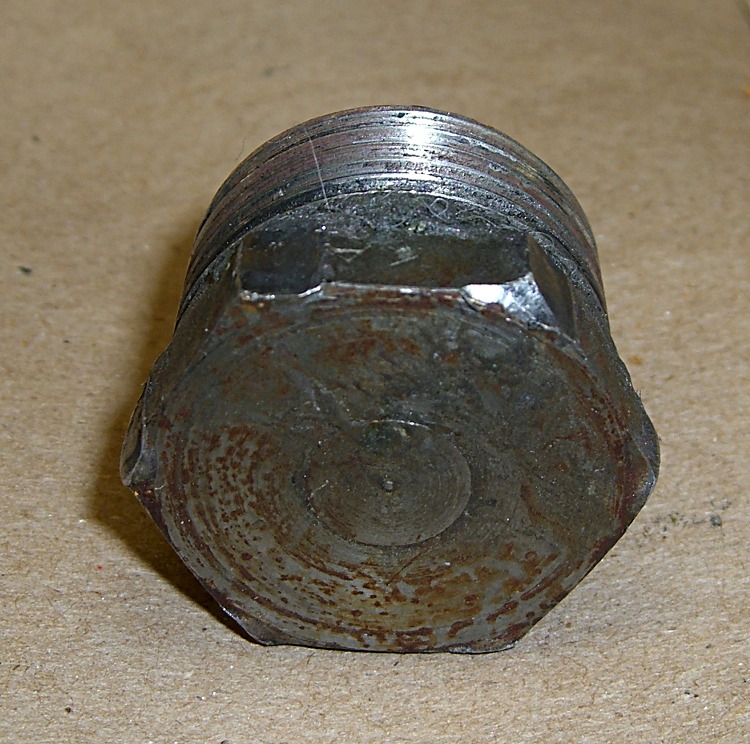
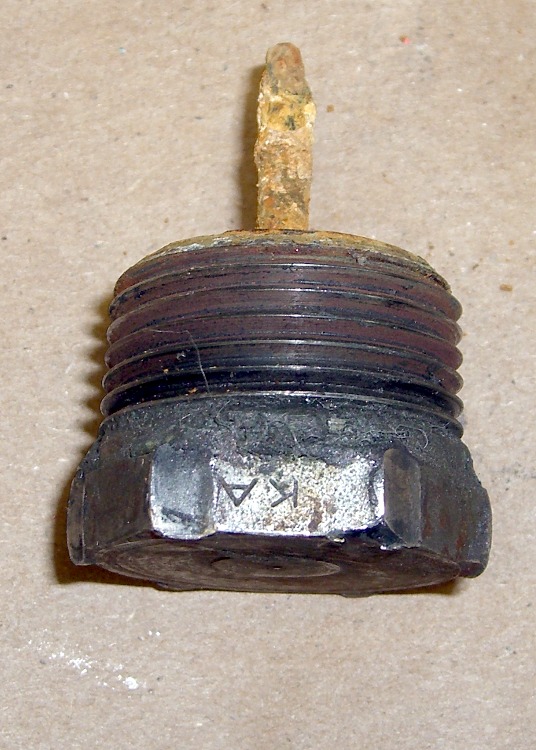
    The first pic shows the head in front of the two sockets; the 6-point socket on the right will do a much better job of not ruining the anode rod bolt head because it grips along the entire length of all six sides.

    Now, in general, you don’t care about ruining the head, because the rod’s pretty much not going to be there by the time you remember to check it. What you do not want: the wrench rips the corners off the head before loosening the thread.

    Goobered anode rod head
    Goobered anode rod head
    Goobered anode rod head - side view
    Goobered anode rod head – side view

    The thread on this anode rod was in great shape (I’d wrapped it in Teflon tape the last time it was out), but it was still firmly jammed in place. These pix show what the 12-point socket did to the bolt head during the beatdown.

    Bottom line: right now, while you’re thinking about it, buy yourself the nice 6-point 1-1/16-inch impact socket you’ll need to extract the anode rod from your water heater. If you don’t already have a honkin’ big breaker bar, get one of those, too; this is no job for a sissy 3/4″-drive ratchet wrench.

    The real problem is holding the water heater in place while you beat on the breaker bar. I have yet to see a good solution.

    Offset Tank - 2009
    Offset Tank – 2009

    That husky 6-point socket isn’t going to fit into the stupidly offset hole in the top of the water heater, even after applying the nibbling tool to get the 12-point socket in place, but that’s in the nature of fine tuning…

  • Improvised Water Heater Element Installation Wrench

    Lower heating element access
    Lower heating element access

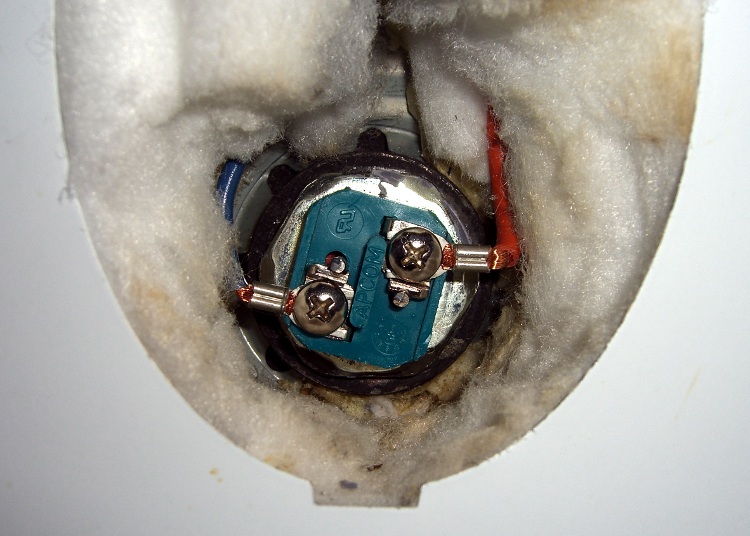
    Removing a water heater element is no big deal: apply the appropriate socket (1-1/2 inch for this heater) to the hex head and turn it out. The trouble comes during installation, when you must hold that long rod exactly horizontal inside the tank, gripping the electrical fittings inside a narrow access port amid all the insulation.

    My fingers can’t hold the element horizontal and twist it at the same time, so I made a tool: cross-threading the heating element and goobering the threads in the tank port is not an option!

    Improvised heating element installation tool
    Improvised heating element installation tool

    A 32 mm socket just cleared the square blue electrical insulation block and butted against the 1-1/2 inch hex head. Because the block is square and the socket is hex, it was a pretty loose fit, but this was the right general idea.

    I put a layer of masking tape on the inside of the socket and covered the electrical connections on the element.

    Then I mixed up a batch of Bondo auto-body repair epoxy, buttered up the end of the heating element, and gooshed it into the socket. The Bondo filled in the gaps between hex and square, turning the wrench into a custom-fit tool that firmly gripped the heating element.

    Reinstalled heating element
    Reinstalled heating element

    A brief pause for Bondo curing, pop an extension into the socket to use as a handle, return to the water heater, and screw that sucker right in place. Worked like a charm!

    There’s a flexible gasket sealing the element to the tank port and I gave the element a few degrees more twist when I tightened it up, so the insulation block isn’t neatly aligned.

    Getting the socket off wasn’t too difficult: twist to the side, pull, and the Bondo pops off the masking tape. Peel the tape off the element and it looks pretty much like it did before. The Bondo fell out of the socket when the element came out, so that was easy enough.

    I was busy getting the water heat back in action and didn’t take any detailed pix, but I think you get the idea…

  • Removing a Water Heater Anode Rod

    Offset Tank - 2009
    Offset Tank – 2009

    While draining the water heater tank, I extracted the anode rod. Well, that was the plan; it took longer to drain the tank than I expected and much longer to get the anode rod out.

    The anode rod is basically an aluminum cylinder around a steel-wire core, attached to a steel bolt that screws into the top of the water heater. It has a 1-1/16″ hex head that calls for a rather large socket.

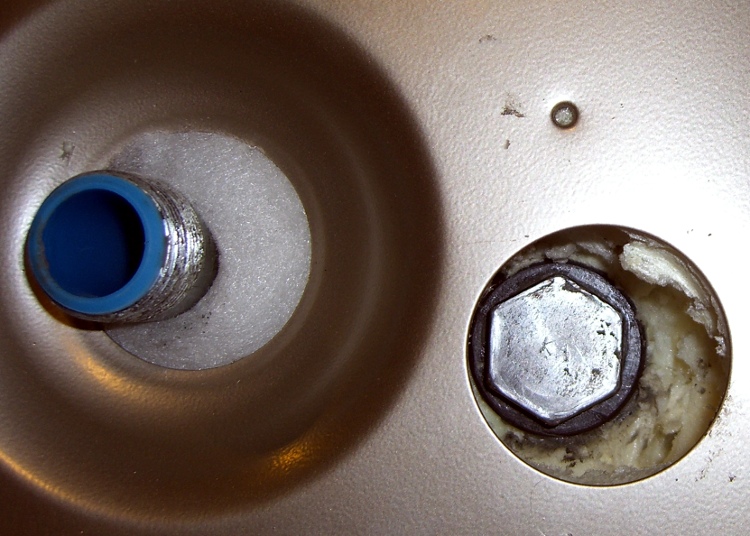
    You can see one problem right away: the anode rod’s head is offset in its opening atop the water heater, making it essentially impossible to get an ordinary 1-1/16″ socket onto the thing. No, they didn’t mis-punch the hole… notice that the cold water inlet nipple is offset in its opening. The hot-water nipple is offset, too, just in case you were wondering.

    Why is that? Well, the one thing that isn’t offset is the temperature & pressure relief valve on the right-front side of the tank. It seems when Whirlpool’s engineers were tasked with adding more insulation to the shell to get a better efficiency rating, they forgot that T&P valves don’t have arbitrarily long stems. Thus, the inner tank is offset within the shell so the T&P valve can reach outside.

    Of course, that means the insulation is thinner on the right-front than the left-rear, you can’t extract the anode rod, and the inlet & outlet nipples rub against the top cover, but so what?

    Offset Tank - 2003
    Offset Tank – 2003

    The photo is of the Whirlpool water heater I just installed, but it’s identical to this one installed back in 2002 and another installed in 2001 (the one that recently failed). They haven’t seen fit to correct the holes in the top cover in the last seven or eight years:

    This on a $400 water heater. “Made with pride in the USA”, indeed.

    Anyway, when I installed the heater, I applied a nibbling tool to the top cover and gnawed an opening sufficient to get the socket in and the anode rod out. When I checked the rod in 2004 (after two years), it was corroding, but that’s the way it’s supposed to be: it’s working!

    Missing Anode Rod
    Missing Anode Rod

    The recommended inspection interval is three years, but I admit I let it slide for five, based on what I saw earlier. Well, this time the anode rod was well and truly stuck. I eventually clicked an 18-inch breaker bar into the socket and wailed on the end with a two-pound hammer; after far more beating that I really liked, the bolt head loosened and the whole affair unscrewed easily and came out without further protest.

    Behold, there’s no rod attached to the head!

    I used a 12-point socket for this operation, but I have a six-point impact socket arriving shortly ($0.99 from eBay, plus $2 shipping). A 6-pointer has the advantage of applying force along the sides of the hex head, rather than just the vertices, which reduces the risk of stripping the head. Been there, done that, you’d think I’d learn from my experience, but I needed to get that thing out so I could proceed with the sediment extraction.

    [Update: More about why you really want a 6-point socket there.]

    There was an ominous clank inside the tank while I was massaging the breaker bar with the hammer. Peering down inside the tank through the rod hole, I spy the remains of the rod standing against the lower heating element, atop the expected pile of sediment in the bottom which is clogging the piddly little drain valve. It’s like looking into the Titanic’s dining room through a rivet hole.

    Turns out that the rod had broken off quite some time earlier. After better than an hour of laparoscopic surgery through the lower heating element port, I finally extracted the rod: it was bent double, which means it had been standing upright for a while and eventually folded over. The long section to the right is actually two rod cores folded against each other; the far right end has a neat U-bend.

    Corroded anode rod core
    Corroded anode rod core

    OK, I shouldn’t have left it slide for that long…

    So it goes. Leaving the rod across the heating element seems like a Bad Thing, plus I should get the rest of the sediment out of the bottom. That’ll be easier if I can flush the tank through the lower element’s port.

    I picked up a new magnesium rod at JD Johnson, a local plumbing outlet, for $28. That’s far less than at Water Heater Rescue, an invaluable source of information on the subject. The rod is 36 inches long, half a foot less than the 42 inch original, but that’s close enough; given the limited headroom, it’s easier to get into the tank.

    Removing the lower heating element requires a 1-1/2″ socket and the courage to cut back the insulation packed into the element port. More on that tomorrow…

  • Water Heater Drain & Flush

    Flushing with Y hose connector
    Flushing with Y hose connector

    For reasons that aren’t germane here, I’m responsible for two water heaters. Having just replaced one of them, I figured I should do a preemptive drain-and-flush on the other and check its anode rod.

    In principle, you just hitch a garden hose to the drain valve, turn it on, and flush the sediment right out of the bottom. In practice, it doesn’t work that smoothly, as the valve has a teeny little opening that instantly clogs with grit.

    The first step is to shut off the water, open the drain valve, and disconnect both flexible couplings at the top of the heater. You will move the heater a little bit during this operation and that will cause the flexy connectors to leak, maybe just a little bit, but enough to cause Bad Things to occur.

    In the past I’ve used a Y hose connector with a homebrew double-female adapter to blow water into the bottom of the heater; the hose runs to a nearby sink with a male hose thread on the cold-water faucet. The two teardrop-shaped black handles on the Y adapter are ball valve handles (crappy valves, but good enough).

    It goes like this:

    • Close the Y hose valve
    • Turn on the water at the sink
    • Open the water heater drain valve
    • Open the Y drain valve
    • Watch a brief piddle of water hit the bucket
    • Close the Y drain valve
    • Open the Y hose valve to blast water into the tank
    • Close it again
    • Open the drain
    • Repeat as needed

    With any luck, you won’t have that much sediment and the drainage will clear after only a few iterations. That didn’t happen here…

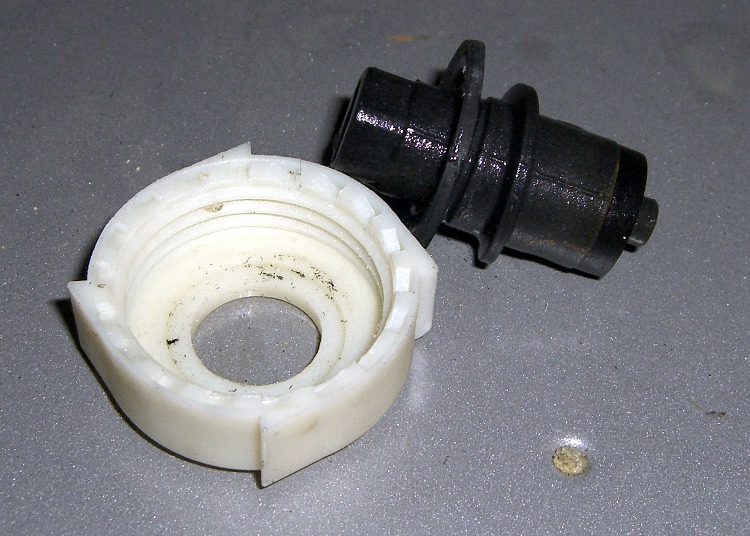
    Water heater drain valve parts
    Water heater drain valve parts

    The next step is to apply a strap wrench to the drain valve, remove the cover and core, and see if the larger opening will produce more flow.

    Note that the drain valve, at least on this Whirlpool heater, is basically a coarse-thread plug that depends on a rubber disk to seal against the valve body. I’d really rather have a full-flow ball valve down there instead of this piddly little thing.

    it is possible to replace the drain valve entirely, but the last time around I applied far more force than I thought prudent to the plastic valve body and got exactly bupkis in the way of rotation. Not wanting to break the damn thing off, I gave up.

    Valve cleanout with copper wire
    Valve cleanout with copper wire

    Anyhow, with the guts of the valve out of the way, the flow was still fairly weak. I rammed a copper wire up its snout and dislodged a truly disheartening amount of crud. The opening kept jamming shut, which meant there was a great pile of sediment atop the opening, so I spent quite  while wiggling the wire to keep the water flowing and the grit emerging. The pic at at the bottom shows some of the pile; there’s a heaping double handful of sediment on that shovel.

    The bottom of the tank is flat, with the valve pretty much flush with the bottom. That means you’ll leave a huge pile of sediment inside unless you swish some water around. That, of course, will clog the valve. Repeat until tired.

    When you go to put the valve back together, don’t be surprised if it doesn’t seal. Tighten the cap, put a hose plug on the outlet, and move on.

    You can tell by the color of the water that Something Is Not Right inside the tank… more on that tomorrow.

    Some of the water heater sediment
    Some of the water heater sediment
  • Forgotten Alkaline D-cell: Corrosion!

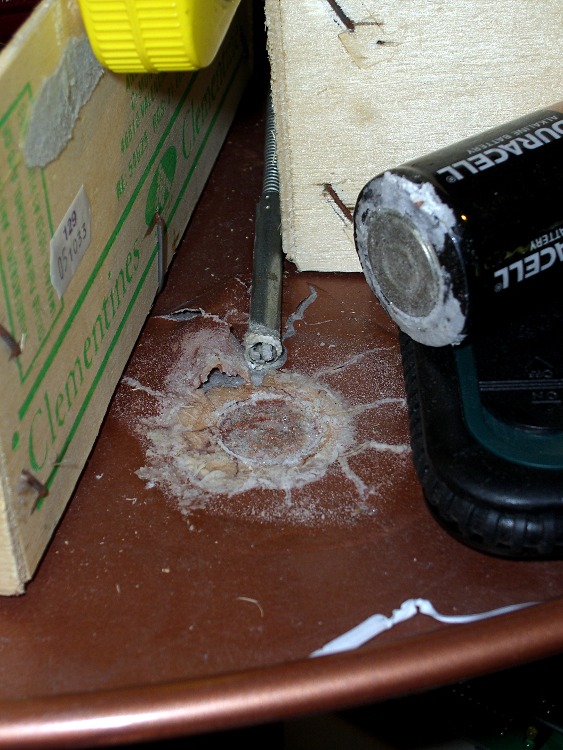
    Alkaline D-cell corrosion
    Alkaline D-cell corrosion

    Found this toxic spill while I was looking for a gadget on another shelf: it seems I left an alkaline D cell standing on my electronics parts & tools carousel for much too long.

    Amazingly, although the cell’s leakage blistered the paint pretty badly, it didn’t affect the steel carousel!

    I wiped most of the crud and dead paint off, then applied white vinegar (which is essentially dilute acetic acid) to neutralize the cell’s potassium hydroxide. The grabber tool sticking  out from between the boxes had a pretty good dose of corrosion up the side, but soaking it in vinegar (wow, the bubbles!) removed that and a shot of penetrating oil expelled the rinse water.

    It’s definitely not Duracell’s fault: the cell had a best-used-by date in 1997.

    Memo to Self: throw ’em out!

  • LED Bike Light Doodles

    LED Bike Light Notes
    LED Bike Light Notes

    I need an LED taillight (and maybe headlight) with a metal case and far more LEDs than seems reasonable. This is a doodle to sort out some ideas… not all of which will work out properly.

    The general notion is that one can put today’s crop of ultrasuperbright 5 mm LEDs to good use. While the Luxeon & Cree multi-watt LEDs are good for lighting up the roadway, they’re really too bright and power-hungry for rear-facing lights. Mostly, you want bright lights facing aft, but the beam pattern & optical niceness really aren’t too critical as long as you’re not wasting too many photons by lighting up the bushes.

    I think, anyway. Must build one and see how it works. I know that a narrow beam is not a Good Thing, as cars do not approach from directly behind and it make aiming the light rather too finicky.

    The problem with commercial bike taillights is that they use piddly little LEDs and not enough of them. If you’ve ever actually overtaken a bicyclist at night with a blinky LED taillight, you’ve seen the problem: they’re too damn small. Automobile taillights must have a very large surface area for well and good reason.

    But who wants to lug the taillight off a ’59 Caddy around?

    So the diagram in the pic explores the notion of arranging a bunch of red & amber LEDs in a fairly compact array. The shaded ones are red, the open ones are amber (with two more side-facing ambers to meet legal requirements), and there are eight of each. The OD is about 40 mm. Figure 5 mm LEDs with 2.5 mm of aluminum shell between them. If the center four LEDs were spaced right, an axial (socket-head cap?) screw could hold the entire affair together.

    Turns out both the red & amber LEDs in the bags of 100 I just got from Hong Kong run at 2 V forward drop @ 30-ish mA, so that’s 16 V total for eight in series.

    Four AA NiMH cells fit neatly behind the array, so the supply will be 4 – 5 V, more or less. The outer casing could be plastic pipe.

    What to do for a battery charging port? Must be mostly weatherproof. Ugh.

    Rather than a regulated supply and a current sink / resistor, use an inductor: build up the desired forward current by shorting the inductor to ground, then snap the juice into the LEDs. The voltage ratio is about 4:1, so the discharge will happen 4x faster than the charge for a duty cycle around 20%. At that ratio, you can kick maybe 50 mA into the poor things.

    Governing equation: V = L (ΔI/ΔT)

    If they’re running continuously, 2 V x 50 mA x 0.2 = 20 mW. The full array of red or amber is 160 mW, 320 mW for both. If you’re powering them at 10% duty cycle, then the average power dissipation is pretty low. Not much need for an external heatsink in any event.

    A 1 kHz overall cycle means a 200 µs inductor charging period. With low batteries at 4 V and 50 mA peak current, the inductor is 16 mH. That’s a lot of inductor. I have a Coilcraft SMD design kit that goes up to 1 mH: 12 µs charge and 16 kHz overall. Well, I wouldn’t be able to hear that.

    No need for current sensing if the microcontroller can monitor battery voltage and adjust the charge duration to suit; three or four durations would suffice. Needs an ADC input or an analog window comparator.

    Automotive LED taillights seem to run at about 10% duty cycle just above my flicker fusion frequency; say between 50 – 100 Hz. If that’s true, red & amber could be “on” simultaneously, but actually occupy different time slots within a 100 Hz repeat and keep the overall duty cycle very low.

    I’d like red on continuously (10% of every 10 ms) with amber blinking at 4 Hz with a 50% duty cycle. When they’re both on the total would be 60% duty.

    The legal status of blinking taillights is ambiguous, as is their color; more there. Motorcycles may have headlight modulators. Bikes, not so much.

    Battery life: assume crappy 1500 mAh cells to 1 V/cell. Red = 50 mA x 0.2 x 0.1 = 1 mA. Amber = 50 mA x 0.2 x 0.5 = 5 mA. Thus 1500 / 6 = 250 hours. Figure half of that due to crappy efficiency, it’s still a week or two of riding.

    Rather than a power switch, use a vibration sensor: if the bike’s parked, shut off the light after maybe 5 minutes. It wouldn’t go off when you’re on the bike, even stopped at a light, because you’re always wobbling around a little.

    Memo to Self: put the side LEDs on the case split line?