The Smell of Molten Projects in the Morning

Ed Nisley's Blog: Shop notes, electronics, firmware, machinery, 3D printing, laser cuttery, and curiosities. Contents: 100% human thinking, 0% AI slop.

Author: Ed

  • Arduino Pro: Power Adaptation for FTDI Basic USB

    Arduino FTDI Basic on modified Arduino Pro
    Arduino FTDI Basic on modified Arduino Pro

    Some time ago, I bought a 5 V Arduino Pro board (about which you read earlier there) and a nominally compatible FTDI Basic USB-to-serial adapter. Turns out that they’re not quite a perfect match, although they do play nicely together in normal use.

    The FTDI Basic board produces a 3.3 V regulated output voltage that’s connected directly to the output of the Pro’s 5 V regulator. This doesn’t cause any particular problem, but one side effect is that you can’t shut the board’s power off: the USB power will keep the CPU alive, more or less.

    You should, of course, use a 3.3 V FTDI Basic board with a 3.3 V Pro, which would at least put two similar voltage sources head-to-head.

    The Pro is using a backup power supply that, for reasons that make perfectly good sense, backfeeds the Pro’s 5 V regulator: when the +12 V main supply Goes Away, the backup power supports VCC directly, rather than through the regulator. The regulator can take a joke like that, as witness the FTDI vs Pro situation; in my case, a diode isolates the two supplies in normal operation.

    For reasons that I don’t completely understand, some combination of voltage to the Pro regulator and the (diode isolated!) backup support voltage caused the FTDI chip to lock up with both TX and RX LEDs on solid.

    I suspect the FTDI chip’s internal 3.3 V regulator, in combination with the USB +5 V supply, in combination with the Pro board power, drove something outside its normal operation range. So I simply removed the 3.3 V pin from the connector, disconnecting that supply from the Pro’s overvoltage, and the thing now works fine.

    Side effects:

    • The FTDI board remains powered when the Pro board gets turned off, thus preventing Linux from changing the serial port device when the power comes back up again
    • I can actually turn the Pro power off, without having the FTDI supply keep it alive. Handy for soldering!

    The Pro pin labeled GND connects to the FTDI CTS line, an input that floats high when not connected. I yanked that pin and shorted CTS to GND on the FTDI board: one less pin to worry about, for reasons that you’ll see tomorrow.

    There are many different versions of the boards and USB adapters, so current production probably doesn’t match what I have. Pay attention to what you have, though…

  • Improvised Snowthrower Skid Shoes

    Our snowthrower rests the entire weight of the front end on a pair of skid shoes, which erode against the asphalt driveway. Replacements cost nigh onto eleven bucks each, which activates my cheapskate gene.

    Worn OEM skid shoes
    Worn OEM skid shoes

    You can see from the markings that the slots are about twice as long as they need to be, so I figured I could replace them with some random angle iron. Might not last as long, but far less expensive.

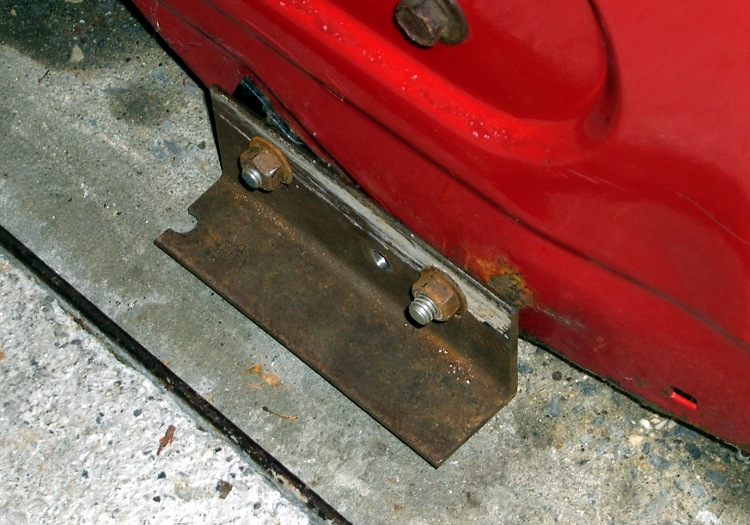
    Bedframe skid shoe
    Bedframe skid shoe

    Having a nearly infinite supply of bedframe steel in the heap, I chopped off two suitable lengths, poked 3/8″ holes into the appropriate spots, then milled short slots to get some adjustability.

    Bedframe steel is about the nastiest stuff you (well, I) can still machine: high carbon, fine blue-hot chips, and hard edges. It might actually be better-suited for skid shoes than the soft steel OEM parts.

    They’re not pretty, but the driveway hasn’t complained yet.

    The only real problem is that those sharp corners snag on the edges of what we loosely term “the lawn”. I should apply the smoke wrench, miter the corners, and bend the edges upward. If I’m going to all that trouble, I should also hitch up the buzz box and wave some hardfacing ‘trodes over the bottom.

    But that’s in the nature of fine tuning and sounds a lot like work.

  • Stainless Steel Rule vs Ferric Chloride: Oops

    This is truly embarassing: I managed to leave a steel rule (not a ruler in the shop) atop a sploosh of ferric chloride for far too long. I eventually noticed the corrosion creeping around the edges.

    Top corrosion
    Top corrosion

    The bottom was hideous.

    Bottom corrosion
    Bottom corrosion

    So I sprayed it down with TopSaver, applied fine sandpaper, applied a Scotchbrite pad, and it came out surprisingly well.

    After treatment
    After treatment

    The ferric chloride, of course, came from a circuit board etching project. How you’re supposed to prevent that is to cover everything for about six feet around the spot marked X, but I don’t do that nearly as often as I should.

    Mostly I lay a sheet of packing paper atop the workbench and whisk it into the trash when I’m done, but this time I’d left it in place because my resistance soldering gizmo wound up anchoring the far end. Soooo, a drop or two soaked into the paper and of course the ruler wound up exactly atop that spot.

    The stuff is murder on stainless steel sinks, too…

  • Fixing an MTD Gas Cap Splash Shield

    OEM plastic post
    OEM plastic post

    MTD used the same design for the gasoline tank caps on our leaf shredder and snow thrower: an aluminum cone (which evidently serves to keep splashes away from the tank vent) mounted on a heat-staked plastic rod molded into the cap. It’s straightforward, but a bit suboptimal for high-vibration yard gadgets.

    The aluminum cone eventually worries its way through the plastic post and falls into the tank, taking the heat-formed button from the post along with it. Trust me on this, fishing those things out of the tank is an exquisite little inconvenience.

    4-40 screw post - inside
    4-40 screw post – inside
    4-40 screw post - exterior
    4-40 screw post – exterior

    The fix is straightforward.

    Chop off the remains of the post, drill a snug 4-40 tapping hole straight through the cap, and tap it accordingly. Secure the cone to the screw with a nut tightened against the head, run the screw through the cap, run a pair of nuts onto it, trim to length, then jam the nuts together so the cone is about where it started out. Loctite on the nuts is a Good Thing, but I don’t know how it feels about gasoline immersion.

    The snowblower cone is getting wobbly; I must make a preemptive strike on it to avoid fishing the debris out of the tank.

  • Debugging Tube Circuitry: Open Resistor

    Open 2.2 meg resistor
    Open 2.2 meg resistor

    I dropped in to mooch some female header strips from my buddy Eks (which is not nearly as obscene as it sounds) and got the story behind this innocent-seeming 2.2 megohm carbon-composition resistor.

    It seems he was debugging a defunct tube-based audio amplifier. He’d probed everything and discovered that the grid bias on one of the tubes was totally wrong, which caused protracted headscratching over the associated circuitry.

    Now, in semiconductor work, a 2.2 meg resistor is an open circuit compared to the other circuit impedances. In fact, you can use pretty nearly any resistor with green or blue in the third band as a standoff in Manhattan-style construction in place of those small insulated pads.

    Megohm-value resistors are actually useful in tube circuitry; you’ll see plenty of green and blue bands sprinkled around those sockets. Although we didn’t get into details, I suspect this one was part of a grid-leak bias circuit that holds the grid voltage just a bit below the cathode; the bias comes from the few electrons that whack into the grid wires rather than passing through, so the total DC current is in the microamp range.

    After more headscratching, Eks yanked this resistor, measured it, and found it was a completely open circuit. A 2.2 meg resistor isn’t all that much different from an open circuit (it’s hard to tell the difference with an in-circuit measurement) when used in a transistor circuit, but the difference separates correct function from failure for a tube amp.

    Eks swapped in a new resisistor and the amp worked fine. Case closed!

    The digital multimeter in my desk drawer tops out at 2000 kΩ, which shows you just how much demand there is for high-value resistors these days…

  • Nichicon SMD Electrolytic Capacitor Polarity

    Nichicon electrolytic capacitors
    Nichicon electrolytic capacitors

    This should be obvious, but isn’t. The black bar marks the negative terminal and the corner-cut side of the base marks the positive terminal.

    How much would it cost to put little hyphens down the middle of the black bar?

    The data sheet for a related, not identical, series of caps is there.

  • Slitting Brass Tubing

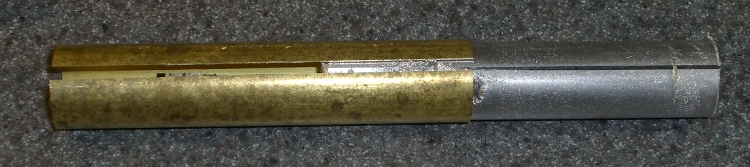
    Casting Wood's Metal in brass tube
    Casting Wood's Metal in brass tube

    I needed a brass tube with a lengthwise slit to serve as an electrostatic shield around a ferrite bar antenna. There are many wrong ways to do this, all of which produce terrible results, pose a serious risk of personal injury, or both. I say that with some confidence, having tried some of them over the years.

    Here’s one right way: fill the tube with Wood’s Metal, thus turning it into a solid rod, then cut the slit with a slitting saw.

    Wood’s Metal is a moderately toxic alloy that melts in hot water, which turns casting into a simple workbench operation. You might not want to cast it in the kitchen, but that’s your call. Clean up the scraps, wash the counter even though you used newspaper, wash your hands, and don’t suck your thumb.

    As shown, I just poured the molten metal into the brass tube atop a steel block, broke off whatever seeped out, and remelted the scraps. Turns out I had just barely enough for the job.

    Slitting brass tubing - overview
    Slitting brass tubing – overview

    My buddy Eks gave me a stack of slitting saws a while ago and I modified a standard Sherline holder to fit them. Turns out there’s just barely enough room for everything within the mill’s working envelope; the saws are a bit over 3 inches in diameter.

    So I cut the back of the tubing, making the pictures somewhat disorienting.

    The tubing fit neatly into an old V-block (evidently homebrewed by a better machinist than I), held down by ordinary Sherline clamps on perilously long studs screwed into the tooling plate. The saw had just enough reach to clear the rather broad V-block’s shoulder.

    The tubing is 0.630 OD with a 15-mil wall and the saw blade is pretty nearly 32 mils thick. I touched off Z=0.331 (630/2 + 32/2) with the blade atop the tubing, then jogged away to Y=+1 and drove down to Z=0 to cut exactly through the middle of the tube.

    Slit 0.015 inch deep
    Slit 0.015 inch deep

    The V-block is aligned with the front of the table, but I did a bit of nudging to persuade it into final alignment. Of course, the saw wasn’t quite centered on the holder, so a blade or three tinged on the tubing when I did a Y=0 trial pass at low RPM.

    For lack of anything smarter, I cut at 500 RPM and fed at 5 inch/min. That’s painfully slow, but correspondingly boring… remember, in machine shop work, boring is good.

    I did five passes: one trial at Y=0, three cuts at 5-mil steps, and a cleanup cut. The picture shows the 15-mil pass left a very thin web at the far end. A final 2-mil cut removed that web, leaving only a few burrs. You could do it in one pass, but I wanted to minimize the depth-of-cut into the Wood’s Metal.

    Unclamp, discover that the cast metal rod slides right out, touch up the edges with a file, and it’s all good. A lovely slit, perfectly aligned, without bent metal or bloodshed.

    As a bonus, I get a nice Wood’s Metal ingot out of the operation. The line along the rod is just barely perceptible with a fingernail; it’s more of a polished line than an actual cut.

    Slit tube with Wood's Metal ingot
    Slit tube with Wood's Metal ingot

    Turns out the shield works a bit too well: it cuts out the WWVB signal, too. I think the tubing is too close a fit to the ferrite rod and detunes the winding. More experimentation is in order…