Ed Nisley's Blog: Shop notes, electronics, firmware, machinery, 3D printing, laser cuttery, and curiosities. Contents: 100% human thinking, 0% AI slop.
Every now and again I search for a few obvious keywords to discover where my posts have wandered off to; there’s a straightforward Creative Commons license (on the About page) that scrapers seem unable to comprehend. In a surprising number of cases, a simple note to the plagiarist webmaster suffices to eliminate the problem.
Lately, though, the scrapers collect a page of text, run it bodily through a thesaurus, then post the ensuing gibberish. I think this gives the page some overall search-engine-friendly English syntax while concealing the deed from the original author.
Loose plugs, it turns out, vibrate the HT’s jacks right off the circuit board in short order and those jacks are a major pain to replace.
A trip through the shredder produces this gem (I won’t reward them with a link):
Loose plugs, it turns out of the closet, quiver the HT’s jacks all there potty the lap conquer rooms in butt in fail ask for and those jacks are a foremost ass effort to be a sensation.
Doesn’t that give you the impression of someone locked in a room with a foreign-language dictionary, desperately trying to force an important message through a noisy channel?
For the record, note that I did not refer to anyone’s posterior anatomy. It seems their phrase-o-matic converter fills in some obvious (to them, anyway) empty spots. All those, um, keywords appeared, as if by magic, in the “translation”.
Sometimes, though, they get it right. My summary:
Memo to Self: It’s always the connectors.
emerged with just one change:
Memo to Self: It’s everlastingly the connectors.
Isn’t that cute?
I collect some of the more amusing spam efforts there.
CDs being such a useful source of raw material, I cooked this up on the lathe while puttering around in the shop thinking about something else. The general idea is to align a short stack of CDs on the Sherline rotary table, close enough to the center, so that you can gnaw away on the top platter and get nearly concentric results. If you really care about concentricity, this isn’t the way to go, but …
CD adapter bushing in place
The washer clamps the CDs in place with the bushing sticking up a bit from the top layer, so it need not be more than eyeball-aligned; the air gap eliminates the need to get the bushing height Exactly Right. If you’re perpetrating fancy machining on the CD, you probably want a form-fitting metal plate atop the stack to hold it down near the perimeter to prevent getting swarf jammed underneath. Note the stack of washers require to reduce that gaping hole to meet a 3/8-16 bolt threaded into the table.
All by itself, the bushing looks like this:
CD Adapter Bushing
The dimensions, roughly as-built:
Rotary Table CD Adapter Bushing
I used a random plastic cylinder from the scrap pile and cleaned up the edges with a razor knife. Next time, I’d put the fat end near the lathe tailstock, so as to make the chamfer easier.
After doing a repeatability test immediately after screwing the new switch to the tooling plate, I let everything sit overnight and ran the test again. In between, I’d done a few small moves, but didn’t change any of the mechanical positions.
The initial position is 0.07 mm, about 3 mils, higher than before, which may well be due to the limited amount of fiddling I’d done in between.
The corresponding picture shows that the values are well and truly quantized to far fewer positions than the number of digits would lead you to believe:
What’s of interest is that the regression line is perfectly flat, which means the switch has pretty much stabilized. I have absolutely no reason to believe it’s repeatable to anywhere near that accuracy, particularly from day to day, but the switch is normally used to set tool lengths relative to a specific tool that’s touched off against the work surface at the start of what passes for a machining job around here.
This relay-like object appeared while shoveling off the Electronics Workbench. Most likely, it started life in the white-goods world, where recurring cost is everything:
Original relay
Now, doesn’t that look just like a tool length probe? It’s certainly less hideous than the one that’s been working fine on my Sherline mill, ever since I figured out how to make tool length probing work.
Here’s what caught my eye:
Plenty of switch overtravel
Nice metal bracket with screws
All the vital pieces in one convenient assembly!
Some brute force removed the spring and actuator, a few shots with a chisel broke the adhesive holding the coil in place, and this collection of parts emerged relatively unscathed:
Disassembled relay parts
Another shot with a pin punch removed the post from the frame. I intended to un-bend the L-shaped feature that held the post, enlarge the hole, and screw it to the mill. Alas, they formed the angle by notching the steel and it cracked when I un-bent it. No great loss.
The two bumps on the frame held the (now defunct) restoring spring. I simply filed those off while cleaning up the broken edges.
Drill a 10-32 clearance hole, solder a cable with a 3.5 mm stereo plug to the switch, add a plastic cable clamp, screw it to the end of the tooling plate, and it’s all good. That’s the butt end of a broken 2 mm end mill poking down from the spindle…
A G-Code routine that displays the Z-axis coordinate where the switch trips looks like this:
(Tool length probing test)

(--------------------)
( Initialize first tool length at probe switch)
(    Assumes G59.3 is still in machine units, returns in G54)
( ** Must set these constants to match G20 / G21 condition!)

#<_Probe_Speed> =        400            (set for something sensible in mm or inch)
#<_Probe_Retract> =        1            (ditto)

O<Probe_Tool> SUB

G49                     (clear tool length compensation)
G30                     (move above probe switch)
G59.3                   (coord system 9)

G38.2 Z0 F#<_Probe_Speed>           (trip switch on the way down)
G0 Z[#5063 + #<_Probe_Retract>]     (back off the switch)
G38.2 Z0 F[#<_Probe_Speed> / 10]    (trip switch slowly)

#<_ToolZ> = #5063                    (save new tool length)
G43.1 Z[#<_ToolZ> - #<_ToolRefZ>]    (set new length)

G54                     (coord system 0)
G30                     (return to safe level)

O<Probe_Tool> ENDSUB

(-------------------)
(-- Initialize first tool length at probe switch)

O<Probe_Init> SUB

#<_ToolRefZ> = 0.0      (set up for first call)
O<Probe_Tool> CALL
#<_ToolRefZ> = #5063    (save trip point)

G43.1 Z0                (tool entered at Z=0, so set it there)

O<Probe_Init> ENDSUB

(--------------------)
( Set up length)

G21                     ( metric units)

(msg,Verify G30.1 above tool change switch, hit Resume)
M0
(msg,Verify blunt tool installed, hit Resume)
M0

O<Probe_Init> CALL

(debug,Initial Z trip = #<_ToolRefZ>)

O100 REPEAT [10]

O<Probe_Tool> CALL
#<DeltaZ> = [#<_ToolZ> - #<_ToolRefZ>]
(debug,Z trip=#<_ToolZ> DeltaZ=#<_DeltaZ>)

O100 ENDREPEAT

M2
Notice that the results have six figures after the decimal point, but they’re really less precise: you’ll find four pairs of duplicates, which seems highly unlikely. I think the values are quantized to about 25 µ-inch and displayed as whatever the metric equivalent might be.
The corresponding plot looks like this:
Probe Repeatability
The trend line is highly suspect, but the slope shows that the trip point gets lower by one wavelength of violet light (393 microns) per trip. The total difference is a whopping 0.004 mm during the test, call it 160 millionth of an inch.
Both of those are better, by roughly a factor of two, than the previous probe switch.
Bottom line: That’s OK for the sort of machining I do… ship it!
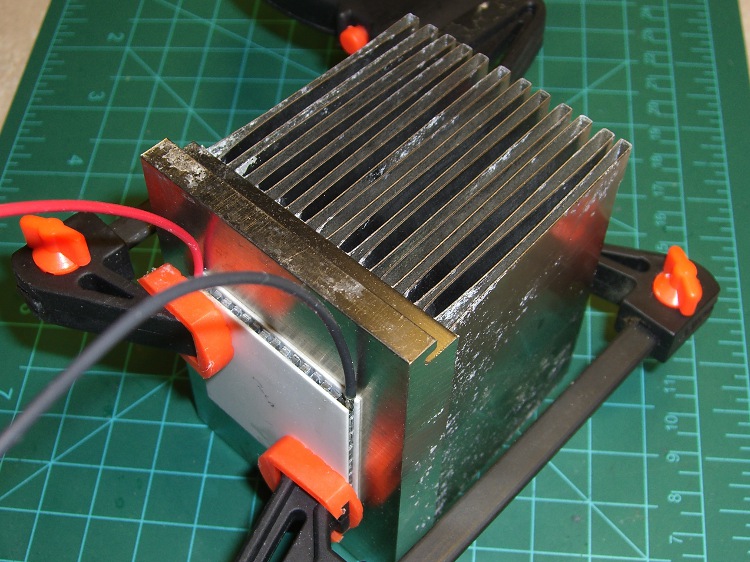
This Peltier cooler just emerged from a pile o’ stuff on the Electronics Workbench, so I combined it with a scrap CPU heatsink (using plain old water as “thermal grease”) and fired it up to get some quick numbers for future reference.
Peltier cooler test lashup
It draws 3 A (the bench supply’s current limit) at 5 V. The cold side got down to 19 °F with the hot side at 75 °F: ΔT = 56 °F.
That’s with zero thermal load, other than whatever arrives from plain old air and those two plastic clamps. It looks like a nice one, so it’s maybe 10% efficient and could pump a watt, barely enough to cool a simple circuit.
Freezes a drop of water just fine, though.
The I-V curve is nearly bar-straight over the first five volts: call it 620 mΩ. The thing would draw 7.5 A at 12 V, call it 90 W, and could pump maybe a whopping 9 W from the cold side.
Actually getting good numbers would require some serious work that I’m not up for. In particular, everything has a serious temperature coefficient, so nothing would be the way it looks. I have doubts about the efficiency guesstimate; I’d like to actually measure that sometime.
But it confirms my opinion of Peltier coolers between hundred-watt CPUs and water-cooled heatsinks: pure delusion.
Just got two eyeglasses from a different supplier halfway around the planet, with satisfactory results.
The frames have the largest lenses I could find that weren’t totally dorky; I still want slightly taller lenses, but that’s not the style these days. Their 35 mm lenses are slightly larger than the 35 mm lenses from previous vendor, but IMHO still not quite tall enough for progressive bifocals. The closeup curves seem to start lower on the lens, which is fine.
The 20 mm nose bridge is a Good Thing and made the nosepiece adjustments much easier than before.
Metal Eyeglasses-Vincent
Dimensions
Width 137 mm
Earpiece 144 mm
Lens width 50 mm
Lens height 35 mm
Nose bridge 20 mm
I used a 60 mm Near Pupillary Distance (for the bifocal lens area), which worked fine, although 1 mm might be better.
The regular glasses have the usual options and work fine. The 1.6 “super thin” refractive index (vs 1.5 “regular” in the sunglasses) makes the lenses noticeably thinner than the sunglasses, but I’m not sure it’s worth the upcharge.
- I use my Glasses for: Progressive - Bifocal without a line
- Lens upgrades 5: Progressive Lens (no line)
- Right Sphere(SPH): -3.50
- Right Cylinder (CYL): +0.50
- Right Axis: 180
- Right Addition (near) ADD: +2.25
- Left Sphere(SPH): -3.50
- Left Cylinder (CYL): +0.75
- Left Axis: 155
- Left Addition (near) ADD: +2.25
- Pupillary Distance (PD): 62
- Near PD: 60
- Lens upgrades 3: Super Thin (1.6)
- Eye Protection and Eyeglasses 1: Anti-Scratch
- Eye Protection and Eyeglasses 2: Anti-Reflective
- Eye Protection and Eyeglasses 3: UV Coating
For the sunglasses I tried Old School with-a-line bifocals and, frankly, don’t like them much at all. The line is very distracting in sunlight, which is where I wear sunglasses. Good news: the line falls directly across the fairing on my bike, so I can see the “dashboard” on the handlebars quite clearly. Bad news: the correction is a bit much for the automobile dashboard and, unlike the no-line bifocals, I can’t tune for best picture by nodding my head.
Their 80% gray tint is significantly lighter than the previous vendor’s 80%; next time go for 90%. Good news: unlike the previous vendor, these folks have no trouble with AR/UV coatings over a tint.
- I use my Glasses for: Bifocal - Both distance and reading with a line
  - Lens upgrades 4: Bifocal Lens (with line)
  - Division of lenses: 70% Distance - 30% Reading
  - Right Sphere(SPH): -3.50
  - Right Cylinder (CYL): +0.50
  - Right Axis: 180
  - Right Addition (near) ADD: +2.25
  - Left Sphere(SPH): -3.50
  - Left Cylinder (CYL): +0.75
  - Left Axis: 155
  - Left Addition (near) ADD: +2.25
  - Pupillary Distance (PD): 62
  - Near PD: 60
  - Lens upgrades 1: Standard (1.5)
  - Eye Protection and Eyeglasses 1: Anti-Scratch
  - Eye Protection and Eyeglasses 2: Anti-Reflective
  - Eye Protection and Eyeglasses 3: UV Coating
  - Tint Key: Grey 80%
  - Eye Protection and Eyeglasses 4: Color Tint
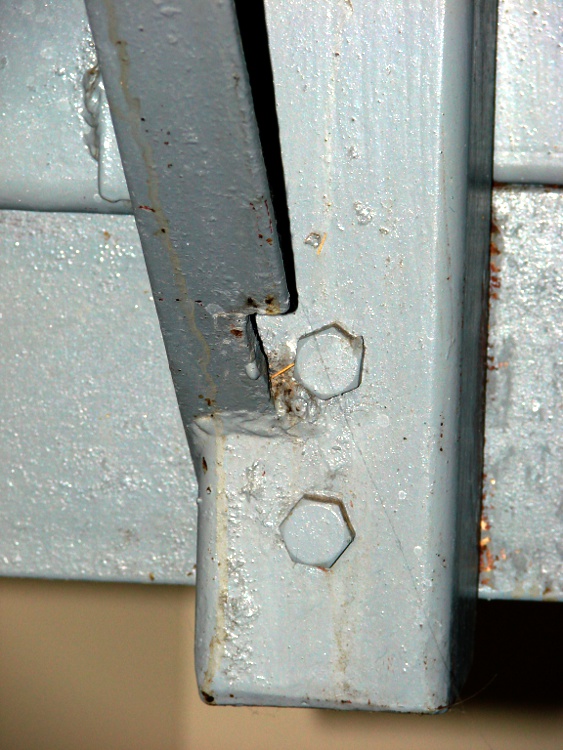
Saw this in the Syracuse Sheraton: every stringer in the stairwell had a torch-cut opening so they could bolt the flight to the landing.
I don’t know if the flights came pre-assembled (minus the concrete, I assume), but the cutouts definitely have that “WTF do we do now?” aspect about them, don’t they?



 The Smell of Molten Projects in the Morning