The Smell of Molten Projects in the Morning

Ed Nisley's Blog: Shop notes, electronics, firmware, machinery, 3D printing, laser cuttery, and curiosities. Contents: 100% human thinking, 0% AI slop.

Author: Ed

  • Bafang Brake Sensor Magnet Realignment

    Bafang Brake Sensor Magnet Realignment

    As mentioned earlier, the Bafang brake sensors on Mary’s Tour Easy require a magnet on the brake levers to activate the switches. They arrived with disk magnets that did not suit the levers, so I used neodymium “bar magnets”:

    Tour Easy Bafang BBS02 - brake sensor - installed
    Tour Easy Bafang BBS02 – brake sensor – installed

    That worked for a few rides, but the alignment turned out to be entirely too critical, because the magnetization is through the bar’s thin dimension, rather than along its length, making the field weakest in the direction of the switch.

    Magnetic field visualization film shows the field null along the thin edge of the bar:

    Neodymium bar magnet - edge field
    Neodymium bar magnet – edge field

    That’s a slightly shorter magnet from a different toothbrush head, cemented edgewise into a holder conjured from the vasty digital deep:

    Brake Magnet Mount - PrusaSlicer prevew
    Brake Magnet Mount – PrusaSlicer prevew

    The field is much more uniform on the flat side of the bar:

    Neodymium bar magnet - side field
    Neodymium bar magnet – side field

    Some double-sided foam tape snuggles the sensor and the magnet together on the brake lever:

    Bafang Brake Sensor - released detail
    Bafang Brake Sensor – released detail

    I coated the magnet with JB Plastic Bonder urethane adhesive in the hope of filling any gaps in its nickel coating caused while extricating it from the toothbrush head.

    The rusty screw head in the upper right positions the lever at the proper distance from the grip to suit Mary’s hand. An earlier version of the holder shows the alignment:

    Bafang Brake Sensor - released position
    Bafang Brake Sensor – released position

    The switch trips (opens) with the lever roughly parallel to the grip, again with the earlier holder:

    Bafang Brake Sensor - activated position
    Bafang Brake Sensor – activated position

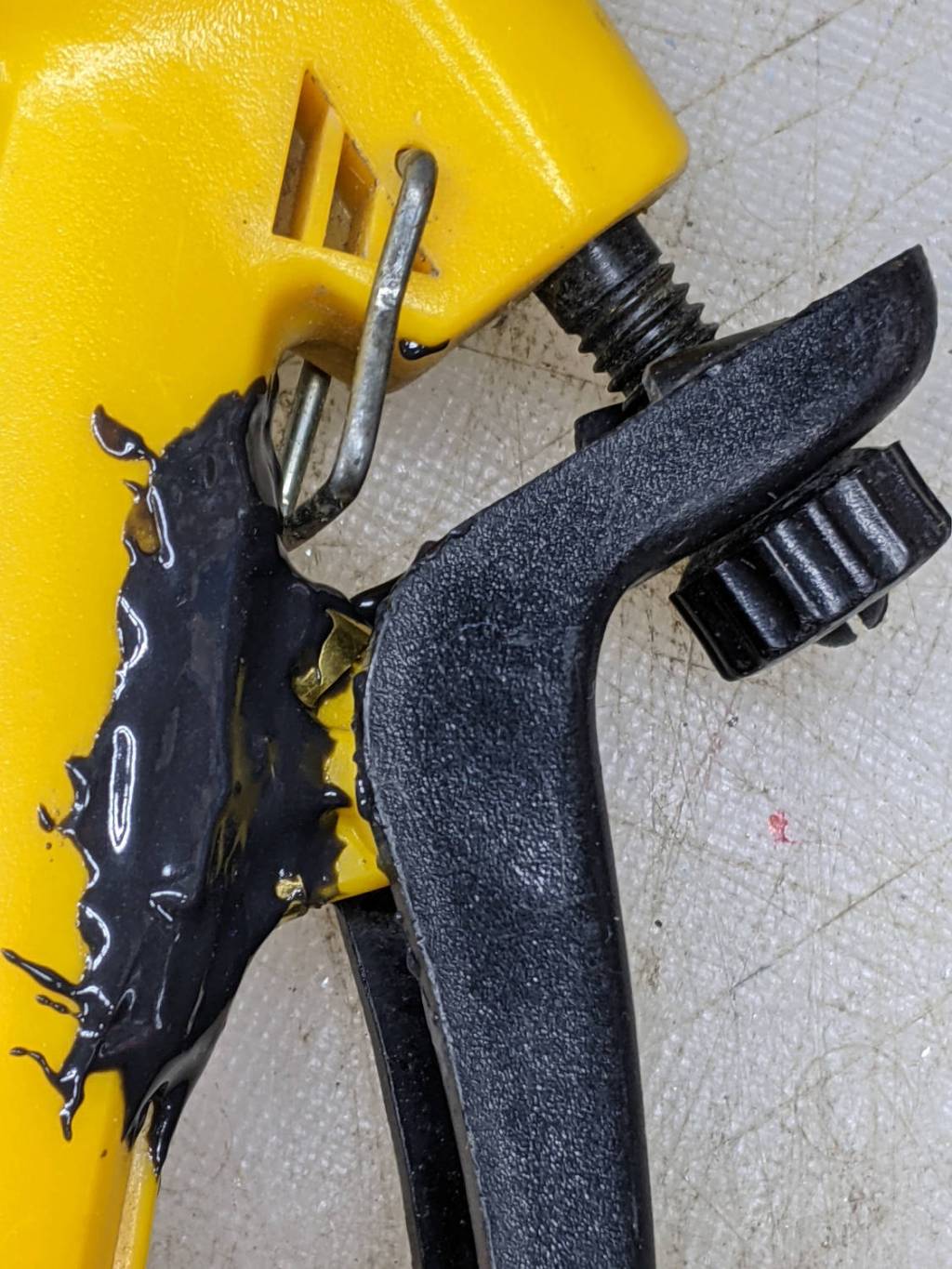
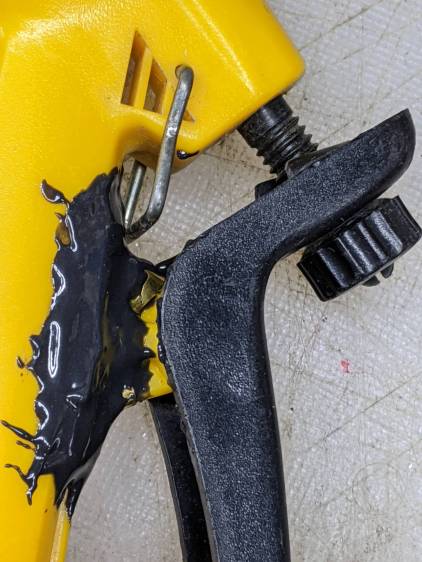
    A detailed view of the gap with the lever at the tripped position:

    Bafang Brake Sensor - activated detail
    Bafang Brake Sensor – activated detail

    The levers have enough travel to prevent accidental trips due to light finger pressure, which turned out to be a problem with the original end-on alignment.

    The brake pads don’t quite touch the rim when the switch trips, so the motor has plenty of time to shut off before the brakes take effect. It also stops when the pedals stop turning, so we should not see any disagreement between motor and brakes as to the bike’s momentum.

    The wider base on the new mounts makes them much more stable on the levers, although I don’t like having them stick up so far. Mounting everything underneath the levers would look better, but any problems will be more obvious with everything in plain sight.

    I may affix the magnets directly to the levers with Plastic Bonder if the foam tape doesn’t live up to its reputation. Removing them would be more challenging; a shot with a small chisel should suffice.

  • Amazon Packaging: Grease Cartridge

    Amazon Packaging: Grease Cartridge

    I knew this would happen, so I made sure to not order anything that could possibly arrive at the same time:

    Grease cartridge - casual packaging
    Grease cartridge – casual packaging

    I’ll apply the grease by hand, so the fact the cartridge cannot fit into a piston-fed gun doesn’t matter:

    Grease cartridge - cap damage
    Grease cartridge – cap damage

    I recently placed one order for a BFW and another for four small bottles, all of which arrived in a single box with a thoroughly flattened air pillow strip. Fortunately, the bottles were plastic and survived unscathed, but I’m sure it got ugly in there.

    Given that one order for multiple items has arrived in three different boxes on two different days, it’s exceedingly difficult to work around Amazon’s corporate-level indifference for safe packaging.

  • Tour Easy Front Fender Bracket Replacement

    Tour Easy Front Fender Bracket Replacement

    After nearly two and a half years, this happened:

    Tour Easy front fender bracket - fracture
    Tour Easy front fender bracket – fracture

    Yup, it broke just where I expected!

    The front fender on Mary’s bike suffers a bit more stress than you might expect, as she must wheel it through high grass to her Vassar Farms garden plot and the low-hanging spray flap can snag on the taller greenery.

    Re-slicing the original model, printing the result, and installing it took about an hour:

    Tour Easy front fender bracket - installed
    Tour Easy front fender bracket – installed

    Affixing the strut with duct tape and a cable tie looks déclassé, but continues to work better than anything else I’ve tried: simple, flexible, easily readjusted, totally nonfussy.

    At least I now use black outdoor-rated double-stick foam tape, so life is increasingly good …

  • Satco PAR30 LED Spotlight Teardown

    Satco PAR30 LED Spotlight Teardown

    One of those LED spotlights may have barely outlasted its worthless warranty, but not by much, and has been languishing on the back of the bench with “Flickers hot” scrawled on its side.

    The metal base didn’t respond to twisting, so I slit the threads with a cutoff wheel:

    Satco PAR30 - thread slit
    Satco PAR30 – thread slit

    Applying the screwdriver removed the base to reveal a silicone rubber casting:

    Satco PAR30 - thread silicone
    Satco PAR30 – thread silicone

    The small wire emerging near the edge of the plastic case seems to be the neutral contact to the shell, with a poor enough joint to suggest it might have been why the lamp flickered when it got hot.

    Some brute force snapped the silicone off at the bottom of the plastic case and broke the two wires bringing AC to the PCB:

    Satco PAR30 - thread silicone base
    Satco PAR30 – thread silicone base

    Digging around inside produced a debris field of silicone crumbs, broken resistors, torn caps, and various other components, with zero progress toward removing the shell:

    Satco PAR30 - silicone extraction
    Satco PAR30 – silicone extraction

    A little lathe work converted a chunk of PVC pipe into a crude mandrel supporting the mangled case:

    Satco PAR30 - base cutting setup
    Satco PAR30 – base cutting setup

    A few millimeters of sissy cuts released a silicone O-ring sealing the shell against the reflector:

    Satco PAR30 - O-ring seal
    Satco PAR30 – O-ring seal

    Continuing the cuts eventually revealed the three screws holding the shell to the reflector and the two wires powering the LED:

    Satco PAR30 - reflector separated
    Satco PAR30 – reflector separated

    Chopping off the screws with a diagonal cutter freed the shell and revealed the top of the PCB:

    Satco PAR30 - electronics top
    Satco PAR30 – electronics top

    It really does have a surprising number of components!

    Those three screws connected the LED panel / heatsink to the shell through the back of the double-walled reflector. More brute force peeled the outer shell away and released the panel:

    Satco PAR30 - lens assembly
    Satco PAR30 – lens assembly

    Each of the 5050 packages contains a pair of white LEDs with 5.2 V forward drop for the pair, at the very low test current. They’re all in series, so you’re looking at well over 60 V total forward drop:

    Satco PAR30 - LED panel detail
    Satco PAR30 – LED panel detail

    Note that the wiring, which nobody will ever see, follows the electrical color code of white = common and gray = hot.

    Perhaps I should turn the lens into an interesting art object

  • Discrete LM3909: Blue LED

    Discrete LM3909: Blue LED

    Once again, the discrete LM3909 circuitry can blink a blue LED while running a pair of alkaline cells all the way down to about 1 V, with one cell ending at 0.2 V and the other at 0.8 V. They started out discharged to 1.2 V each during their useful life, then blinked for a month; it’s as good a use for dead cells as I can think of.

    With another pair of not-dead-yet cells providing 2.4 V, it started up again:

    Blue LM3909 2.4V alkaline - 042
    Blue LM3909 2.4V alkaline – 042

    That’s a frame from a short video taken in subdued light, just to show it really does work.

  • Cordomatic 500P Disassembly

    Cordomatic 500P Disassembly

    A pair of antique collectible Cordomatic reels get occasional use in the Basement Laboratory:

    Cordomatic 500P reel - installed
    Cordomatic 500P reel – installed

    The extension cord reel didn’t latch reliably when needed, so …

    There’s an obvious screw on the other side and a non-obvious screw hidden in the obvious place:

    Cordomatic 500P reel - hidden screw
    Cordomatic 500P reel – hidden screw

    The electrical contacts were in good shape, although I smeared the grease around the rings just to make it seem like I did something:

    Cordomatic 500P reel - contacts
    Cordomatic 500P reel – contacts

    The ratchet pawls hide under a riveted cover:

    Cordomatic 500P reel - pawl cover
    Cordomatic 500P reel – pawl cover

    The duct tape shows I’d been in there once before, likely for the same problem, and had already drilled out the rivets.

    Alas, I forgot to take a picture after removing the cover, but the general idea is to put just a dot of oil on the pivots (which, as you’d expect, are the rivets), wiggle everything around, and reassemble in reverse order.

    It’ll surely work long enough that I can forget I was in there twice before …

  • Tour Easy: Another Rear Fender Bracket

    Tour Easy: Another Rear Fender Bracket

    All the work on Mary’s bike reminded me of the rear fender bracket I meant to install on mine, with more clearance for the strut stabilizing the under-seat packs:

    Tour Easy Rear Fender Bracket - long setback - solid model - show
    Tour Easy Rear Fender Bracket – long setback – solid model – show

    Rather than glue a PETG filament snippet into a screw, I turned a little Delrin plug:

    Tour Easy Rear Fender Bracket - screw insert
    Tour Easy Rear Fender Bracket – screw insert

    It’s ready for installation when I’m willing to put the bike up on the rack and pull the rear wheel:

    Tour Easy Rear Fender Bracket - screw detail
    Tour Easy Rear Fender Bracket – screw detail

    That’s actually the second iteration for the screw, as the first suffered a lethal encounter with the Greater Shopvac. I know exactly where it is, but I’m not going there …