The Smell of Molten Projects in the Morning

Ed Nisley's Blog: Shop notes, electronics, firmware, machinery, 3D printing, laser cuttery, and curiosities. Contents: 100% human thinking, 0% AI slop.

Month: August 2023

  • Onion Maggot Fly vs. Sticky Traps: Season 3 Finale

    Onion Maggot Fly vs. Sticky Traps: Season 3 Finale

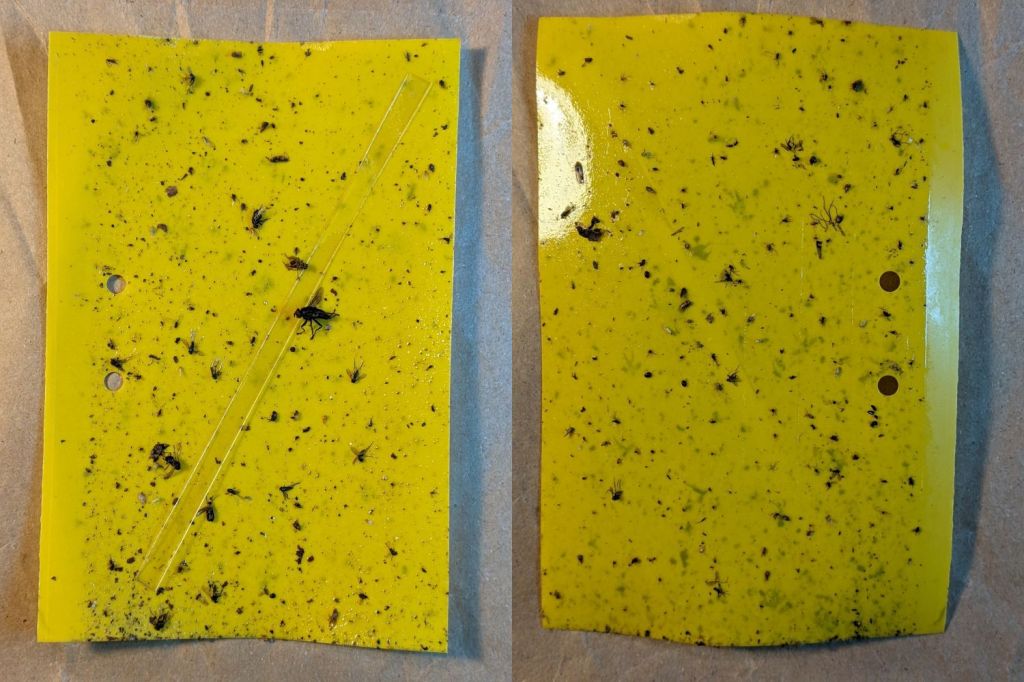
    The six sticky traps guarding Mary’s onion beds in her Vassar Community Gardens plots collected this assortment of critter and mulch from mid-July through mid-August, when she harvested the last of the crop:

    • VCCG Onion Maggot Trap A
    • VCCG Onion Maggot Trap B
    • VCCG Onion Maggot Trap C
    • VCCG Onion Maggot Trap D
    • VCCG Onion Maggot Trap E
    • VCCG Onion Maggot Trap F

    The labels do not match those on the first set through mid-July, because I don’t care quite enough to keep track of them.

    The traps don’t collect many onion maggot flies, which suggests that a little control goes a long way. As far as she’s concerned, these traps work very well, because the crop has very little maggot damage.

    Searching for onion sticky traps will produce the rest of the collection. Contact me for the full resolution images, should you need to ID all the critters.
  • Onion Maggot Fly Sticky Trap Repair

    Onion Maggot Fly Sticky Trap Repair

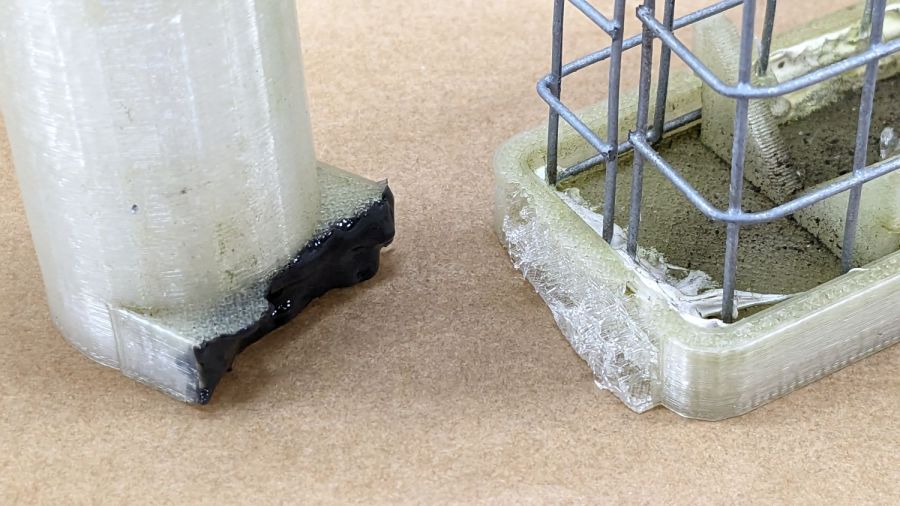
    One of the sticky traps absorbed a mighty blow during the season and its ski-pole mount snapped off. Rather then rebuild the whole thing, I decided to just epoxy the pieces together and stick a reinforcing plate on the bottom.

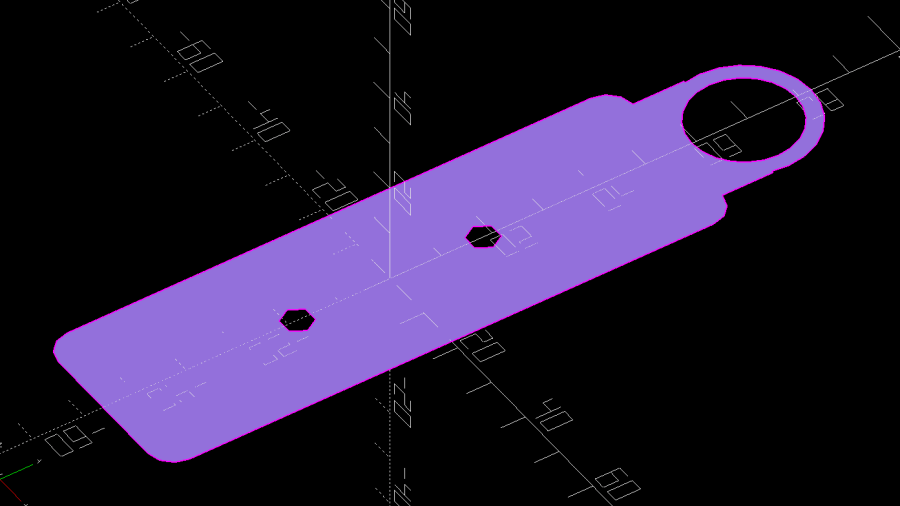
    I added a pair of screw holes to the OpenSCAD model and produced a projection of the bottom layer:

    if (Layout == "Projection") {
        projection(cut=true) {
            Attachment();
            Cap();
        }
    }
    

    Which looked like this:

    Sticky Sheet Cage - projection
    Sticky Sheet Cage – projection

    Cutting that shape from an adhesive sheet looks the same:

    Onion Maggot Fly Trap - adhesive sheet
    Onion Maggot Fly Trap – adhesive sheet

    The somewhat raggedy large hole seems to come from OpenSCAD’s somewhat low-res SVG outline conversion.

    Fill the broken part with epoxy:

    Onion Maggot Fly Trap - epoxy ready
    Onion Maggot Fly Trap – epoxy ready

    Clamp it together on a plate to keep the bottom aligned:

    Onion Maggot Fly Trap - clamping
    Onion Maggot Fly Trap – clamping

    Cut an acrylic baseplate:

    Onion Maggot Fly Trap - acrylic cut
    Onion Maggot Fly Trap – acrylic cut

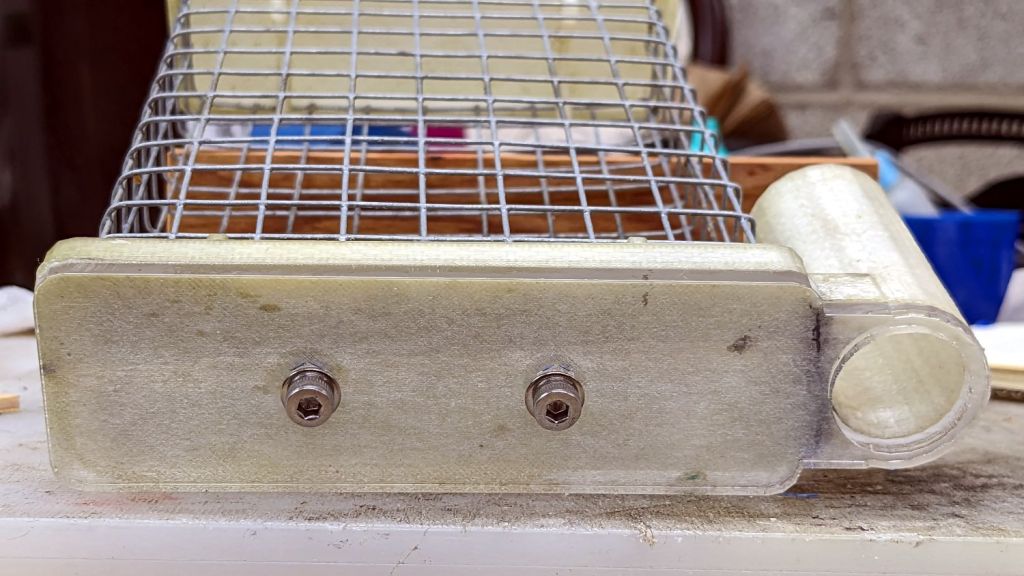
    Apply adhesive sheet to acrylic, stick it on the bottom of the cage, add a pair of stainless steel screws, and declare victory:

    Onion Maggot Fly Trap - bottom view
    Onion Maggot Fly Trap – bottom view

    We’ll see how long that lasts out in the garden next year …

  • Popsicle Mixing Sticks

    Popsicle Mixing Sticks

    Perhaps popsicle stick mixers?

    Popsicle stick mixer - in action
    Popsicle stick mixer – in action

    I made a batch to see if they’d simplify mixing my usual tiny batches of epoxy … and they do! Now I need not worry about forgetting to wipe off the screwdriver or cross-contaminating the resin / hardener tubes.

    Reshaping the tip so the laser beam enters at right angles to the stick produced a cleaner cut and a slightly narrower blade:

    Popsicle stick mixer - cutting
    Popsicle stick mixer – cutting

    The fixture and LightBurn template I made for the engraved markers came in handy. Aligning the template to the fixture proceeds as with the larger craft stick garden markers.

    A small holder keeps finished sticks ready for use:

    Popsicle stick mixer - presentation box
    Popsicle stick mixer – presentation box

    I don’t know how long the box originally holding 1000 sticks has been sitting on the shop shelf, but it’s at least half full despite my continuing efforts. Maybe I can get ahead on my holiday gift prep?

    The LightBurn SVG template layout as a GitHub Gist:

    Loading
    Sorry, something went wrong. Reload?
    Sorry, we cannot display this file.
    Sorry, this file is invalid so it cannot be displayed.

  • Zenni Optical Glasses: Metalbending

    Zenni Optical Glasses: Metalbending

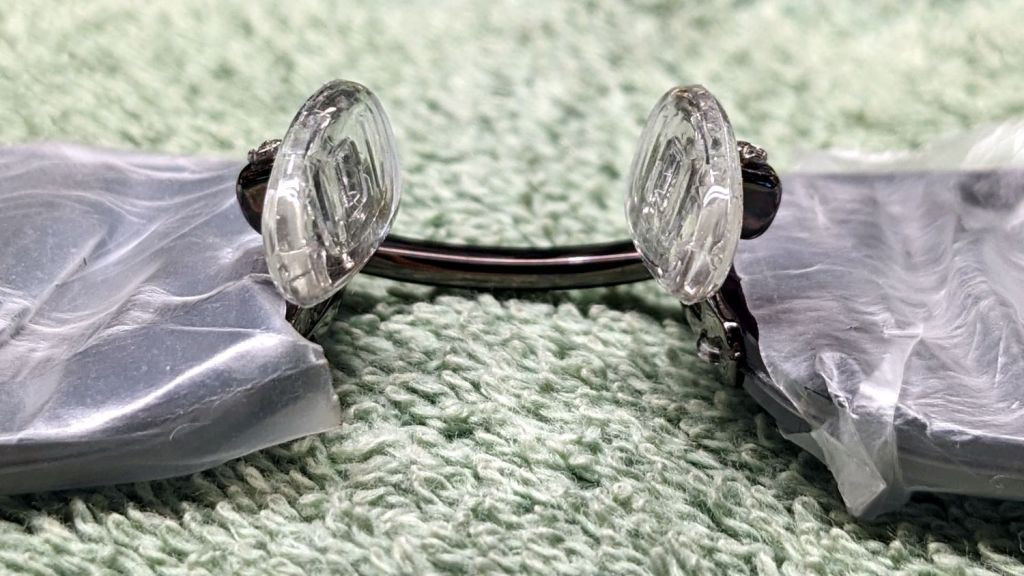
    The new batch of glasses I just received makes me take back any nice things I previously implied about Zenni Optical’s nose pad alignment:

    Zenni eyeglass pads - as received
    Zenni eyeglass pads – as received

    Zenni does have a guide to reshaping the frames, but it does not include aligning the pads parallel to your nose, which definitely goes better with wire-bending pliers in hand.

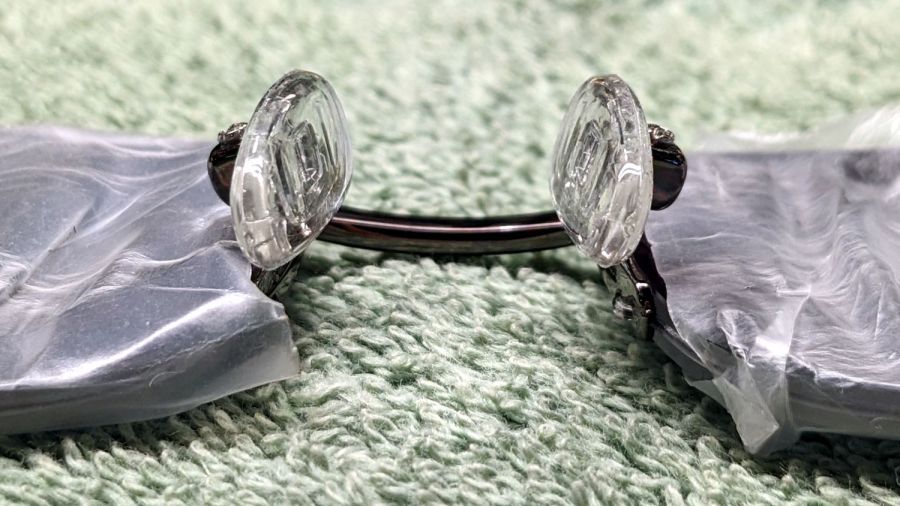
    They should look more like this when you’re done:

    Zenni eyeglass pads - aligned
    Zenni eyeglass pads – aligned

    I suppose this is a consequence of being able to get two eyeglasses + two sunglasses in three different frame styles and two different prescriptions, each with progressive lenses and antireflective coating, for about $350 delivered halfway around the planet.

    Makes owning a set of metal-forming pliers look downright economical.

    A few years ago, Mary paid more than that for a single pair of badly fitted glasses from a local outlet. Those days are over.

  • Magnetic Stirrer Resurfacing & Mug Decoration

    Magnetic Stirrer Resurfacing & Mug Decoration

    Half a year of plunking my morning cocoa mug on the magnetic stirrer had pretty well scuffed up its platform, so this seemed like a good idea:

    Magnetic stirrer - vinyl surface
    Magnetic stirrer – vinyl surface

    Rather than add the blue disk to the small-scraps collection, I converted the Squidwrench logo into a LightBurn layout:

    Squidwrench logo - laser cut layout
    Squidwrench logo – laser cut layout

    The roll of transfer tape I have on hand doesn’t stick well to the polyurethane sheet, so easing the vinyl onto the mug required careful tweezer work:

    Squidwrench logo on mug
    Squidwrench logo on mug

    It’s on the other side of the mug from the original, somewhat battered, logo.

    Now we can learn how long polyurethane sheets survive under the same conditions.

  • Newmowa NP-BX1

    Newmowa NP-BX1

    After a year’s service in my Sony AS-30V helmet camera, the Newmowa NP-BX1 lithium cells perform pretty nearly as well as they started out:

    NP-BX1 - Newmowa 2022 - 2023-08
    NP-BX1 – Newmowa 2022 – 2023-08

    Recharging the cells after that test averaged 907 mA·hr within 2%, so they’re still reasonably well grouped.

    The camera burns 1.9 W, so the worst of the cells has a 100 minute runtime = 3.3 W·hr/1.9 W × 60 min/hr,.

    Our usual weekday rides run a little over an hour and I change the batteries during our longer weekend rides, so they rarely see more than an hour’s use.

    A recent 1-¼ hour = 75 minute ride soaked up 687 mA·hr, just about exactly 75% of 907 mA·hr. Gotta love it when the numbers work.

    Surprisingly good performance, given the drama involved in finding those cells. I wonder if that will hold next year when I buy another set?

  • Eneloop AAA Cells: Six Years of Blinkiness

    Eneloop AAA Cells: Six Years of Blinkiness

    With the rear running lights up and mmmm running on our Tour Easy recumbents, I could finally retire the Planet Bike Superflash blinkie after a decade of constant use:

    Superflash on Tour Easy
    Superflash on Tour Easy

    For the last six years, a set of eight Panasonic Eneloop AAA cells have been marching in pairs through the Superflashes in lockstep alphabetic order. We ride several times a week, less in the winter, and I changed the batteries once a week whether they need it or not, so they’ve gone through maybe 200 charge cycles. With four pairs and two bikes, that’s 100 cycles each.

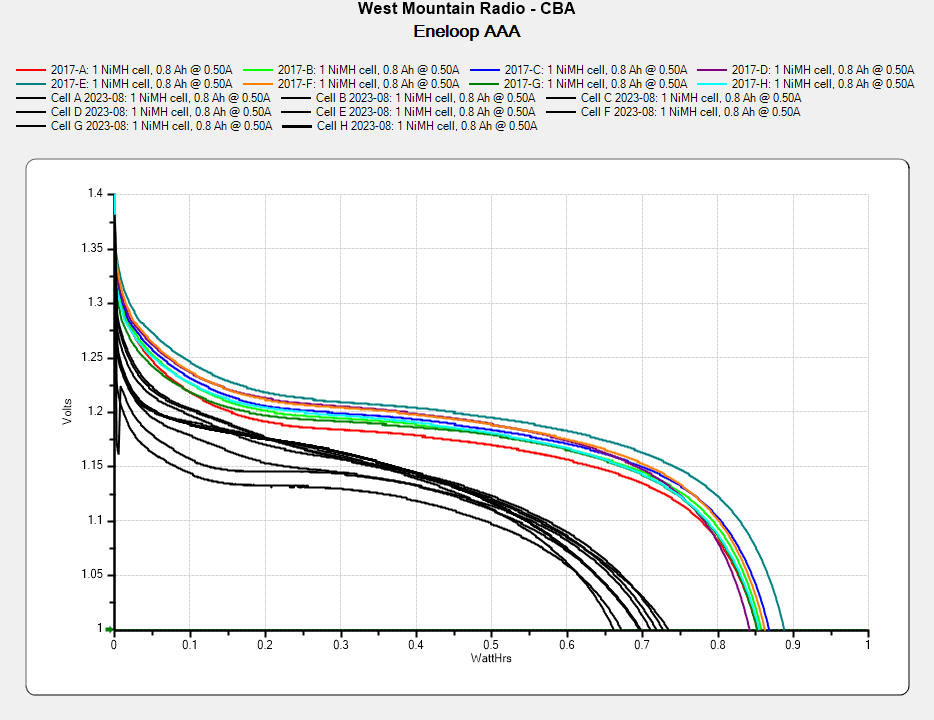
    They’re not dead yet, but they’re showing signs of age:

    Eneloop AAA - final - 2023-08
    Eneloop AAA – final – 2023-08

    In round numbers, the capacity is down 20% from their original 850 mW·hr. The 50 to 75 mV depression is probably more significant for an LED power supply intended for alkaline cells, as the light was running from 2.3 V instead of 3 V.

    They worked surprisingly well, all things considered.

    Nowadays, one might use bucked lithium cells with a constant 1.5 V output for their entire discharge curve, although I absolutely do not believe a claimed 1000+ mW·hr capacity.