The Smell of Molten Projects in the Morning

Ed Nisley's Blog: Shop notes, electronics, firmware, machinery, 3D printing, laser cuttery, and curiosities. Contents: 100% human thinking, 0% AI slop.

Month: July 2021

  • Tour Easy: Amber Running Light

    Tour Easy: Amber Running Light

    Having seen a few bikes with amber “headlights” and being desirous of reducing the number of batteries on Mary’s bike, this seems like an obvious first step:
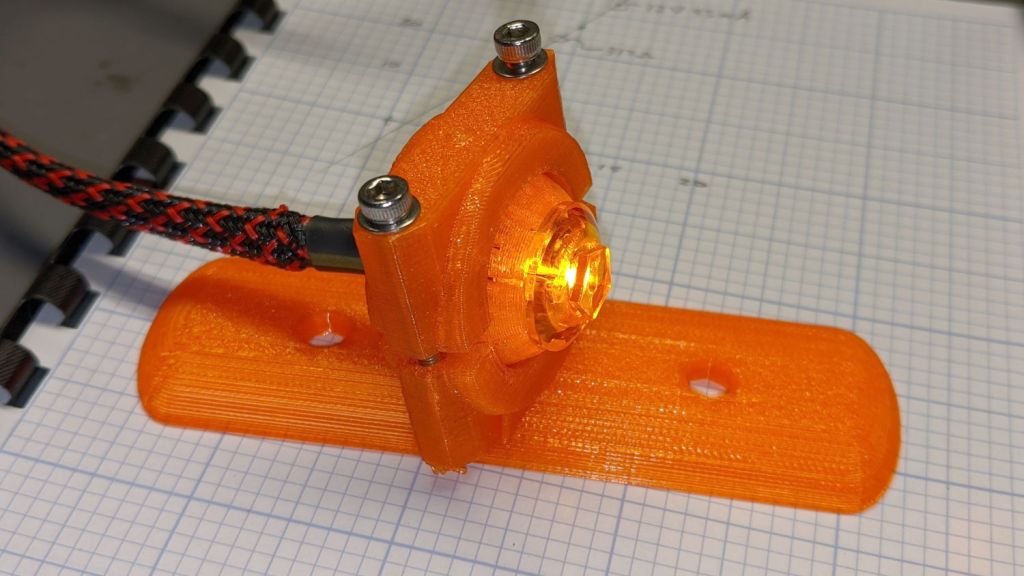
    Fairing Mounted Side Marker - First Light
    Fairing Mounted Side Marker – First Light

    It descends from the fairing flashlight mount with an entry to suit a 15 mm truck side marker body:

    LightBodies = [
      ["AnkerLC90",26.6,48.0],
      ["AnkerLC40",26.6,55.0],
      ["J5TactV2",25.0,30.0],
      ["InnovaX5",22.0,55.0],
      ["Sidemarker",15.0,20.0],
      ["Laser",10.0,30.0],
    ];
    

    The rest of the code gets a few cleanups you’d expect when you compile code untouched for a few years using the latest OpenSCAD.

    The markers are allegedly DOT rated, which matters not for my use case: SAEP2PCDOT.

    The mount is grossly overqualified for a wide-beam light with little need for aiming:
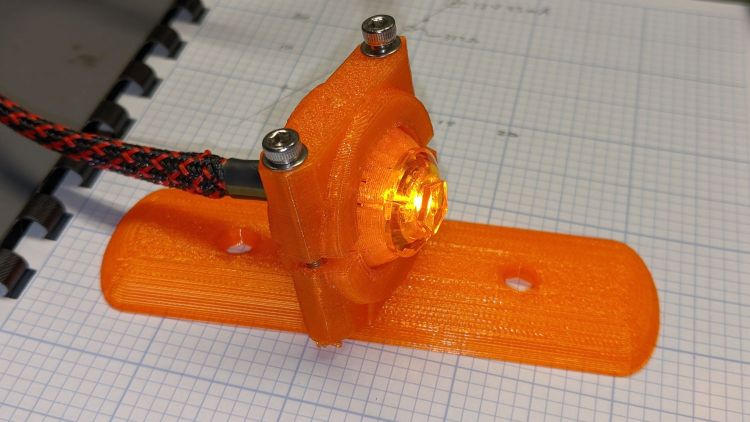
    Fairing Mounted Side Marker - test light
    Fairing Mounted Side Marker – test light

    Eventually, the marker should slip into a prealigned cylindrical holder, with a dab of epoxy to keep it there.

    The lights are a buck apiece, so there’s no reason to form a deep emotional attachment. They are the usual poorly molded and badly assembled crap, although the next step up from a nominally reputable supplier is a factor of five more expensive.

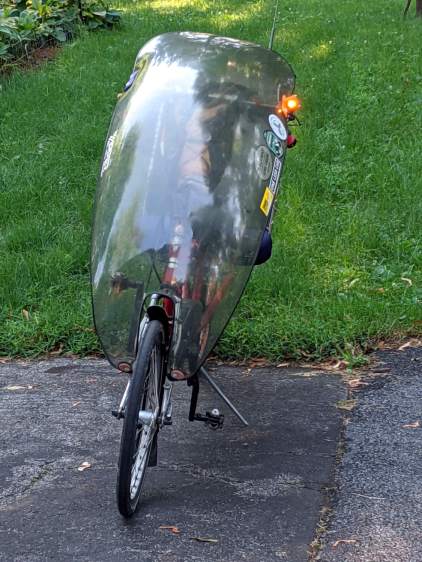
    It’s generated for the left side of the fairing, although I think having a pair of them would improve conspicuity:
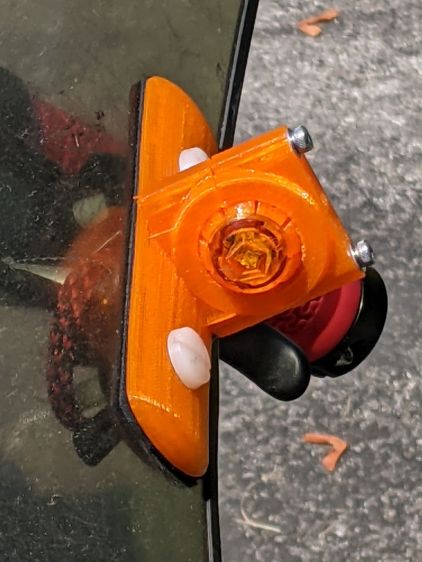
    Fairing Mounted Side Marker - installed
    Fairing Mounted Side Marker – installed

    Being automotive, it runs from a 12 V supply, which comes from a boost converter driven by the Bafang 6 V headlight output. The absurdity of bucking a 48 V lithium battery to a 6V switched headlight output, then boosting it to 12 V to drive a single amber LED with a 1.5 V forward drop does not escape me.

    It’s possible to slice the lens off (using a lathe), remove / replace the resistor, then glue it back together, which would be worthwhile if you were intending to drive it from, say, an Arduino-ish microcontroller to get a unique blink pattern.

    Given the overall lack of build quality, it might make more sense to slap a condenser lens in front of a Piranha LED.

    Bonus: contrary to what you (well, I) might expect, the black lead is positive and the white lead is negative.

  • Carolina Wren Construction

    Carolina Wren Construction

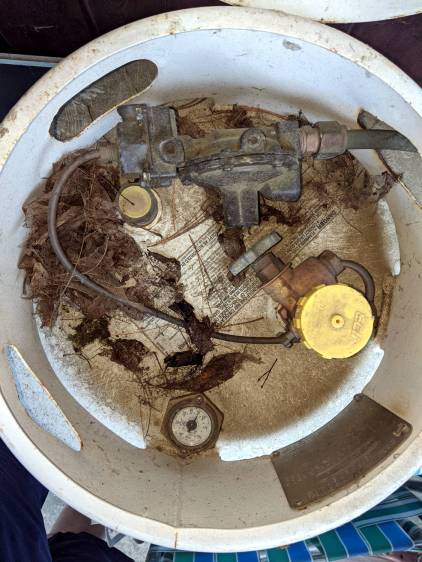
    A great musical interlude on the patio announced an airlift of construction materials eventually producing this pile inside the top cover of the propane tank:

    Carolina Wren - nest started atop propane tank
    Carolina Wren – nest started atop propane tank

    The male Carolina Wren switched from the Tweedle of Great Nestbuilding to the less musical Mighty Chirr of Disapproval, presumably because he noticed a mouse (or, perhaps, chipmunk) occupying the lower ring of the tank. Rodents and birds do not coexist well at all; I have no doubt a mouse would climb right up the tank for a supply of breakfast eggs.

    I must blow the crud off the tank before the next fill.

  • Bafang BBS02: Assist Power Levels

    Bafang BBS02: Assist Power Levels

    Although Gee’s Terry Symmetry is sized for female bodies, I managed to ride it up and down the driveway while watching the power display:

    Voltage52.5
    Rated Current24
    Max current18
    PowerPower
    PASAssistAmpCalcObservedRatio
    00%0.000~
    14%0.7382669%
    26%1.1575292%
    39%1.6857892%
    413%2.312310485%
    520%3.618918296%
    630%5.428425891%
    750%9.047345396%
    885%15.380367584%
    9100%18.094590095%
    Bafang BBS02 on Terry Symmetry – actual voltage

    The variations in the last column suggest my data-taking is … wobbly, at best.

    I think the displayed power does not come from actual current and voltage measurements, because recalculating the power using the nominal 48 V battery value produces an unnatural agreement:

    Voltage48
    Rated Current24
    Max current18
    PowerPower
    PASAssistAmpCalcObservedRatio
    00%0.000~
    14%0.7352675%
    26%1.15252100%
    39%1.67878100%
    413%2.311210493%
    520%3.6173182105%
    630%5.4259258100%
    750%9.0432453105%
    885%15.373467592%
    9100%18.0864900104%
    Bafang BBS02 on Terry Symmetry – nominal voltage

    The motor controller may measure the actual winding currents while generating the BLDC waveforms, but the values may not be available to the display at the end of the cable. If Bafang documented the commands & responses, we’d know for sure, but they don’t.

    Those assist values come from Mary’s Tour Easy, a much heavier bike than the Symmetry, but the first few levels work well in my limited tests. The highest levels may be too peppy for Gee’s normal routes, but having some serious boost in reserve can defang (hah) the worst hills.

    Terry Symmetry - Tour Easy
    Terry Symmetry – Tour Easy

    IMO, the bike would burn rubber at the motor’s full 24 A current …