Ed Nisley's Blog: Shop notes, electronics, firmware, machinery, 3D printing, laser cuttery, and curiosities. Contents: 100% human thinking, 0% AI slop.
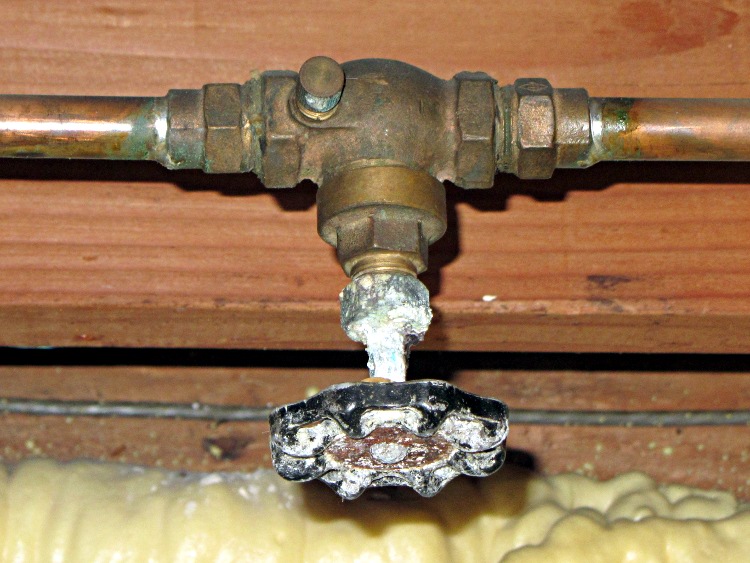
After replacing the hose valve in the garage, I promised to repair its leaky upstream shutoff valve:
Corroded gate valve
I shut off the hard water supply, dismantled the valve, and let everything soak in a cup of white vinegar for a few hours. The fizzing was a wonder to behold and the parts came out much cleaner without any effort at all.
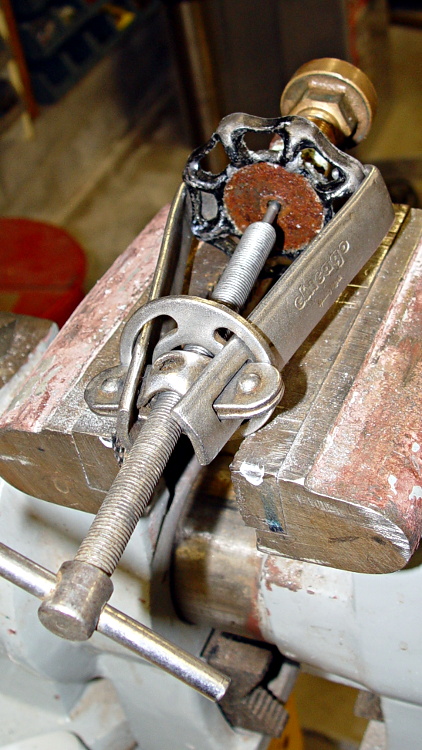
Removing the handle required the handle puller and considerable rapping on the corroded-in-place handle at the tapered shaft. That reddish disk used to be a tin-plated steel data plate, but now it’s just a corroded sheet:
Shutoff valve – handle puller
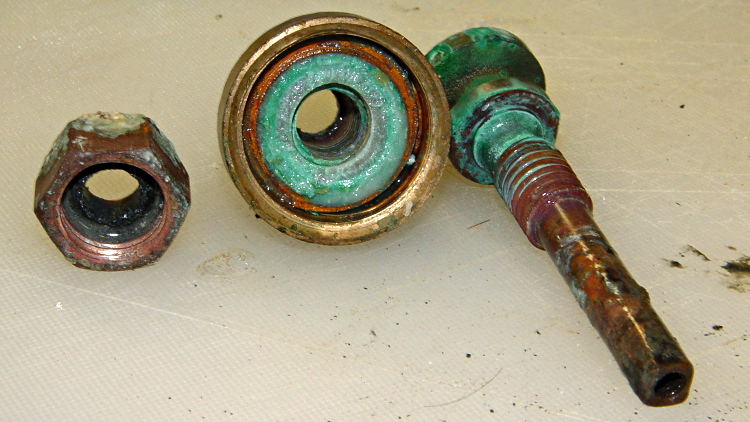
Because a shutoff valve will be open nearly all the time, it has a large washer that seals the cap and valve stem in addition to the usual stem packing:
Shutoff valve – full-open washer
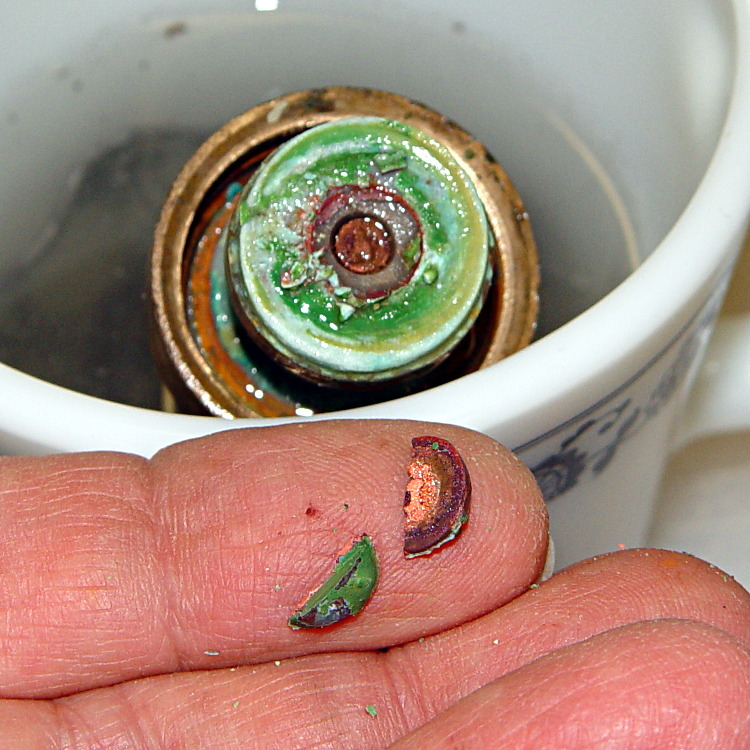
Attempting to remove the screw from the stem broke the head into two pieces:
Shutoff valve – broken washer screw
Worse, the screw shaft was a soft mass of corroded brass, so I had to drill it out and chase the threads with a 10-32 tap. I replaced the full-open washer with a slightly smaller one from the supply box, which required drilling out the hole to suit, adding some packing string under the main cap, and replacing the packing around the stem. But, eventually, putting everything back together works fine with no leaks at all.
This turned out to be slightly less horrible than I expected, which probably doesn’t justify procrastinating until the evening before the coldest night of the season.
While pondering whether I should use the carcass of an old Dell PC to house the stepper drivers and control logic for the LinuxCNC M2 project, I bandsawed a scrap of aluminum sheet to about the right size. It had some truly nasty gouges and bonded-on crud, so I chucked up a wire brush cup in the drill press and had at it:
Machine jeweled baseplate
It’s obvious I haven’t done jeweling in a long time, isn’t it? Even a crude engine jeweling job spiffs things right up, though, even if a cough showcase job like this deserves straighter lines and more precise spacing. The aluminum sheet is far too large for the Sherline, which put CNC right out of consideration, and I’m not up for sufficient crank spinning on the big manual mill.
I match-marked mounting holes directly from the harvested motherboard and drilled them, whereupon I discovered that the aluminum is a dead-soft gummy alloy that doesn’t machine cleanly: it won’t become the final baseplate.
Memo to Self: Use the shop vacuum with the nozzle spinward of the brush, fool.
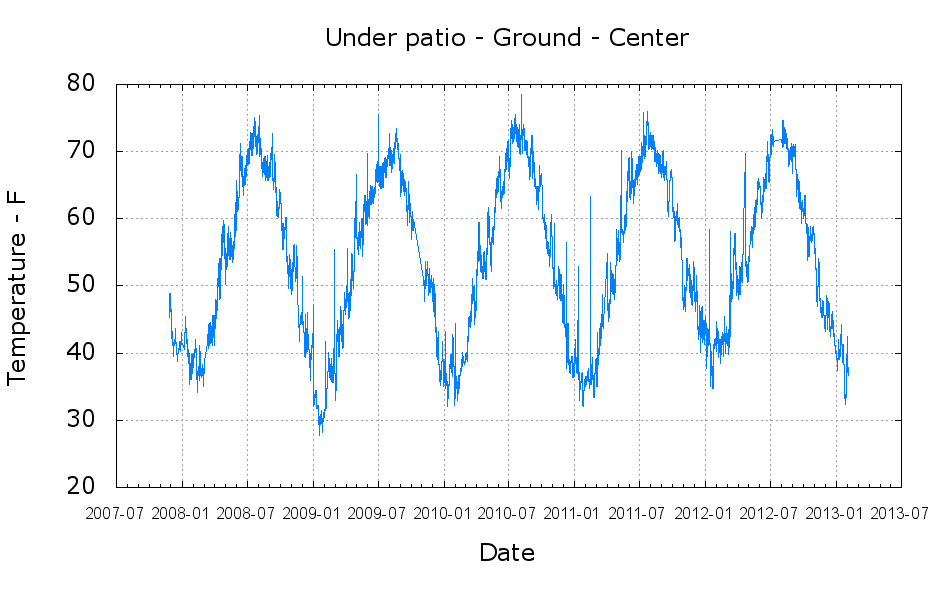
The patio at the rear of our house is a six inch concrete slab with a five foot “crawlspace” below it, with a HOBO datalogger pendant in the dirt near the pole at the middle of the I beam supporting the slab. The pendant is very close to the surface, so there’s a big diurnal temperature variation, but it still gives a reasonable picture of seasonal change.
A configuration setting in Hoboware determines whether it stores / exports dates with years having two digits or four digits. As you might expect, over the course of five years the dates have both formats, but there’s always a blank separating the date and the time:
grep "/12 " /tmp/data.csv | head -1
1,11/09/12 08:45:00 ,49.050,,,,
grep "/2012 " /tmp/data.csv | head -1
2235,01/01/2012 00:00:00,44.560,0.0,,,,
This burst of sed regex line noise normalizes all years to four digits:
sed 's/\/\([0-9][0-9]\) /\/20\1 /' whatever.csv
The parenthesized subexpression matches the digits of a two digit year preceding a blank, then the \1 plugs it into the right spot in the output. This suffers from the usual failure when the century rolls over, but frankly, my dear readers, I don’t give a damn. The backslashes escape forward slashes and parentheses, in addition to making the regex pretty much write-only.
The plot shows the expected annual variation:
Under patio – Ground – Center
The periodic upward spikes happen when I carry the logger to the Token Windows Laptop and read it out; the air temperature upstairs is always warmer than the dirt under the patio.
The Bash and gnuplot script that produced the graph:
#!/bin/sh
#-- overhead
export GDFONTPATH="/usr/share/fonts/truetype/"
base="${1%.*}"
echo Base name: ${base}
ofile=${base}.png
tfile=$(tempfile)
echo Input file: $1
echo Temporary file: ${tfile}
echo Output file: ${ofile}
#-- prepare csv Hobo logger file
sed 's/^\"/#&/' "$1" | sed 's/^.*Logged/#&/' | sed 's/ ,/,/' | sed 's/\/\([0-9][0-9]\) /\/20\1 /' > ${tfile}
#-- do it
gnuplot << EOF
#set term x11
set term png font "arialbd.ttf" 18 size 950,600
set output "${ofile}"
set title "${base}"
set key noautotitles
unset mouse
set bmargin 4
set grid xtics ytics
set timefmt "%m/%d/%Y %H:%M:%S"
set xdata time
set xlabel "Date"
set format x "%Y-%m"
#set xrange [1.8:2.2]
set xtics font "arial,12"
#set mxtics 2
#set logscale y
#set ytics nomirror autofreq
set ylabel "Temperature - F"
#set format y "%4.0f"
#set yrange [30:90]
#set mytics 2
#set y2label "right side variable"
#set y2tics nomirror autofreq 2
#set format y2 "%3.0f"
#set y2range [0:200]
#set y2tics 32
#set rmargin 9
set datafile separator ","
#set label 1 "label text" at 2.100,110 right font "arialbd,18"
#set arrow from 2.100,110 to 2.105,103 lt 1 lw 2 lc 0
plot	\
    "${tfile}" using 2:3 with lines lt 3
EOF

 The Smell of Molten Projects in the Morning