
Having cooked up a simpleminded 12.000 MHz crystal oscillator for the WWVB simulator and gotten something close-to-but-not-spot-on the right frequency, I thought it’d be interesting to measure some of my 12 MHz crystal grab-bag collection.
This is in the nature of exploratory surgery to see if anything more complex is warranted.
The general procedure is covered in excellent detail by K8IQY there. His method includes building a precision oscillator and a very nice test fixture, plus a bit of straightforward commercial instrumentation. Well worth perusing.
I have the good fortune to own an HP8591E spectrum analyzer (hereinafter, the SA) with a tracking generator (ditto, TG) that can calibrate itself to a fare-thee-well. I had to let it warm up for a few hours, as the Basement Laboratory is a wee bit colder than it really likes. Heck, it’s a lot colder than I really like, for whatever that’s worth.
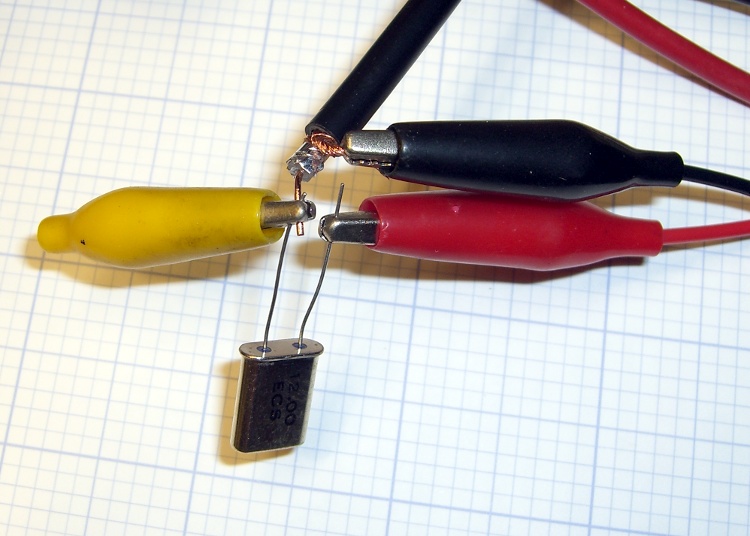
I bodged up some random coax and a few clip leads into a fur-ball circuit in front of the SA. This is not the right way to do it; a fixture with mechanical stability is the first step toward solid numbers.
The tracking generator & analyzer present 50 Ω impedances to the outside world, which is much too high for the expected crystal series resistance, but it’ll do for a start. You want to measure the crystal in an environment that’s pretty close to what it’ll be built into, so as to get meaningful numbers.
The crystal sits in series between the TG and the SA, looking a lot like a simpleminded (and badly terminated) crystal filter. Write down the sum of the crystal’s source (TG) and load (SA) termination resistances: 50+50 = 100.

Center frequency to 12 MHz (or whatever the crystal’s nominal frequency might be), span to 200 kHz, TG at -10 dBm, get a display of the series resonance peak and the parallel resonance dip, poke the Auto Tracking Adjust button to get the TG lined up with the SA. Span to 100 kHz, tune center frequency for best picture.
That shows the series resonant peak and parallel resonance notch, but it’s way too broad for any decent resolution in the measurements.
Soooo…
Poke marker peak search to find the series peak, poke marker to center frequency to slap the peak to the middle of the screen.
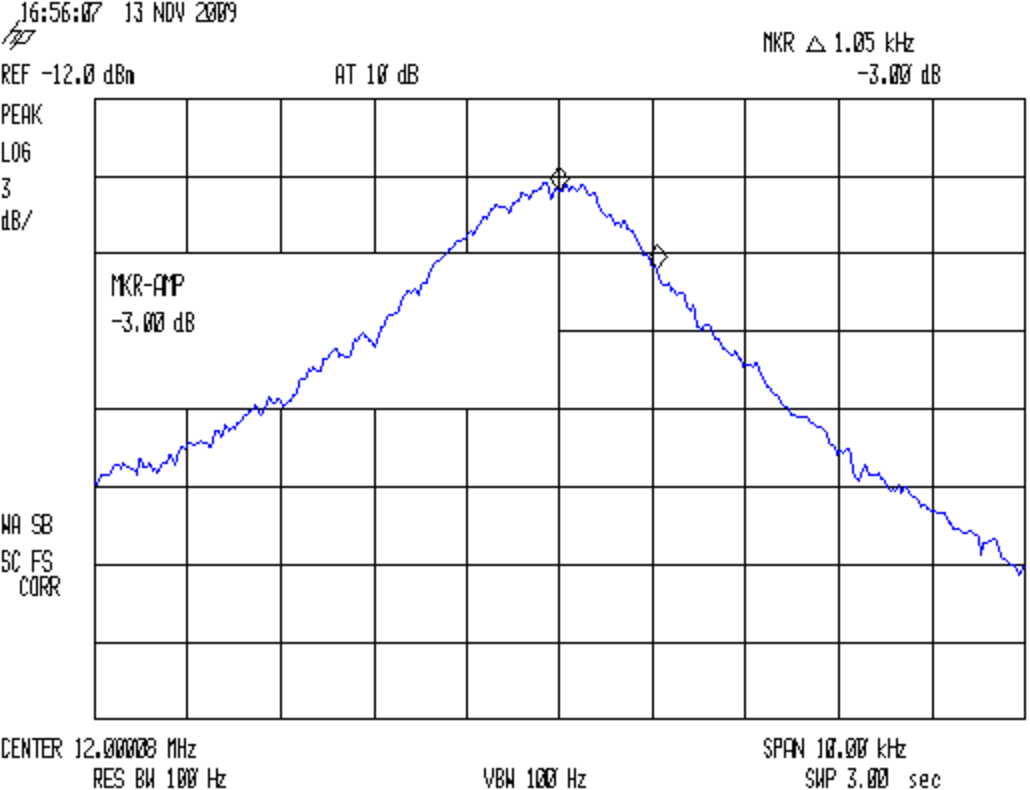
Span down to 5 kHz, which sets the resolution bandwidth to 100 Hz. Poke auto tracking adjust again, because it’ll be way off. Manual adjust moves in too-large steps.
Marker peak search, marker to center frequency. Tick the reference level down enough to get the peak near the top of the graticule, set 3 dB/div to get enough vertical resolution. Another peak search, to center, then write down the peak frequency Fs. Single sweep to freeze the display.
Marker delta, dial up the marker frequency, poke marker amplitude, set -3 dB, read off the marker delta frequency. Dial the marker frequency down to the other side of the peak, set amplitude -3 dB again, read off the frequency again. Compute the crystal’s 3-dB bandwidth BW as the sum of those two values.
Marker normal, auto-sweep to get a live trace again, auto tracking adjust again as needed. Display line on, set to peak for amplitude reference.
Replace the crystal with a 50-Ω (or so) non-inductive twiddlepot, twiddle to set level to the display line. Measure twiddlepot resistance, which will be equal to the crystal’s series resistance. Write down Rs (a.k.a, the ESR).
Measure crystal capacitance: short both leads, measure to case. Write down C0. I used an Autek RF-1 with a homebrew fixture, which has 1 pF resolution at RF frequencies; obviously, you pick a frequency well below Fs.
With all those numbers in hand, compute the crystal’s motional parameters…
Lm = (100 + Rs) / (2π BW)
Cm = 1 / ( (2π Fs)^2 Lm)
Q = (2π Fs Lm) / Rs
The three crystals from the grab bag are all reasonably close to what you’d expect.
| 12 MHz Crystal Parameters | 50 | Ohm Term | ||||||||
| Marking | Fs | -3 dB Lo | -3 dB Hi | Fp-Fs | Rs | C0 | BW | Lm | Cm | Q |
| MHz | Hz | Hz | kHz | Ω | pF | Hz | mH | fF | ||
| TEW 5C | 11.996962 | 1030 | 920 | 24.8 | 8.9 | 3 | 1950 | 8.16 | 21.56 | 69133 |
| HCI 1200 | 11.997500 | 1087 | 1025 | 26.8 | 5.0 | 2 | 2112 | 7.54 | 23.35 | 113618 |
| ECS 12.00 | 11.999975 | 1162 | 1125 | 26.3 | 6.2 | 2 | 2287 | 6.96 | 25.28 | 84635 |
Memo to Self:
The Lm equation shows why you really need lower termination resistances. The K8IQY fixture involves 4:1 matching transformers on each side of the crystal to get the generator down to 12.5-ish Ω and the output back up to 50 Ω. Time to rummage through my pile of ferrite toroids.
An accurate BW with excellent (1 Hz) resolution feeds directly into better Lm values. I’m not convinced I have the SA set up for that much resolution.
Absolute Fs accuracy isn’t needed, but high resolution is. With that many digits, thermal drift is a real issue, hence the repeated TG tweakage.
I also need better resolution for Rs and C0. The former needs a smaller twiddlepot. Both could use a better meter with more resolution and zero-offset for low values. Measuring pF caps requires a good fixture.
 The Smell of Molten Projects in the Morning
Comments
3 responses to “Crystal Properties: Quick-and-Dirty”
Hey, how do you get plots out of your SA? I have a large number of GPIB machines (my dad was an instrumentation engineer at HP) and so far I’ve had little luck talking to the machines. Windows software (national instruments) has horrendous limitations, like a max 256 character transfer, which is useless for screendumps, and linux requires some pretty big hoops to get gpib hardware working. I can use serial on the stuff that has serial output (oscope) but for old fngens and multimeters, it’s gpib or nothing, and that’s depressing.
Can’t help with the GPIB, but here’s how I get the pix…
Spectrum Analyzer
Oscilloscope
It’s worth noting that I specifically didn’t get GPIB because it was just entirely too complicated for what I needed…
[…] seem to come in 12.5 Hz increments despite a (very narrow) 2 kHz span. The general process is there. Resistance measured from a cermet trimpot using a multimeter good for 0.1 Ω around 10 Ω. Crystal […]