The Smell of Molten Projects in the Morning

Ed Nisley's Blog: Shop notes, electronics, firmware, machinery, 3D printing, laser cuttery, and curiosities. Contents: 100% human thinking, 0% AI slop.

Tag: Arduino

All things Arduino

  • LED Curve Tracer: Repeatability

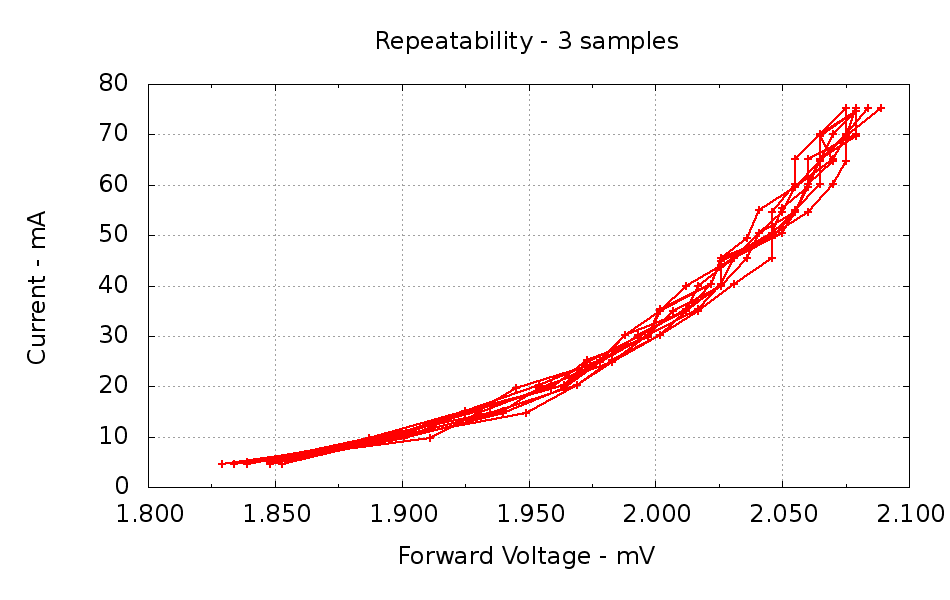
    Measuring the same LED many times should produce the same data every time. Here’s an LED measured ten times in quick succession, with each data point consisting of the average of three ADC conversions:

    Repeatability - 3 samples
    Repeatability – 3 samples

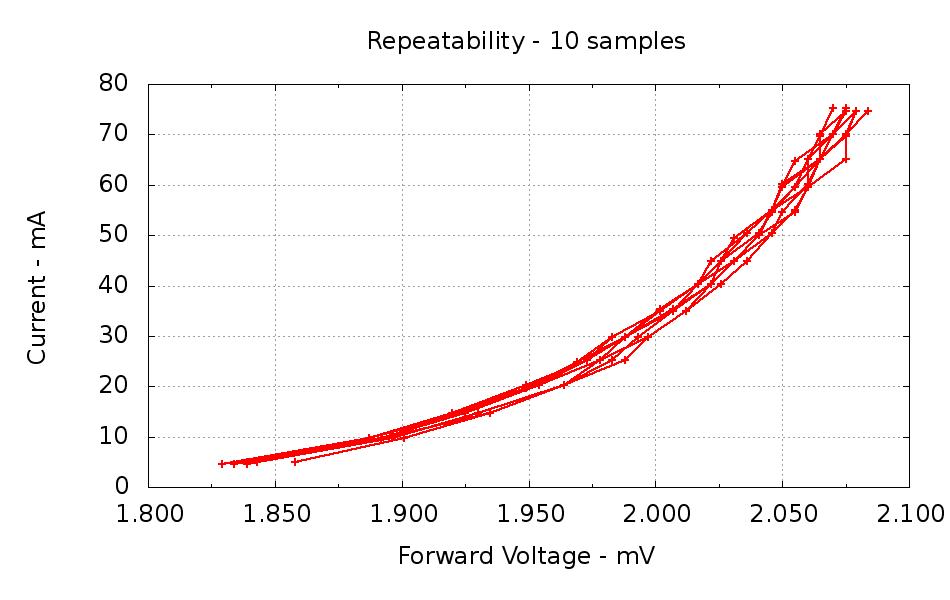
    Ten more measurements of the same LED, but with each data point being the average of ten ADC conversions:

    Repeatability - 10 samples
    Repeatability – 10 samples

    Not much to choose between the two, although averaging more readings does reduce the scatter just a bit. The ADC resolution is 5 mV, which is painfully obvious along the X axis. The Y axis has a smaller spread because it’s the independent variable: the firmware sets the MOSFET gate voltage to produce a given current and the ADC steps are relatively larger (the input voltage is only 75 mA × 10.5 Ω = 800 mV, tops).

    I think it’s close enough for my simple needs.

    The ADC code looks like this:

    //-- Read AI channel
    // averages several readings to improve noise performance
    // returns value in mV assuming VCC ref voltage
    
    #define NUM_T_SAMPLES 10
    
    float ReadAI(byte PinNum) {
      word RawAverage;
    
      digitalWrite(PIN_SYNC,HIGH); // scope sync
    
      RawAverage = analogRead(PinNum); // prime the averaging pump
    
      for (int i=2; i <= NUM_T_SAMPLES; i++) {
        RawAverage += (word)analogRead(PinNum);
      }
    
      digitalWrite(PIN_SYNC,LOW);
    
      RawAverage /= NUM_T_SAMPLES;
      return Vcc * (float)RawAverage / 1024.0;
    }
    

    And the Gnuplot routine that produces the graphs, including a bit of cruft that reminds me how to make two Y axis scales:

    #!/bin/sh
    #-- overhead
    export GDFONTPATH="/usr/share/fonts/truetype/"
    base="${1%.*}"
    echo Base name: ${base}
    ofile=${base}.png
    echo Output file: ${ofile}
    #-- do it
    gnuplot << EOF
    #set term x11
    set term png font "arialbd.ttf" 18 size 950,600
    set output "${ofile}"
    set title "${base}"
    set key noautotitles
    unset mouse
    set bmargin 4
    set grid xtics ytics
    set xlabel "Forward Voltage - mV"
    set format x "%6.3f"
    set xrange [1.8:2.1]
    #set xtics 0,5
    set mxtics 2
    #set logscale y
    #set ytics nomirror autofreq
    set ylabel "Current - mA"
    set format y "%4.0f"
    #set yrange [0:${rds_max}]
    #set mytics 2
    #set y2label "right side variable"
    #set y2tics nomirror autofreq 2
    #set format y2 "%3.0f"
    #set y2range [0:200]
    #set y2tics 32
    #set rmargin 9
    set datafile separator "\t"
    #set label 1 "Comment" at 0.90,0.35 font "arialbd,18"
    plot	\
        "$1" using (\$5/1000):((\$1>0)?\$2/1000:NaN) with linespoints lt 3 lw 2 lc 1
    EOF
    
  • LED Curve Tracer: First Light!

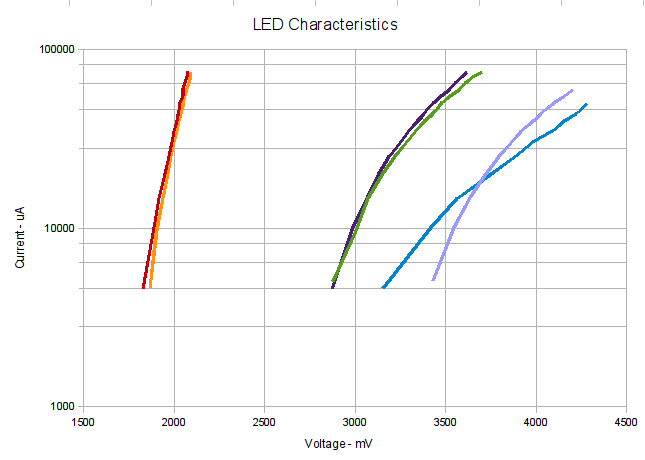
    Measuring a handful of random LEDs from the heap produced a dataset that boiled down into a set of curves:

    LED Curve Tracer - First Light
    LED Curve Tracer – First Light

    The Y axis (current) is logarithmic, so the traces should be straight lines. They’re loosely color-coded by LED color (black trace = white LED) and that blue trace looks mildly suspicious even to me. You’d want a better graphing program than OpenOffice Calc, but it’s OK for a quick look.

    Note that the rated current for 5 mm LEDs is generally 20 mA, so 75 mA really puts the screws to them. That notwithstanding, the curve tracer machinery seems to work well enough.

    The numeric values in the dataset have way more precision than the measurements have either accuracy or resolution. If we could put floats in those printf() format strings, then I’d be more inclined to prettify the results.

    INOM is the nominal current in mA (and also the loop counter) and ILED is the measured LED current in μA. All the voltages are in mV, with a resolution of 5 V/1024 steps = 5 mV.

    The dataset behind the curves, slightly massaged to weed out some, ah, bogosity that won’t appear with that firmware:

    # LED Curve Tracer
    # Ed Nisley - KE4ZNU - July 2012
    # VCC at LED: 4867 mV
    # Bandgap reference voltage: 1039 mV
    
    # Insert LED, press button 1 to start...
    # INOM	ILED	VccLED	VD	VLED	VG	VS	VGS	VDS	<--- LED 1
    0	0	4867	3745	1121	0	0	0	3745
    5	4585	4867	3042	1824	1925	48	1877	2994
    10	10087	4867	2980	1887	2070	105	1964	2874
    15	14672	4867	2951	1916	2142	154	1988	2797
    20	20174	4867	2917	1949	2243	211	2031	2705
    25	25218	4867	2898	1969	2320	264	2055	2633
    30	30262	4867	2879	1988	2392	317	2075	2561
    35	34847	4867	2869	1997	2450	365	2084	2503
    40	39891	4867	2854	2012	2527	418	2108	2436
    45	45393	4867	2840	2026	2604	476	2127	2363
    50	49978	4867	2835	2031	2667	524	2142	2310
    55	54563	4867	2821	2046	2729	572	2156	2248
    60	60066	4867	2816	2050	2806	630	2176	2185
    65	65109	4867	2806	2060	2859	683	2176	2123
    70	70153	4867	2797	2070	2912	736	2176	2060
    75	75197	4867	2792	2075	2989	789	2200	2002
    
    # Insert LED, press button 1 to start...
    # INOM	ILED	VccLED	VD	VLED	VG	VS	VGS	VDS	<--- LED 2
    0	0	4867	3914	953	0	0	0	3914
    5	5043	4867	1993	2874	1949	52	1896	1940
    10	9628	4867	1863	3004	2070	101	1969	1762
    15	14672	4867	1795	3071	2142	154	1988	1641
    20	20174	4867	1713	3153	2243	211	2031	1502
    25	25218	4867	1646	3220	2315	264	2050	1381
    30	30262	4867	1583	3283	2397	317	2079	1266
    35	34847	4867	1535	3331	2450	365	2084	1169
    40	39891	4867	1482	3384	2532	418	2113	1063
    45	44934	4867	1425	3442	2609	471	2137	953
    50	50437	4867	1386	3480	2667	529	2137	856
    55	54563	4867	1343	3524	2720	572	2147	770
    60	60066	4867	1285	3581	2797	630	2166	654
    65	64651	4867	1256	3610	2859	678	2180	577
    70	69694	4867	1218	3649	2912	731	2180	486
    75	74738	4867	1165	3702	2999	784	2214	380
    
    # Insert LED, press button 1 to start...
    # INOM	ILED	VccLED	VD	VLED	VG	VS	VGS	VDS	<--- LED 3
    0	0	4867	3577	1290	0	0	0	3577
    5	4585	4867	1997	2869	1945	48	1896	1949
    10	10087	4867	1877	2989	2070	105	1964	1771
    15	15131	4867	1795	3071	2166	158	2007	1636
    20	20174	4867	1738	3129	2238	211	2026	1526
    25	25218	4867	1680	3187	2320	264	2055	1415
    30	30262	4867	1617	3249	2397	317	2079	1299
    35	34847	4867	1574	3293	2450	365	2084	1208
    40	39891	4867	1521	3346	2527	418	2108	1102
    45	45393	4867	1473	3394	2604	476	2127	996
    50	49978	4867	1434	3432	2667	524	2142	909
    55	54563	4867	1391	3476	2720	572	2147	818
    60	60066	4867	1343	3524	2802	630	2171	712
    65	64651	4867	1314	3553	2854	678	2176	635
    70	69694	4867	1280	3586	2907	731	2176	548
    75	74738	4867	1246	3620	2970	784	2185	462
    
    # Insert LED, press button 1 to start...
    # INOM	ILED	VccLED	VD	VLED	VG	VS	VGS	VDS	<--- LED 4
    0	0	4867	3736	1131	0	0	0	3736
    5	5043	4867	1439	3427	1949	52	1896	1386
    10	10087	4867	1323	3543	2070	105	1964	1218
    15	15131	4867	1227	3639	2166	158	2007	1068
    20	19716	4867	1150	3716	2243	207	2036	943
    25	25218	4867	1073	3793	2315	264	2050	808
    30	30262	4867	1006	3861	2402	317	2084	688
    35	34847	4867	953	3914	2450	365	2084	587
    40	39891	4867	881	3986	2527	418	2108	462
    45	45393	4867	823	4044	2604	476	2127	346
    50	50437	4867	760	4106	2676	529	2147	231
    55	55022	4867	707	4159	2777	577	2200	129
    60	59607	4867	659	4207	3134	625	2508	33
    
    # Insert LED, press button 1 to start...
    # INOM	ILED	VccLED	VD	VLED	VG	VS	VGS	VDS	<--- LED 5
    0	0	4867	3702	1165	0	0	0	3702
    5	4585	4867	1713	3153	1959	48	1911	1665
    10	10087	4867	1449	3418	2070	105	1964	1343
    15	14672	4867	1304	3562	2147	154	1993	1150
    20	20174	4867	1116	3750	2243	211	2031	905
    25	25218	4867	982	3885	2320	264	2055	717
    30	30262	4867	885	3981	2397	317	2079	568
    35	35305	4867	770	4097	2469	370	2099	399
    40	39891	4867	712	4154	2527	418	2108	293
    45	45393	4867	621	4246	2647	476	2171	144
    50	49520	4867	582	4284	2797	519	2277	62
    
    # Insert LED, press button 1 to start...
    # INOM	ILED	VccLED	VD	VLED	VG	VS	VGS	VDS	<--- LED 6
    0	0	4867	3687	1179	0	0	0	3687
    5	4585	4867	3004	1863	1954	48	1906	2956
    10	9628	4867	2965	1901	2041	101	1940	2864
    15	14672	4867	2932	1935	2137	154	1983	2777
    20	20174	4867	2903	1964	2243	211	2031	2691
    25	25218	4867	2888	1978	2315	264	2050	2623
    30	30262	4867	2869	1997	2397	317	2079	2551
    35	34847	4867	2854	2012	2450	365	2084	2489
    40	39891	4867	2840	2026	2527	418	2108	2421
    45	45393	4867	2826	2041	2604	476	2127	2349
    50	49978	4867	2816	2050	2662	524	2137	2291
    55	54563	4867	2806	2060	2720	572	2147	2233
    60	60066	4867	2797	2070	2802	630	2171	2166
    65	64651	4867	2787	2079	2859	678	2180	2108
    70	69694	4867	2777	2089	2917	731	2185	2046
    75	74738	4867	2773	2094	2975	784	2190	1988
    
  • LED Curve Tracer: Firmware

    The main loop of the LED Curve Tracer firmware waits for a button push, then steps the LED current upward in 5 mA increments, measures a bunch of voltages, and prints the results in the tired old CSV format that feeds into Gnuplot and spreadsheets like nothing else.

    The output looks thuslike:

    # LED Curve Tracer
    # Ed Nisley - KE4ZNU - July 2012
    # VCC at LED: 4872 mV
    # Bandgap reference voltage: 1039 mV
    
    # Insert LED, press button 1 to start...
    # INOM	ILED	VccLED	VD	VLED	VG	VS	VGS	VDS	<--- LED 1
    0	0	4867	3697	1169	0	0	0	3697
    5	4585	4867	3013	1853	1959	48	1911	2965
    10	9628	4867	2970	1896	2075	101	1973	2869
    15	14672	4867	2917	1949	2166	154	2012	2763
    20	20174	4867	2898	1969	2282	211	2070	2686
    25	25218	4867	2883	1983	2339	264	2075	2619
    30	30262	4867	2864	2002	2407	317	2089	2546
    35	34847	4867	2850	2017	2498	365	2132	2484
    40	40349	4867	2835	2031	2546	423	2123	2412
    45	45393	4867	2821	2046	2614	476	2137	2344
    50	49978	4872	2826	2046	2657	524	2132	2301
    55	54563	4872	2811	2060	2729	572	2156	2238
    60	60066	4872	2802	2070	2792	630	2161	2171
    65	64651	4867	2792	2075	2874	678	2195	2113
    70	69694	4867	2792	2075	2922	731	2190	2060
    75	75197	4867	2777	2089	3004	789	2214	1988
    
    # Insert LED, press button 1 to start...
    

    I suppose calling it a “curve tracer” isn’t quite accurate, because the graphs actually come from the plotting software. Feel free to add one of those gorgeous color LCD panels and draw curves on the fly.

    The code includes a constant for the measured VCC voltage from the regulator on the board, which is not, in general, ever the 5.000 V you expect. This will vary from board to board, so don’t kvetch if you get the wrong results without changing the constant. I assume that the analog reference voltage is just about exactly equal to the supply voltage, because I can’t measure it any more accurately.

    Measuring VCC, however, calibrates all the other voltages, including the LED supply regulator and the bandgap.

    Just for fun, the code measures & reports the 1.1 V bandgap reference voltage, which works out to be a bit on the low side at 1.039 V. That’s well within the hardware’s 10% tolerance spec, but no better than the usual power supply tolerance, so you must measure one or the other to get the right answer.

    The Pro Mini board includes a cap on the analog reference pin, making it as quiet as it’ll get. The datasheet recommends an elaborate LC filter upstream of AVCC that nobody uses and there’s no room for, but it doesn’t really matter for this purpose.

    The function that adjusts the gate voltage to produce a given LED current includes a bailout test to make sure the MOSFET drain-to-source voltage doesn’t drop too low. That happens with blue or violet LEDs (or, maybe white LEDs, which have a similar chemistry) at high currents, where the forward drop exceeds 4 V. There’s not enough headroom between the +5 V LED supply and the 10.5 Ω sense resistor, but the LED supply can’t exceed 5 V because we’re using the Arduino’s internal ADC and that’s limited to the supply voltage.

    The Arduino source code:

    // LED Curve Tracer
    // Ed Nisley - KE4ANU - July 2012
    
    #include <stdio.h>
    
    //----------
    // Pin assignments
    
    const byte PIN_READ_LEDSUPPLY = 0;	// AI - LED supply voltage		blue
    const byte PIN_READ_VDRAIN = 1;		// AI - drain voltage			red
    const byte PIN_READ_VSOURCE = 2;	// AI - source voltage			orange
    const byte PIN_READ_VGATE = 3;		// AI - VGS after filtering		violet
    
    const byte PIN_SET_VGATE = 11;		// PWM - gate voltage			brown
    
    const byte PIN_BUTTON1 = 8;			// DI - button to start tests	green
    const byte PIN_BUTTON2 = 7;			// DI - button for options		yellow
    
    const byte PIN_HEARTBEAT = 13;		// DO - Arduino LED
    const byte PIN_SYNC = 2;			// DO - scope sync output
    
    //----------
    // Constants
    
    const int MaxCurrent = 75;				// maximum LED current - mA
    
    const float Vcc = 4.930;				// Arduino supply -- must be measured!
    
    const float RSense = 10.500;			// current sense resistor
    
    const float ITolerance = 0.0005;		// current setpoint tolerance
    
    const float VGStep = 0.019;				// increment/decrement VGate = 5 V / 256
    
    const byte PWM_Settle = 5;				// PWM settling time ms
    
    #define TCCRxB 0x01						// Timer prescaler = 1:1 for 32 kHz PWM
    
    #define MK_UL(fl,sc) ((unsigned long)((fl)*(sc)))
    #define MK_U(fl,sc) ((unsigned int)((fl)*(sc)))
    
    //----------
    // Globals
    
    float AVRef1V1;					// 1.1 V bandgap reference - calculated from Vcc
    
    float VccLED;					// LED high-side supply
    
    float VDrain;					// MOSFET terminal voltages
    float VSource;
    float VGate;
    
    unsigned int TestNum = 1;
    
    long unsigned long MillisNow;
    
    //-- Read AI channel
    //      averages several readings to improve noise performance
    //		returns value in mV assuming VCC ref voltage
    
    #define NUM_T_SAMPLES    10
    
    float ReadAI(byte PinNum) {
    
      word RawAverage;
    
      digitalWrite(PIN_SYNC,HIGH);                // scope sync
    
      RawAverage = analogRead(PinNum);            // prime the averaging pump
    
      for (int i=2; i <= NUM_T_SAMPLES; i++) {
        RawAverage += (word)analogRead(PinNum);
      }
    
      digitalWrite(PIN_SYNC,LOW);
    
      RawAverage /= NUM_T_SAMPLES;
    
      return Vcc * (float)RawAverage / 1024.0;
    
    }
    
    //-- Set PWM output
    
    void SetPWMVoltage(byte PinNum,float PWMVolt) {
    
    byte PWM;
    
      PWM = (byte)(PWMVolt / Vcc * 255.0);
    
      analogWrite(PinNum,PWM);
      delay(PWM_Settle);
    
    }
    
    //-- Set VGS to produce desired LED current
    //		bails out if VDS drops below a sensible value
    
    void SetLEDCurrent(float ITarget) {
    
      float ISense;				// measured current
      float VGateSet;			// output voltage setpoint
      float IError;				// (actual - desired) current
    
      VGate = ReadAI(PIN_READ_VGATE);					// get gate voltage
      VGateSet = VGate;									//  because input may not match output
    
      do {
    
    	VSource = ReadAI(PIN_READ_VSOURCE);
    	ISense = VSource / RSense;						// get LED current
    
    //	printf("\nITarget: %lu mA",MK_UL(ITarget,1000.0));
    	IError = ISense - ITarget;
    
    //	printf("\nISense: %d mA VGateSet: %d mV VGate %d IError %d mA",
    //		   MK_U(ISense,1000.0),
    //		   MK_U(VGateSet,1000.0),
    //		   MK_U(VGate,1000.0),
    //		   MK_U(IError,1000.0));
    
    	if (IError < -ITolerance) {
    	  VGateSet += VGStep;
    //	  Serial.print('+');
    	}
    	else if (IError > ITolerance) {
    	  VGateSet -= VGStep;
    //	  Serial.print('-');
    	}
    
    	VGateSet = constrain(VGateSet,0.0,Vcc);
    	SetPWMVoltage(PIN_SET_VGATE,VGateSet);
    
    	VDrain = ReadAI(PIN_READ_VDRAIN);		// sample these for the main loop
    	VGate = ReadAI(PIN_READ_VGATE);
    	VccLED = ReadAI(PIN_READ_LEDSUPPLY);
    
    	if ((VDrain - VSource) < 0.020) {			// bail if VDS gets too low
    	  printf("# VDS=%d too low, bailing\n",MK_U(VDrain - VSource,1000.0));
    	  break;
    	}
    
      } while (abs(IError) > ITolerance);
    
    //	Serial.println("# Done");
    }
    
    //-- compute actual 1.1 V bandgap reference based on known VCC = AVcc (more or less)
    //		adapted from http://code.google.com/p/tinkerit/wiki/SecretVoltmeter
    
    float ReadBandGap(void) {
    
      word ADCBits;
      float VBandGap;
    
      ADMUX = _BV(REFS0) | _BV(MUX3) | _BV(MUX2) | _BV(MUX1);	// select 1.1 V input
      delay(2); // Wait for Vref to settle
    
      ADCSRA |= _BV(ADSC);										// Convert
      while (bit_is_set(ADCSRA,ADSC));
    
      ADCBits = ADCL;
      ADCBits |= ADCH<<8;
    
      VBandGap = Vcc * (float)ADCBits / 1024.0;
      return VBandGap;
    }
    
    //-- Print message, wait for a given button press
    
    void WaitButton(int Button,char *pMsg) {
      printf("# %s",pMsg);
      while(HIGH == digitalRead(Button)) {
        delay(100);
        digitalWrite(PIN_HEARTBEAT,!digitalRead(PIN_HEARTBEAT));
      }
    
      delay(50);				// wait for bounce to settle
      digitalWrite(PIN_HEARTBEAT,LOW);
    }
    
    //-- Helper routine for printf()
    
    int s_putc(char c, FILE *t) {
      Serial.write(c);
    }
    
    //------------------
    // Set things up
    
    void setup() {
      pinMode(PIN_HEARTBEAT,OUTPUT);
      digitalWrite(PIN_HEARTBEAT,LOW);	// show we arrived
    
      pinMode(PIN_SYNC,OUTPUT);
      digitalWrite(PIN_SYNC,LOW);		// show we arrived
    
      TCCR1B = TCCRxB;					// set frequency for PWM 9 &amp; 10
      TCCR2B = TCCRxB;					// set frequency for PWM 3 &amp; 11
    
      pinMode(PIN_SET_VGATE,OUTPUT);
      analogWrite(PIN_SET_VGATE,0);		// force gate voltage = 0
    
      pinMode(PIN_BUTTON1,INPUT_PULLUP);	// use internal pullup for buttons
      pinMode(PIN_BUTTON2,INPUT_PULLUP);
    
      Serial.begin(9600);
      fdevopen(&s_putc,0);				// set up serial output for printf()
    
      printf("# LED Curve Tracer\n# Ed Nisley - KE4ZNU - July 2012\n");
    
      VccLED = ReadAI(PIN_READ_LEDSUPPLY);
      printf("# VCC at LED: %d mV\n",MK_U(VccLED,1000.0));
    
      AVRef1V1 = ReadBandGap();			// compute actual bandgap reference voltage
      printf("# Bandgap reference voltage: %lu mV\n",MK_UL(AVRef1V1,1000.0));
    
      Serial.println();
    
    }
    
    //------------------
    // Run the test loop
    
    void loop() {
    
      WaitButton(PIN_BUTTON1,"Insert LED, press button 1 to start...\n");
      printf("# INOM\tILED\tVccLED\tVD\tVLED\tVG\tVS\tVGS\tVDS\t<--- LED %d\n",TestNum++);
      digitalWrite(PIN_HEARTBEAT,LOW);
    
      for (int ILED=0; ILED <= MaxCurrent; ILED+=5) {
    	SetLEDCurrent(((float)ILED)/1000.0);
    	printf("%d\t%lu\t%d\t%d\t%d\t%d\t%d\t%d\t%d\n",
    		    ILED,
    			MK_UL(VSource / RSense,1.0e6),
    			MK_U(VccLED,1000.0),
    			MK_U(VDrain,1000.0),
    			MK_U(VccLED - VDrain,1000.0),
    			MK_U(VGate,1000.0),
    			MK_U(VSource,1000.0),
    			MK_U(VGate - VSource,1000),
    			MK_U(VDrain - VSource,1000.0)
    		  );
      }
    
      SetPWMVoltage(PIN_SET_VGATE,0.0);
    
    }
    
  • LED Curve Tracer: Hardware

    Based on that comment and faced with two sacks of LEDs, I thought an LED curve tracer might come in handy at some point. While I could modify the MOSFET tester to work with LEDs, they have a higher forward voltage and a much lower current than that hardware can handle without some serious chopping & slicing.

    At least for the cheap 5 mm LEDs I’m considering, a forward drop well under 4 V and current under 75 mA should suffice. That suggests a +5 V supply for the LED, a fairly high current-sense resistor, and an Arduino for a quick-and-dirty controller.

    The overall idea:

    • Run the LED between a regulated supply and the MOSFET drain
    • MOSFET source to current-sense resistor to ground
    • Measure all three MOSFET terminal voltages
    • Set the gate voltage with a PWM-to-DC filtered voltage

    The MOSFET current depends on the gate-to-source voltage, which varies with the current through the sense resistor, so the firmware must measure the actual current and adjust the gate voltage to make the answer come out right. This being a DC application, it can probably monotonically increase VGS and stop when it sees the right current. The MOSFET must have a logic-level gate, so that voltages around +4 V will produce sufficient drain current.

    The PWM must run at 32 kHz to minimize the size of the filter cap.

    If the LED supply is slightly lower than the Arduino’s VCC supply, then the analog input can report the actual voltage and the forward drop is VCCLED - VDrain. Given a regulated supply, that’s as good measuring the voltage against the ground reference.

    The current is VSource / RSense. For a current under, say, 100 mA, a 10 Ω sense resistor will drop 1 V, leaving about 4 V of headroom for VGS. The default 5 V reference means the ADC steps are 5 mV, so the current steps will be 0.5 mA. One could use the Arduino’s internal 1.1 V band-gap reference for higher resolution: 0.11 mA. Changing that is a simple matter of software.

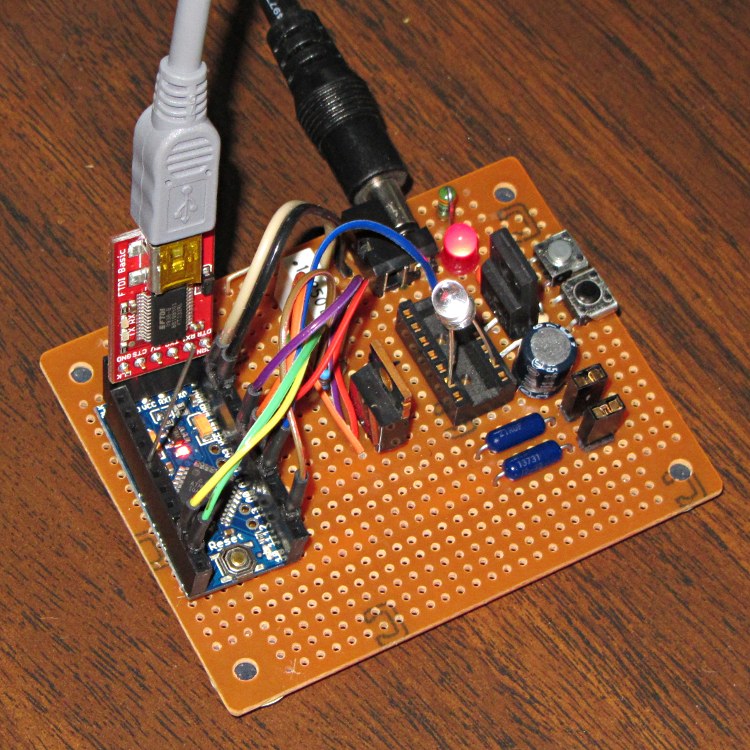
    So, after a bit of doodling and a pair of afternoon thunderstorms that forced a complete computer shutdown (and forced me into the Basement Laboratory), here it is:

    LED Curve Tracer - overview
    LED Curve Tracer – overview

    The Arduino Pro Mini board (it’s actually a cheap knockoff) has female headers for all the usual signals and a male header to match the sockets on the FTDI Basic programmer board, all from my heap. The connections use flying leads stripped from a length of ribbon cable, soldered to male header pins snipped from a stick, and reinforced with heatstink tubing. The Pro Mini isn’t anchored in place and probably never will be.

    Another view, minus cables and FTDI:

    LED Curve Tracer - top
    LED Curve Tracer – top

    The LED leads just jam into an old IC socket. The top pushbutton triggers the test, the bottom one doesn’t do anything yet.

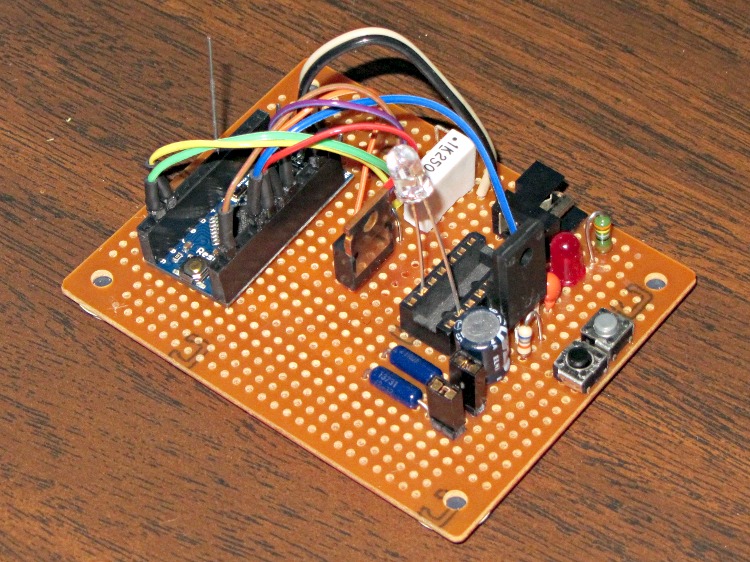
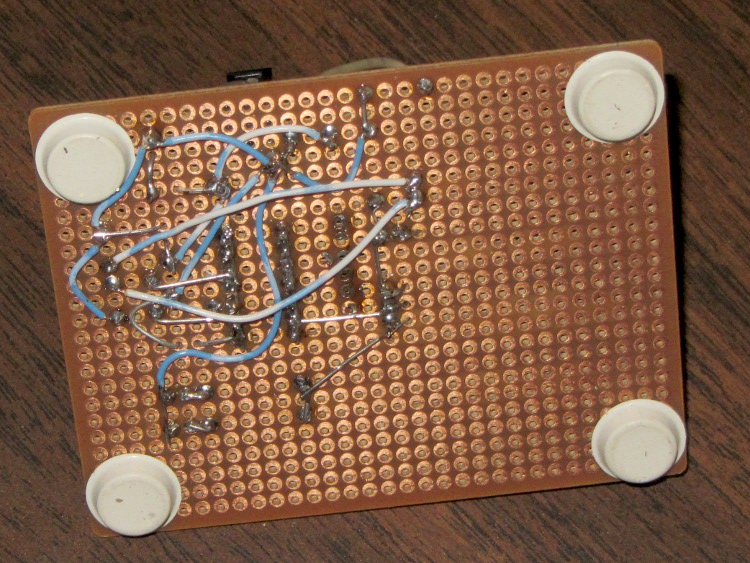
    Nothing fancy at all; I hand-wired it to avoid all the usual DIY PCB hassles.The bottom view shows all the wiring:

    LED Curve Tracer - bottom
    LED Curve Tracer – bottom

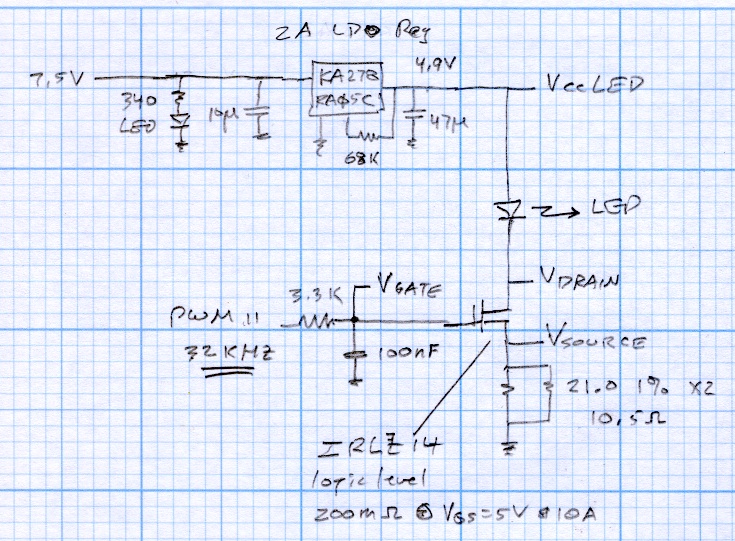
    The schematic, such as it is:

    LED Curve Tracer Schematic
    LED Curve Tracer Schematic

    The regulator is a random Fairchild KA278RA05C +5 V LDO, obtained surplus. The 68 kΩ resistor trims the internal divider to pull the output to 4.87 V, just a touch under the Arduino’s 4.93 V regulator. The power supply is a 7.5 V 2 A surplus lump with no pedigree.

    The MOSFET is an IRLZ14 logic-level FET with grossly excessive qualifications.

    The sense resistor is a pair of 21.0 Ω 1% resistors in parallel = 10.5 Ω. That’s just a firmware constant, so I don’t care what the actual value works out to be.

    Next, a dab of firmware…

  • Contact Bounce: Why Capacitors Don’t Fix It

    As part of our discussion around those Hall effect switches, I cautioned our Larval Engineer that she can’t use capacitors to “smooth out” mechanical switch bounce, even though all of her cronies and (most likely) her profs will advocate doing exactly that. The subject also came up at the local hackerspace when she showed off her project, so I should explain why capacitors don’t solve the problem.

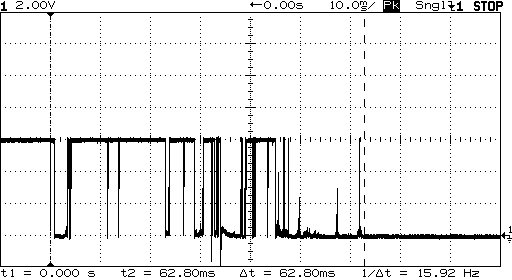
    Here’s some switch contact bounce:

    Switch bounce - black panel-mount
    Switch bounce – black panel-mount

    Another push on the button, just to show how unpredictable the bounces can be:

    Switch bounce - black panel-mount - 2
    Switch bounce – black panel-mount – 2

    Note the horizontal scale: 10 ms/div. The smaller glitches appear only by courtesy of the scope’s glitch-catching mode; they’re down around a few microseconds.

    Now, let’s add the canonical 100 nF “debounce” capacitor in parallel with the contacts and record another set of bounces:

    Switch bounce - black panel-mount - 100 nF cap
    Switch bounce – black panel-mount – 100 nF cap

    Notice that the switch contacts bounce in a completely unpredictable manner.

    The pullup resistor is a rather stiff 1 kΩ, so the RC time constant is τ = 1 kΩ × 100 nF = 100 μs, but that applies only to the rising edges of the waveform as the switch opens. You can, indeed, see a slight rounding of those corners: the voltage requires about 5τ = 500 μs to reach 99% of the final voltage.

    The capacitor also forms an LC tank circuit with the usual parasitic wiring inductance, producing spikes that exceed the supply voltage: that’s the first half-cycle of the tank oscillation as the switch opens. The Q is fairly low due to the relatively high resistance, so the oscillations die out quickly. If this were feeding a microcontroller’s input pin, its input protection diodes would clamp the spikes to one diode drop above the supply voltage and below 0 V, but that’s an entirely different study.

    It should be obvious that adding the cap hasn’t done diddly squat to debounce the switch transition.

    Increasing the pullup resistor to the usual 10 kΩ will increase the time constant to τ = 1 ms, round off the leading edges a bit more, and further reduce the Q. It won’t debounce the longest transitions, which are on the order of 20 ms for this particular switch. You can’t increase the pullup too much, because you want enough current through it to ensure a valid logic level despite external noise (which is also an entirely different study); 100 kΩ may be as much as you can stand.

    But that’s just for glitches due to the switch opening. The closed switch puts a dead short across the capacitor, so the cap provides no filtering as the switch closes: the microcontroller will see every single low-going bounce. The photos show only bounces during the open→closed switch transition, but the closed→open transition can be equally ugly: yes, switches bounce closed as they open.

    That means the microcontroller will see glitches as the switch opens.

    So let’s increase the capacitor enough that the voltage can’t rise beyond the logic threshold until the switch stops bouncing. Ignoring LC tank effects, the voltage rises as 1 – e-t/τ, so we need that value to be less than 0.25 (for a bit of margin) of the supply voltage after the longest possible bounce as the switch opens. Let’s assume the switch has a single closed (low) glitch after a long time being open (high), at which time the voltage must still be under the logic threshold to prevent a false input. The datasheets only give the maximum bounce duration, if they give any bounce time at all, so let’s assume the longest bounce will be 60 ms.

    That says τ = -60 ms / ln(0.75) = 210 ms. Given a 10 kΩ pullup, that’s C = 210 ms / 10 Ω = 21 μF.

    No problem, right? Let’s just put a 22 μF electrolytic cap across every switch and be done with it!

    Well, except for the fact that most pushbutton switches can’t tolerate that much energy through their contacts. Assuming a 100 mΩ resistance and ignoring stray inductance, the initial current will be 5 V / 100 mΩ = 50 A with a time constant of τ = 22 μF × 100 mΩ = 2 μs. At the usual 5 V logic supply, the cap stores 22 μF × (5 V)2 = 550 μJ of energy, so we’re now burning the switch contacts with a 250 W pulse. Some switches have a maximum energy rating to deter exactly this design blunder, but you should not assume the lack of such a rating means the switch can handle anything you throw at it.

    No problem, let’s just put a resistor in series with the switch to reduce the initial current.

    I think you can see where this is going, though, so I’ll leave all that as an exercise for the student.

    Moral of the story: you must do debouncing in software by filtering the raw switch input. The trick will be to get that code right, which isn’t nearly as simple as you might think. In fact, the first half-dozen techniques you come up with won’t work, so use a dependable library and test the results… which is an entirely different study, too.

    If it’s any consolation, I didn’t know this stuff when I was a Larval Engineer, either. In fact, I didn’t learn much of it until after I made all the usual mistakes…

  • Honeywell 201SN1B1 Hall Effect Switch

    Our Larval Engineer has begun writing the Arduino code (Baby’s First Real Program!) that will control ground effect lighting on her longboard, with RGB LED colors keyed to the wheel rotation speed. Her back of the envelope says the wheels spin at about 60 rev/s (= 17 ms/rev) at 30 mph, which rules out mechanical / reed switches; some experimentation with a simple mechanical switch showed why the Arduino bounce library is a Good Thing even for pushbuttons.

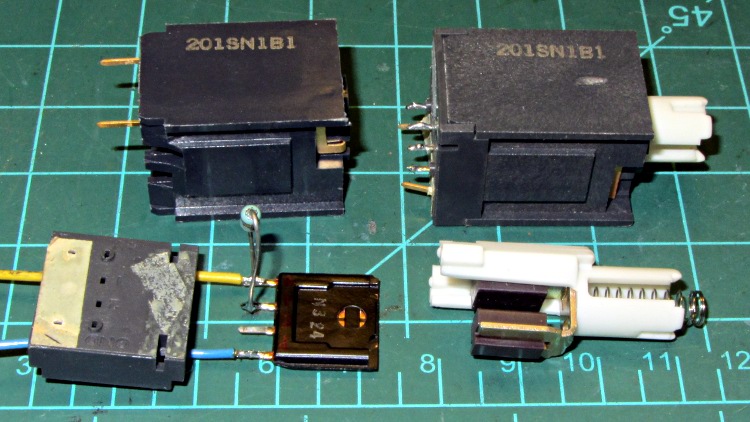
    Some rummaging produced a collection of these Hall effect switches:

    201SN1B1 Hall Effect Switch Components
    201SN1B1 Hall Effect Switch Components

    I thought they were ordinary keyboard switches, but nooooHoneywell 201SN1B1 switches turn out to be Mil-Spec items, with brethren serving in B-52 bombers, F-16 fighters, and even long-departed Peacekeeper ICBMs (most likely in the ground support equipment). There are no data sheets at this late date, but this compressed specs burst gives some hints:

    General Characteristics Item Description: Switch body 1.060 in. l; 0.740 in. h; 0.740 in. w; hall effect solid state switching; alternate action; 5V dc; 9 ma.; operated at 0.4V dc max.; sinking 4 ma. per output; pulse output; printed circuit terminals

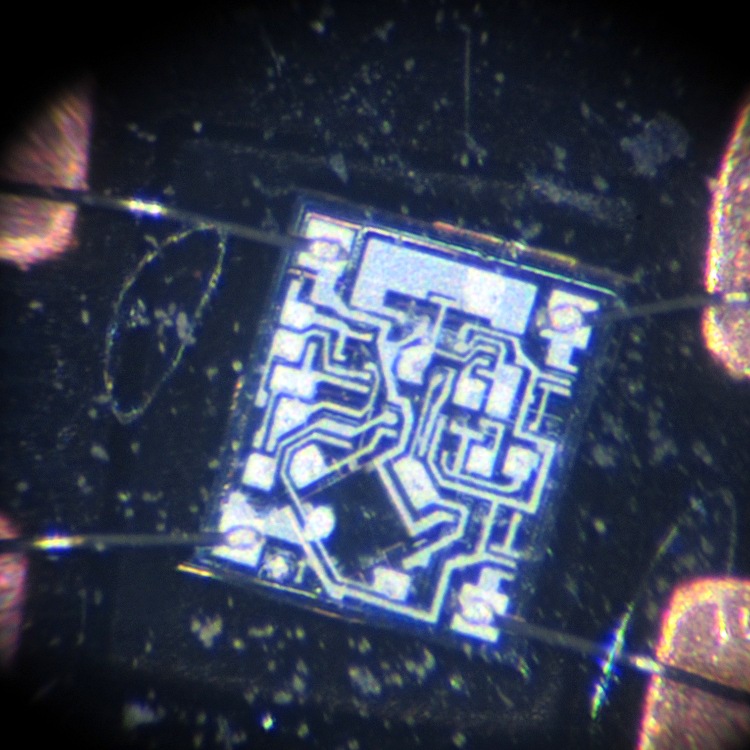
    A gentle twist of a small screwdriver under the plastic latches releases the base plate and frees the Hall effect switch module, which is the square black plate above. It contains an IC (downward in the picture) with wire-bonded leads embedded in a flexible silicone seal that has pale gray smudges on its surface:

    201SN1B1 IC - Overview
    201SN1B1 IC – Overview

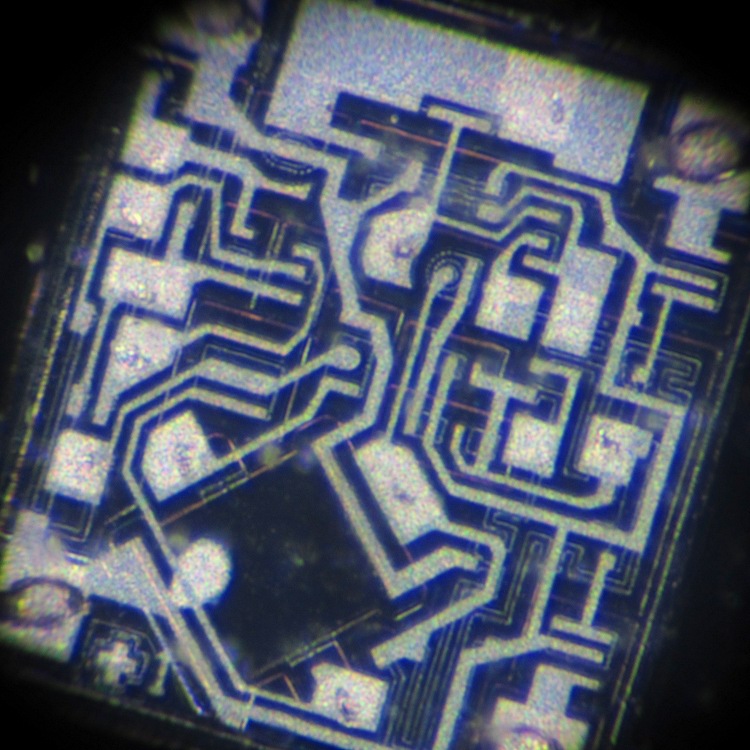
    A closer look at the IC shows actual components:

    201SN1B1 IC - Detail
    201SN1B1 IC – Detail

    That’s from back when you could see components on an IC…

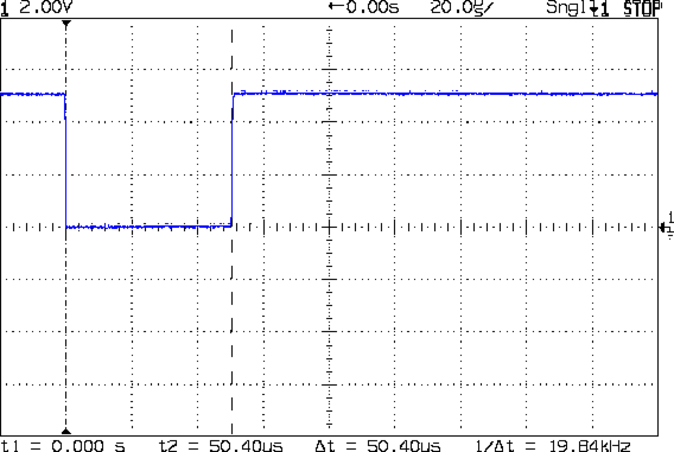
    I soldered wires to the +V and Gnd pins, plus a 10 kΩ pullup resistor to one of the two output pins, applied 5 V from the bench supply, then waved a small neodymium magnet nearby:

    201SN1B1 Switch Output
    201SN1B1 Switch Output

    The two output pins appear to produce separate-but-equal 50 µs output pulses that are completely independent of the magnet’s proximity, speed, and polarity, which is a Nice Touch. The IC draws about 10 mA when inactive and 12 mA with the magnet nearby.

    The form factor seems a bit awkward for a longboard wheel sensor, but it’ll get her closer to the goal. Most likely, it’ll wind up embedded in an epoxy block strapped to one of the wheel trucks.

    The Arduino’s Bounce update function / method / whatever has a polled view of the input pin, which means that if you don’t call it during that 50 µs pulse you’ll completely miss that revolution. Sooo, the pulse must go into one of the Arduino’s external interrupt pins, which can catch short pulses with no trouble at all if you write a suitable interrupt handler.

    Somewhere I have a handful of Hall effect motor commutation sensors, but they have an internal latch that requires alternating magnetic poles to switch the output, thus requiring two magnets halfway around the wheel circumference. Haven’t figured out how to embed the magnets in the wheels or mount the sensors, but …

  • Arduino Survival Guide: First Pass

    I’ll be giving a short presentation for the Squidwrench meeting at /root in New Paltz this evening:

    Arduino Survival Guide for Squidwrench – 2012-06-12

    The general idea is to mention the things you need to know so you don’t kill your Arduino while fiddling around with the software side of the project.

    It’s a rather dense collection of facts & figures and I expect a whole bunch of Q&A activity… which should result in a better Survival Guide the next time around.