-
MK5 Extruder: Cartridge Heater Time Constant
So I recorded more temperatures from that modified MK5 Thermal Core to get better numbers.
Warming it up to 230 °C:
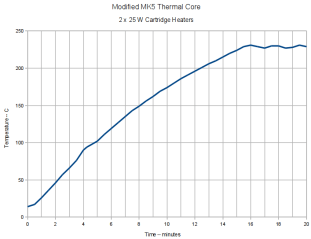
Cartridge Heater 2x25W Warm-up Graph A pair of 25 W cartridge heaters can get from (a cold!) room temperature to 230 °C in about 16 minutes, after which the Extruder Controller begins cycling the heater power. The bump at 4 minutes comes from a momentary lapse of attention.
The PID constants were P=100, I=0, D=0, which forces the Extruder Controller to run in bang-bang mode: heater on below the setpoint, heater off above it. The firmware uses a built-in hysteresis of 2 °C, so there’s a built-in ripple of a bit more than that.
Cooling it down from 230 °C to (almost) room temperature:
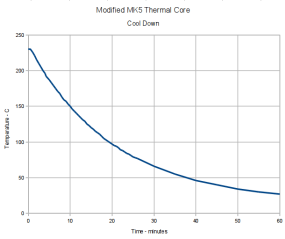
Cartridge Heater 2x25W – Cooldown Now, isn’t that just the cutest little exponential you’ve ever seen? Here’s the same data in a semilog plot, which shows that it really is suspiciously exponential:
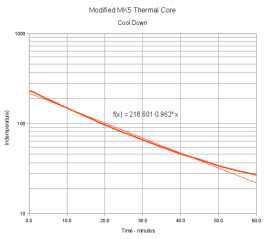
Cartridge Heater 2x25W – Cooldown – log scale For some reason, OpenOffice figures the trend line in the form y=m^x + c, which isn’t helpful. The first part looks to be the most closely exponential part of the curve, so let’s pick a couple of points and see how they fare.
The equation we want is of the form:
temp(t) = (room temp) + (temp rise) • e-t/τ
Room temperature was 14 °C and the temperature rise was 216 °C = 230 – 14. The Basement Laboratory gets entirely too cold during this part of the year!
Solving for the time constant τ:
τ = (-t)/loge((temp - room temp)/(temp rise))
That’s the natural logarithm, of course, not the decimal logarithm.
At t=5:
τ = (-5)/(-0.222) = 22.5
At t=15:
τ = (-15)/(-0.712) = 21.1
At t=30:
τ = (-30)/(-1.42) = 21.1
So the time constant looks to be a bit over 21 minutes, almost exactly twice that of the unmodified MK5 Thermal Core with resistors. The additional steel around those cartridge heaters basically doubles the heated mass and, thus, the time constant. I’d guesstimated a 30 minute time constant.
That gives a better estimate of the worst-case temperature with the cartridge heaters jammed on. The temperature rise at t = (0.1 • τ) is 9% of the total temperature rise. A bit of interpolation says the initial rise was 34 °C (= 48 – 14), so the final rise is 378 °C and the Core would top out just shy of 400 °C = 750 °F.
That’s lower than I originally estimated, based on the First Light data, but it’s still plenty hot enough for some serious damage. Don’t install cartridge heaters without a dead-simple thermal cutout to prevent runaway!
The raw data:
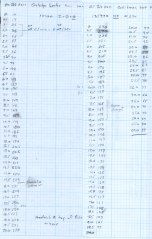
Cartridge Heater 2×25 W Heat and Cool Data


-
Subscribe
Subscribed
Already have a WordPress.com account? Log in now.
 The Smell of Molten Projects in the Morning