-
Thing-O-Matic: Large Knots
Printing tiny knots showed the need for support under the loop takeoff points, which xorxo’s Hi-Res 3D Knot provides:
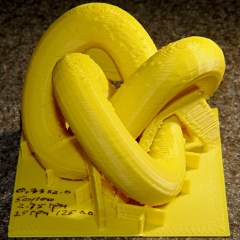
Large Knot – scaffolded My Shop Assistant cleaned up a second version:
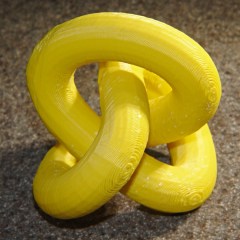
Large Knot cleaned – top As the scrawled notation says: printed at 50 mm/s with 100 mm/s moves. The only cleanup: remove the scaffolding and slice off the Reversal zittage.
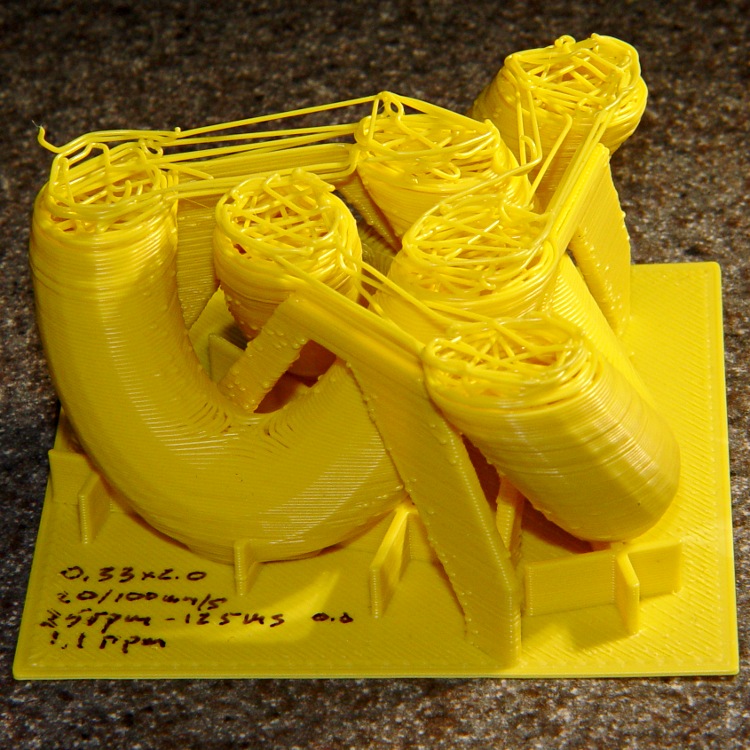
If the truth be known, that was actually the third knot. The first suffered a spectacular failure: one corner of the filament spool snagged on the wall behind the printer and jammed the filament:
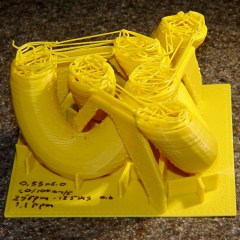
Large Knot – failed The filament drive pulled all the slack out of the bundle, broke off three of the six internal guide posts (admittedly, they’re just hot-melt glued in place), and dragged a nasty kink halfway down the feeder tube. Obviously the stepper was shedding steps during that whole process, but it came rather close to doing the Ouroboros thing.
While that went down, I was puttering around in the far reaches of the Basement Laboratory, attempting to clean up a bit of the clutter, and checking in on the printer every now and again. Seemed like a good idea at the time, is all I can say.
Perhaps the Lords of Cosmic Jest simply decided this was an appropriate object to mess with. The vertices of the hexagonal filament spool stick out perhaps 10 mm from the printer’s backside and every one has cleared the wall on countless previous rotations. I moved the entire affair a bit further from the wall and maybe it’ll be all good from now on.


-
Subscribe
Subscribed
Already have a WordPress.com account? Log in now.
 The Smell of Molten Projects in the Morning