-
HQ Sixteen: Track Lock Blocks
Mary’s practice quilts on the HQ Sixteen suggest locking the machine’s wheels will simplify sewing a line parallel to the long edge of a quilt parallel to the table, but contemporary “Channel Locks” fit newer machines with larger wheels than on this one.
Duplicating those rings in a smaller size seemed both difficult and not obviously functional, so I built a pair of blocks to capture the wheel on its track:
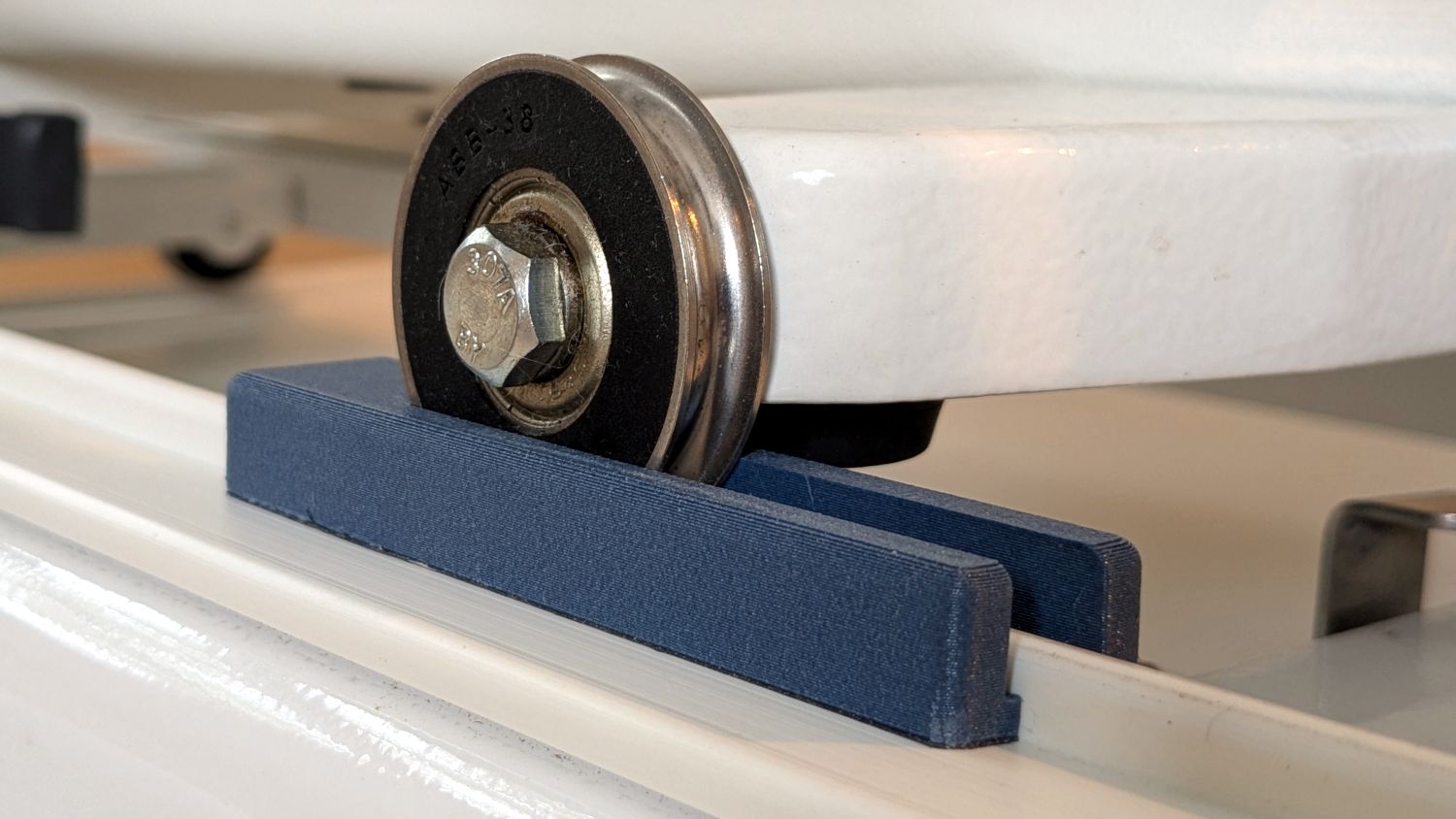
HQ Sixteen – track lock – engaged The wheel sits in a recess holding it just barely above the track surface, so the (considerable) weight of the machine holds the block in place.
Because lines on quilts have precise placement and Mary has quilting rulers within reach, the block measures exactly two inches from the point where it first touches the wheel to the center of the recess:
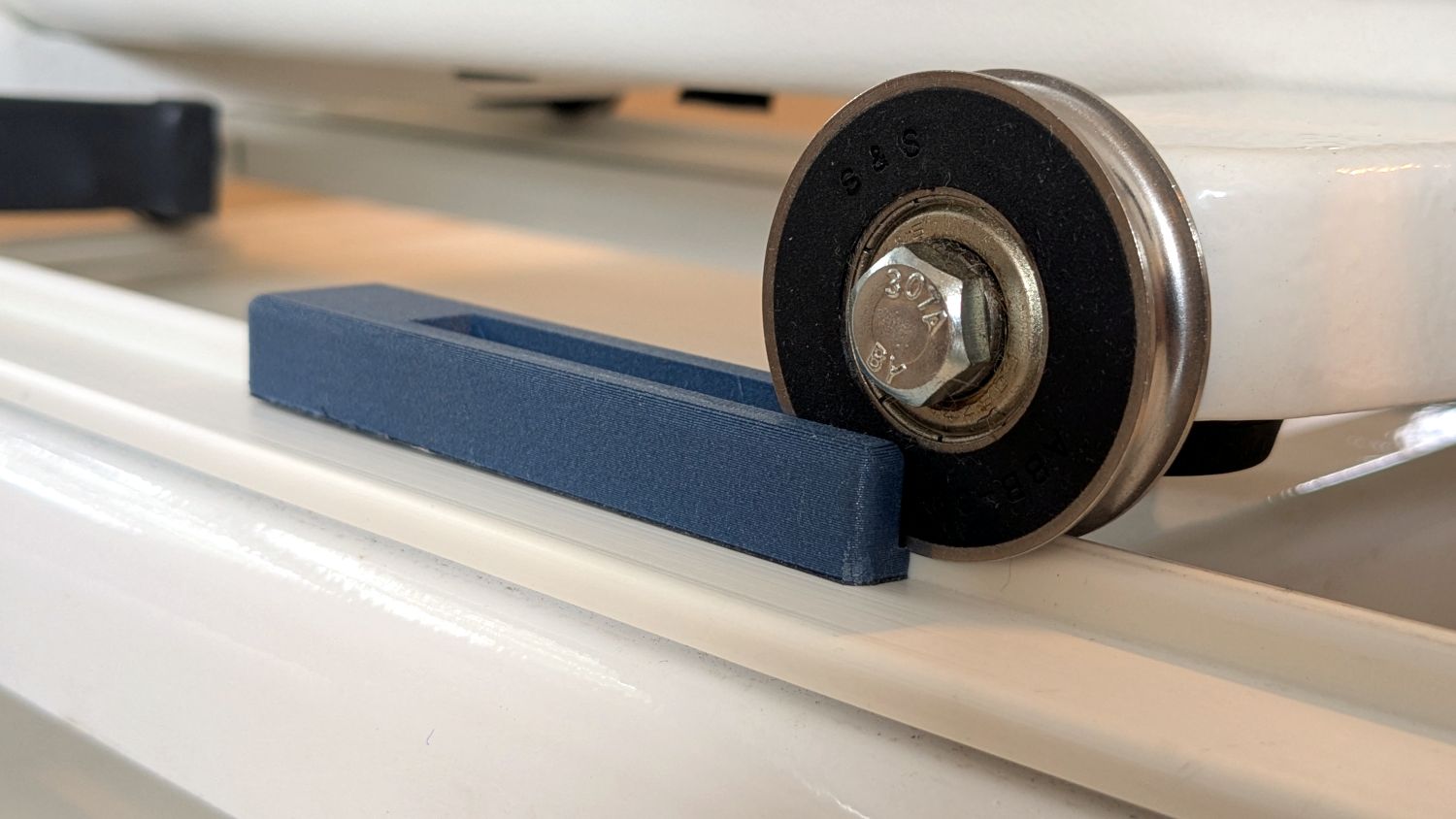
HQ Sixteen – track lock – setup She can then lay a ruler on the quilt, roll the machine front or back two inches, slide a block against each wheel, then roll the machine up a slight incline until the wheel drops into the recess:
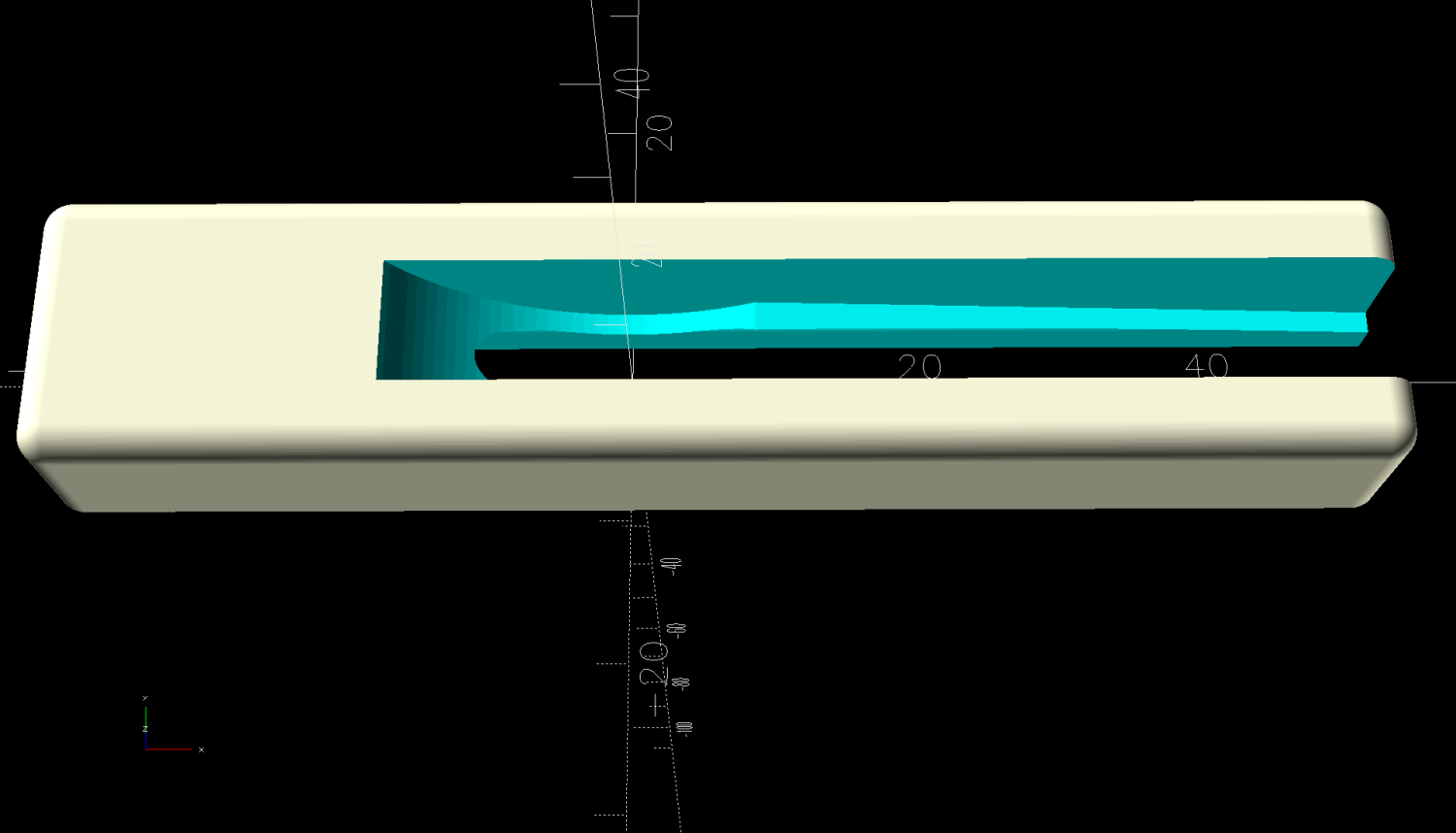
HQ Sixteen – track lock block – solid model The spacing looks like this:
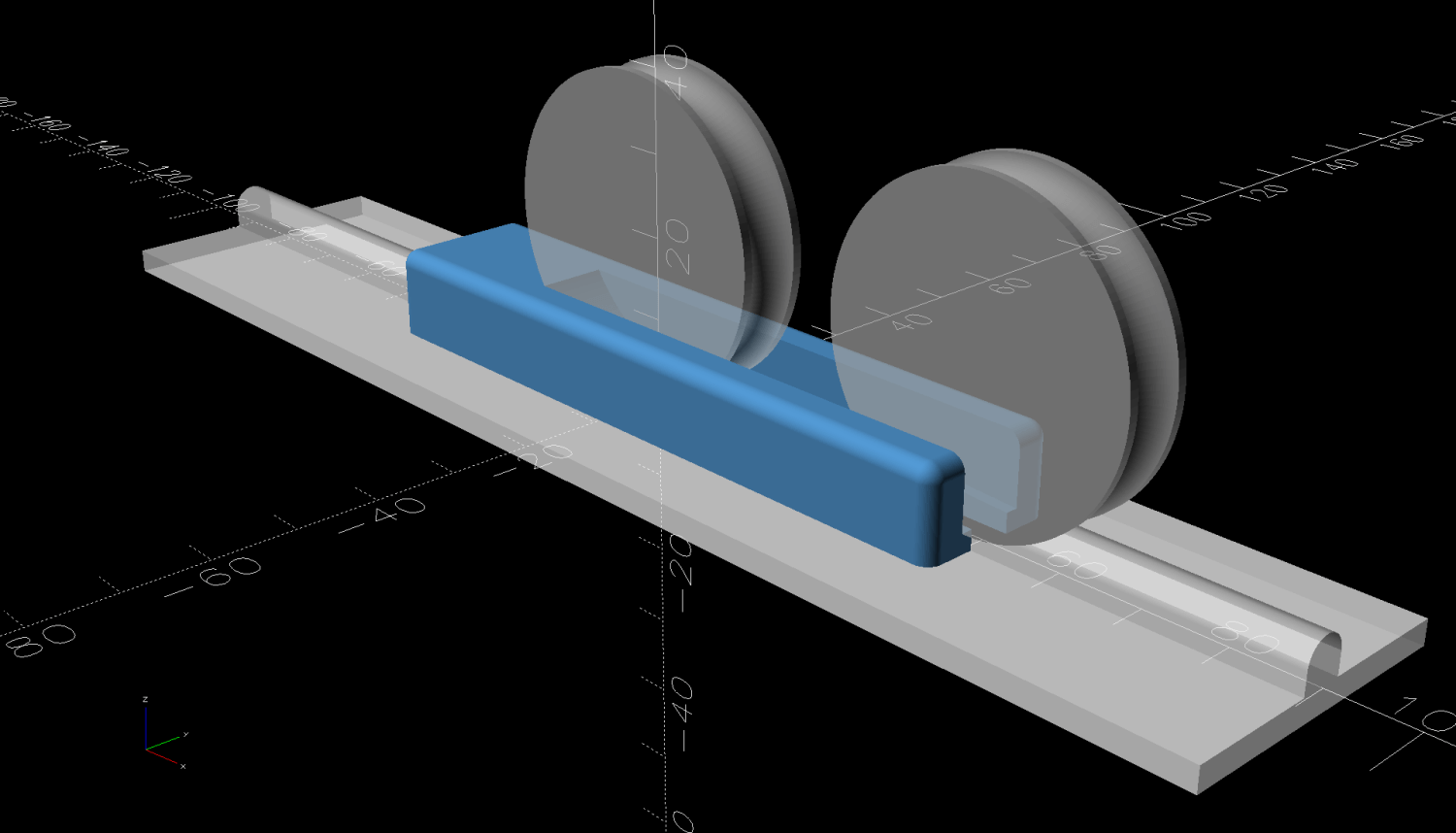
HQ Sixteen – track lock block – solid model – show view The usual 3D printing process puts 0.2 mm steps along the ramp, but they’re almost imperceptible while rolling the machine:
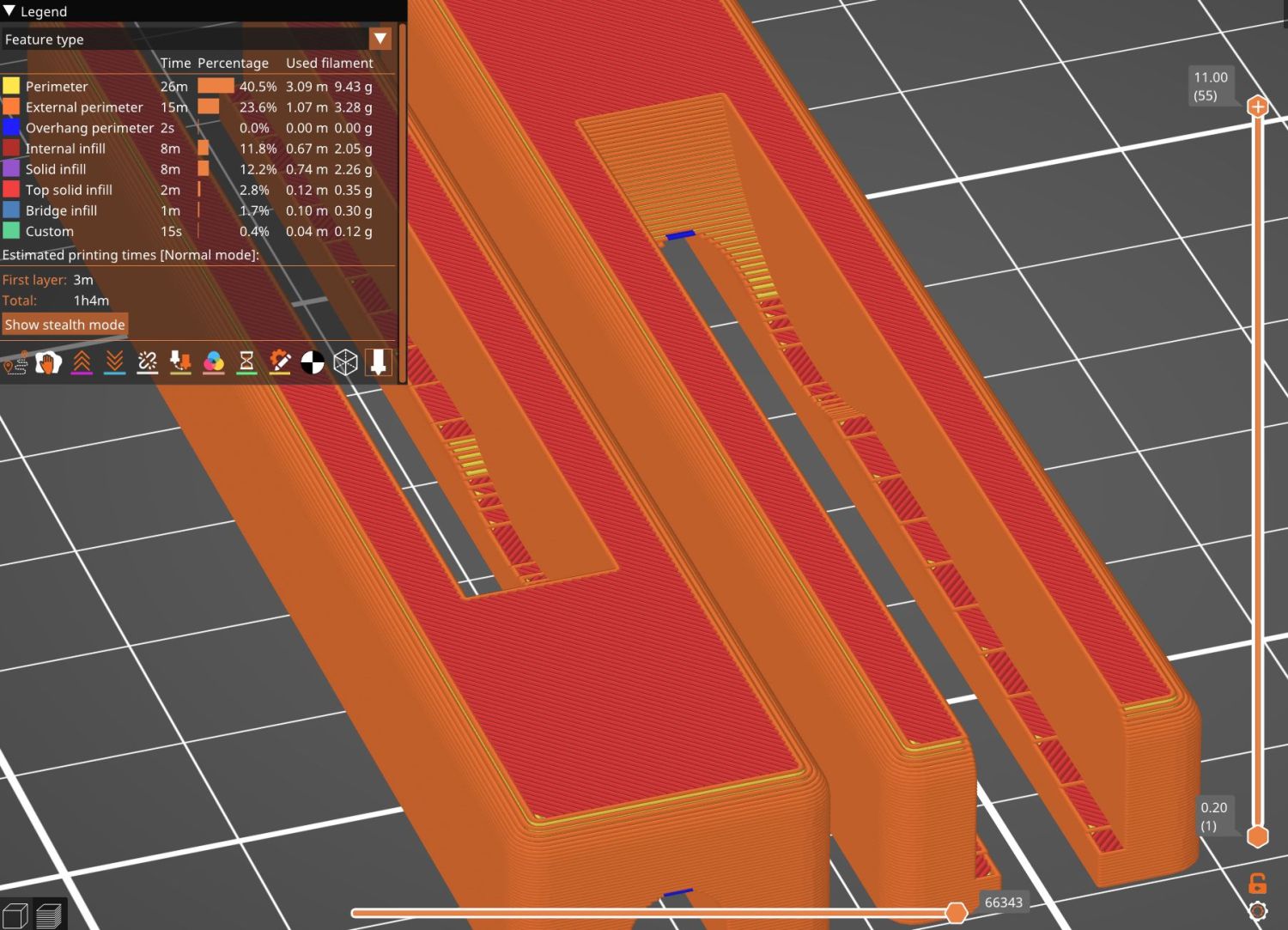
HQ Sixteen – track lock block – PrusaSlicer preview The ramp slope is all of 1:20 = 2.5°, so pulling / pushing the machine requires very little oomph.
I put thin cloth tape (approximately friction tape, but with real adhesive) on the bottom of the block by the simple expedient of sticking it to the block and scissoring off the excess. A little compliance between the block and the track prevents the hard plastic shapes from sliding more easily than I’d like. If your tape is thicker than mine, knock a little off the
WheelZvalue.The OpenSCAD code can produce shapes to laser-cut an adhesive sheet, although stacking a foam sheet will definitely require height adjustment :
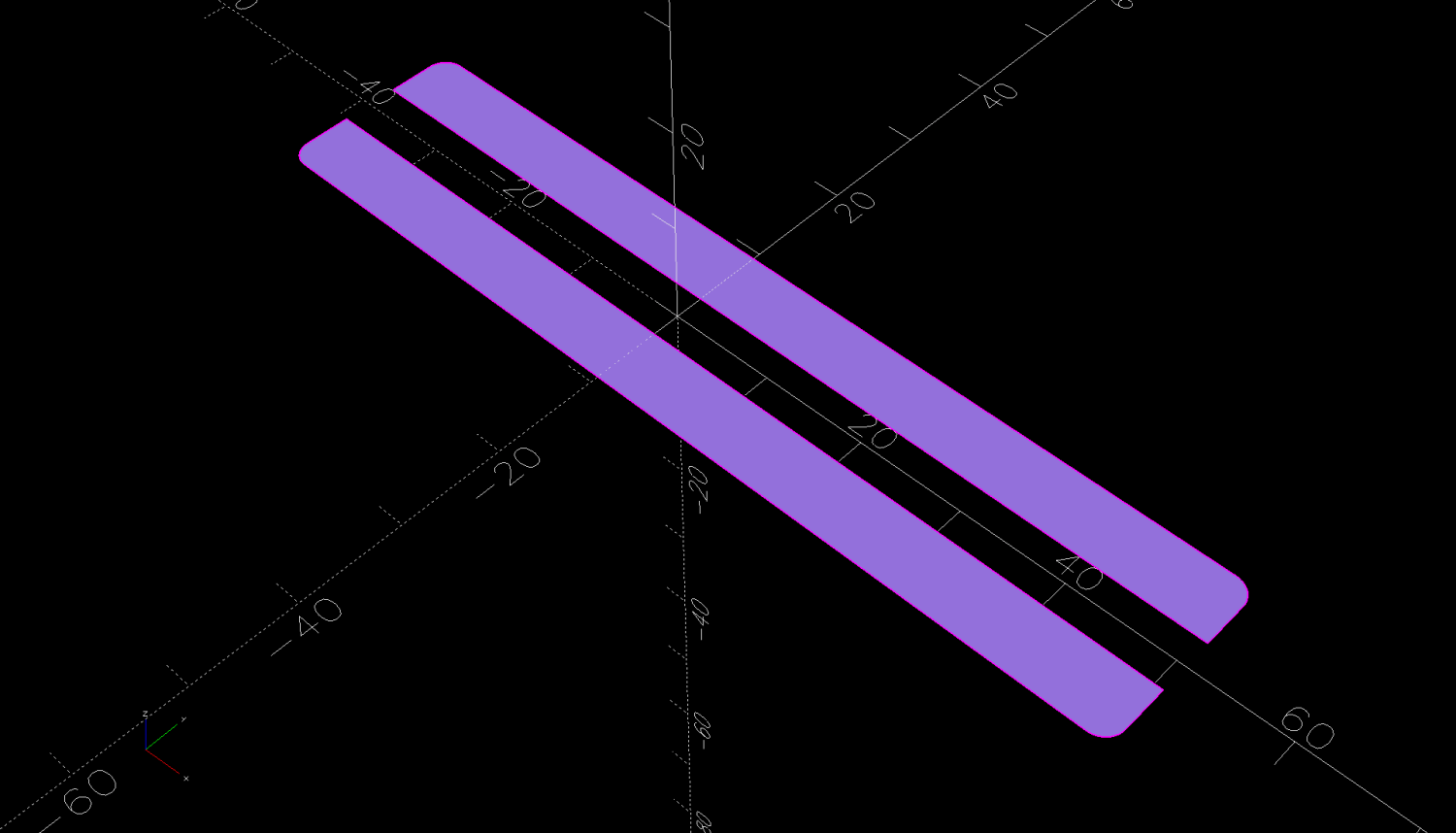
HQ Sixteen – track lock block – glue sheet The OpenSCAD source code as a GitHub Gist:
This file contains hidden or bidirectional Unicode text that may be interpreted or compiled differently than what appears below. To review, open the file in an editor that reveals hidden Unicode characters. Learn more about bidirectional Unicode characters// HQ Sixteen – wheel track lock block // Ed Nisley – KE4ZNU // 2025-02-14 include <BOSL2/std.scad> Layout = "Show"; // [Show,Build,Glue,Track,Block,Wheel] /* [Hidden] */ ID = 0; OD = 1; LENGTH = 2; Protrusion = 0.1; Windage = 0.1; WallThick = 5.0; // minimum wall thickness RailOD = 5.5; // rounded top of rail RailHeight = RailOD; // … flange to top RailBase = [100,2*15.7 + RailOD,3]; // … Y = flange width, arbitrary X & Z WheelOD = 38.0; // rail roller WheelMinor = 6.2; // … rail recess WheelWidth = 8.3 + 2*Windage; // … outer sides WheelZ = RailHeight + (WheelOD – WheelMinor)/2; // axle centerline wrt rail flange LockOC = 2.0*INCH; // engagement to lock recess GripLength = 20.0; BlockOA = [GripLength + WheelOD/2 + LockOC,WheelWidth + 2*WallThick,2*RailHeight]; BlockRadius = 2.0; $fn = 12*3*4; // smooth outer perimeters //———- // Construct the pieces module Track(Len = 2*BlockOA.x) { zrot(90) back(Len/2) down(RailBase.z) xrot(90) linear_extrude(height=Len,convexity=5) rect([RailBase.y,RailBase.z],anchor=FRONT) attach(BACK,FRONT) rect([RailOD,RailHeight – RailOD/2]) attach(BACK) circle(d=RailOD); } module Wheel(Len = WheelWidth) { xrot(90) difference() { cylinder(d=WheelOD,h=Len,center=true); torus(r_maj=WheelOD/2,d_min=WheelMinor); } } module Block() { difference() { left(GripLength + WheelOD/2) cuboid(BlockOA,anchor=LEFT + BOTTOM,rounding=BlockRadius,except=BOTTOM); Track(); up(WheelZ) xrot(90) cylinder(d=WheelOD,h=WheelWidth,center=true); right(LockOC) up(WheelZ – WheelOD/2) yrot(atan((RailHeight – WheelMinor/2)/LockOC)) cuboid([LockOC,WheelWidth,BlockOA.z],anchor=RIGHT+BOTTOM); } } //———- // Show & build the results if (Layout == "Block" || Layout == "Build") Block(); if (Layout == "Track") Track(); if (Layout == "Wheel") Wheel(); if (Layout == "Glue") projection(cut=true) Block(); if (Layout == "Show") { color("SteelBlue") Block(); for (i=[0,1]) right(i*LockOC) color("Silver",0.7) up(WheelZ) Wheel(); color("White",0.5) Track(); }
-
Subscribe
Subscribed
Have a WordPress.com account? Log in now.

