-
Victoreen 710-104 Ionization Chamber
Using radiation to generate random numbers reminded me of some Victoreen 710-104 ionization chambers that have been in the pile basically forever:
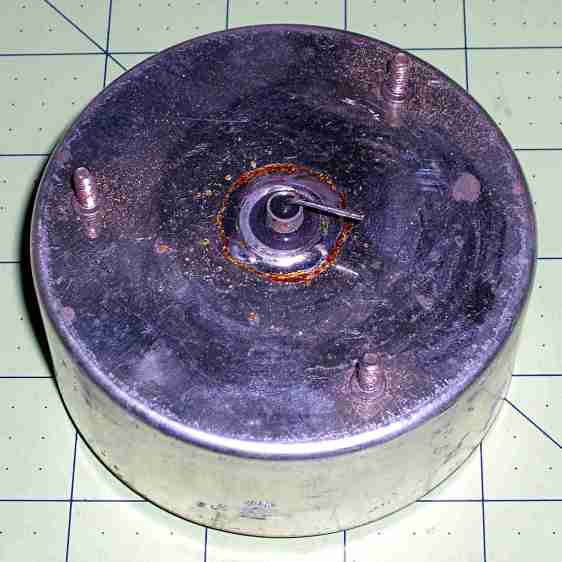
Victoreen 710-104 Ionization Chamber The central contact seems to be double-insulated from the chamber with glass (?) seals in a soldered-in-place assembly:
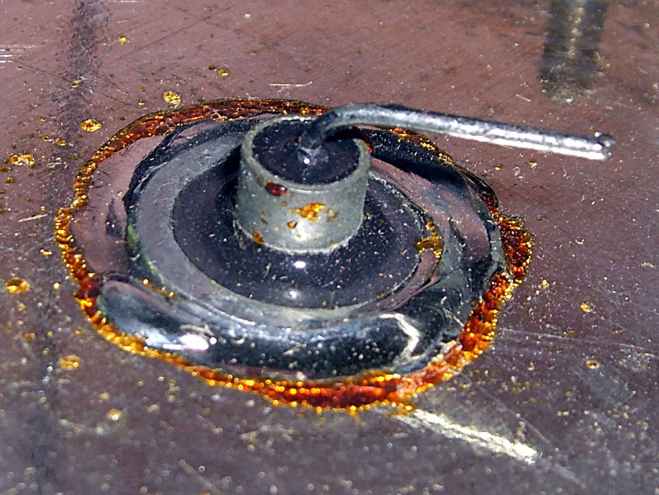
Victoreen 710-104 Ionization Chamber – terminal detail That might be rosin left over from soldering, but you’d think they would have rinsed it off to reduce the leakage. Some cleaning will be in order.
A picture in The Fine Manual for the CD-V-710 Model 5 Radiation Survey Meter showed that the circuit board used point-to-point wiring, with the range switch soldered directly to that bent metal contact:
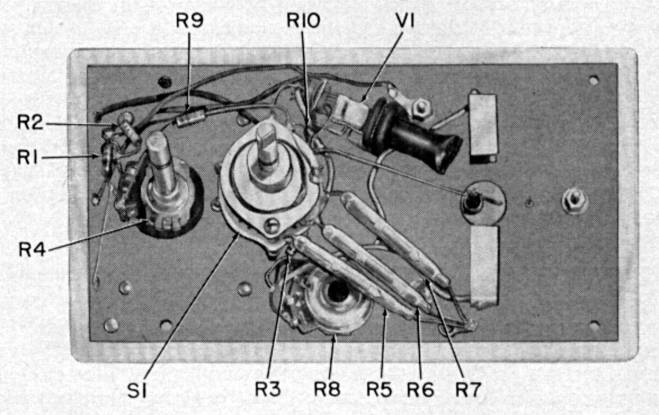
Victoreen CD-V-710 Model 5 Manual – Page 10 – circuit layout Another page gave some useful values and a simplified schematic:
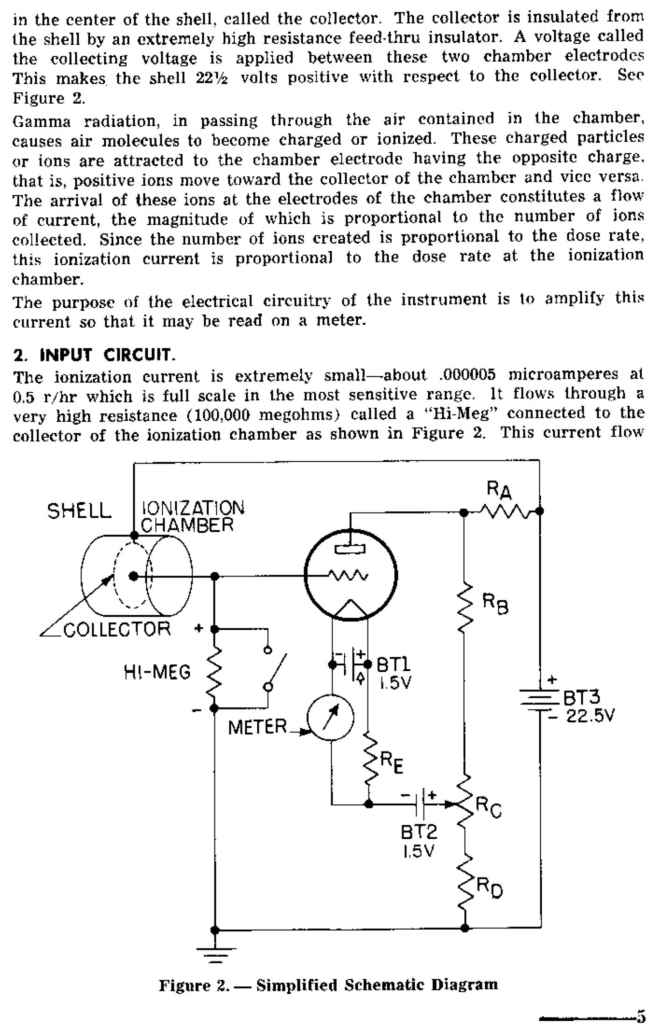
Victoreen CD-V-710 Model 5 Manual – Page 5 Never fear, the manual also has the full schematic; they don’t write manuals like that any more.
The chamber bias voltage was +22.5, from one carbon-zinc battery available back in the 1950s. You can still get 22.5 V batteries at about ten bucks a pop, but 24 V from a pair of cheap & readily available 12 V A23 alkaline batteries should be close enough. There’s no current drain, so the batteries should last their entire shelf life.
The “HI-MEG” resistor represents a trio of glass-body resistors selected by the range switch:
- R5 = 100 GΩ → 0.5 R/h
- R6 = 10 GΩ→ 5 R/h
- R7 = 1 GΩ→ 50 R/h
As the saying goes, if you must select R7 in an actual emergency, you should sit down, put your head between your legs, and kiss your ass goodbye.
The steel-wall chamber responds only to gamma radiation, with a nominal current of 5 pA at 0.5 R/h. However, given an op amp like the LMC6081 with 10 fA bias current, maybe building an electrometer-style amplifier that can respond to background gamma radiation or maybe secondary gamma rays from cosmic ray air showers would be feasible; I haven’t done anything like that in a while and even a faceplant would be interesting.
Alas, radium-226 and its progeny, including radon-222 decay through alpha and beta emission that’s specifically excluded by the can.
This is not a new idea, by any means, as shown by some extensive discussion and well-done circuitry. Any amplifier that works with the Victoreen can will certainly work with a homebrew ionization chamber.


-
Subscribe
Subscribed
Have a WordPress.com account? Log in now.

