-
Avalanche Noise Amp
This lashes a pretty good avalanche noise source to an absolute dog of an op amp:
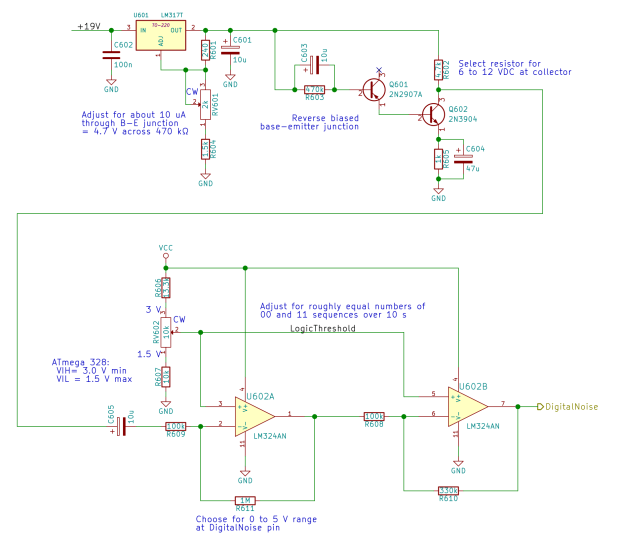
Noise Source – Schematic It’s built into the formerly vacant space on the 8×8 LED matrix board last seen generating random numbers by timing Geiger detector pulses:
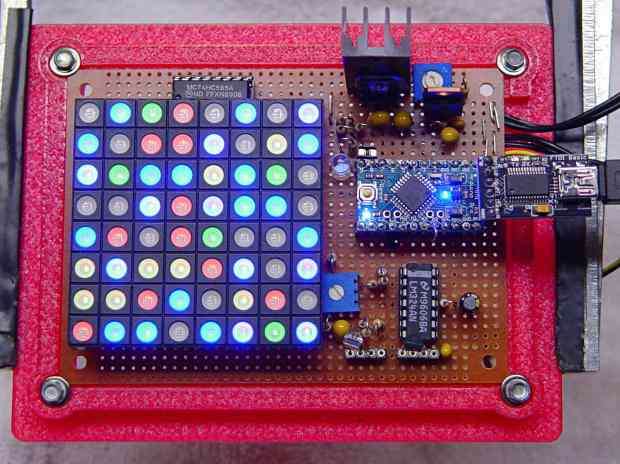
Reverse-bias noise amplifier – overview The LM317 tweaks the reverse bias voltage to ram about 10 µA of DC current through the 2N2907A base-emitter junction; I picked that transistor because it has a 5.0 V breakdown spec that translates into about +8 V in reality, plus I have a few hundred lying around.
The 4.7 kΩ collector resistor sets the operating point of the 2N3904 NPN transistor at a bit over 6 V with a collector current of 1.6 mA, around which there appears ±500 mV of pure noise:
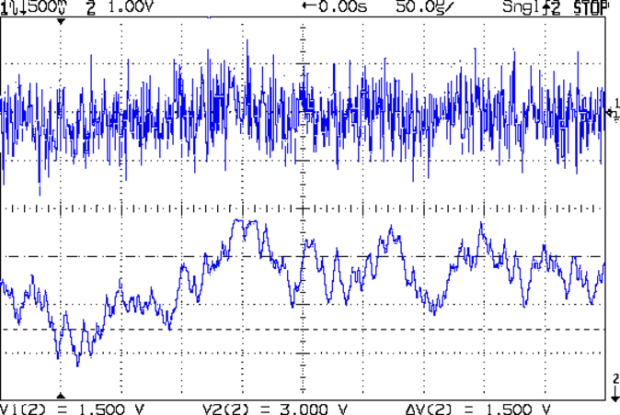
Noise – NPN C inv – op amp The 2N3904 spec says hFE > 100 and, indeed, I measure 200: 8 µA in, 1.6 mA out.
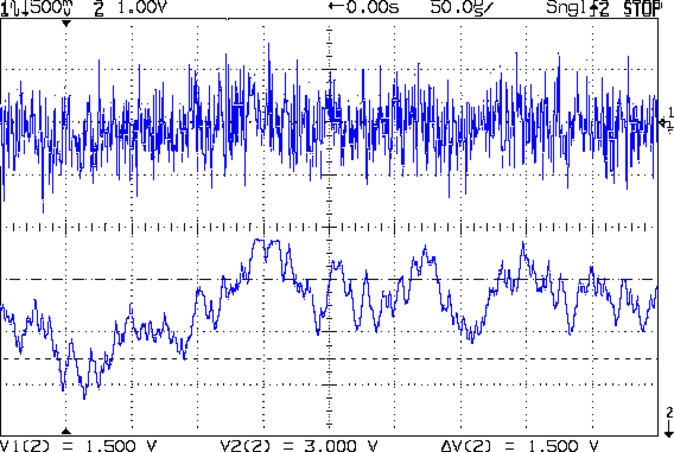
The bottom trace is the output of the first LM324. With a GBW of 1 MHz and a voltage gain of 10, it should have a cutoff at 100 kHz, but that’s obviously not true; the 0.5 V/µs large-signal slew rate just kills the response. The flat tops at 3.8 V show that it’s definitely not a rail-to-rail op amp.
The horizontal cursors mark the ATmega 328 minimum VIH and maximum VIL; the actual thresholds lie somewhere between those limits. What you don’t get is the crisp transition from a comparator.
The trimpot setting the logic level lets you tune for best picture; in this case, that means balancing the number of 0 and 1 bits. It’s a bit more complex, of course, about which, more later.
I picked the LM324 for pedagogic reasons; it’s a Circuit Cellar column and I get to explain how a nominally good analog circuit can unexpectedly ruin the results, unless you know what to look for…

-
Subscribe
Subscribed
Have a WordPress.com account? Log in now.

