-
Olfa Rotary Cutter Spacer
At some point along the way, the bright yellow washer (they call it a “spacer”) on Mary’s 60 mm Olfa rotary cutter went missing. A casual search suggests that replacement washers come directly from Olfa after navigating their phone tree, but …
Judging from scuffs on the rear surface, the washer serves two purposes:
- Hold the blade close to the handle against slightly misaligned cutting forces
- Add more compression to the wave washer under the nut
This model is much more intricate than the stock washer:

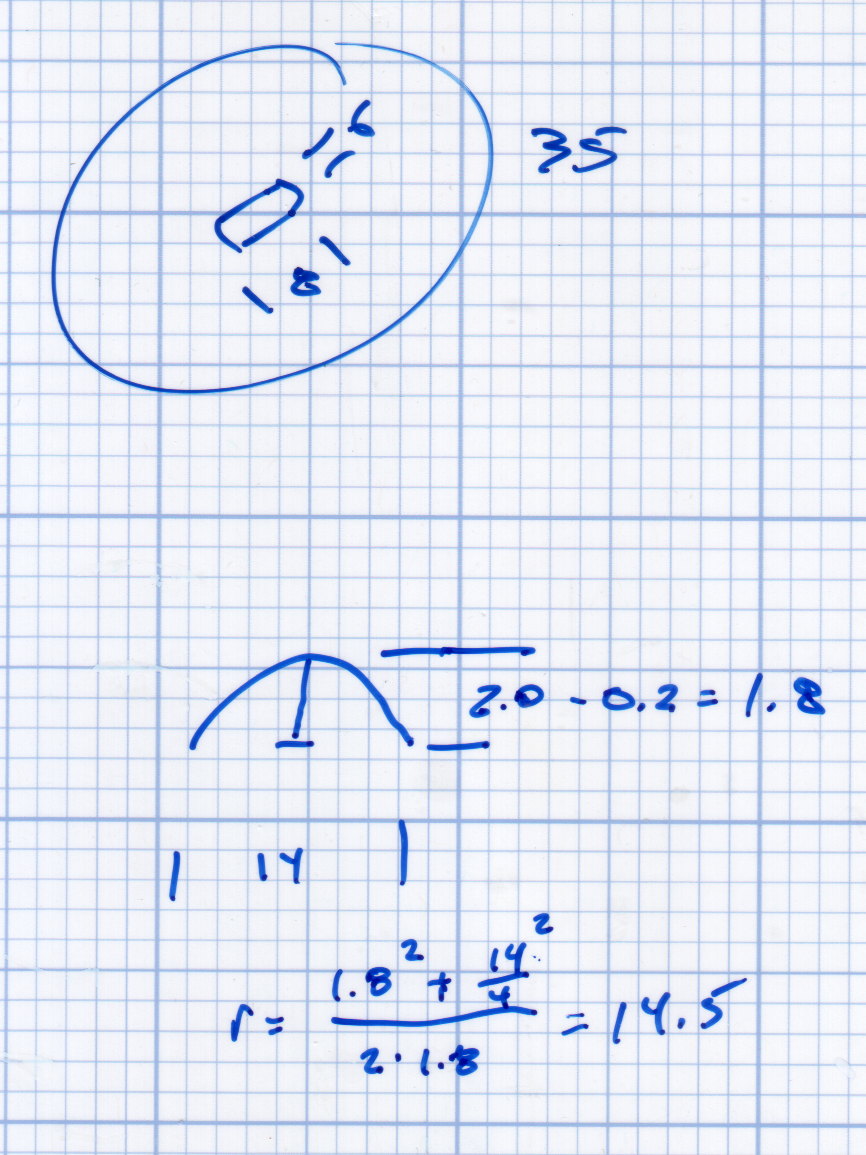
Olfa Rotary Cutter – backing washer The trench across the middle of the thicker part allows a wider compression adjustment range for the wave washer and provides more thread engagement at the lightest setting for my liking. The shape comes from the chord equation based on measurements of the wave washer:

Olfa Rotary Cutter – washer doodles The wave washer keys on the bolt flats: the whole affair rotates with the blade and gives the nut no inclination to unscrew. If you remove the trench, the remaining hole has the proper shape to key on the bolt and rotate with it; with the trench in place, the wave washer’s sides haul the plastic washer along with it.
The plain ring, just two threads thick, glues bottom-to-bottom on the thicker part to soak up the air gap and provide more blade stability. It’s not entirely clear that’s a win; it’s easy to omit.
It looks about like you’d expect:

Olfa Rotary Cutter – washer in place The wave washer must go on the bolt with the smooth curve downward into the trench. That orientation that wasn’t enforced by the Official Olfa spacer washer’s smooth sides.
The nut sits upside-down to show the face that normally sits against the wave washer. I’d lay long odds that the recess around the threads originally held a conical compression spring with a penchant for joining the dust bunnies under the sewing table. You can insert the wave washer the wrong way, but it doesn’t store enough energy to go airborne unless you drop it, which did happen once with the expected result.
The OpenSCAD source code as a GitHub gist:
This file contains hidden or bidirectional Unicode text that may be interpreted or compiled differently than what appears below. To review, open the file in an editor that reveals hidden Unicode characters. Learn more about bidirectional Unicode characters// Olfa rotary cutter backing washer // Ed Nisley KE4ZNU January 2016 Layout = "Build"; //- Extrusion parameters must match reality! // Print with +1 shells and 3 solid layers ThreadThick = 0.20; ThreadWidth = 0.40; HoleWindage = 0.2; function IntegerMultiple(Size,Unit) = Unit * ceil(Size / Unit); Protrusion = 0.1; // make holes end cleanly //———————- // Dimensions WasherOD = 35.0; WasherThick = 1.5; WaveOD = 14.0; // wave washer flat dia WaveM = 1.8; // height of wave washer bend BendRad = (pow(WaveM,2) + pow(WaveOD,2)/4) / (2*WaveM); // radius of wave washer bend echo(str("Wave washer bend radius: ",BendRad)); SpacerID = WaveOD + 2.0; SpacerThick = 2*ThreadThick; NumSides = 12*4; $fn = NumSides; //———————- // Useful routines module PolyCyl(Dia,Height,ForceSides=0) { // based on nophead's polyholes Sides = (ForceSides != 0) ? ForceSides : (ceil(Dia) + 2); FixDia = Dia / cos(180/Sides); cylinder(r=(FixDia + HoleWindage)/2, h=Height, $fn=Sides); } //———————- // Parts module Upper() { difference() { cylinder(d1=WasherOD,d2=(WasherOD – 2.0),h=WasherThick); translate([0,0,-Protrusion]) intersection() { PolyCyl(8.2,2.0,8); cube([(6.0 + HoleWindage),10,2*WasherThick],center=true); } translate([-(WaveOD + 1.0)/2,0,BendRad]) rotate([0,90,0]) rotate(0*180/16) PolyCyl(BendRad*2,(WaveOD + 1),16); } } module Spacer() { difference() { cylinder(d=WasherOD,h=SpacerThick); translate([0,0,-Protrusion]) cylinder(d=SpacerID,h=2*SpacerThick); } } //———————- // Build it! if (Layout == "Show") { translate([0,0,SpacerThick]) color("Cyan") Upper(); color("LightCyan") Spacer(); } if (Layout == "Build") { translate([-0.6*WasherOD,0,0]) Upper(); translate([0.6*WasherOD,0,0]) Spacer(); }


-
Subscribe
Subscribed
Have a WordPress.com account? Log in now.

